

The kanji: 幽 and 玄
Yūgen is written with two kanji that both point towards depth and darkness. The first, 幽, means faint, dim, deep or secluded. It appears in yūrei, ghost, and in words for remote, quiet places, and it gives yūgen a sense of something hidden away. The second, 玄, means dark, deep or profound. It appears in genkan, the entrance hall of a Japanese home, and in words connected with deep or mystical learning.
Put together, the two kanji suggest beauty that lies deep and out of plain sight. The term came into Japanese from Chinese, where it was used in Buddhist and philosophical texts for truths too profound to grasp directly, before Japanese poets and critics made it their own.
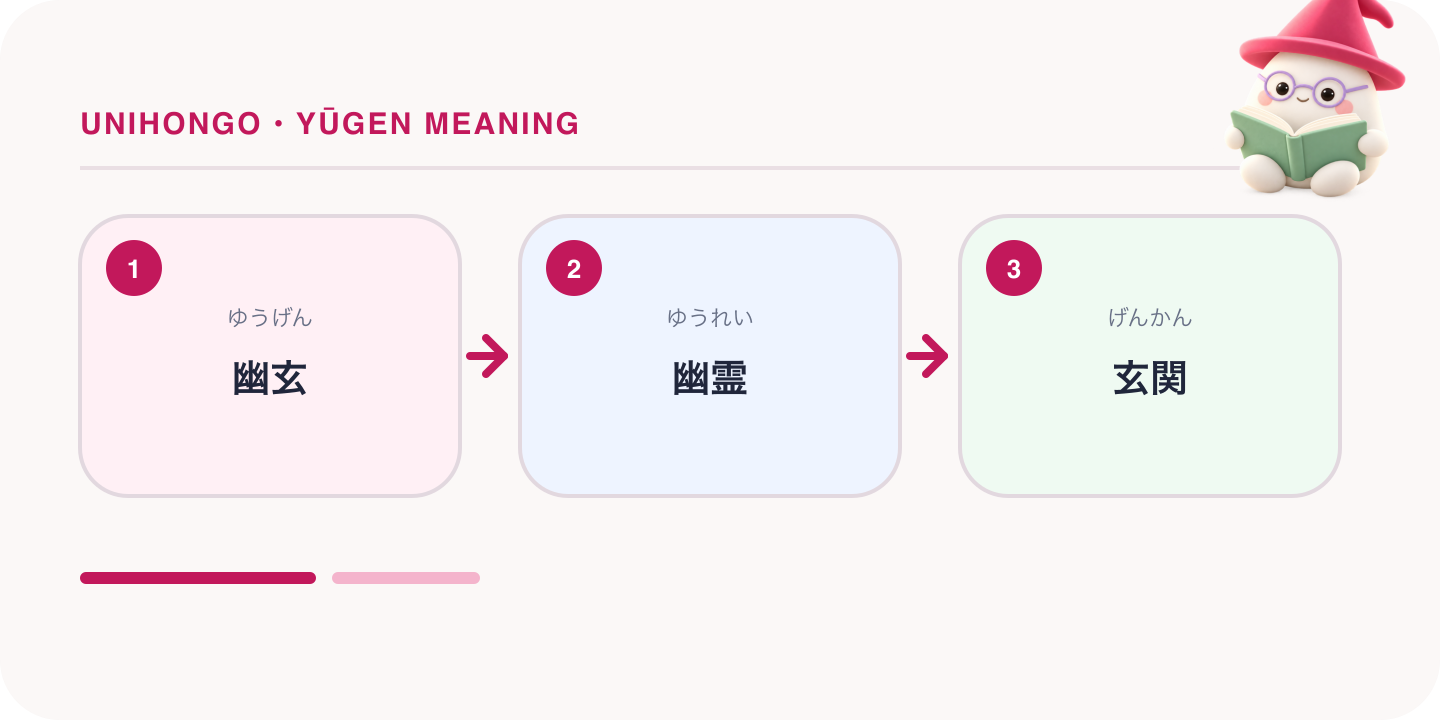
| Kanji or word | Reading | Meaning |
|---|---|---|
| 幽 | yū | Faint, dim, deep, secluded |
| 玄 | gen | Dark, deep, profound |
| 幽玄 | yūgen | Mysterious depth, subtle profound beauty |
| 幽霊 | yūrei | Ghost |
| 玄関 | genkan | Entrance hall of a house |
| 玄人 | kurōto | Expert, professional (opposite of an amateur) |
Yūgen in medieval poetry
In Japan, yūgen became important in the criticism of waka, the classical thirty-one-syllable poem. In the late Heian and Kamakura periods, poets and judges at poetry contests used it to praise verses that had depth beyond their surface meaning: a mood that lingered after the poem ended. Fujiwara no Shunzei, a leading poet and judge of the period, is closely associated with this use.
A related idea is yojō, lingering feeling, the resonance a poem leaves in the reader. A poem with yūgen does not explain everything. It shows an autumn evening, a faint moon or a sound across the water, and lets the reader feel what cannot be put directly into words.
Kamo no Chōmei, best known for Hōjōki, also discussed yūgen in his writing on poetry, comparing it to the feeling of looking at an autumn evening sky that has no colour and no sound yet moves you to tears. That image is often quoted when Japanese books explain the word.
- Waka: the classical poem where yūgen first became a critical ideal.
- Poetry contests, uta-awase: settings where judges praised poems for yūgen.
- Yojō: the lingering resonance after a poem, closely related to yūgen.
- Suggestion over statement: the poem shows a little and implies much more.
Yūgen in Noh theatre
Most people who know the word today connect it with Noh, the masked musical drama that took shape in the Muromachi period. Zeami, the actor and playwright who did much to shape Noh, wrote treatises on performance in which yūgen is a supreme ideal. In his writing it leans strongly towards graceful, refined elegance, the beauty of a noble figure moving with perfect poise.
Over time, and especially in modern explanations, yūgen in Noh has also come to suggest mystery and depth: the slow, restrained movement, the masks whose expression seems to change with the angle of light, the ghosts and spirits who appear in many plays, and the bare stage with its painted pine. Audiences today often describe a Noh performance, especially an outdoor torchlit one, as yūgen.
This is the setting where you are most likely to hear the word from a Japanese speaker: a guide at a Noh theatre, a programme note or a television feature about traditional arts.
| Japanese | Romaji | Meaning |
|---|---|---|
| 能 | nō | Noh theatre |
| 能面 | nōmen | Noh mask |
| 能舞台 | nō butai | Noh stage |
| 薪能 | takiginō | Outdoor Noh performed by firelight |
| 能は幽玄の世界だと言われます。 | Nō wa yūgen no sekai da to iwaremasu. | Noh is said to be a world of yūgen. |
| 薪能は幽玄な雰囲気でした。 | Takiginō wa yūgen na fun'iki deshita. | The torchlit Noh had a mysterious, profound atmosphere. |
How rare yūgen is in everyday Japanese
Yūgen is a real word, and most adults understand it, but it lives in writing. You will find it in tourism brochures, museum captions, reviews of traditional performances, photography descriptions of misty landscapes and essays on Japanese aesthetics. It is far less common in speech than wabi-sabi, and much less common than shibui.
In conversation, people describing a foggy mountain temple are more likely to say shinpiteki da ne, it's mysterious, or nanka fushigi na fun'iki, a strange, otherworldly atmosphere. Using yūgen out loud is not wrong, but it sounds like you are reading from a guidebook, and people may smile at the choice.
The word is used as a na-adjective and as a noun. The typical patterns are yūgen na fun'iki, a mysterious atmosphere, yūgen na keshiki, a profound, mysterious landscape, and yūgen no sekai, the world of yūgen.
| Japanese | Romaji | Meaning |
|---|---|---|
| 幽玄な雰囲気 | yūgen na fun'iki | A mysterious, profound atmosphere |
| 霧に包まれた幽玄な景色 | kiri ni tsutsumareta yūgen na keshiki | A mysterious landscape wrapped in mist |
| 幽玄の美 | yūgen no bi | The beauty of yūgen |
| 朝霧のお寺は本当に幽玄でした。 | Asagiri no o-tera wa hontō ni yūgen deshita. | The temple in the morning mist was truly mysterious and profound. |
Everyday words for the same feeling
If you want to describe a yūgen scene in normal conversation, these are the words Japanese speakers actually reach for. Shinpiteki is mysterious in the sense of wondrous and hard to explain. Gensōteki is dreamlike or fantastical, often used for light displays, fog and snow at night. Okubukai means deep, with a lot beneath the surface, and suits arts, ideas and flavours. Kōgōshii means divine or sacred-looking, and is common for shrines, old trees and sunlight through clouds.
| Japanese | Romaji | Meaning |
|---|---|---|
| 神秘的 | shinpiteki | Mysterious, wondrous |
| 幻想的 | gensōteki | Dreamlike, fantastical |
| 奥深い | okubukai | Deep, profound, with hidden depth |
| 神々しい | kōgōshii | Divine, sacred-looking, awe-inspiring |
| 荘厳 | sōgon | Solemn, majestic |
| 静か | shizuka | Quiet, still |
| 不思議な雰囲気 | fushigi na fun'iki | A strange, otherworldly atmosphere |
Okubukai is particularly useful. You can say that Noh, tea ceremony, calligraphy or even Japanese grammar is okubukai, deep and endlessly rich, which is the everyday cousin of saying it has yūgen.
Yūgen next to other aesthetic words
Yūgen is often listed alongside wabi-sabi and mono no aware, and learners sometimes treat them as synonyms. Each points at a different quality. This table is a rough guide rather than strict definitions, since the words overlap and have changed over time.
| Word | Core idea | Typical setting |
|---|---|---|
| 幽玄 yūgen | Mysterious depth, beauty only suggested | Noh, waka, misty landscapes |
| もののあわれ mono no aware | Being moved by the passing of things | Cherry blossoms, The Tale of Genji |
| 侘び寂び wabi-sabi | Quiet beauty of simplicity and age | Tea ceremony, old temples |
| 渋い shibui | Understated, mature, refined | Clothes, colours, people, tea |
| 粋 iki | Chic, stylish sophistication | Edo townspeople, kimono style |
The Western image of yūgen
Online, yūgen is often defined with long poetic sentences about watching the sun set behind a flower-clad hill or wandering in a forest without thought of return. Some of these images echo passages in Zeami's writing, but they are frequently presented as a dictionary definition, which makes the word sound more like a personal feeling of awe at the universe than a term of art criticism.
The Japanese word is narrower and more concrete. It is used about artworks, performances and landscapes that have a hidden, elegant depth. It is not usually used for personal emotions such as wonder at the stars, and a Japanese speaker would rarely say they feel yūgen about their own life.
- Treat yūgen as a description of a thing or scene, not of your inner state.
- Expect to read it more than you hear it.
- Be cautious with viral definitions; check them against how Japanese sources use the word.
- When unsure, describe the scene with shinpiteki or okubukai instead.
Talking about yūgen as a learner
Japanese friends are often pleased when a visitor knows the word yūgen, because it shows interest in traditional arts. The best approach is to use it lightly and ask about their view, rather than defining it for them.
| Japanese | Romaji | Meaning |
|---|---|---|
| 能を初めて見て、幽玄という言葉の意味が少し分かりました。 | Nō o hajimete mite, yūgen to iu kotoba no imi ga sukoshi wakarimashita. | Seeing Noh for the first time, I understood the word yūgen a little. |
| 霧の山が神秘的でした。 | Kiri no yama ga shinpiteki deshita. | The misty mountains were mysterious. |
| 幽玄って、どういう感じですか。 | Yūgen tte, dō iu kanji desu ka. | What sort of feeling is yūgen? |
| 日本の伝統芸能は奥深いですね。 | Nihon no dentō geinō wa okubukai desu ne. | Japan's traditional performing arts are so deep. |
| 言葉では説明しにくい美しさですね。 | Kotoba de wa setsumei shinikui utsukushisa desu ne. | It's a beauty that's hard to put into words. |
The last line, kotoba de wa setsumei shinikui utsukushisa, is itself a good summary of yūgen, and it is natural enough to say in any conversation about art or travel.