
From rough sketch to finished colour
Most illustrators, on paper or on a tablet, work in the same order, and Japanese has a word for each step. You make a rough sketch to plan the picture, trace clean line art over it, fill in the colours and shading, and add the finishing touches. Japanese artists talk about their progress with these words all the time, so they are the best place to start.
Shitagaki can be written 下書き or 下描き; both are common, and the second uses the drawing kanji to make the meaning clear. In digital illustration, the loanword rafu (rough) is used for the same stage. Nuru (塗る) is a broad verb: to paint, to spread butter, to put on make-up, and to colour in.
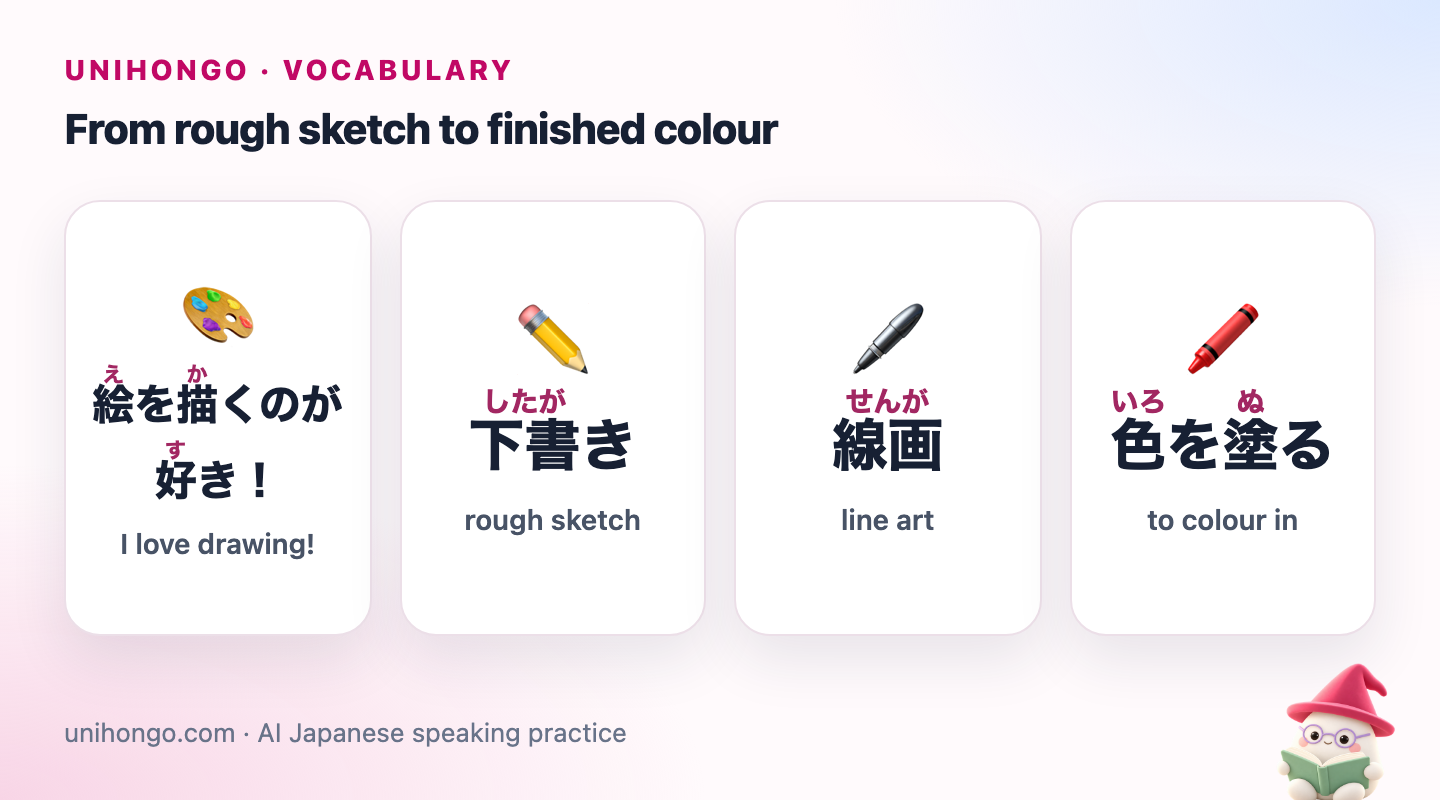
| Japanese | Romaji | Meaning |
|---|---|---|
| 絵を描くのが好き! | E o kaku no ga suki! | I love drawing! |
| 下書き | shitagaki | rough sketch |
| 線画 | senga | line art |
| 色を塗る | iro o nuru | to colour in |
| 仕上げ | shiage | finishing touches |
| 今、線画の途中です。 | Ima, senga no tochū desu. | I'm in the middle of the line art now. |
Kaku, egaku and the verbs of drawing
The verb kaku has two kanji. 書く is to write letters and words; 描く is to draw or paint pictures. They sound identical, so in speech the object tells you which one is meant: e o kaku is drawing, tegami o kaku is writing a letter. When you type, choose 描く for pictures. Many people also write 絵をかく in hiragana, which is not wrong.
The same kanji 描 also has the reading egaku, which is more literary and means to depict or portray. You hear it about novels, films and dreams as often as about pictures. Other useful verbs describe specific kinds of drawing.
| Japanese | Romaji | Meaning |
|---|---|---|
| 猫の絵を描きました。 | Neko no e o kakimashita. | I drew a picture of a cat. |
| この映画は東京の夏を描いている。 | Kono eiga wa Tōkyō no natsu o egaite iru. | This film depicts summer in Tokyo. |
| スケッチする | suketchi suru | to sketch |
| デッサンを練習する | dessan o renshū suru | to practise life drawing |
| 好きな絵を模写する | suki na e o mosha suru | to copy a picture you like for practice |
| 落書きする | rakugaki suru | to doodle |
| 写生する | shasei suru | to draw from life outdoors |
Dessan (デッサン), from the French word for drawing, means careful observational drawing, the kind practised with plaster busts and still lifes in art schools. Rakugaki (落書き) is a doodle, and also graffiti. Shasei (写生) is the old school word for sketching a landscape outdoors; many Japanese adults remember shasei taikai, outdoor drawing days at primary school.
Tools: from pencils to pen tablets
Traditional tools are mostly native words, and digital tools are mostly loanwords, often shortened in the typical Japanese way to four syllables. Pentabu (ペンタブ) is short for pen tablet, the kind you draw on while looking at the computer screen, and ekitabu (液タブ), short for liquid-crystal tablet, is a tablet with a built-in screen you draw on directly.
| Japanese | Romaji | Meaning |
|---|---|---|
| 鉛筆 | enpitsu | pencil |
| 消しゴム | keshigomu | eraser |
| 色鉛筆 | iro enpitsu | coloured pencils |
| 絵の具 | enogu | paints |
| 水彩画 | suisaiga | watercolour painting |
| 筆 | fude | brush |
| スケッチブック | suketchi bukku | sketchbook |
| ペンタブ | pentabu | pen tablet |
| 液タブ | ekitabu | tablet with a screen |
| お絵描きアプリ | oekaki apuri | drawing app |
Art shops in Japan sort paper by thickness and texture, and the staff are used to questions. Two handy lines are kono kami wa suisai ni muite imasu ka, is this paper good for watercolour, and hajimete na no de, osusume wa arimasu ka, it is my first time, do you have a recommendation. Both are polite and work at any counter.
Subjects, light and colour
When you describe a drawing, you name the subject and then talk about the light and colours. Japanese art teachers often comment on proportion, light and shadow, and how the colours are used, so these words are worth knowing even if you never take a class.
| Japanese | Romaji | Meaning |
|---|---|---|
| 人物 | jinbutsu | people, figures |
| 背景 | haikei | background |
| 風景画 | fūkeiga | landscape painting |
| 似顔絵 | nigaoe | portrait sketch, caricature |
| 自画像 | jigazō | self-portrait |
| 影をつける | kage o tsukeru | to add shadows |
| 光の当たり方 | hikari no atarikata | how the light falls |
| 色使い | irozukai | use of colour |
| 構図 | kōzu | composition |
| Word | Meaning | When you hear it |
|---|---|---|
| haikei (背景) | Background | Many illustrators say haikei ga nigate, backgrounds are my weak point |
| kōzu (構図) | Composition | Teachers and judges talk about kōzu first |
| nigaoe (似顔絵) | Portrait sketch | Street artists at festivals and tourist spots draw nigaoe |
| dessan ga kurutte iru | The proportions are off | Blunt feedback in art classes; do not say it about a friend's work |
Praising art and taking a compliment
Japanese compliments on art tend to be specific: people praise the colours, the atmosphere or the lines, not only the whole picture. Jōzu (上手) means skilful, and e ga jōzu desu ne is the standard compliment. When you receive praise, a modest reply is expected, but you do not need to reject it strongly; a smile and a small denial are enough.
| Japanese | Romaji | Meaning |
|---|---|---|
| 絵が上手ですね。 | E ga jōzu desu ne. | You're good at drawing. (polite) |
| 色使いがきれいですね。 | Irozukai ga kirei desu ne. | Your use of colour is beautiful. |
| 雰囲気がすごく好きです。 | Fun'iki ga sugoku suki desu. | I really love the atmosphere. |
| 線がきれい! | Sen ga kirei! | Your lines are so clean! (casual) |
| いえいえ、まだまだです。 | Ie ie, mada mada desu. | Oh no, I still have a long way to go. |
| そう言ってもらえて嬉しいです。 | Sō itte moraete ureshii desu. | I'm happy to hear you say that. |
| この絵、SNSに載せてもいいですか。 | Kono e, esu enu esu ni nosete mo ii desu ka. | May I post this picture on social media? |
The last question matters. Many Japanese artists are careful about how their work is shared, and some ask people not to repost, edit or use their pictures to train software. Ask before you share, credit the artist, and never use a picture for anything commercial without permission.
Mini dialogues: a sketching meetup
Sketching meetups, called suketchi kai, gather people to draw a park, a street or a café together and then look at each other's sketchbooks. The first dialogue is with a stranger at the meetup; the second is with a friend who draws digitally.
| Japanese | Romaji | Meaning |
|---|---|---|
| 何を使って描いているんですか。 | Nani o tsukatte kaite iru n desu ka. | Stranger: What are you drawing with? |
| 水彩です。まだ下書きですけど。 | Suisai desu. Mada shitagaki desu kedo. | You: Watercolour. It's still only a rough sketch, though. |
| 構図がいいですね。 | Kōzu ga ii desu ne. | Stranger: The composition is nice. |
| ありがとうございます。背景が苦手で… | Arigatō gozaimasu. Haikei ga nigate de... | You: Thank you. I'm not good at backgrounds... |
| 最近、何描いてる? | Saikin, nani kaiteru? | Friend: What have you been drawing lately? |
| 液タブ買ったから、毎日練習してる。 | Ekitabu katta kara, mainichi renshū shiteru. | You: I bought a screen tablet, so I practise every day. |
| 完成したら見せてね。 | Kansei shitara misete ne. | Friend: Show me when it's finished. |
Common learner mistakes
- Typing 書く for drawing. It is understood, but 描く is the correct kanji for pictures. Use 書く for letters, words and documents.
- Saying e o shimasu. Japanese does not use suru with e; say e o kakimasu, or suketchi shimasu with the loanword.
- Calling every illustration manga. Manga means comics in panels; a single character picture is an irasuto.
- Accepting praise with sō desu ne. It can sound like you agree that you are very good. A small modest reply is more natural.
- Using kakkoii for a pretty landscape. Kakkoii means cool or stylish; for a calm, beautiful picture say kirei or sutekina e.
- Saying a friend's dessan ga kurutte iru. It is real art-class feedback, but it sounds harsh outside a lesson.
Sketch your vocabulary with Mocchi
Open Mocchi and type /kanji 描 to see the kanji's meaning, both readings and everyday words that use it, then ask: Explain the difference between 描く and 書く with three example sentences each, and quiz me tomorrow. Mocchi remembers that you asked and brings the pair back in a later quiz, along with any tool words you got wrong.
For the tool and step words, ask Mocchi to make flashcards: shitagaki, senga, nuri, haikei and kōzu, each with a photo you choose, perhaps of your own sketches. Review them with spaced repetition, then play Mocchi Flight with your own deck, guiding Mocchi through the gate with the right word.