

Hanasu: conversations, languages and topics
Hanasu is the verb of talking as an activity: two or more people exchanging words, or one person speaking on a subject. Its most common frames are tomodachi to hanasu, to talk with a friend; shigoto ni tsuite hanasu, to talk about work; and Nihongo o hanasu, to speak Japanese. Notice that o with hanasu marks the language or the matter as a whole, not a sentence that was said.
Hanasu is neutral in register: hanashimasu works with anyone, and o-hanashi shimasu is the humble form for explaining something to a customer or a senior. The noun hanashi is just as important. Hanashi ga aru means I need to talk to you about something, and chotto o-hanashi ga aru n desu ga is the gentle opener for a serious conversation.
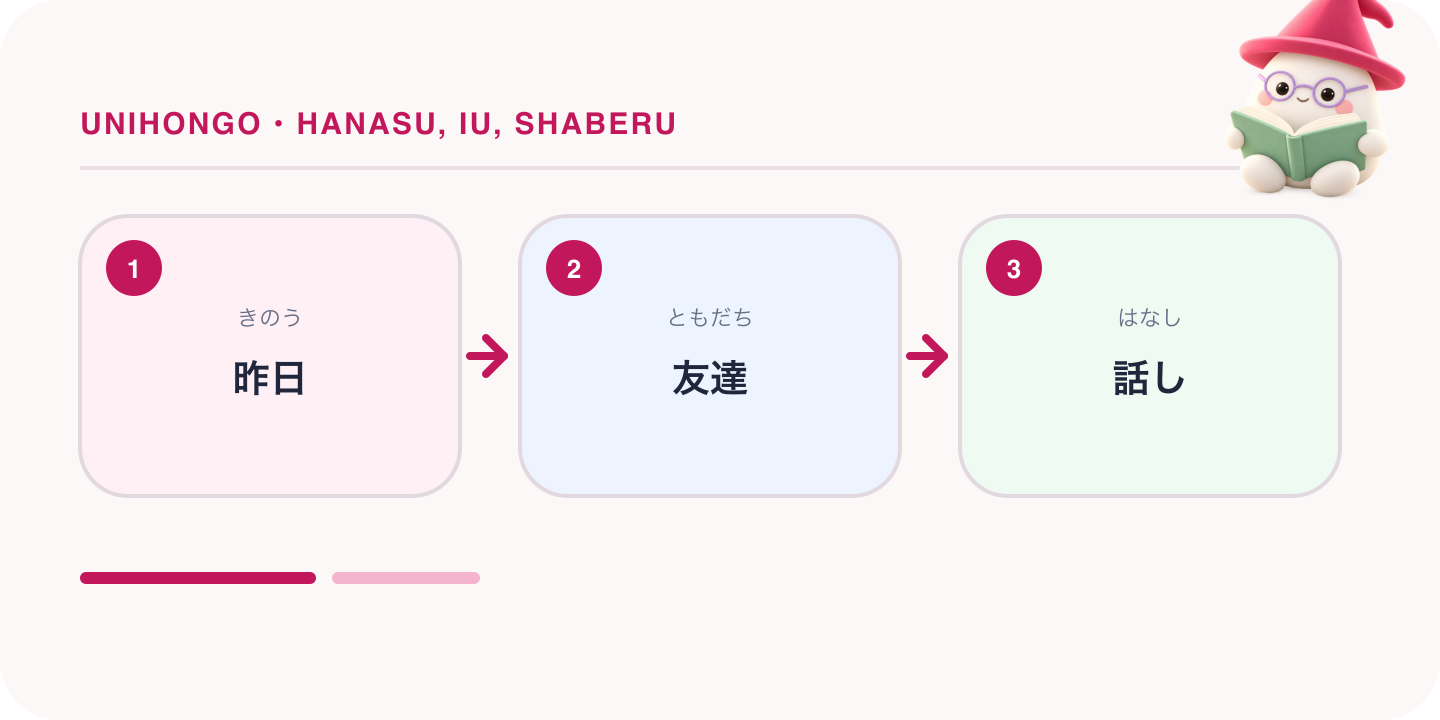
| Japanese | Romaji | Meaning |
|---|---|---|
| 昨日、友達と三時間も話した。 | Kinō, tomodachi to sanjikan mo hanashita. | I talked with a friend for three whole hours yesterday. |
| 日本語を話せますか。 | Nihongo o hanasemasu ka. | Can you speak Japanese? |
| 今後の予定について話しましょう。 | Kongo no yotei ni tsuite hanashimashō. | Let's talk about the upcoming schedule. |
| ちょっとお話があるんですが。 | Chotto o-hanashi ga aru n desu ga. | There's something I need to talk to you about. |
| その件は、後で話します。 | Sono ken wa, ato de hanashimasu. | I'll talk about that later. |
Iu: the words themselves
Iu is to say: it points at the words that leave someone's mouth. That is why it is the verb behind quotation with to. Arigatō to itta, said thank you; iku to itte imashita, said they would go. Iu also takes a small set of nouns directly: namae o iu, to say a name; iken o iu, to give an opinion; uso o iu, to tell a lie; monku o iu, to complain; jōdan o iu, to make a joke. Each object is something said, not a subject discussed.
Iu is also the verb of naming and meaning. Kore wa Nihongo de nan to iimasu ka asks what something is called in Japanese, and dō iu imi desu ka asks what something means. Quotation with to iu is a large topic of its own, covered in the separate guide to quoting speech and thought, so here it is enough to remember: iu for words, hanasu for talking.
In register, iu is neutral, and iimasu is fine anywhere. The casual contraction yū is what you actually hear: nante yutta? is what did you say.
| Japanese | Romaji | Meaning |
|---|---|---|
| 先生は明日休みだと言いました。 | Sensei wa ashita yasumi da to iimashita. | The teacher said tomorrow is a day off. |
| 何か意見を言ってください。 | Nani ka iken o itte kudasai. | Please give an opinion. |
| これは日本語で何と言いますか。 | Kore wa Nihongo de nan to iimasu ka. | What is this called in Japanese? |
| 彼はいつも文句を言っている。 | Kare wa itsumo monku o itte iru. | He is always complaining. |
| 冗談を言っただけだよ。 | Jōdan o itta dake da yo. | I was only joking. |
Shaberu: chatting and talking too much
Shaberu overlaps with hanasu but lives in a more relaxed world. It means to chat, to talk freely, and it often carries a hint of talking a lot. Tomodachi to shabetta is chatting with a friend; jugyō chū ni shaberu na is a teacher telling pupils to stop talking. Shaberisugita, I talked too much, and o-shaberi, a chatterbox, show the same colour.
Because it is casual, shaberu sits well between friends and in relaxed workplaces. It is not vulgar, but it is the wrong choice for describing a serious conversation with a client or for formal writing. With languages, Nihongo o shaberu is common in speech and means speaking Japanese in a practical, get-by sense, whereas Nihongo o hanasu is the neutral statement of ability. Pera pera shaberu, to talk fluently, is a common collocation.
| Japanese | Romaji | Meaning |
|---|---|---|
| 休み時間にみんなでしゃべった。 | Yasumi jikan ni minna de shabetta. | We all chatted during the break. |
| 授業中にしゃべらないでください。 | Jugyō chū ni shaberanaide kudasai. | Please don't talk during the lesson. |
| 昨日はしゃべりすぎて、のどが痛い。 | Kinō wa shaberisugite, nodo ga itai. | I talked too much yesterday and my throat hurts. |
| 彼女は本当におしゃべりだね。 | Kanojo wa hontō ni o-shaberi da ne. | She really is a chatterbox. |
| 英語がぺらぺらしゃべれたらいいのに。 | Eigo ga pera pera shaberetara ii no ni. | I wish I could speak English fluently. |
Kataru, noberu and tsutaeru: telling, stating and passing on
Kataru is to tell or narrate. It suits stories, experiences, memories and beliefs, and it suggests speaking at some length with feeling: yume o kataru, to talk about your dream; taiken o kataru, to recount an experience. Monogatari, a tale, and katarite, a narrator, are built on it. Between friends it can sound heavy, the verb for someone holding forth on their philosophy after a few drinks.
Noberu is to state or express, and it belongs to formal speech and writing: iken o noberu, to state an opinion; riyū o noberu, to give reasons. You will meet it in exam instructions and news reports far more than in conversation, where iu or hanasu takes its place.
Tsutaeru is to convey or pass on. The message starts with one person and reaches another, often through you. Buchō ni tsutaete kudasai, please tell the manager; yoroshiku o-tsutae kudasai, please give my regards. It is also the verb for feelings that need to reach someone, kimochi o tsutaeru. The intransitive twin tsutawaru describes the message arriving: imi ga tsutawatta, the meaning got through.
| Japanese | Romaji | Meaning |
|---|---|---|
| 祖父はよく戦争の体験を語ってくれた。 | Sofu wa yoku sensō no taiken o katatte kureta. | My grandfather often told me about his wartime experiences. |
| 自分の意見を述べてください。 | Jibun no iken o nobete kudasai. | Please state your own opinion. |
| 田中さんに伝えておきます。 | Tanaka-san ni tsutaete okimasu. | I'll pass that on to Tanaka. |
| ご家族によろしくお伝えください。 | Go-kazoku ni yoroshiku o-tsutae kudasai. | Please give my regards to your family. |
| 気持ちがうまく伝わらなかった。 | Kimochi ga umaku tsutawaranakatta. | My feelings did not get through properly. |
Which verb takes which object
The fastest way to fix these verbs in memory is by their typical objects and particles. The table pairs each verb with the words that most often stand next to it, along with the compounds hanashiau and hanashikakeru, which keep the particles of hanasu.
| Verb | Reading | Typical objects and partners |
|---|---|---|
| 話す | hanasu | A person with to, a topic with ni tsuite, a language with o |
| 言う | iu | A quotation with to, namae, iken, uso, monku, jōdan |
| しゃべる | shaberu | A friend with to, a language with o; often no object at all |
| 語る | kataru | Yume, taiken, omoide, rekishi, shinjitsu |
| 述べる | noberu | Iken, riyū, kansō, kekka, in formal or written contexts |
| 伝える | tsutaeru | Dengon, kimochi, yōken, jōhō, with the receiver marked by ni |
| 話し合う | hanashiau | A problem or plan discussed together to reach agreement |
| 話しかける | hanashikakeru | A person you approach and start speaking to, marked by ni |
| 言い訳する | iiwake suru | An excuse, made about a lateness or a failure |
| 申す | mōsu | Your own name, request or opinion, humbly |
| おっしゃる | ossharu | What a customer, teacher or senior says, respectfully |
Keigo: ossharu and mōsu
When politeness rises, iu disappears. For what a respected person says, use ossharu, whose polite form is the irregular osshaimasu and whose -te form is osshatte. Nan to osshaimashita ka is the polite way to ask what someone said, and osshatta tōri means just as you said.
For your own words, use mōsu, the humble form: Suzuki to mōshimasu introduces yourself, and mōshiwake arimasen, literally I have no excuse to state, is the everyday apology. Mōshiageru is a step more humble and appears in set phrases such as o-rei mōshiagemasu, I express my thanks. Hanasu follows the regular pattern: o-hanashi suru is humble and o-hanashi ni naru is respectful. A simple test for direction: ossharu points outward, mōsu points at you.
| Japanese | Romaji | Meaning |
|---|---|---|
| お名前は何とおっしゃいますか。 | O-namae wa nan to osshaimasu ka. | May I ask your name? |
| 鈴木と申します。 | Suzuki to mōshimasu. | My name is Suzuki. |
| 先生がおっしゃったとおりでした。 | Sensei ga osshatta tōri deshita. | It was just as the teacher said. |
| もう一度おっしゃっていただけますか。 | Mō ichido osshatte itadakemasu ka. | Could you say that once more? |
| ご説明の前に一言申し上げます。 | Go-setsumei no mae ni hitokoto mōshiagemasu. | Before the explanation, allow me a brief word. |
Hanashi o suru and the noun forms
Japanese often prefers a noun plus suru to a bare verb. Hanashi o suru, to have a talk, is more or less equal to hanasu, but it frames the conversation as an event, so it is what you use to arrange one: ato de hanashi o shimashō, let's talk later. Hanashi ni naranai means something is not even worth discussing.
O-shaberi o suru is to have a chat, dengon o nokosu leaves a message, and hōkoku o suru makes a report. For opinions, the polite way to invite one is go-iken o o-kikase kudasai, please let us hear your opinion, rather than iken o itte kudasai, which sounds abrupt.
- Hanashi o suru: to have a talk, arranged as an event
- O-shaberi o suru: to have a chat, casual
- Hanashi ga aru: I have something to discuss with you
- Hanashi ni naranai: not worth discussing
- Dengon o nokosu: to leave a message
- Hōkoku suru: to report, in the workplace
- Go-iken o o-kikase kudasai: please share your opinion, polite
Hanashi also appears in hanashi o kiku, to listen to what someone has to say, and ii hanashi, a heart-warming story.
Mistakes learners make with the speaking verbs
The most common mistake is hanasu for say. Kare wa iku to hanashita is wrong; quoted words need itta. The reverse also happens: tomodachi to itta for talked with a friend needs hanashita. A quick check is whether you can point at the words. If you can, use iu.
The second is shaberu in formal settings. Kachō to shaberimashita about a meeting with a manager sounds as if you two had a gossip; use hanashimashita. The third is tsutaeru for ordinary telling: tomodachi ni tsutaeta when you simply told a friend something sounds like relaying a message, and itta is more natural.
Finally, the direction of keigo. Learners say buchō ga mōshimashita when they mean the manager said, and tell customers watashi wa Tanaka to osshaimasu. Ossharu is for the other person, mōsu is for your side, with no exceptions.
| Japanese | Romaji | Meaning |
|---|---|---|
| 彼は行くと言った。 | Kare wa iku to itta. | He said he would go. |
| 昨日、友達と話した。 | Kinō, tomodachi to hanashita. | I talked with a friend yesterday. |
| 課長と今後の計画について話しました。 | Kachō to kongo no keikaku ni tsuite hanashimashita. | I talked with the section chief about the plan going forward. |
| 部長はそうおっしゃいました。 | Buchō wa sō osshaimashita. | The manager said so. |
| 私からお伝えしておきます。 | Watashi kara o-tsutae shite okimasu. | I will pass that on myself. |