
The first question: tare or shio?
Almost every skewer can be seasoned two ways. Tare (たれ) is a glaze of soy sauce, mirin and sugar that caramelises over the charcoal. Shio (塩) is just salt, which lets you taste the chicken itself. After you order, staff ask which you want, and you can answer differently for each cut.
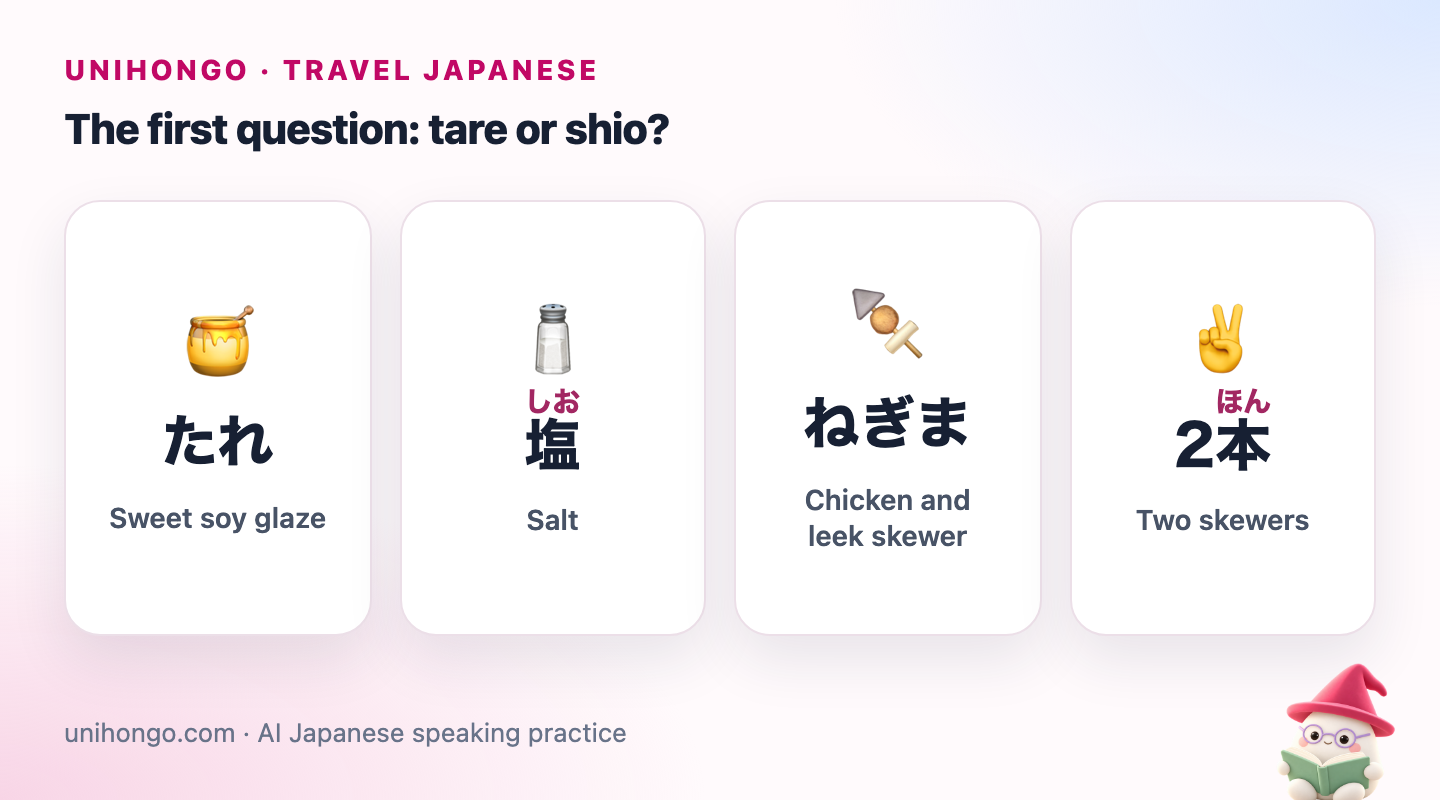
| Japanese | Romaji | Meaning |
|---|---|---|
| たれ | Tare | Sweet soy glaze |
| 塩 | Shio | Salt |
| ねぎま | Negima | Chicken and leek skewer |
| 2本 | Nihon | Two skewers |
| たれと塩、どちらになさいますか。 | Tare to shio, dochira ni nasaimasu ka. | Staff: Glaze or salt? |
| 塩でお願いします。 | Shio de onegai shimasu. | You: Salt, please. |
| おすすめでお願いします。 | Osusume de onegai shimasu. | You: Whichever you recommend. |
The cuts on the menu
Names are usually written in hiragana or katakana. The first four below are on every menu; the rest are where the fun starts.
| Japanese | Romaji | Meaning |
|---|---|---|
| もも | Momo | Thigh |
| つくね | Tsukune | Chicken meatball |
| 皮 | Kawa | Skin |
| ささみ | Sasami | Lean breast tenderloin |
| 手羽先 | Tebasaki | Wing |
| 砂肝 | Sunagimo | Gizzard |
| レバー | Rebā | Liver |
| ハツ | Hatsu | Heart |
| ぼんじり | Bonjiri | Tail |
| なんこつ | Nankotsu | Cartilage |
Momo is juicy and familiar. Tsukune is often served with tare and sometimes an egg yolk for dipping. Sasami is very lean and commonly topped with wasabi or pickled plum. Sunagimo and nankotsu are crunchy, bonjiri is rich and fatty, and hatsu is firm and mild. Most shops also grill vegetables such as shiitake and shishitō peppers.
Counting skewers with hon
Skewers are long and thin, so they take the counter hon (本). Its first sound shifts with the number: pon after one, six, eight and ten, bon after three.
| Japanese | Romaji | Meaning |
|---|---|---|
| 1本 | Ippon | One skewer |
| 3本 | Sanbon | Three skewers |
| 4本 | Yonhon | Four skewers |
| 6本 | Roppon | Six skewers |
| ももとねぎまを2本ずつください。 | Momo to negima o nihon zutsu kudasai. | Two each of thigh and chicken with leek, please. |
The exchange in order
At a yakitori shop, as at any izakaya, drinks are ordered first and food second. Skewers are grilled to order and arrive a few at a time, so it is normal to order in two or three rounds.
| Japanese | Romaji | Meaning |
|---|---|---|
| お飲み物からお伺いします。 | Onomimono kara oukagai shimasu. | Staff: May I take your drinks first? |
| 生ビールを二つお願いします。 | Nama bīru o futatsu onegai shimasu. | You: Two draft beers, please. |
| つくねと皮を1本ずつください。 | Tsukune to kawa o ippon zutsu kudasai. | You: One each of meatball and skin, please. |
| ももは塩、ねぎまはたれでお願いします。 | Momo wa shio, negima wa tare de onegai shimasu. | You: Thigh with salt, chicken and leek with glaze, please. |
| 少々お時間をいただきます。 | Shōshō ojikan o itadakimasu. | Staff: It will take a little while. |
| はい、大丈夫です。 | Hai, daijōbu desu. | You: That is fine. |
The wa in Momo wa shio, negima wa tare marks a contrast: as for the thigh, salt; as for the negima, glaze. It is the neatest way to give two different answers in one sentence.
Moriawase and omakase: when you cannot choose
If the list is too long, let the shop decide. Moriawase (盛り合わせ) is an assortment plate. Omakase gohon (おまかせ5本) is five skewers of the cook's choice, and menus offer other numbers too. Because the cook chooses, you will usually be asked about dislikes first.
| Japanese | Romaji | Meaning |
|---|---|---|
| 盛り合わせ | Moriawase | Assorted skewers |
| おまかせ5本をお願いします。 | Omakase gohon o onegai shimasu. | Five skewers of the cook's choice, please. |
| 苦手なものはありますか。 | Nigate na mono wa arimasu ka. | Staff: Is there anything you do not eat? |
| レバーが苦手です。 | Rebā ga nigate desu. | You: I am not keen on liver. |
| 特にありません。 | Toku ni arimasen. | You: Nothing in particular. |
On the table: shichimi and the skewer cup
Two things on the table are for you. Shichimi (七味) is a blend of chili and other spices; shake a little onto tare skewers or onto the edge of your plate. The tall cup or bamboo tube is a kushi-ire (串入れ), where finished skewers go. Kushi (串) is the skewer itself, a word you will also see in kushiyaki and kushikatsu.
Sharing: off the skewer or not?
Japanese diners genuinely disagree about this. Sliding the pieces off with chopsticks lets four people taste one skewer, and many groups do it automatically. Others, including some cooks, feel the meat cools and dries, and that a skewer is meant to be eaten as it was grilled. Neither side is wrong, so ask before you act.
| Japanese | Romaji | Meaning |
|---|---|---|
| 串から外してもいいですか。 | Kushi kara hazushite mo ii desu ka. | May I take it off the skewer? |
| 一人1本ずつ頼みましょう。 | Hitori ippon zutsu tanomimashō. | Let us order one skewer each. |
| このまま食べましょう。 | Kono mama tabemashō. | Let us eat it as it is. |