

Why Miyama's thatched village is worth the long bus ride
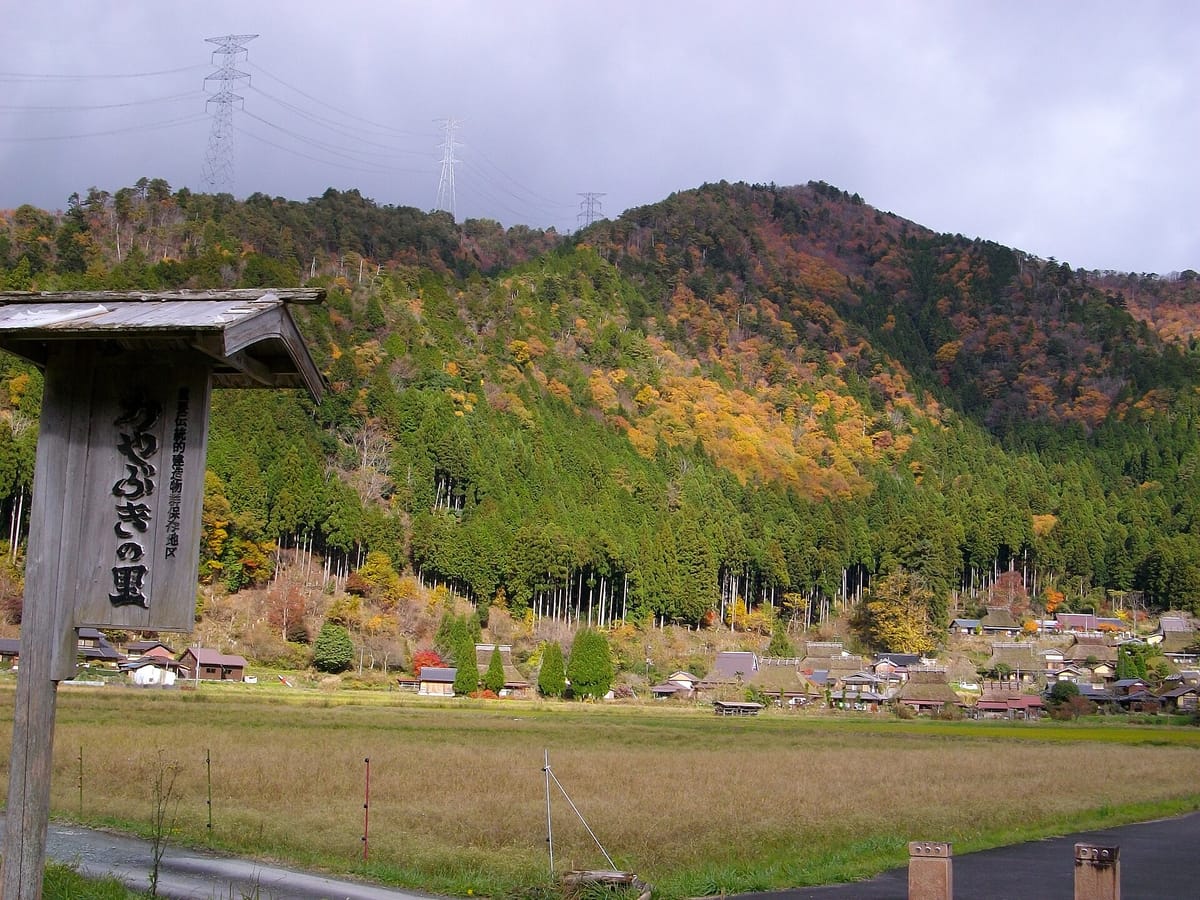
Miyama is a large, thinly populated district in the mountains north of Kyoto, part of Nantan City since the towns of the area merged in 2006. Across its valleys more than two hundred thatched farmhouses survive, scattered among rice fields and cedar forest. The hamlet of Kita, on the upper Yura River, is where they cluster most densely: nearly forty houses with thatched roofs stand close together on the hillside, and the Japanese government designated the hamlet a Preservation District for Groups of Historic Buildings in December 1993.
What makes Kita different from better-known thatched villages is that it has not been turned into a stage set. Most of the houses are ordinary homes, with laundry on the veranda, tractors in the sheds and vegetables growing beside the lane. A company set up by the village runs the restaurant, the shop and the farm, growing rice and buckwheat in the fields below the houses. You walk through the hamlet as a guest, and the rhythm of the day is set by the farm and the bus timetable rather than by tour groups.
For a Japanese learner, Miyama is a chance to practise the quiet, polite Japanese of the countryside. There are few signs and fewer English speakers, and the useful sentences are short and courteous: may I take a photo, where is the museum, what time is the last bus. Say them slowly and with a smile, and people will usually answer in kind.
Getting there: the Sagano Line to Hiyoshi and the Nantan City bus
Public transport to Miyama takes two steps. First, take the JR Sagano Line, the name used for the San'in Main Line near Kyoto, from Kyoto Station to Hiyoshi Station, Hiyoshi-eki; the ride takes around forty-five minutes. From the bus stop outside Hiyoshi Station, the Nantan City bus, Nantan shiei basu, runs up the valley to Miyama in about fifty minutes. Get off at Kita (Kayabuki no Sato), and the thatched roofs are a couple of minutes' walk away. Some Nantan City bus routes also start from Sonobe Station, closer to Kyoto on the same railway line.
The bus is the thing to plan around. Services are infrequent, and the last bus back towards Hiyoshi leaves early by city standards, so note the return times as soon as you arrive; the timetable is posted at the stop. A one-day bus pass has been sold for the Nantan City buses, which is worth asking about if you plan to stop elsewhere in Miyama. By car, the drive from Kyoto takes around an hour and a half, and there is a paid car park at the village, which must be reserved in advance on event days.
| Japanese | Romaji | Meaning |
|---|---|---|
| 日吉駅までの切符をください。 | Hiyoshi-eki made no kippu o kudasai. | A ticket to Hiyoshi Station, please. |
| 美山に行くバスはどこから出ますか。 | Miyama ni iku basu wa doko kara demasu ka. | Where does the bus to Miyama leave from? |
| このバスはかやぶきの里に止まりますか。 | Kono basu wa Kayabuki no Sato ni tomarimasu ka. | Does this bus stop at Kayabuki no Sato? |
| 北で降りたいので、教えていただけますか。 | Kita de oritai node, oshiete itadakemasu ka. | I want to get off at Kita; could you tell me when? |
| 帰りのバスの時刻表はありますか。 | Kaeri no basu no jikokuhyō wa arimasu ka. | Do you have a timetable for the return bus? |
| 一日乗車券はありますか。 | Ichinichi jōshaken wa arimasu ka. | Is there a one-day pass? |
What you will see: the folk museum, the shrine and the red water cannons
The hamlet is small enough to walk round in an hour, but most visitors stay longer, climbing the lanes for the view back over the roofs, stopping for soba and sitting by the river. Start at the viewpoint near the bus stop, where the whole cluster of roofs is framed by the mountain, then cross into the village and follow the lanes uphill.
Look out for the small red boxes and hydrant-like towers beside many of the houses. These are hōsuijū, water cannons, installed because a single spark can destroy a thatched roof. Twice a year, in spring and autumn, the village tests all of them together in the ichisei hōsui tenken, the simultaneous water discharge inspection: for a few minutes, arcs of water rise over every roof at once. In 2026 the spring test was held in May and the autumn test was scheduled for early December; the dates are announced on the official site, and car parking on those days is by advance reservation only.
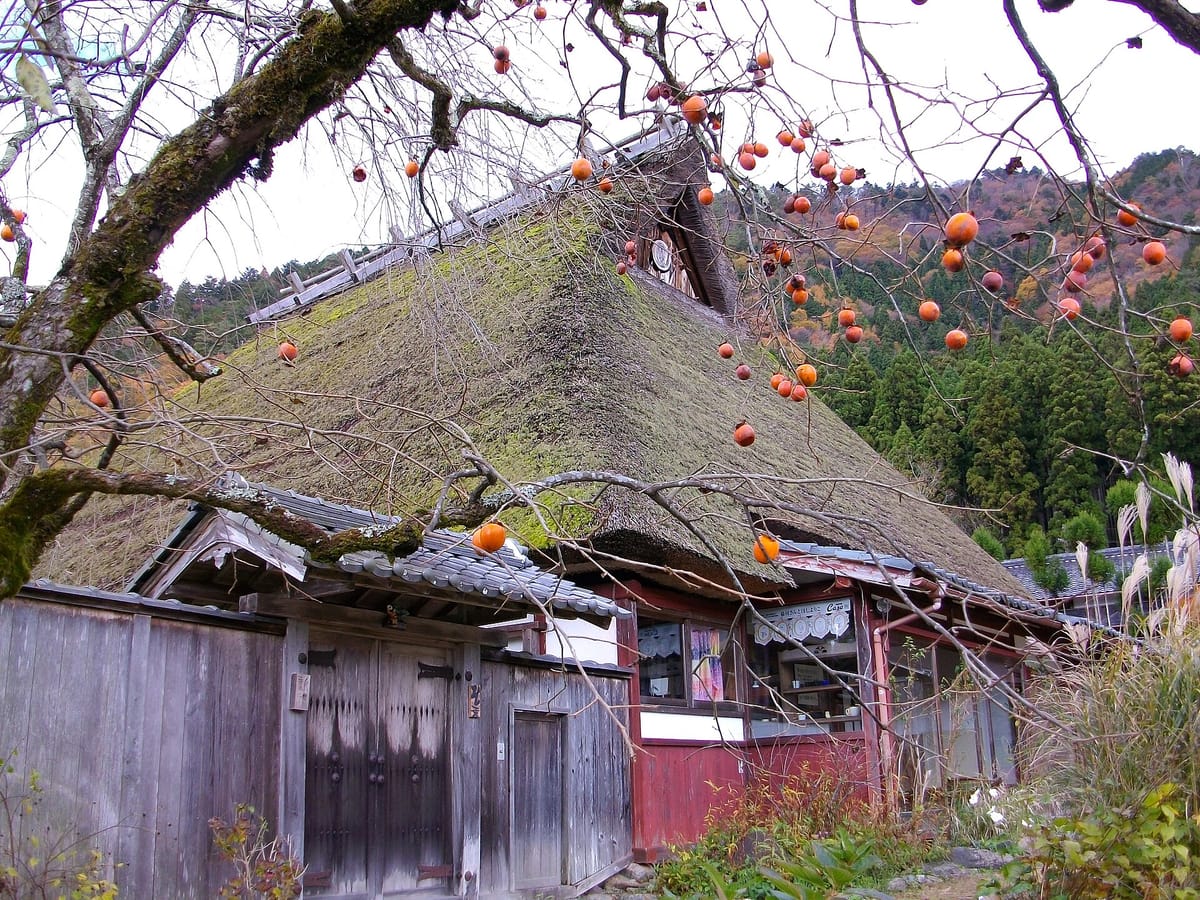
- Miyama Minzoku Shiryōkan: the folk museum, a former farmhouse showing everyday tools and how the roofs are built; you can see the inside of the thatch from the attic.
- Chiisana Ai Bijutsukan: the Little Indigo Museum, a collection of indigo-dyed textiles from Japan and abroad, closed in the depth of winter.
- Chii Hachiman Jinja: the shrine that serves the hamlets of the upper valley, designated a cultural property by Kyoto Prefecture.
- The viewpoint by the road: the classic view of roofs, fields and mountain in one frame.
- The Yura River: the clear river below the village, known for ayu, sweetfish, in summer.
- Buckwheat and rice fields: farmed by the village, white with buckwheat flowers in early autumn.
Words on the signs in Kayabuki no Sato
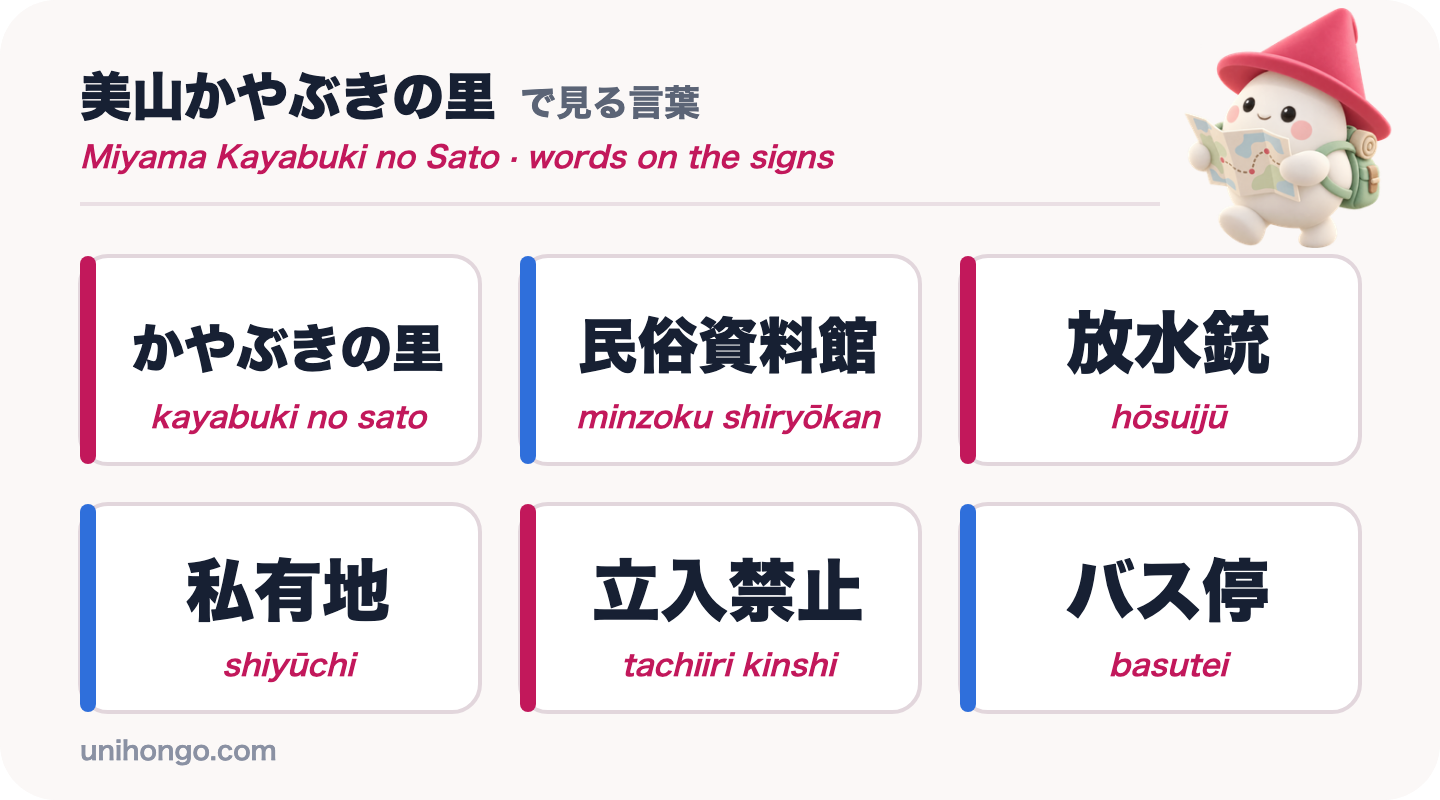
Signs in the hamlet are few, and many of them exist for one reason: to tell visitors politely where the village ends and people's homes begin. You will see 私有地, shiyūchi, private land, on gardens and driveways, and 立入禁止, tachiiri kinshi, no entry, on paths that lead to someone's door. Learn to recognise both at a glance; they matter more here than any museum label.
The other signs give names. The village's own name is usually written in hiragana, かやぶきの里, because the kanji for thatch, 茅葺き, is hard to read even for many Japanese children. The table below covers the words you are most likely to meet between the bus stop and the shrine.
| Word | Reading | Meaning |
|---|---|---|
| かやぶきの里 | kayabuki no sato | The village of thatched roofs |
| 茅葺き | kayabuki | Thatched, thatch roofing |
| 民俗資料館 | minzoku shiryōkan | Folk museum |
| 小さな藍美術館 | Chiisana Ai Bijutsukan | The Little Indigo Museum |
| 放水銃 | hōsuijū | Water cannon for fire protection |
| 私有地 | shiyūchi | Private land |
| 立入禁止 | tachiiri kinshi | No entry |
| バス停 | basutei | Bus stop |
| 駐車場 | chūshajō | Car park |
| 知井八幡神社 | Chii Hachiman Jinja | The village shrine of the upper valley |
Japanese for soba, the folk museum and a night in a minshuku
The main restaurant in the hamlet, run by the village company, is Kitamura, serving handmade soba, rice dishes and ayu tempura, and there are a café and a souvenir shop. Food service is simple and the staff are local, so short, polite requests work best. On busy days, popular dishes can sell out, so an early lunch is a good plan.
At the folk museum you pay a small fee at the entrance and can climb to the attic to see the underside of the roof: a lattice of bamboo and timber lashed with rope, with the thatch packed on top. A few thatched houses also take overnight guests as minshuku, and a night in one, with dinner around the table and the silence after the last bus, is the best way to know the village.
| Japanese | Romaji | Meaning |
|---|---|---|
| 民俗資料館の入館料はここで払いますか。 | Minzoku shiryōkan no nyūkanryō wa koko de haraimasu ka. | Do I pay the folk museum entry fee here? |
| 屋根裏も見られますか。 | Yaneura mo miraremasu ka. | Can I see the attic too? |
| この屋根は何でできていますか。 | Kono yane wa nan de dekite imasu ka. | What is this roof made of? |
| ざるそばを一つお願いします。 | Zarusoba o hitotsu onegai shimasu. | One cold soba on a bamboo tray, please. |
| 鮎の天ぷらはありますか。 | Ayu no tenpura wa arimasu ka. | Do you have sweetfish tempura? |
| 今夜、二人で泊まれますか。 | Kon'ya, futari de tomaremasu ka. | Can two of us stay tonight? |
| 夕食は何時からですか。 | Yūshoku wa nanji kara desu ka. | What time is dinner? |
Etiquette, timing and the winter light-up
Kayabuki no Sato works as a place to visit because the residents allow it. The most useful thing you can bring is the habit of treating every garden as someone's front yard, because it is.
- Stay on the public lanes. Do not walk into gardens, onto verandas or behind houses, even when a gate is open, and never touch the thatch.
- Ask before photographing people, and avoid pointing a camera through windows or open doors.
- Smoking is a real danger to thatched roofs. Do not smoke in the village, and keep lighters and any open flame away from the houses.
- Take your rubbish home; there are few bins, and villagers clear up whatever is left behind.
- Check the return bus times as soon as you arrive, and be at the stop a few minutes early. Missing the last bus means a long taxi ride.
- In winter the village holds a light-up, now called the Fuyu Tōrō, winter lanterns. It was renamed from Yuki Tōrō, snow lanterns, for the 2026 edition because of a run of snowless winters; the next one is announced for 30 January to 6 February 2027, with the lights on in the early evening, and parking must be reserved in advance.
- Electric bicycles can be rented in Miyama outside the winter months, useful for reaching the other hamlets of the valley.
Practise the village before you go
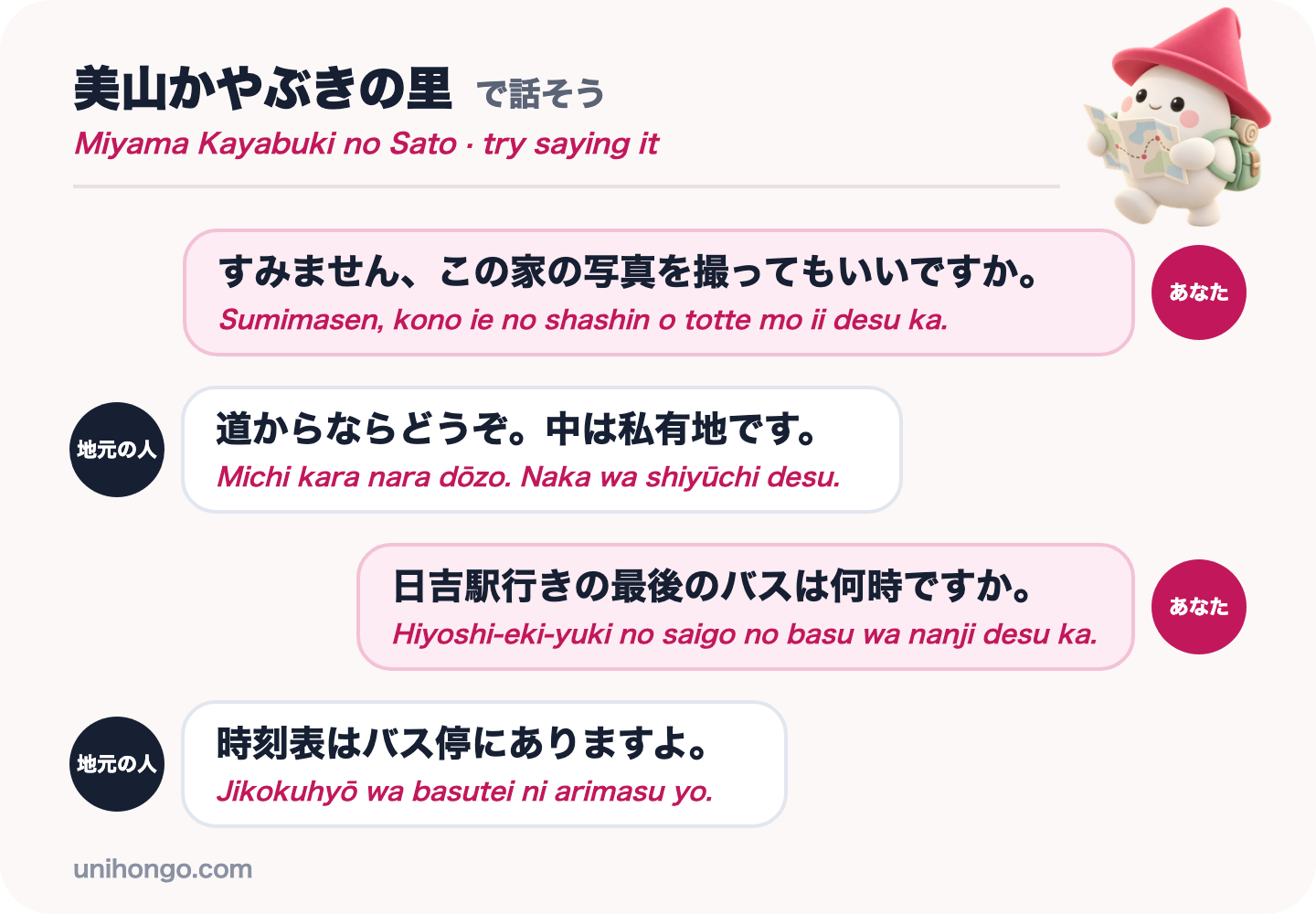
The two conversations most visitors need in Miyama are about photos and about the bus. Residents are used to cameras, and a polite question shows that you know you are in their village. Practise the four lines below until you can say them without reading, and listen in the replies for the key words michi, the road, shiyūchi, private land, and jikokuhyō, timetable.
Then practise with a partner who answers back. In Unihongo, choose the Sightseeing topic and ask your AI Sensei to play a resident of the village, or pick the Directions topic to rehearse finding the right bus stop at Hiyoshi. Saying the lines once before you travel is what makes them come out naturally in the lane.
| Japanese | Romaji | Meaning |
|---|---|---|
| すみません、この家の写真を撮ってもいいですか。 | Sumimasen, kono ie no shashin o totte mo ii desu ka. | Excuse me, may I take a photo of this house? |
| 道からならどうぞ。中は私有地です。 | Michi kara nara dōzo. Naka wa shiyūchi desu. | Go ahead from the road. Inside is private land. |
| 日吉駅行きの最後のバスは何時ですか。 | Hiyoshi-eki-yuki no saigo no basu wa nanji desu ka. | What time is the last bus to Hiyoshi Station? |
| 時刻表はバス停にありますよ。 | Jikokuhyō wa basutei ni arimasu yo. | The timetable is at the bus stop. |
Official information
The village's own site lists the restaurant, shop, lodgings and news such as the water cannon tests; the Miyama tourism association covers access and the museums; the winter light-up has a dedicated site with dates, parking reservations and bus notes. Check all three before you go, especially in winter.