

Why the Kyoto Imperial Palace is worth an hour
Kyoto was the imperial capital for over a thousand years, and the Kyoto Imperial Palace was the emperor's residence from the fourteenth century until 1869, when the court moved to Tokyo after the Meiji Restoration. The palace burned many times, and the buildings you see today were completed in 1855, deliberately built in the style of the Heian court. Even after the move to Tokyo, the enthronements of the Taishō and Shōwa emperors were held here.
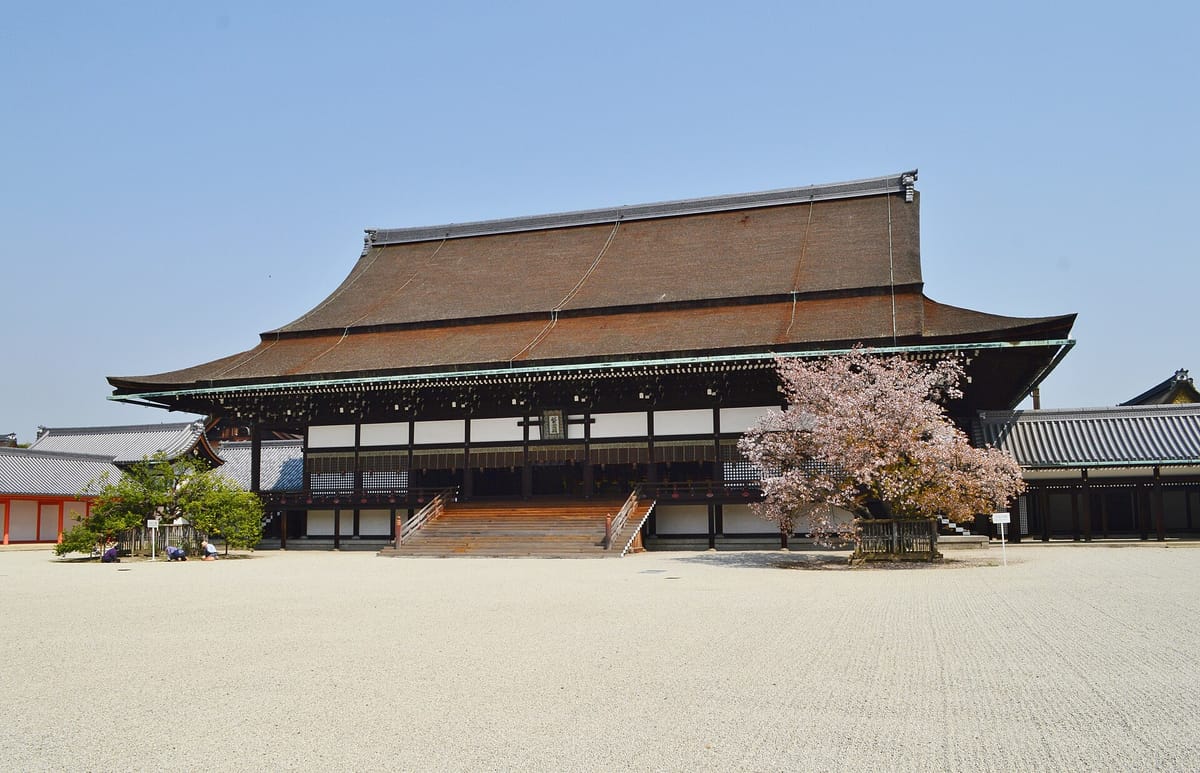
The scale is what strikes you first. The palace enclosure is a long rectangle surrounded by earthen walls and gates, and the ceremonial courtyard in front of the Shishinden is a sea of white gravel. Inside, the architecture changes from formal to intimate as you move from the ceremonial halls to the emperor's living quarters and the gardens.
The palace is run by the Imperial Household Agency and has been open to the public all year without a reservation since 2016, so you can simply walk in. It is one of the few places in Kyoto where you can join a free, structured tour, which makes it good practice for listening to Japanese explanations too.
Getting there: Imadegawa Station and the Seishomon gate
The nearest station is Imadegawa Station, Imadegawa-eki, on the Karasuma subway line. The palace is about five minutes' walk away, through the western side of Kyoto Gyoen. City buses also stop along Karasuma-dōri, and the Keihan line's Demachiyanagi and Jingū-Marutamachi stations are within walking distance on the eastern side.
Visitors enter through the Seishomon gate on the western side of the palace enclosure. You and your bags go through a security check, and then you follow the marked route. There is no parking for cars or bicycles, and large bags, pets and drones are not allowed.
| Japanese | Romaji | Meaning |
|---|---|---|
| 京都御所の入口はどこですか。 | Kyōto Gosho no iriguchi wa doko desu ka. | Where is the entrance to the Kyoto Imperial Palace? |
| 清所門はこちらですか。 | Seishomon wa kochira desu ka. | Is the Seishomon gate this way? |
| 今出川駅から歩いて何分ですか。 | Imadegawa-eki kara aruite nanpun desu ka. | How many minutes on foot from Imadegawa Station? |
| 荷物を預けるところはありますか。 | Nimotsu o azukeru tokoro wa arimasu ka. | Is there somewhere to leave my luggage? |
| ここで荷物の検査をしますか。 | Koko de nimotsu no kensa o shimasu ka. | Is the bag check here? |
What you will see on the palace route
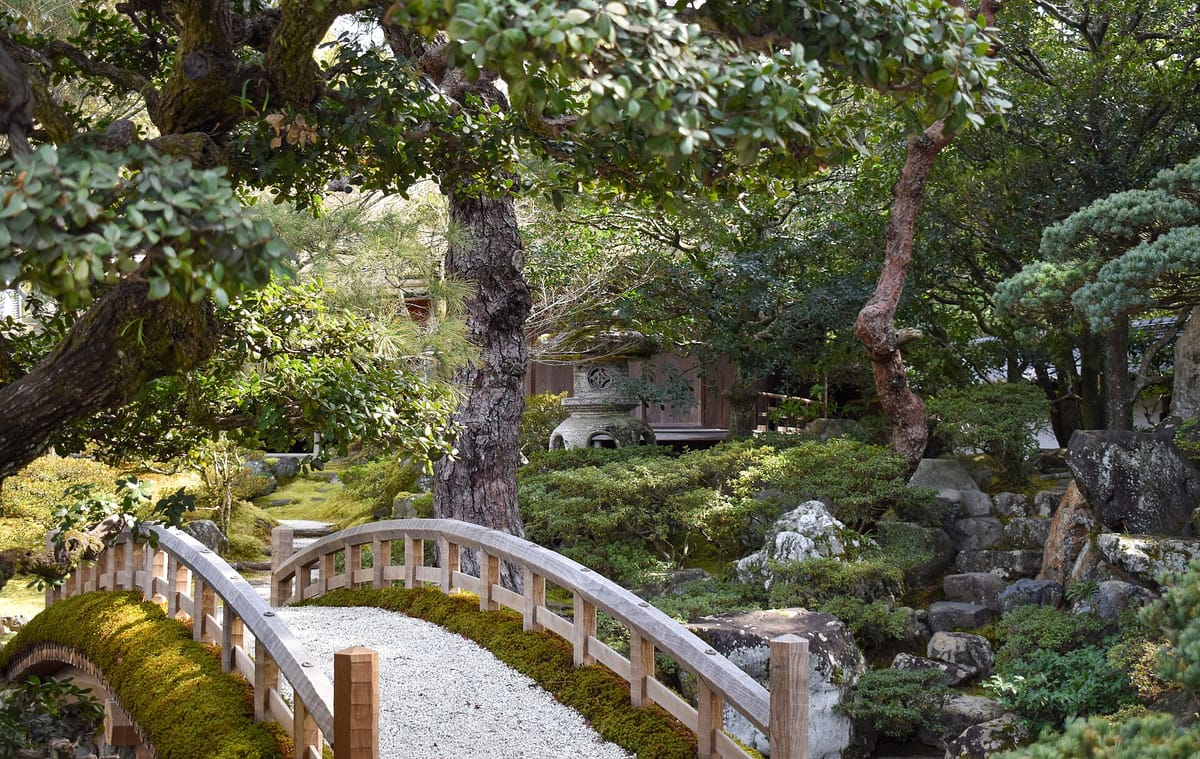
The route runs roughly from the western gates, past the formal waiting rooms and the Kenreimon, to the heart of the palace: the Shishinden, where enthronements and the most important ceremonies were held. It then passes the Seiryōden, once the emperor's residence, before moving to the smaller Kogosho and Ogakumonsho halls and the Oikeniwa, a pond garden with an arched wooden bridge, stepping stones and a pebble shore.
Doors and shutters are often opened so you can look into the halls and see the painted sliding doors and the mats where the court once sat. Information boards along the way are in Japanese and English, and the guided tours, about fifty minutes long, add stories that the boards leave out.
- Okurumayose: the carriage porch where nobles arrived for ceremonies.
- Kenreimon: the grand southern gate, used by the emperor.
- Shishinden: the ceremonial hall, facing a vast courtyard of white gravel.
- Seiryōden: the former living quarters of the emperor.
- Kogosho: the hall used for smaller ceremonies and meetings.
- Ogakumonsho: the emperor's study and reading hall.
- Oikeniwa: the pond garden with its arched bridge and pebble shore.
- Otsunegoten: the later residence of the emperor, with many rooms.
Words on the signs at the palace
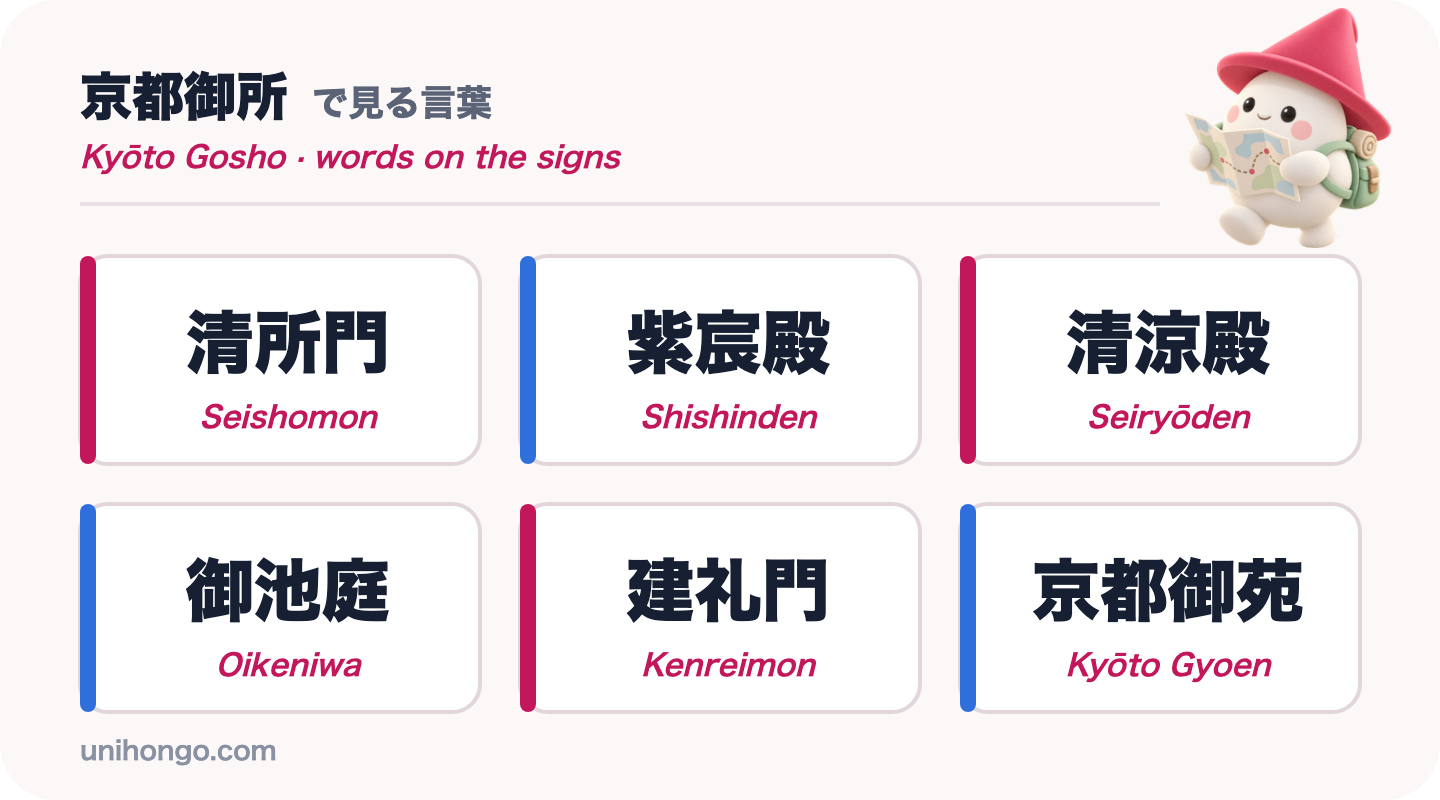
Palace names use the honorific 御, which can be read go, gyo or o depending on the word: 御所 Gosho, 御苑 Gyoen, 御池庭 Oikeniwa. It marks something as belonging to the emperor, and it is one of the first kanji you will learn to read in several ways.
Hall names end in 殿, den, hall or palace, and gates end in 門, mon. 紫宸殿 is the Shishinden, the hall of the purple polestar, a name taken from Chinese imperial tradition; 清涼殿 is the Seiryōden, the pure and cool hall.
| Word | Reading | Meaning |
|---|---|---|
| 京都御所 | Kyōto Gosho | The Kyoto Imperial Palace |
| 京都御苑 | Kyōto Gyoen | The public park around the palace |
| 清所門 | Seishomon | The gate where visitors enter |
| 紫宸殿 | Shishinden | The ceremonial hall |
| 清涼殿 | Seiryōden | The emperor's former living quarters |
| 御池庭 | Oikeniwa | The pond garden |
| 建礼門 | Kenreimon | The grand southern gate |
| 参観 | sankan | Visit, the word used for palace visits |
| 順路 | junro | Visitor route, this way |
Japanese for the free guided tour
The Imperial Household Agency runs free guided tours with no registration: in Japanese several times a day, and in English and Chinese twice a day, one in the morning and one in the afternoon. Each lasts about fifty minutes. Gather at the meeting point after the security check a little before the start time.
Joining a Japanese tour is excellent listening practice even if you understand only part of it. Guides speak clearly and repeat the key names, and you can follow along with the English boards. The phrases below help you find the right group and ask a question at the end.
| Japanese | Romaji | Meaning |
|---|---|---|
| ガイドツアーの集合場所はどこですか。 | Gaido tsuā no shūgō basho wa doko desu ka. | Where is the meeting point for the guided tour? |
| 英語のツアーは何時からですか。 | Eigo no tsuā wa nanji kara desu ka. | What time does the English tour start? |
| 日本語のツアーに参加してもいいですか。 | Nihongo no tsuā ni sanka shite mo ii desu ka. | May I join the Japanese tour? |
| 紫宸殿は何に使われていましたか。 | Shishinden wa nani ni tsukawarete imashita ka. | What was the Shishinden used for? |
| もう一度お願いします。 | Mō ichido onegai shimasu. | Once more, please. |
| 写真を撮ってもいいですか。 | Shashin o totte mo ii desu ka. | May I take photos? |
Etiquette, timing and practical tips
The palace is still an imperial property, and the rules are a little stricter than at a temple or park.
- Bring only a small bag; large luggage is not allowed and there are no lockers at the gate.
- Eating, drinking alcohol and smoking are not allowed on the route.
- Photography is allowed, but not tripods or commercial filming equipment.
- Keep to the marked route and do not step onto the gravel courtyards.
- Check the day: the palace is closed on Mondays and over New Year.
- Allow time for Kyoto Gyoen too; its plum and cherry trees and wide gravel avenues are free to walk at any hour.
Practise the visit before you go
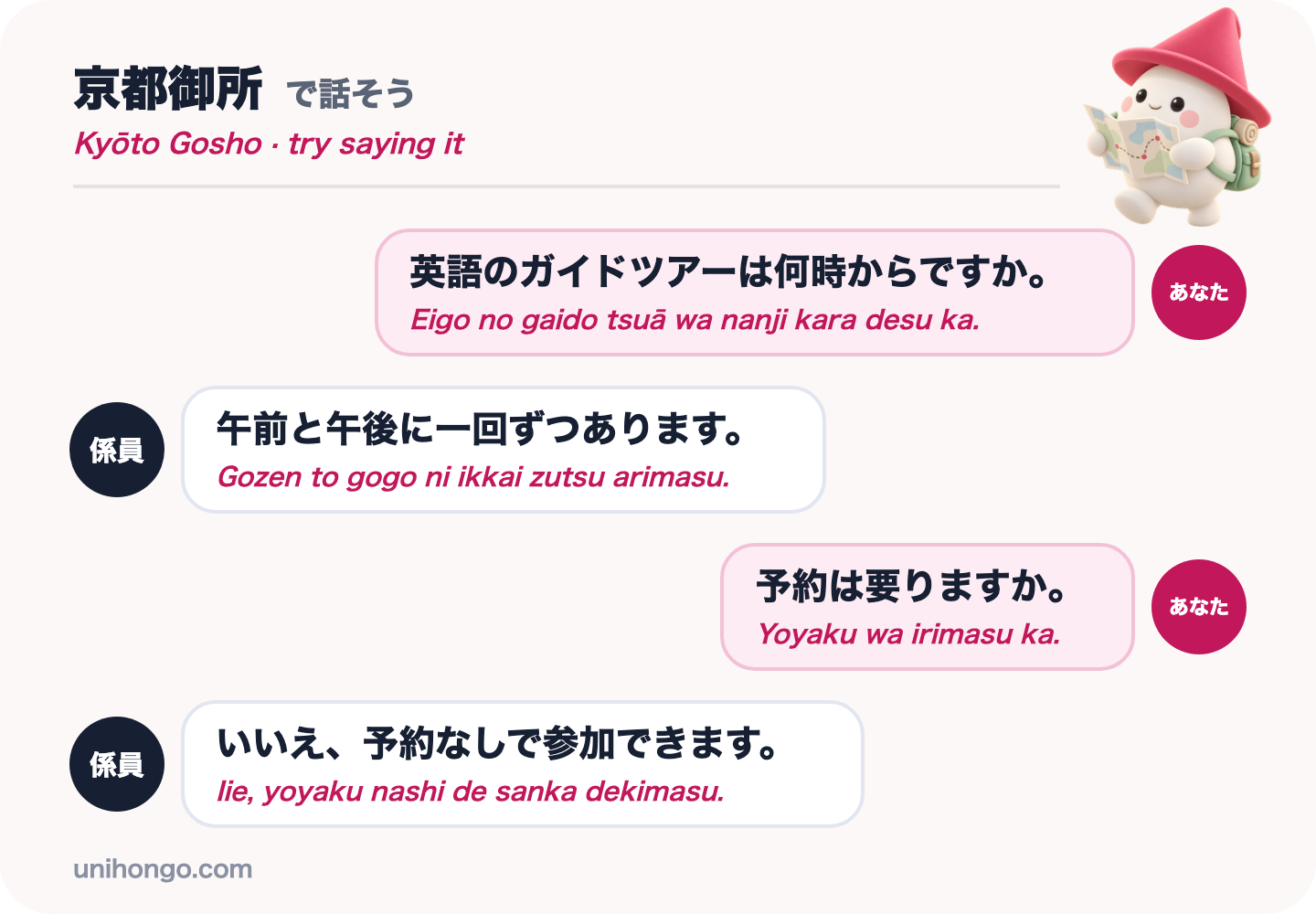
At the gate, the two things visitors ask most are when the tour starts and whether they need a reservation. Practise the four lines below until you can say them without reading, and listen for gozen, morning, and gogo, afternoon, in the reply.
Then practise with a partner who answers back. In Unihongo, choose the Sightseeing topic and ask your AI Sensei to play a palace guide who explains the Shishinden, and ask them to speak at the pace of a real tour.
| Japanese | Romaji | Meaning |
|---|---|---|
| 英語のガイドツアーは何時からですか。 | Eigo no gaido tsuā wa nanji kara desu ka. | What time does the English guided tour start? |
| 午前と午後に一回ずつあります。 | Gozen to gogo ni ikkai zutsu arimasu. | There is one in the morning and one in the afternoon. |
| 予約は要りますか。 | Yoyaku wa irimasu ka. | Do I need a reservation? |
| いいえ、予約なしで参加できます。 | Iie, yoyaku nashi de sanka dekimasu. | No, you can join without booking. |
Official information
The Imperial Household Agency publishes the palace's opening days, seasonal hours, tour times and rules in English. Check before you go, as the palace can close for official events at short notice.