

Why Kenroku-en is one of Japan's three great gardens
Kenroku-en is traditionally counted among the three great gardens of Japan, the Nihon sanmeien, together with Kairaku-en in Mito and Kōraku-en in Okayama. It is a kaiyūshiki teien, a strolling garden, meant to be walked on a loop so that each turn of the path opens a new composed view. The national government has designated it a Special Place of Scenic Beauty, the highest rank for a garden.
The garden grew out of the grounds of Kanazawa Castle, seat of the Maeda family, the lords of the Kaga domain and the richest feudal lords in Edo-period Japan after the shogun. The fifth lord, Maeda Tsunanori, began the garden in the late seventeenth century, and later lords, above all the thirteenth, Maeda Nariyasu, extended it into roughly its present shape. Water still reaches the ponds by an early seventeenth-century canal that brought river water into the castle.
The name was given in the early nineteenth century and borrows an idea from a classic Chinese text on gardens: that six qualities, rokushō, rarely come together, because each pair pulls against the other. Spaciousness fights seclusion, human artifice fights the look of age, and plentiful water fights wide views from high ground. Kenroku-en means the garden that combines all six. For a learner, it is a satisfying word to take apart: 兼, combine, 六, six, 園, garden.
Getting there: the bus from Kanazawa Station
Kanazawa is on the Hokuriku Shinkansen, which runs from Tokyo through Nagano and on to Fukui and Tsuruga. From Kanazawa Station, leave by the East Exit, Higashi-guchi, also signed Kenrokuen-guchi, where the great wooden Tsuzumi-mon gate stands in front of the bus terminal. City buses to the garden area leave from here, and the ride takes about fifteen to twenty minutes. Get off at Kenrokuen-shita or at the Kanazawa-jō stop, depending on the route.
The garden has several entrances. The Katsurazaka entrance, Katsurazaka-guchi, is the most used: it faces the Ishikawa-mon gate of Kanazawa Castle across the road, so you can walk straight from one to the other. The Renchi-mon and Zuishinzaka entrances are the ones that open early for free morning entry, and the Kodatsuno entrance on the south side is closest to the Seisonkaku villa and the museums.
| Japanese | Romaji | Meaning |
|---|---|---|
| 兼六園に行くバスはどれですか。 | Kenroku-en ni iku basu wa dore desu ka. | Which bus goes to Kenroku-en? |
| 兼六園下で降りたいです。 | Kenrokuen-shita de oritai desu. | I would like to get off at Kenrokuen-shita. |
| このバス乗り場で合っていますか。 | Kono basu noriba de atte imasu ka. | Is this the right bus stop? |
| 桂坂口はどちらですか。 | Katsurazaka-guchi wa dochira desu ka. | Which way is the Katsurazaka entrance? |
| 駅まで歩くと何分くらいですか。 | Eki made aruku to nanpun kurai desu ka. | About how many minutes is it to the station on foot? |
What you will see: ponds, lanterns and famous pines
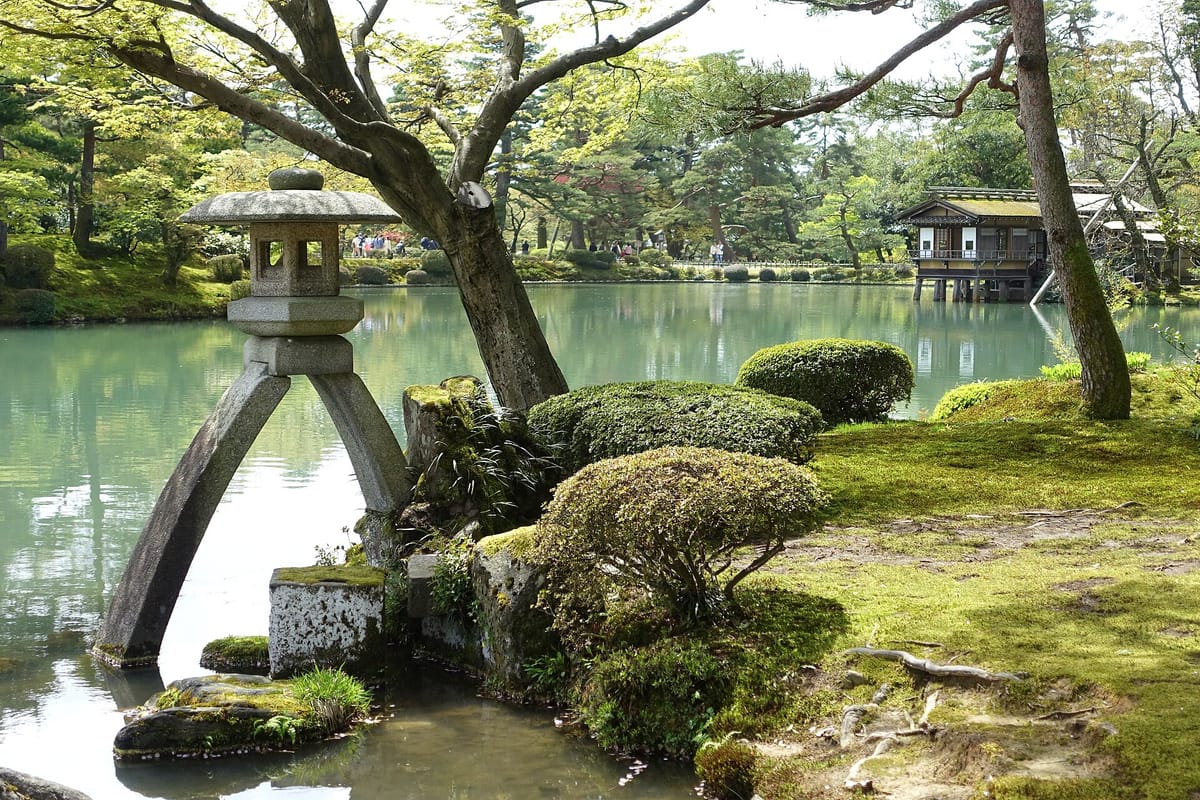
The heart of the garden is Kasumiga-ike, the largest pond, with a small island and a tea house built out over the water. On its northern shore stands the view that appears on almost every poster of Kanazawa: the Kotoji-tōrō, a stone lantern with two legs of different lengths, one in the water and one on the rocks, beside the little stone Niji-bashi, rainbow bridge. The shape is said to recall the bridge that holds up the strings of a koto, the Japanese harp.
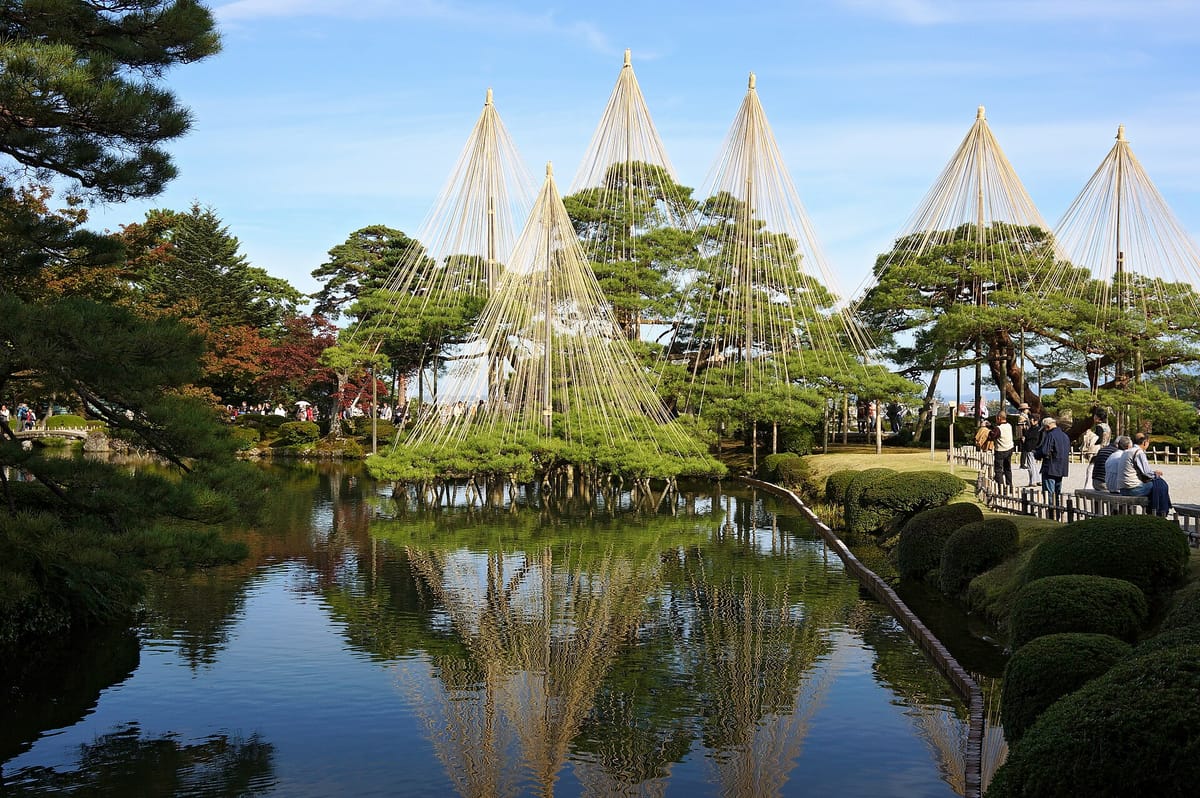
From early November, gardeners tie the branches of the larger pines to tall central poles with fans of rope. These cones, yukitsuri, protect the branches from the heavy, wet snow of the Hokuriku coast, and they have become the winter symbol of Kanazawa. The most famous is on the Karasaki pine beside Kasumiga-ike, grown from a seed of the celebrated pine at Karasaki on Lake Biwa.
- Kotoji-tōrō: the two-legged lantern on Kasumiga-ike, the garden's emblem.
- Kasumiga-ike: the largest pond, with Hōrai island and the Uchihashi-tei tea house.
- Karasaki-matsu: the Karasaki pine, planted by the thirteenth lord and the centrepiece of the yukitsuri.
- Neagari-no-matsu: a pine with its roots raised a metre or more above the ground.
- Funsui: a fountain driven only by the height of the water in Kasumiga-ike, often described as the oldest in Japan.
- Hisago-ike and Midori-taki: a gourd-shaped pond and waterfall in the quieter, older part of the garden.
- Shiguretei: a rebuilt tea house where you can sit and take matcha with a Japanese sweet.
- Seisonkaku: an elegant villa built by the thirteenth lord for his mother, next to the garden with its own entry fee.
Words on the garden signs
Kenroku-en's signposts are mostly name boards for its ponds, trees and tea houses, and they repeat a small set of kanji. 池 is pond, read ike, and turns up in Kasumiga-ike and Hisago-ike. 亭 is a pavilion or tea house, read tei, in Shiguretei and Uchihashi-tei. 松 is pine, and often turns into matsu at the end of a name.
The hardest name is also the most famous. 徽軫 is so rare that most Japanese visitors cannot read it without the furigana on the sign; it is read kotoji, the bridge of a koto, and 灯籠, tōrō, is a stone lantern. If you can read this one, you have done better than many native speakers.
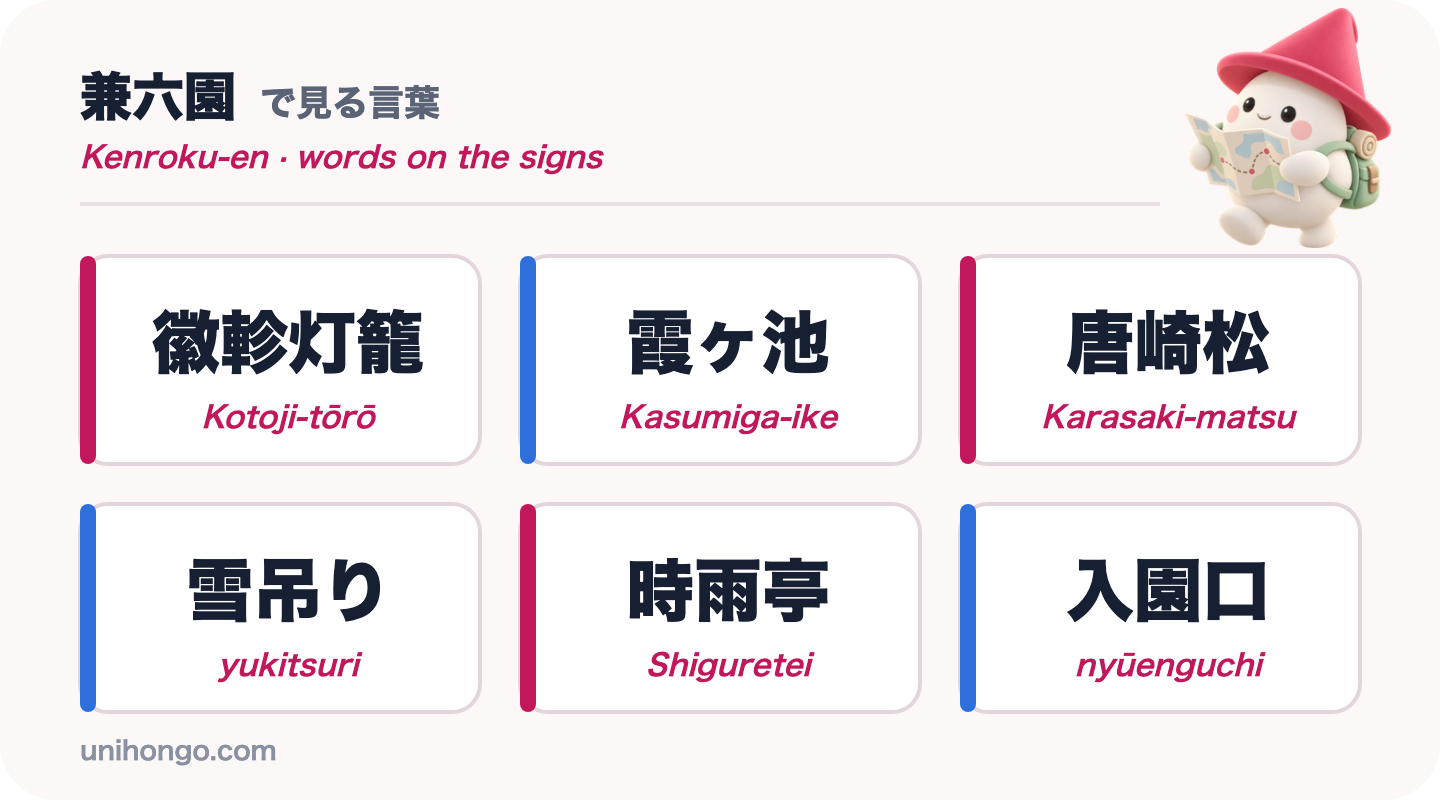
| Word | Reading | Meaning |
|---|---|---|
| 兼六園 | Kenroku-en | The garden that combines six qualities |
| 徽軫灯籠 | Kotoji-tōrō | The two-legged Kotoji lantern |
| 霞ヶ池 | Kasumiga-ike | The largest pond, literally misty pond |
| 唐崎松 | Karasaki-matsu | The Karasaki pine |
| 雪吊り | yukitsuri | Rope cones that protect trees from snow |
| 時雨亭 | Shiguretei | Tea house serving matcha and sweets |
| 入園口 | nyūenguchi | Garden entrance |
| 出口 | deguchi | Exit |
| 入園料 | nyūenryō | Admission fee |
Japanese for the ticket window and the tea house
At the gate you buy a ticket at the ticket window, the kippu uriba or uketsuke. The official site says admission is paid in cash, so keep coins ready. Inside, the Shiguretei tea house serves matcha with a seasonal Japanese sweet, and the staff will show you where to sit. You are not expected to know tea ceremony rules; a polite request and a thank you are enough.
When the tea arrives, eat the sweet first, then lift the bowl with both hands and drink. If the front of the bowl, with its most attractive side, faces you, turn it a little before drinking so that your lips do not touch it. Staff do not expect visitors to know this, so it is a nice touch rather than a rule.
| Japanese | Romaji | Meaning |
|---|---|---|
| 大人一枚お願いします。 | Otona ichimai onegai shimasu. | One adult ticket, please. |
| 現金だけですか。 | Genkin dake desu ka. | Is it cash only? |
| 英語の地図はありますか。 | Eigo no chizu wa arimasu ka. | Do you have a map in English? |
| 徽軫灯籠はどちらですか。 | Kotoji-tōrō wa dochira desu ka. | Which way is the Kotoji lantern? |
| お抹茶とお菓子をお願いします。 | O-matcha to o-kashi o onegai shimasu. | Matcha and a sweet, please. |
| 正座しなくても大丈夫ですか。 | Seiza shinakute mo daijōbu desu ka. | Is it all right if I do not sit in seiza? |
| 写真を撮っていただけますか。 | Shashin o totte itadakemasu ka. | Could you take a photo for me? |
| ごちそうさまでした。 | Gochisōsama deshita. | Thank you for the tea and sweet. |
Etiquette, seasons and practical tips
Kenroku-en is calm and well kept, and the rules are simple. The official site asks visitors not to smoke and not to bring pets, and the gardeners work hard to keep the moss and the lawns in shape.
- Stay on the paths and do not step on the moss or climb on the stones for photos.
- Do not feed the carp in the ponds or throw anything into the water.
- Come early for free entry: the Renchi-mon and Zuishinzaka entrances open before regular hours, and early visitors are asked to leave shortly before the regular opening time.
- Walk across to Kanazawa Castle Park from the Katsurazaka entrance; the castle grounds are free to walk.
- In winter, paths can be icy after snow. Wear shoes with a good grip.
- The paths include slopes, but wheelchairs can be borrowed free of charge at the entrances.
Practise the visit before you go
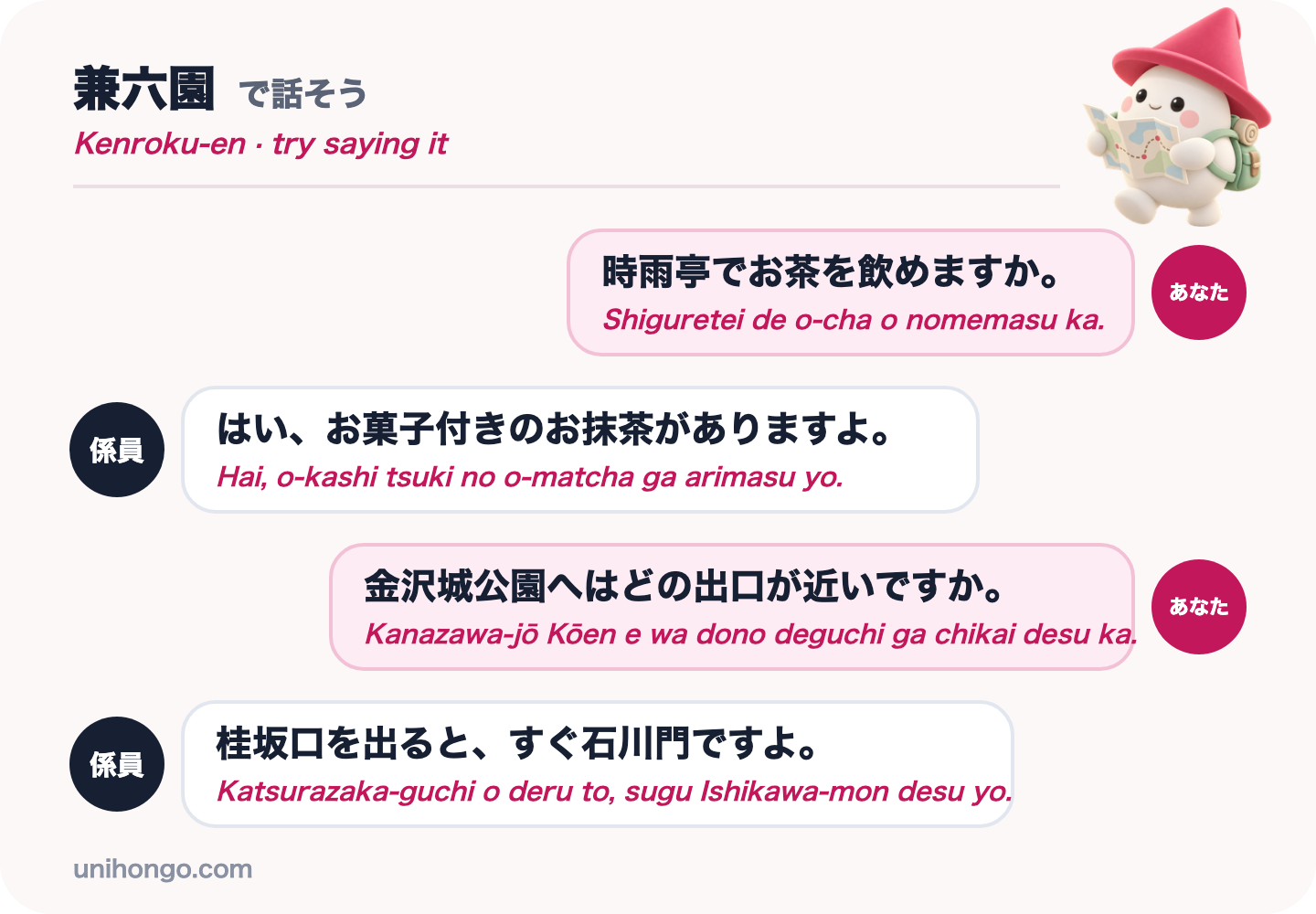
Two questions come up on almost every visit: can I have tea here, and which way to the castle? The attendant's answers below use the plain, friendly desu yo that garden staff use with visitors. Practise the four lines until you can say them without reading, and listen for the gate name in the reply.
Then practise with someone who answers back. In Unihongo, choose the Tea Ceremony topic and ask your AI Sensei to play the tea house host, or choose Directions to practise asking the way between the garden, the castle and the bus stop. The more often you say the lines out loud, the easier they come on the day.
| Japanese | Romaji | Meaning |
|---|---|---|
| 時雨亭でお茶を飲めますか。 | Shiguretei de o-cha o nomemasu ka. | Can I have tea at Shiguretei? |
| はい、お菓子付きのお抹茶がありますよ。 | Hai, o-kashi tsuki no o-matcha ga arimasu yo. | Yes, we have matcha served with a sweet. |
| 金沢城公園へはどの出口が近いですか。 | Kanazawa-jō Kōen e wa dono deguchi ga chikai desu ka. | Which exit is nearest to Kanazawa Castle Park? |
| 桂坂口を出ると、すぐ石川門ですよ。 | Katsurazaka-guchi o deru to, sugu Ishikawa-mon desu yo. | Go out of the Katsurazaka entrance and the Ishikawa Gate is right there. |
Official information
Regular hours, the early-morning free entry times, admission and the tea house hours are published by Ishikawa Prefecture, which manages the garden and Kanazawa Castle Park. Check the usage guide before you go, especially for evening light-ups and winter hours.