

Why the slopes below Kiyomizu-dera are worth slowing down for
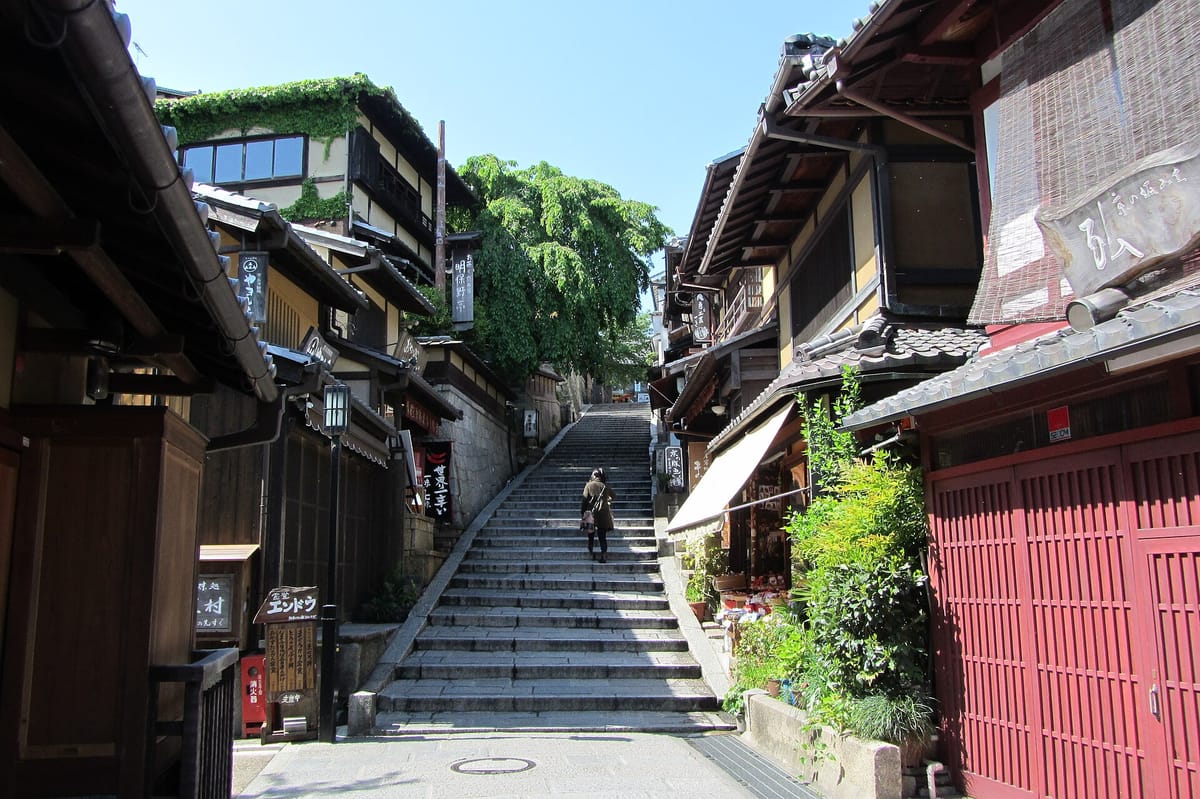
Most visitors pass through Sannenzaka and Ninenzaka on the way to or from Kiyomizu-dera, but the lanes deserve time of their own. They are among the few places in Kyoto where a whole streetscape survives: two-storey wooden houses with latticed fronts, tiled roofs, stone paving and stairways, and shopfronts that open straight onto the street. In 1976 the area was designated an Important Preservation District for Groups of Traditional Buildings, and later extended to include the quiet lane of Ishibe-kōji to the north, so new buildings and signs have to fit the old style.
Inside the houses is a living shopping street. You will find Kiyomizu-yaki pottery, fans and folding umbrellas, pickles, shichimi spice, incense, and Kyoto sweets such as yatsuhashi, plus tea houses with tatami rooms and small gardens behind the shopfront. A coffee chain even has a branch in a traditional townhouse on Ninenzaka, with a noren curtain instead of a sign.
For a Japanese learner, the slopes are a perfect practice ground. Every shop has someone ready to talk, the questions are simple and repeat from shop to shop, and the signs use a small set of everyday words.
Getting there: the bus, the Yasaka side and which way to walk
There is no station on the slopes. From Kyoto Station, city buses run up Higashiōji-dōri to the Kiyomizu-michi and Gojōzaka stops; from Kiyomizu-michi, walk uphill towards Kiyomizu-dera and Sannenzaka branches off to the left near the top. From Gion, walk south past Yasaka Jinja and Kōdai-ji along Nene-no-michi and climb to Ninenzaka from the Yasaka pagoda side, about fifteen to twenty minutes. Keihan Kiyomizu-Gojō and Gion-Shijō stations are each about twenty minutes on foot.
If you plan to visit the temple, climb to it first by the main approach and come down through the slopes: the steps of Sannenzaka are easier going down, and you end the day near Gion. If you only want the lanes, start from the Yasaka pagoda and walk up and back.
| Japanese | Romaji | Meaning |
|---|---|---|
| 清水道で降りればいいですか。 | Kiyomizu-michi de orireba ii desu ka. | Should I get off at Kiyomizu-michi? |
| 産寧坂はこの角を曲がるんですか。 | Sannenzaka wa kono kado o magaru n desu ka. | Do I turn at this corner for Sannenzaka? |
| 二寧坂の方へ下りたいんですが。 | Ninenzaka no hō e oritai n desu ga. | I would like to go down towards Ninenzaka. |
| 八坂の塔はこの道の先ですか。 | Yasaka no tō wa kono michi no saki desu ka. | Is the Yasaka pagoda further along this road? |
| ねねの道へはどう行けばいいですか。 | Nene no michi e wa dō ikeba ii desu ka. | How do I get to Nene-no-michi? |
Walking the slopes: what you will see
From the Kiyomizu approach, Sannenzaka drops steeply down stone steps, then bends between shops to its lower end, where Ninenzaka continues north with a few more steps and a gentler slope. At the bottom of Ninenzaka, the lanes open towards the five-storey Yasaka pagoda of Hōkan-ji, one of the classic views of Kyoto, and to the north begin the wide flagstones of Nene-no-michi, named after the widow of Toyotomi Hideyoshi, who founded Kōdai-ji nearby.
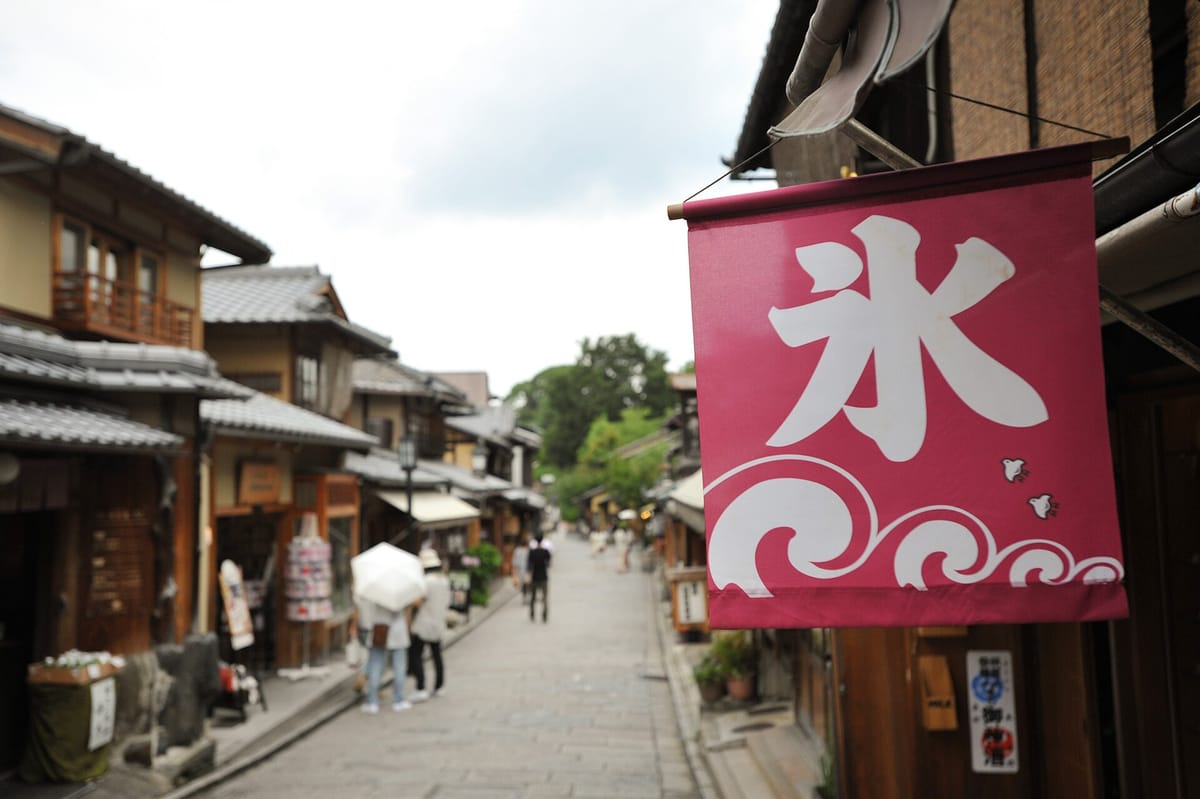
Look up as well as at the shop windows. Many houses keep their mushiko-mado, the slatted clay windows of the low upper floor, and inuyarai, curved bamboo screens at the base of the walls. Small signs, written vertically on wood, give each shop's name, and on hot days red and white banners with the single kanji 氷 announce shaved ice.
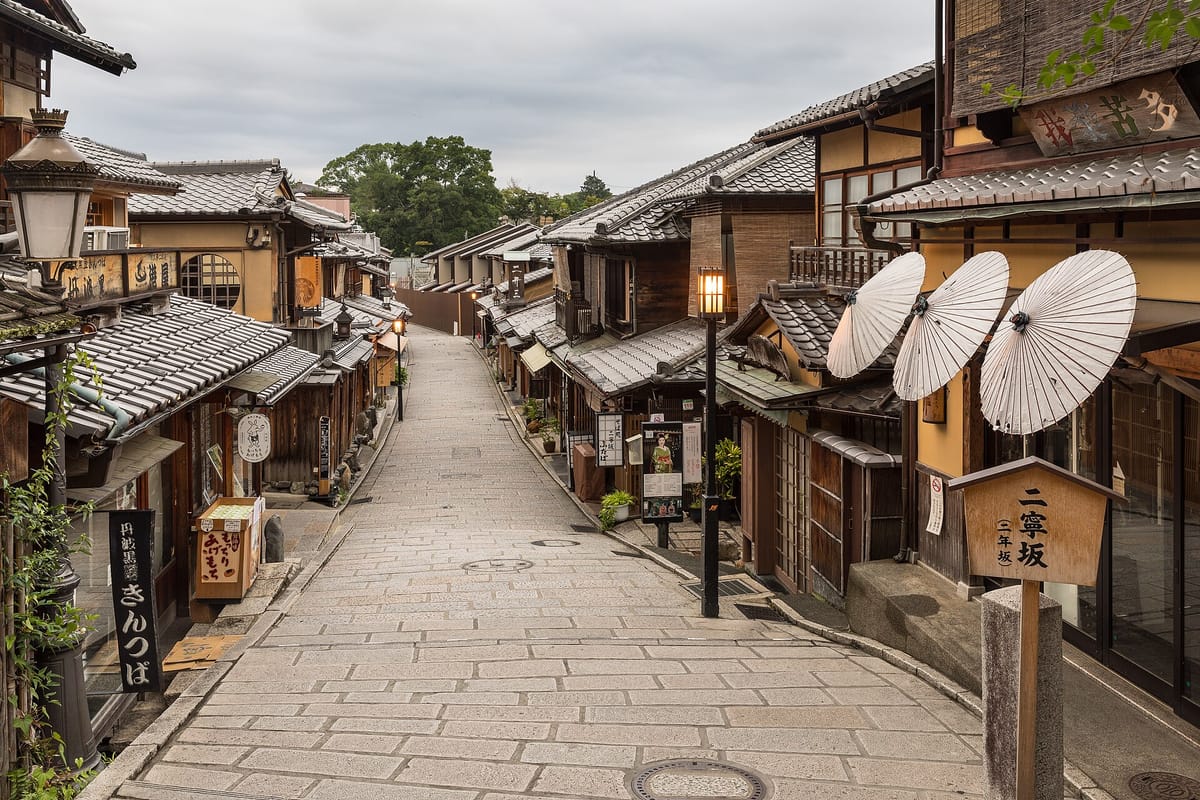
- Sannenzaka: the steep stepped slope just below the Kiyomizu approach.
- Gourd shops: hyōtan charms at the foot of the steps, against the three-year curse.
- Ninenzaka: the gentler continuation, with tea houses and sweet shops.
- Yasaka no tō: the five-storey pagoda of Hōkan-ji, seen from the lanes below Ninenzaka.
- Ishibe-kōji: a quiet stone-walled lane of inns and restaurants to the north.
- Nene-no-michi: the broad flagstone path towards Kōdai-ji and Maruyama Park.
Words on the signs along the slopes
The street names appear on wooden markers at each end, often in both spellings. 産寧 and 二寧 use the character 寧, peace or safety, while the everyday spellings 三年 and 二年 mean three years and two years. Both are read the same way, which is a nice example of Japanese place names choosing auspicious kanji for a familiar sound.
In the shops, look for 営業中, open for business, on the door, 試食, tasting, beside samples, and the eating rule, usually 食べ歩き禁止 or a politer request. The sweet you will see everywhere is 八ツ橋, yatsuhashi, made from rice flour and cinnamon; the soft, unbaked version 生八ツ橋 comes folded round sweet bean paste.
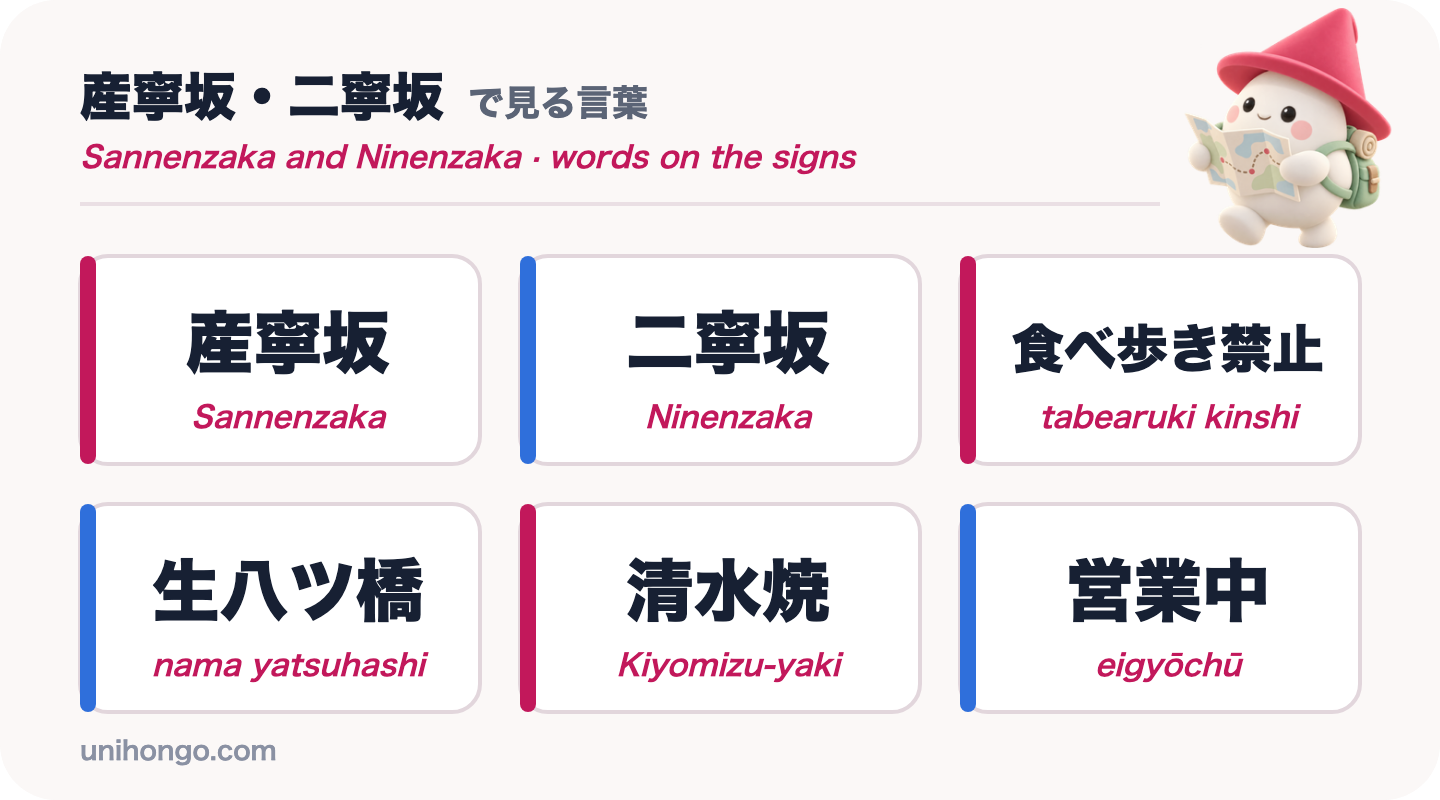
| Word | Reading | Meaning |
|---|---|---|
| 産寧坂 | Sannenzaka | The slope of safe childbirth, also written 三年坂 |
| 二寧坂 | Ninenzaka | The slope below it, also written 二年坂 |
| 食べ歩き禁止 | tabearuki kinshi | No eating while walking |
| 生八ツ橋 | nama yatsuhashi | Soft cinnamon rice sweet filled with bean paste |
| 清水焼 | Kiyomizu-yaki | Kyoto pottery named after this area |
| 営業中 | eigyōchū | Open for business |
| 試食 | shishoku | Free tasting sample |
| 撮影禁止 | satsuei kinshi | No photography, often inside shops |
| 氷 | kōri | Shaved ice, on summer banners |
Japanese for shopping and tasting on the slopes
Shopping on the slopes is relaxed and polite. Staff greet you with irasshaimase and will not expect a reply, but a nod or a smile helps. Samples are often set out for you to try; it is fine to taste and leave, though a quick arigatō gozaimasu is appreciated.
Because many shops ask you not to eat while walking, a key phrase is whether you can eat here. Some shops have a bench or a small counter; others will point you to their tea room. For pottery and fragile goods, ask for wrapping, and for food gifts ask how long they keep.
| Japanese | Romaji | Meaning |
|---|---|---|
| ここで食べてもいいですか。 | Koko de tabete mo ii desu ka. | May I eat it here? |
| 中で食べられる席はありますか。 | Naka de taberareru seki wa arimasu ka. | Is there somewhere to sit and eat inside? |
| 試食してもいいですか。 | Shishoku shite mo ii desu ka. | May I try a sample? |
| これは清水焼ですか。 | Kore wa Kiyomizu-yaki desu ka. | Is this Kiyomizu-yaki? |
| 割れ物なので、しっかり包んでください。 | Waremono na node, shikkari tsutsunde kudasai. | It is fragile, so please wrap it well. |
| お店の中の写真を撮ってもいいですか。 | O-mise no naka no shashin o totte mo ii desu ka. | May I take photos inside the shop? |
Etiquette, crowds and timing
The slopes are narrow, steep in places and very busy, and people live and work in the houses. A few habits make the walk better for everyone.
- Follow the eating rules: buy, eat at the shop, then walk on, and carry your rubbish until you find a bin.
- Ask before photographing inside shops or photographing staff, and keep doorways clear when you stop for pictures.
- Watch your step on the Sannenzaka stairs, especially in the rain and in rented sandals.
- Keep to one side on the steps so people can pass in both directions.
- Come early for photos and quiet lanes; by late morning the slopes are crowded, especially at weekends.
- Expect most shops to close by early evening; the lanes are pleasant after dark but there is little open.
Practise the sweet shop before you go
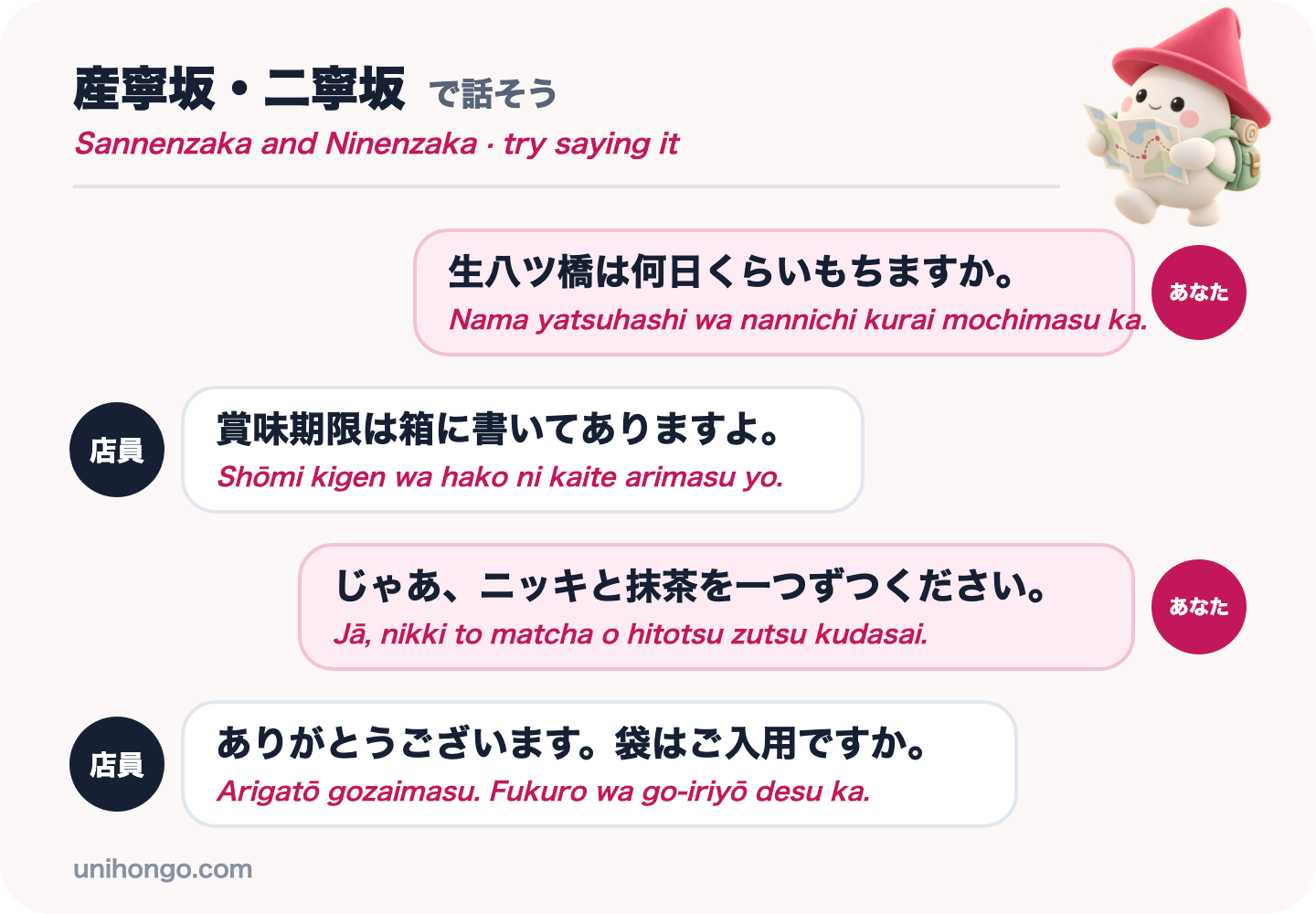
Buying nama yatsuhashi is the most typical shop conversation on the slopes. You ask how long it keeps, the assistant points you to the date on the box, you choose flavours, and you are asked whether you need a bag. Listen for shōmi kigen, best-before date, and go-iriyō, which is the polite way to ask whether you need something.
Say the four lines aloud until you can do it without reading, then practise with a partner who can vary the flavours and questions. In Unihongo, choose the Shopping topic and ask your AI Sensei to play a shop assistant on Ninenzaka, or choose Cultural Etiquette to rehearse asking where you can eat. A short answer such as hai, onegai shimasu or daijōbu desu to the bag question is all you need.
| Japanese | Romaji | Meaning |
|---|---|---|
| 生八ツ橋は何日くらいもちますか。 | Nama yatsuhashi wa nannichi kurai mochimasu ka. | About how many days does the nama yatsuhashi keep? |
| 賞味期限は箱に書いてありますよ。 | Shōmi kigen wa hako ni kaite arimasu yo. | The best-before date is written on the box. |
| じゃあ、ニッキと抹茶を一つずつください。 | Jā, nikki to matcha o hitotsu zutsu kudasai. | Then one cinnamon and one matcha, please. |
| ありがとうございます。袋はご入用ですか。 | Arigatō gozaimasu. Fukuro wa go-iriyō desu ka. | Thank you. Do you need a bag? |
Official information
Sannenzaka and Ninenzaka are public streets, so there are no hours or tickets, but Kyoto City's official travel guide covers the Higashiyama area, seasonal events and manners for visitors. Check it before you go.