

Why Sumiyoshi Taisha is Osaka's great shrine
Sumiyoshi Taisha is the head shrine of the Sumiyoshi gods, three brother deities of the sea known together as the Sumiyoshi Sanjin, and of Empress Jingū, who according to legend enshrined them here. Its founding is dated by tradition to 211. When this was still the shore of Osaka Bay, sailors and envoys to China prayed here before setting out, and the shrine became a guardian of voyages, of waka poetry and, in merchant Osaka, of business.
Its greatest treasure is its architecture. The four main halls, rebuilt in 1810 on the ancient pattern, are National Treasures in a style called Sumiyoshi-zukuri: straight gabled roofs of cypress bark, vermilion posts and white walls, with no curves or Buddhist influence. It is one of the oldest shrine styles in Japan, and seeing it helps you understand why Japanese shrines look the way they do.
For a learner, Sumiyoshi is quieter and more local than the big Kyoto shrines. Families come for children's blessings, office workers for business, and you will hear Osaka people call it Sumiyossan, a friendly Kansai contraction of Sumiyoshi-san.
Getting there: Nankai trains and the Hankai tram
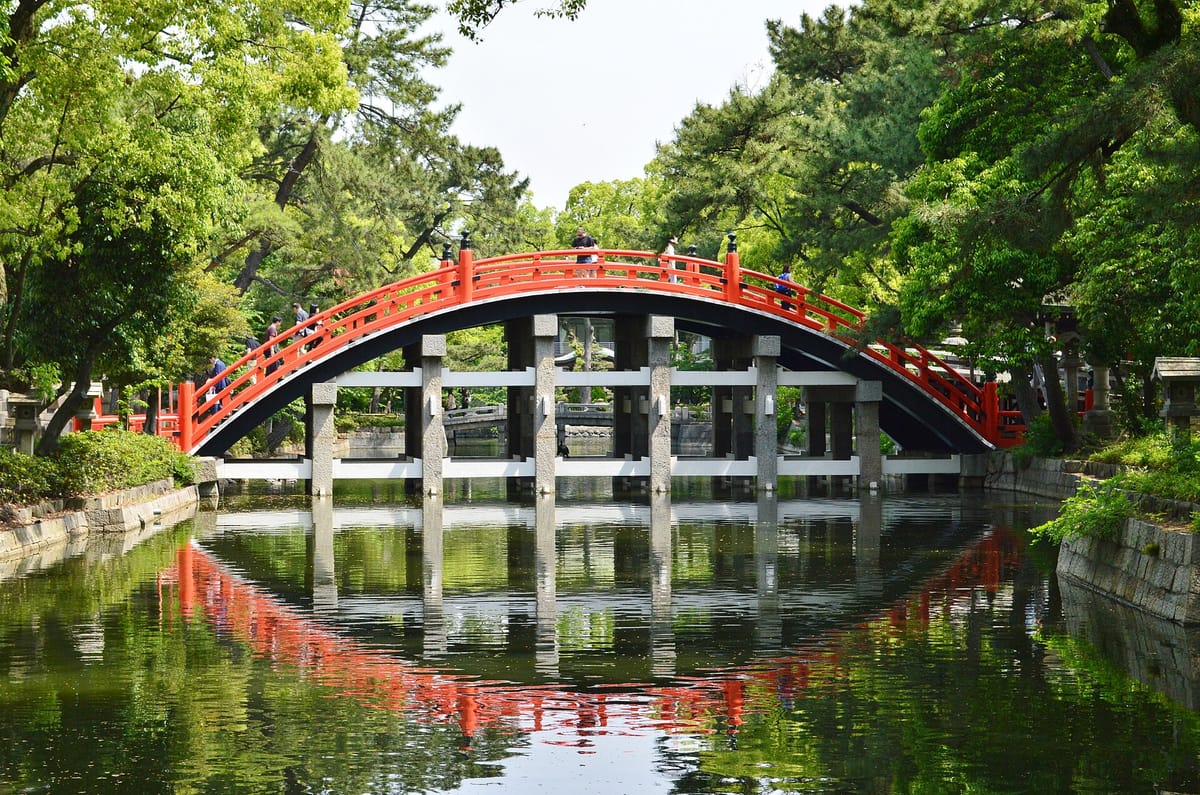
Sumiyoshitaisha Station on the Nankai Main Line is the usual approach. From Nankai Namba it takes around ten to fifteen minutes by local train; check that your train stops there, since faster services pass through. From the station, walk east for a few minutes and you reach the shrine's western entrance and the Sorihashi bridge.
The more charming route is the Hankai tram, Osaka's last streetcar line, which runs from Tennōji Ekimae and from Ebisuchō down to Sakai. Get off at Sumiyoshi-toriimae, in front of the great torii, and the shrine is right there. Nankai's Kōya Line also stops at Sumiyoshi-higashi, a slightly longer walk from the east.
| Japanese | Romaji | Meaning |
|---|---|---|
| 住吉大社駅に止まりますか。 | Sumiyoshitaisha-eki ni tomarimasu ka. | Does this stop at Sumiyoshitaisha Station? |
| 各駅停車は何番線ですか。 | Kakueki teisha wa nanbansen desu ka. | Which platform is the all-stations train? |
| 住吉大社はどちらですか。 | Sumiyoshi Taisha wa dochira desu ka. | Which way is Sumiyoshi Taisha? |
| この路面電車は住吉鳥居前に行きますか。 | Kono romen densha wa Sumiyoshi-toriimae ni ikimasu ka. | Does this tram go to Sumiyoshi-toriimae? |
| ICカードで乗れますか。 | IC kādo de noremasu ka. | Can I ride with an IC card? |
From the Sorihashi to the four main halls: what you will see
Enter from the west and the first thing you meet is the Sorihashi, the arched bridge over a pond. The curve is so steep that the steps are set into the slope like the rungs of a ladder; take it slowly and use the railing. On the far side, rinse your hands at the temizuya and walk on to the main halls.
The four halls, the hongū, are arranged unusually. The first, second and third stand one behind another in a straight line, and the fourth stands beside the third, a layout often compared to a fleet of ships sailing west. Pray at each: the first three are for the three Sumiyoshi gods and the fourth for Empress Jingū. Rabbits appear all over the grounds, from charms and ema to the nade-usagi, a rabbit statue near the fourth hall that visitors stroke for good health, because the shrine dates its founding to a year, month and day of the rabbit.
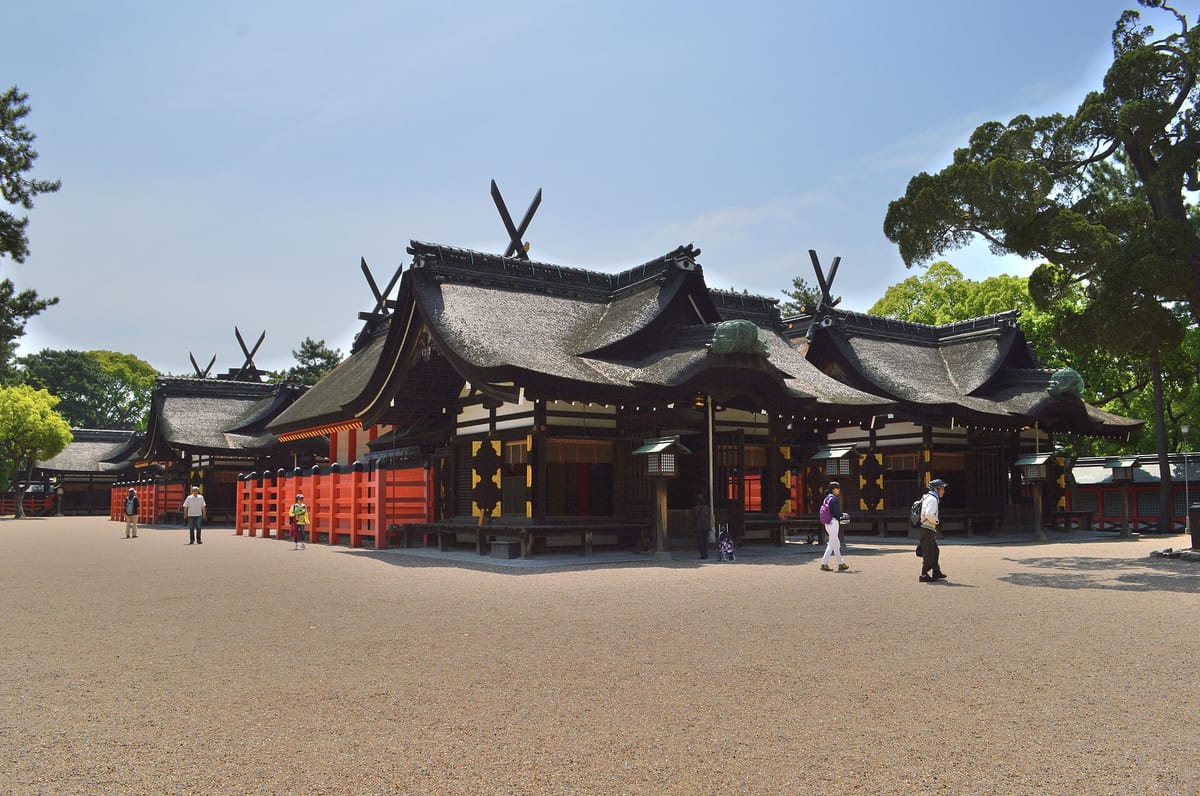
- Sorihashi: the steep vermilion arched bridge over the pond.
- Temizuya: the water basin for purifying your hands and mouth, where the water pours from a stone rabbit.
- Dai-ichi to Dai-yon Hongū: the four National Treasure main halls.
- Gosho Gozen: the sacred enclosure where you search for the godairiki stones.
- Tanekashi-sha, Nankun-sha, Asazawa-sha and Ōtoshi-sha: the four smaller shrines visited in order on hatsutatsu days.
- Stone lanterns: hundreds of them, many donated by merchants and shipping businesses over the centuries.
- Otaue paddy field: the shrine's rice field, used for the planting ritual in June.
Words on the shrine signs
Shrine signs use a small set of kanji again and again. 本宮, hongū, is a main hall, and the four halls are numbered 第一本宮 to 第四本宮, daiichi to daiyon hongū; 第, dai, turns a number into an order, first, second, third. 授与所, juyosho, is the office where charms and goshuin are given out.
At the Gosho Gozen, a small sign explains the godairiki custom. Look for the characters 五, 大 and 力 in the text: they are the same ones you are searching for on the pebbles.
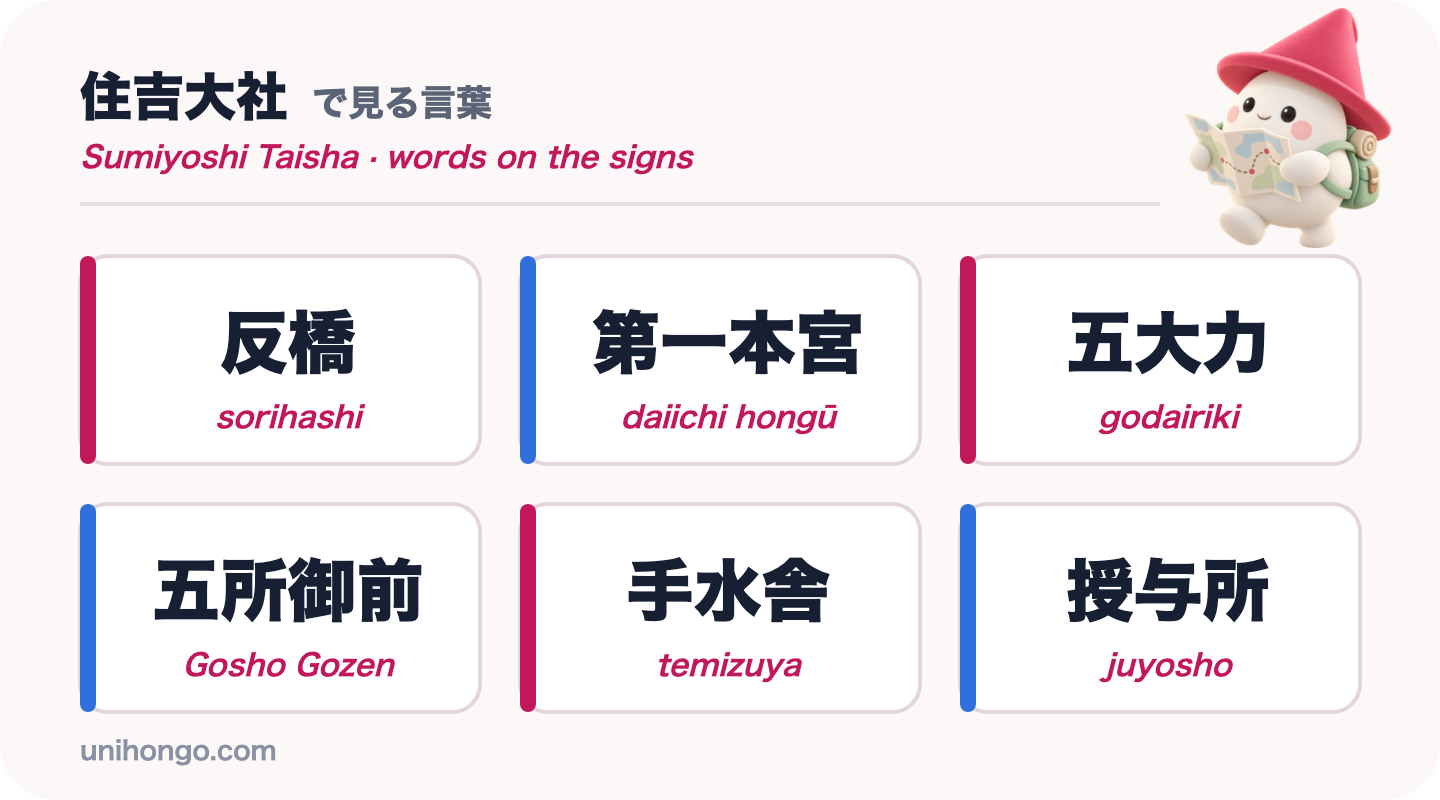
| Word | Reading | Meaning |
|---|---|---|
| 住吉大社 | Sumiyoshi Taisha | Sumiyoshi Grand Shrine |
| 反橋 | sorihashi | The arched bridge |
| 第一本宮 | daiichi hongū | First main hall |
| 手水舎 | temizuya | Water basin for purification |
| 五所御前 | Gosho Gozen | The sacred enclosure where the stones are found |
| 五大力 | godairiki | The five great powers, on the lucky stones |
| 授与所 | juyosho | Office for charms and goshuin |
| 初辰 | hatsutatsu | First Day of the Dragon of the month |
| お守り | o-mamori | Protective charm |
Japanese for the shrine office, goshuin and the godairiki stones
The stones are the fun part. At the Gosho Gozen, visitors crouch at the fence searching through the gravel for three small pebbles inscribed with 五, 大 and 力. When you find one of each, you can keep them in a small bag available at the juyosho as a charm. Tradition says that if your wish comes true, you return the stones along with a second set that you have written yourself.
The shrine office is also where you ask for a goshuin, the calligraphy stamp collectors gather in a book, and where you choose an omamori. As at other shrines, receiving a charm is spoken of politely: itadakemasu ka, may I receive, rather than kaemasu ka, can I buy.
| Japanese | Romaji | Meaning |
|---|---|---|
| 御朱印をお願いできますか。 | Goshuin o onegai dekimasu ka. | Could I ask for a goshuin? |
| 御朱印帳を持っていないんですが。 | Goshuinchō o motte inai n desu ga. | I don't have a goshuin book, though. |
| 旅行安全のお守りはどれですか。 | Ryokō anzen no o-mamori wa dore desu ka. | Which charm is for safe travel? |
| このうさぎのお守りをいただけますか。 | Kono usagi no o-mamori o itadakemasu ka. | May I have this rabbit charm? |
| おみくじを引いてもいいですか。 | Omikuji o hiite mo ii desu ka. | May I draw a fortune? |
| 石を見つけました。これでいいですか。 | Ishi o mitsukemashita. Kore de ii desu ka. | I found the stones. Are these right? |
Etiquette, timing and practical tips
Sumiyoshi is a living shrine used every day by local people, and a few habits show respect.
- Bow once at the torii, and walk to the side of the path rather than the centre.
- Cross the Sorihashi slowly and hold the railing; it is steep and can be slippery after rain.
- At each main hall, bow twice, clap twice, pray and bow once more.
- Search for the stones gently and leave the others you do not keep where you found them.
- Do not photograph ceremonies or people praying up close.
- Avoid the first days of January unless you want the full hatsumōde crowd.
Practise the stone hunt before you go
This exchange is the one you are most likely to need at Sumiyoshi. Sagasemasu ka, can I search?, is the can-do form of sagasu, to look for. The attendant's reply uses the humble-polite o-uke itadakemasu, you may receive it, which is how shrine staff talk about charms.
Then practise with a partner. In Unihongo, choose the Shrine Visit topic and ask your AI Sensei to play a shrine attendant at Sumiyoshi Taisha, answering at natural speed. Ask about the stones, the charm bag, a goshuin and the right way to pray, and you will arrive having said it all once already.
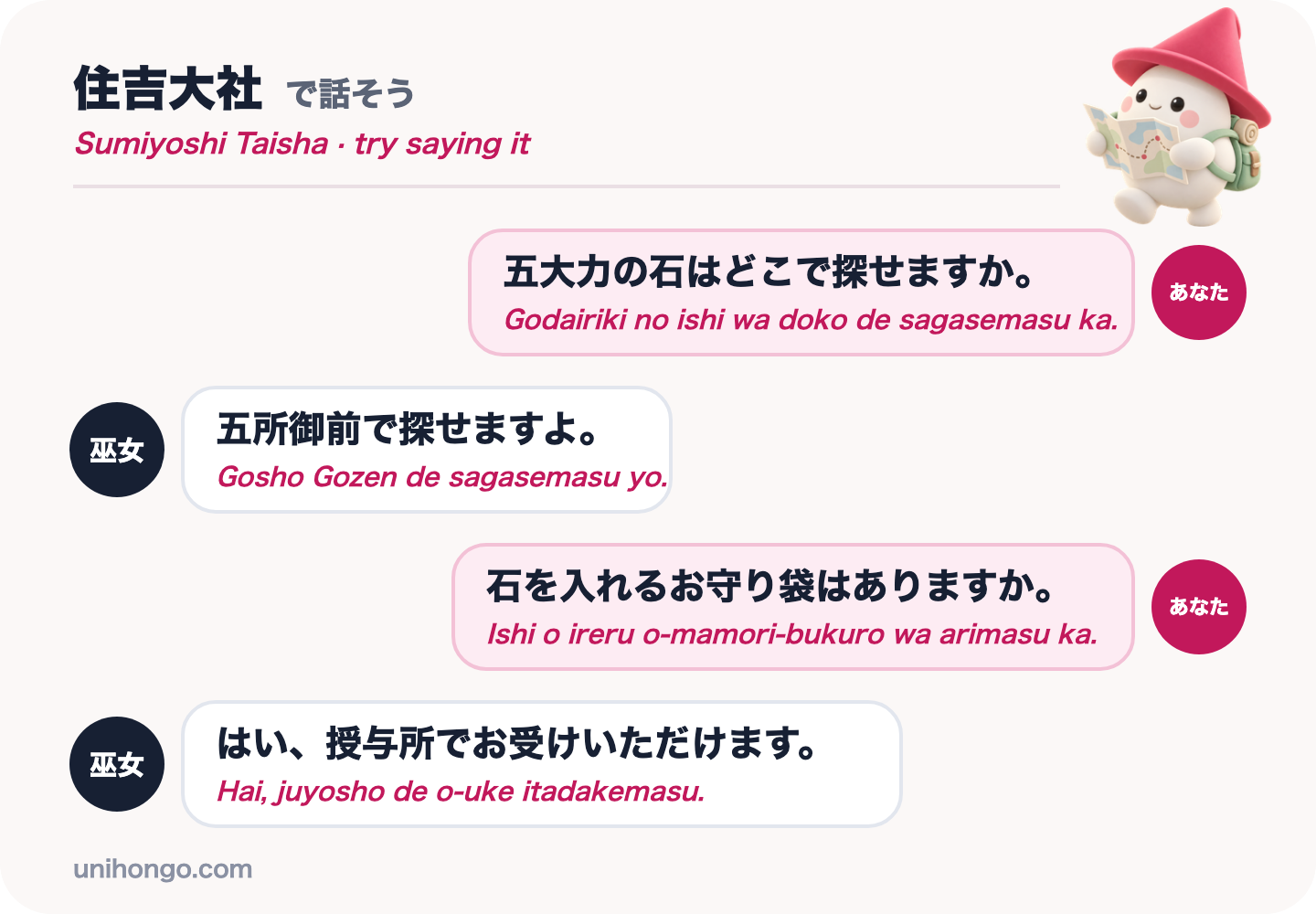
| Japanese | Romaji | Meaning |
|---|---|---|
| 五大力の石はどこで探せますか。 | Godairiki no ishi wa doko de sagasemasu ka. | Where can I search for the godairiki stones? |
| 五所御前で探せますよ。 | Gosho Gozen de sagasemasu yo. | You can search at the Gosho Gozen. |
| 石を入れるお守り袋はありますか。 | Ishi o ireru o-mamori-bukuro wa arimasu ka. | Is there a charm bag to keep the stones in? |
| はい、授与所でお受けいただけます。 | Hai, juyosho de o-uke itadakemasu. | Yes, you can receive one at the shrine office. |
Official information
The shrine's English site covers its history, the main halls, the festivals and access. Check it before you go for festival dates and any closures of parts of the grounds.