
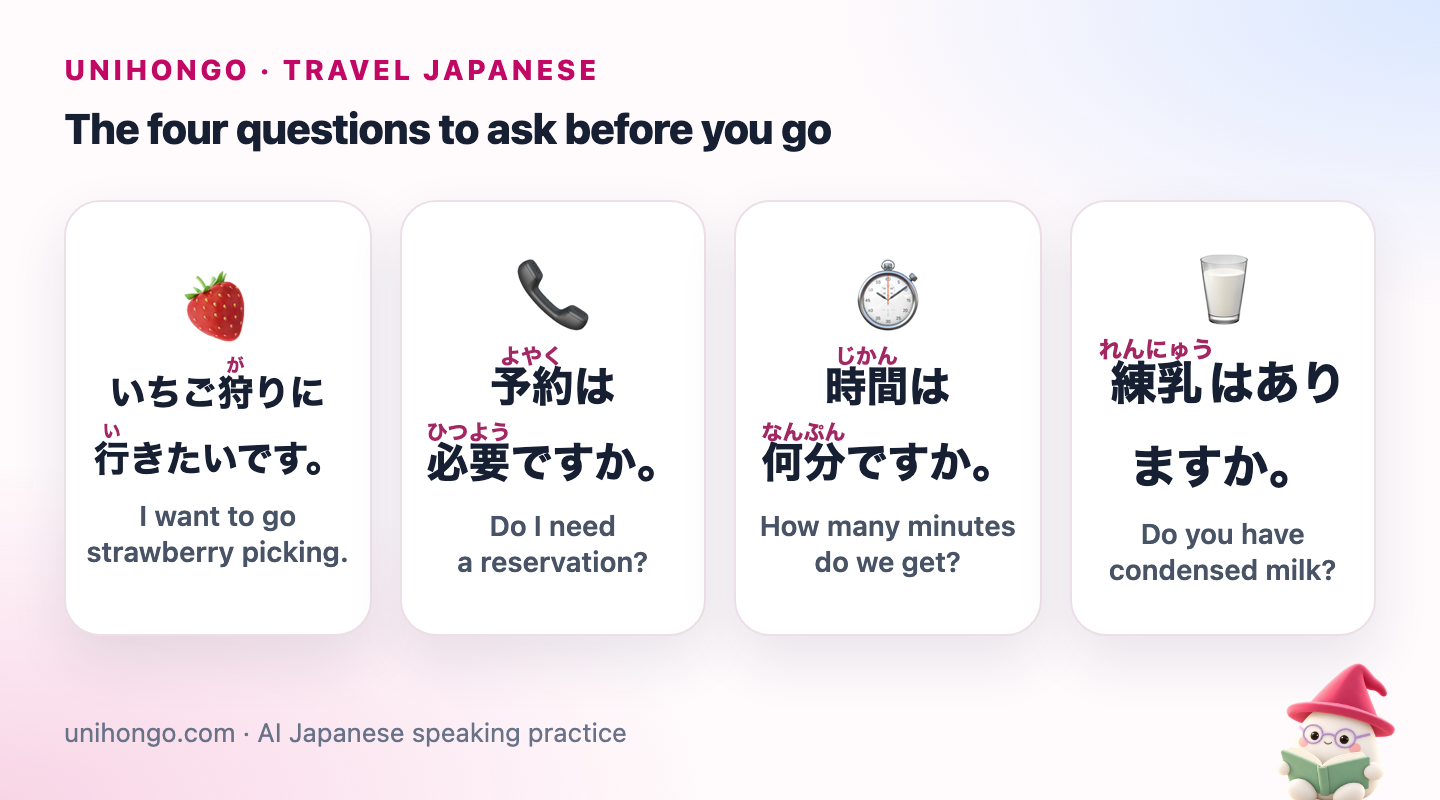
The four questions to ask before you go
Most of what you need to know about a strawberry farm can be found with four short questions. Ask them on the phone or at the entrance. Gari (狩り) literally means hunting, and it is used for seasonal picking outings: ichigo-gari for strawberries, budō-gari for grapes, mikan-gari for mandarins.
| Japanese | Romaji | Meaning |
|---|---|---|
| いちご狩りに行きたいです。 | Ichigo-gari ni ikitai desu. | I want to go strawberry picking. |
| 予約は必要ですか。 | Yoyaku wa hitsuyō desu ka. | Do I need a reservation? |
| 時間は何分ですか。 | Jikan wa nanpun desu ka. | How many minutes do we get? |
| 練乳はありますか。 | Rennyū wa arimasu ka. | Do you have condensed milk? |
Key words: the season, the system and the farm
Strawberries in Japan are mostly grown in greenhouses, so the picking season starts in winter. It runs roughly from January to May, though some farms open in December and some continue into June, depending on the region and the weather. Prices often change through the season, and farms may close for the day as soon as the ripe berries are gone.
| Japanese | Reading | Meaning |
|---|---|---|
| いちご狩り | ichigo-gari | Strawberry picking |
| 時間制食べ放題 | jikan-sei tabehōdai | All you can eat within a time limit |
| ビニールハウス | binīru hausu | Plastic greenhouse |
| 品種 | hinshu | Variety |
| ヘタ | heta | The green top of the strawberry |
| 持ち帰り | mochikaeri | Taking some home |
| なくなり次第終了 | nakunari shidai shūryō | Closes when the berries run out |
Japan grows many named strawberry varieties, and prefectures often develop their own. A farm may grow several side by side, which is a good excuse for a conversation: kono hinshu wa nan desu ka, what variety is this?
Booking by phone: a mini dialogue
Phone bookings follow a fixed pattern: you say what you want, the farm asks the date, the number of people and the time. Children are often counted separately from adults, so say both.
| Japanese | Romaji | Meaning |
|---|---|---|
| もしもし、いちご狩りの予約をしたいんですが。 | Moshimoshi, ichigo-gari no yoyaku o shitai n desu ga. | Caller: Hello, I'd like to book strawberry picking. |
| ありがとうございます。何日がご希望ですか。 | Arigatō gozaimasu. Nannichi ga go-kibō desu ka. | Farm: Thank you. Which day would you like? |
| 今度の土曜日は空いていますか。 | Kondo no doyōbi wa aite imasu ka. | Caller: Do you have space this Saturday? |
| はい。何名様ですか。 | Hai. Nanmei-sama desu ka. | Farm: Yes. How many people? |
| 大人二人と子ども一人です。 | Otona futari to kodomo hitori desu. | Caller: Two adults and one child. |
| では、十時からでよろしいですか。 | Dewa, jūji kara de yoroshii desu ka. | Farm: Then, would ten o'clock suit you? |
| はい、お願いします。 | Hai, onegai shimasu. | Caller: Yes, please. |
At the greenhouse: what staff tell you
At the entrance you pay, receive a small cup or tray and hear a short explanation of the rules. Staff often show how to pick: hold the stalk or the green top and snap the berry off upwards, rather than pulling. The cup is for the green tops and, sometimes, a little condensed milk. Then you are free to walk the rows until the time is up.

| Japanese | Romaji | Meaning |
|---|---|---|
| ヘタはこのカップに入れてください。 | Heta wa kono kappu ni irete kudasai. | Staff: Please put the green tops in this cup. |
| 上に折るように取ってください。 | Ue ni oru yō ni totte kudasai. | Staff: Pick them by snapping them upwards. |
| 赤いのを選んでくださいね。 | Akai no o erande kudasai ne. | Staff: Choose the red ones, okay? |
| ハウスの中で食べてください。 | Hausu no naka de tabete kudasai. | Staff: Please eat inside the greenhouse. |
| どれが甘いですか。 | Dore ga amai desu ka. | Which ones are sweet? |
| ヘタはどこに捨てますか。 | Heta wa doko ni sutemasu ka. | Where do I throw away the tops? |
Getting there and what to bring
Many strawberry farms are in the countryside, often easiest to reach by car, though some near cities have a bus stop or a station within walking distance. Popular farms can be fully booked on weekends in spring, and some open bookings only a short time ahead, so check early. On busy days the ripe berries can run out by midday, which is why farms say nakunari shidai shūryō: closed once they run out.
Greenhouses are warm, even on a cold day, so wear layers you can take off. Bring a small towel or wet wipes for sticky hands, and leave large bags in the car or at the reception if there is space. If you want to buy strawberries to take home, a cool bag helps on a long drive.
| Japanese | Romaji | Meaning |
|---|---|---|
| 駅から歩けますか。 | Eki kara arukemasu ka. | Can I walk from the station? |
| 駐車場はありますか。 | Chūshajō wa arimasu ka. | Is there a car park? |
| 今日はまだやっていますか。 | Kyō wa mada yatte imasu ka. | Are you still open today? |
| 荷物はどこに置けばいいですか。 | Nimotsu wa doko ni okeba ii desu ka. | Where should I leave my bags? |
Farm rules and manners
| Japanese | Romaji | Meaning |
|---|---|---|
| 持ち帰りはできますか。 | Mochikaeri wa dekimasu ka. | Can I take some home? |
| この品種は何ですか。 | Kono hinshu wa nan desu ka. | What variety is this? |
| あと何分ですか。 | Ato nanpun desu ka. | How many minutes are left? |
- Eat only inside the greenhouse during your time. Putting berries in a bag or pocket to take out is not allowed.
- If you want to take some home, buy a pack: ask mochikaeri wa dekimasu ka.
- Pick only what you will eat, and choose ripe, red berries. Half-eaten or unripe berries left on the plants are wasted.
- Stay on the paths, do not touch other rows unless staff say so, and keep an eye on children.
- Follow the farm's hygiene rules; some ask you to wash or sanitise your hands before entering.
Talking about the taste
Japanese visitors talk about strawberries in detail: sweetness, sourness, juiciness and size. The words are simple and useful well beyond the farm, at any fruit shop or market. Compare two berries with motto (more) and chotto (a little), and you have a real conversation with the people around you.
| Japanese | Romaji | Meaning |
|---|---|---|
| こっちの方が甘いです。 | Kotchi no hō ga amai desu. | This one is sweeter. |
| ちょっと酸っぱいですね。 | Chotto suppai desu ne. | It's a little sour, isn't it? |
| ジューシーですね。 | Jūshī desu ne. | It's so juicy. |
| 香りがいいですね。 | Kaori ga ii desu ne. | It smells wonderful. |
Kotchi no hō ga (this one, more) is the casual way to compare; in a careful, polite setting you might hear kochira no hō ga instead.
Reacting and common mistakes
Strawberry picking is a chance to use reaction words. Amai! (sweet!), oishii! and ōkii! (big!) are what you will hear from Japanese visitors around you, and staff enjoy hearing them too.
| Japanese | Romaji | Meaning |
|---|---|---|
| 甘い! | Amai! | So sweet! |
| 大きいですね! | Ōkii desu ne! | It's big, isn't it! |
| もうお腹いっぱいです。 | Mō onaka ippai desu. | I'm already full. |
| ごちそうさまでした。とてもおいしかったです。 | Gochisōsama deshita. Totemo oishikatta desu. | Thank you for the treat. They were delicious. |
- Saying ichigo o toritai for picking. It is understandable, but ichigo-gari ni ikitai is the natural phrase for the outing.
- Arriving late. Time slots are fixed, so a late start may simply shorten your time.
- Assuming the season is the same everywhere. Ask the farm directly.
- Forgetting the counters: futari and hitori for people, but sanjuppun for thirty minutes.