

Why Shibuya Crossing is worth seeing for yourself
Shibuya Crossing works like any other scramble intersection: the car lights all turn red at once, and for a short time pedestrians can cross in every direction, including diagonally across the middle. What makes it famous is the scale. Several streets meet here in front of one of the busiest stations in Tokyo, the buildings around it are covered in giant video screens, and at peak times the whole junction fills and empties in the space of one light cycle.
It is also the front door to Shibuya, the district that has shaped Japanese youth fashion and music for decades. From the crossing, Center Gai leads into a maze of shops, game centres and cheap restaurants, Kōen-dōri climbs towards Shibuya Parco, and the rebuilt area around the station has added new towers with shopping, restaurants and observation decks.
For a Japanese learner, the station itself is the challenge. It is served by many lines, it has been under redevelopment for years, and corridors and exits move as the work goes on. Reading the exit signs and asking one clear question is often faster than following a map.
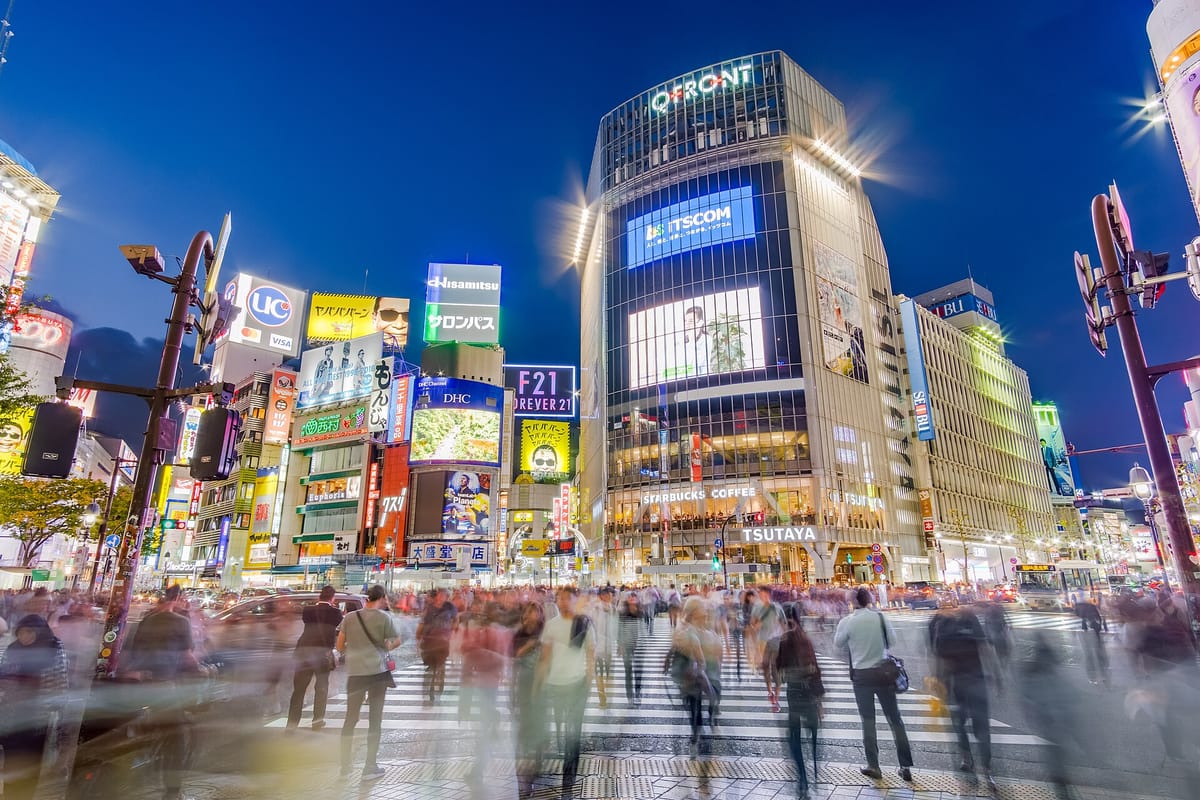
Getting there: finding the Hachikō exit
Shibuya Station is served by the JR Yamanote, Saikyō and Shōnan-Shinjuku lines, the Tokyo Metro Ginza, Hanzōmon and Fukutoshin lines, the Tokyu Tōyoko and Den-en-toshi lines, and the Keiō Inokashira Line. The crossing is right outside the JR station's Hachikō exit, ハチ公口, and that is the sign to follow from almost anywhere in the building. Coming from the subway, look for exits signed for the Hachikō side or the scramble crossing; the underground passages lead up to street level close to it.
Because the redevelopment is ongoing, the route inside the station can change from one visit to the next. Look for temporary yellow or white signs, and if in doubt, ask a station attendant. The Yamanote Line makes Shibuya easy to reach from Shinjuku, Harajuku and Ebisu, and Harajuku and Meiji Jingū are a single stop or a pleasant walk away.
| Japanese | Romaji | Meaning |
|---|---|---|
| ハチ公口はどちらですか。 | Hachikō-guchi wa dochira desu ka. | Which way is the Hachikō exit? |
| スクランブル交差点に出たいんですが。 | Sukuranburu kōsaten ni detai n desu ga. | I would like to come out at the scramble crossing. |
| 山手線の乗り換えはどこですか。 | Yamanote-sen no norikae wa doko desu ka. | Where do I change to the Yamanote Line? |
| この出口で合っていますか。 | Kono deguchi de atte imasu ka. | Is this the right exit? |
| 銀座線のホームは何階ですか。 | Ginza-sen no hōmu wa nankai desu ka. | Which floor is the Ginza Line platform on? |
Hachikō, the crossing and the best places to watch it
Start at the Hachikō statue in the square outside the exit. Hachikō was an Akita dog who waited for his owner at the station every evening, and kept coming for years after the man died in 1925. The first statue was put up in his lifetime; the one you see today replaced it after the war, and Hachikō-mae, in front of Hachikō, has been Tokyo's classic meeting place ever since.
Then cross the scramble yourself at least once, ideally diagonally, and look back at the station. For the view from above, Shibuya Sky sits on top of Shibuya Scramble Square, the tower directly above the station, with an indoor gallery and an open-air rooftop looking straight down on the crossing and out over the city. Free or cheaper views come from the windows of cafés and shopping buildings facing the junction, and from the walkways inside the station building itself.
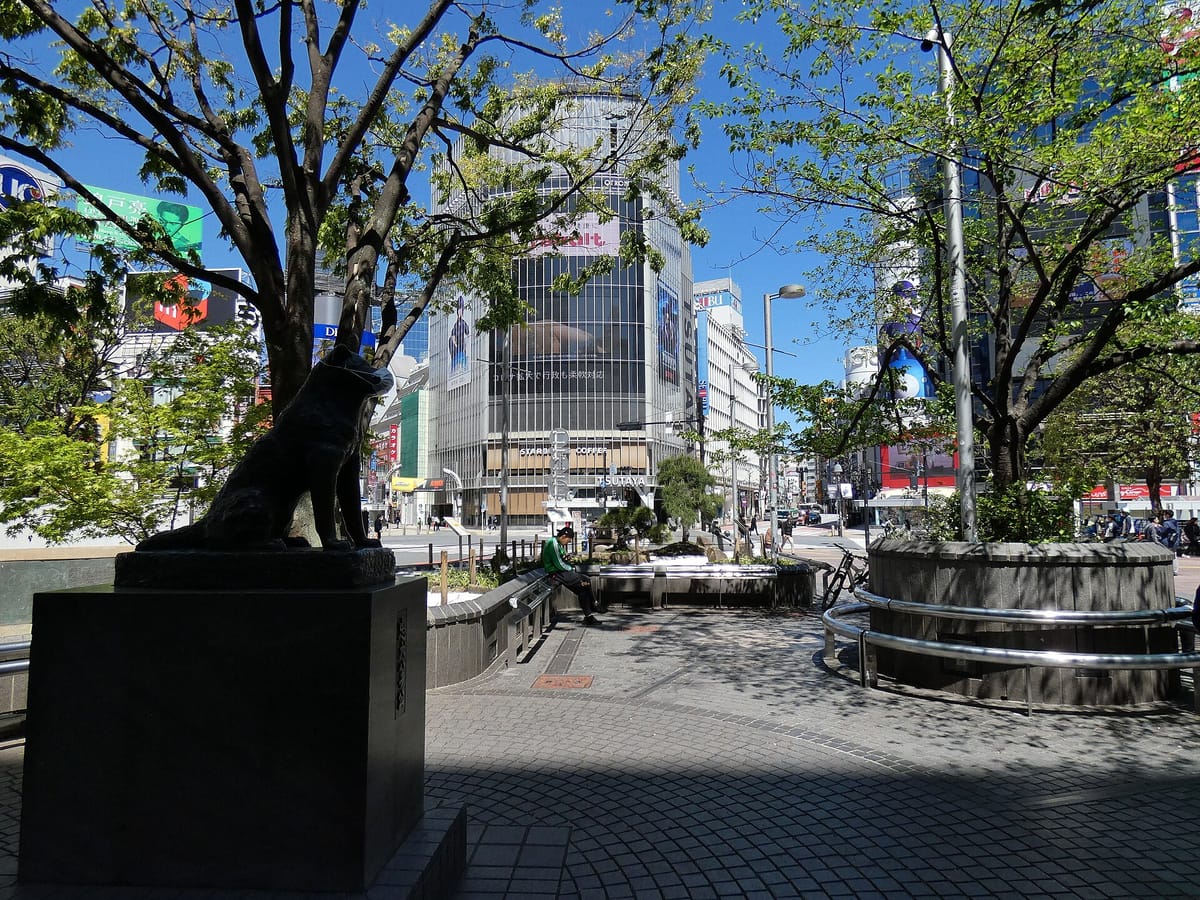
- Hachikō-zō (ハチ公像): the statue of the loyal dog, Shibuya's meeting point.
- Sukuranburu kōsaten (スクランブル交差点): the scramble crossing itself.
- Shibuya Sky (渋谷スカイ): the open-air rooftop deck on Shibuya Scramble Square.
- Center Gai (センター街): the busy pedestrian street of shops and game centres.
- Miyashita Park (宮下公園): a shopping complex with a rooftop park.
- Shibuya Parco (渋谷パルコ): fashion, art and game and character shops up Kōen-dōri.
The words on Shibuya's signs
Station signs in Shibuya are bilingual, but the Japanese comes first and is often larger, and the temporary signs put up during construction are sometimes Japanese only. The words below are the ones you will need most to get out of the station, across the street and up to a view.
The last one matters. Shibuya Ward bans drinking alcohol in the street in the area around the station, the crossing, Center Gai and Miyashita Park every night from 6 p.m. to 5 a.m., and signs saying 路上飲酒禁止 are posted all around. Drink inside a bar or restaurant instead.
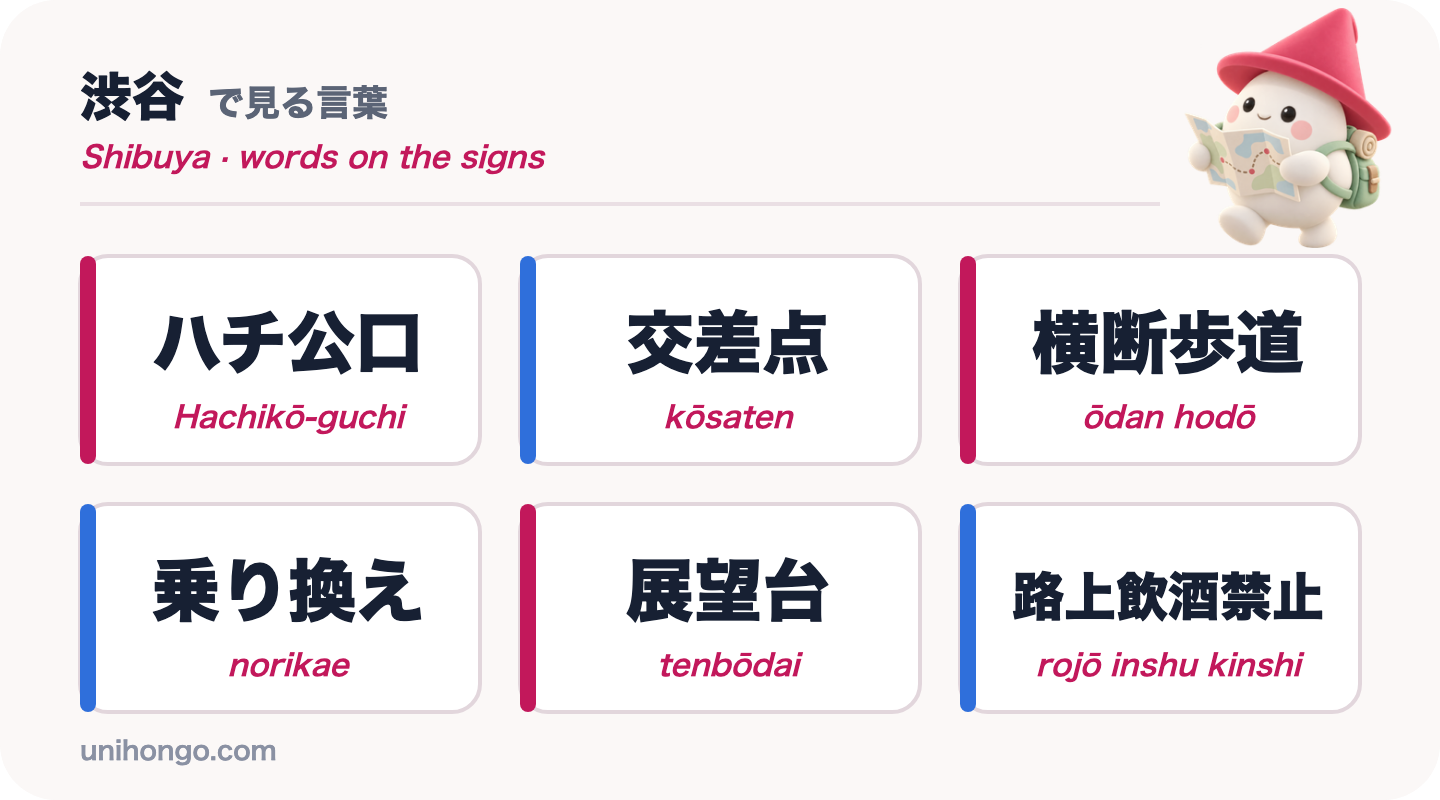
| Word | Reading | Meaning |
|---|---|---|
| ハチ公口 | Hachikō-guchi | The Hachikō exit of the station |
| 交差点 | kōsaten | Intersection |
| 横断歩道 | ōdan hodō | Pedestrian crossing |
| 乗り換え | norikae | Transfer to another line |
| 展望台 | tenbōdai | Observation deck |
| 路上飲酒禁止 | rojō inshu kinshi | No drinking alcohol in the street |
| 出口 | deguchi | Exit |
| 改札 | kaisatsu | Ticket gates |
| 待ち合わせ | machiawase | Meeting up with someone |
Japanese for meeting friends and booking the view
Two situations come up again and again in Shibuya: meeting someone in the crowd, and getting up to an observation deck. For meeting, the key words are machiawase, meeting up, and mae, in front of, as in Hachikō-mae. Say where you are with the building or sign you can see, and the other person can find you.
For Shibuya Sky, the entrance and ticket counter are on the fourteenth floor of Shibuya Scramble Square, and the lift takes you up to the top floors and the rooftop. Book a time slot online if you can, especially for sunset. On the day, staff will tell you about the rooftop rules; loose items such as hats and bags are restricted outdoors, and lockers are provided.
| Japanese | Romaji | Meaning |
|---|---|---|
| ハチ公前で待ち合わせしましょう。 | Hachikō-mae de machiawase shimashō. | Let's meet in front of Hachikō. |
| 今、交差点の近くにいます。 | Ima, kōsaten no chikaku ni imasu. | I'm near the crossing now. |
| 少し遅れます。すみません。 | Sukoshi okuremasu. Sumimasen. | I'll be a little late. Sorry. |
| 今日の夕方のチケットはまだありますか。 | Kyō no yūgata no chiketto wa mada arimasu ka. | Are there still tickets for this evening? |
| 屋上には何を持って行けますか。 | Okujō ni wa nani o motte ikemasu ka. | What can I take up to the rooftop? |
| ロッカーはどこですか。 | Rokkā wa doko desu ka. | Where are the lockers? |
| 写真を撮っていただけますか。 | Shashin o totte itadakemasu ka. | Could you take a photo of us? |
Crossing etiquette, timing and practical tips
Shibuya is relaxed and noisy, but a crossing this busy runs on everyone moving at the same pace.
- Cross on the green light only, and do not start when the signal is flashing; the lights change quickly.
- Do not stop in the middle for photos or videos, and never set up a tripod on the crossing.
- Keep to the left in the station corridors and on the stairs, and step aside before checking your phone.
- Drink in bars and restaurants, not on the street: the ward's night-time street-drinking ban covers the area around the station and the crossing.
- Come at dusk to see the screens light up, or very early in the morning to see the junction almost empty.
- On Halloween and New Year's Eve, expect crowd controls, police and extra restrictions around the station.
Practise the visit before you go
Station attendants at Shibuya answer the question in this dialogue all day. Listen for tsūro, passage, massugu, straight on, and a direction such as hidari, left, or migi, right. The second question uses nankai, which floor, a word you will need in every tall building in Tokyo.
Then practise with someone who answers back. In Unihongo, try the Ask the Way to the Station mission, or choose the Directions topic and ask your AI Sensei to play a station attendant in Shibuya. A few rounds of asking and listening to the reply makes the real station much less daunting.
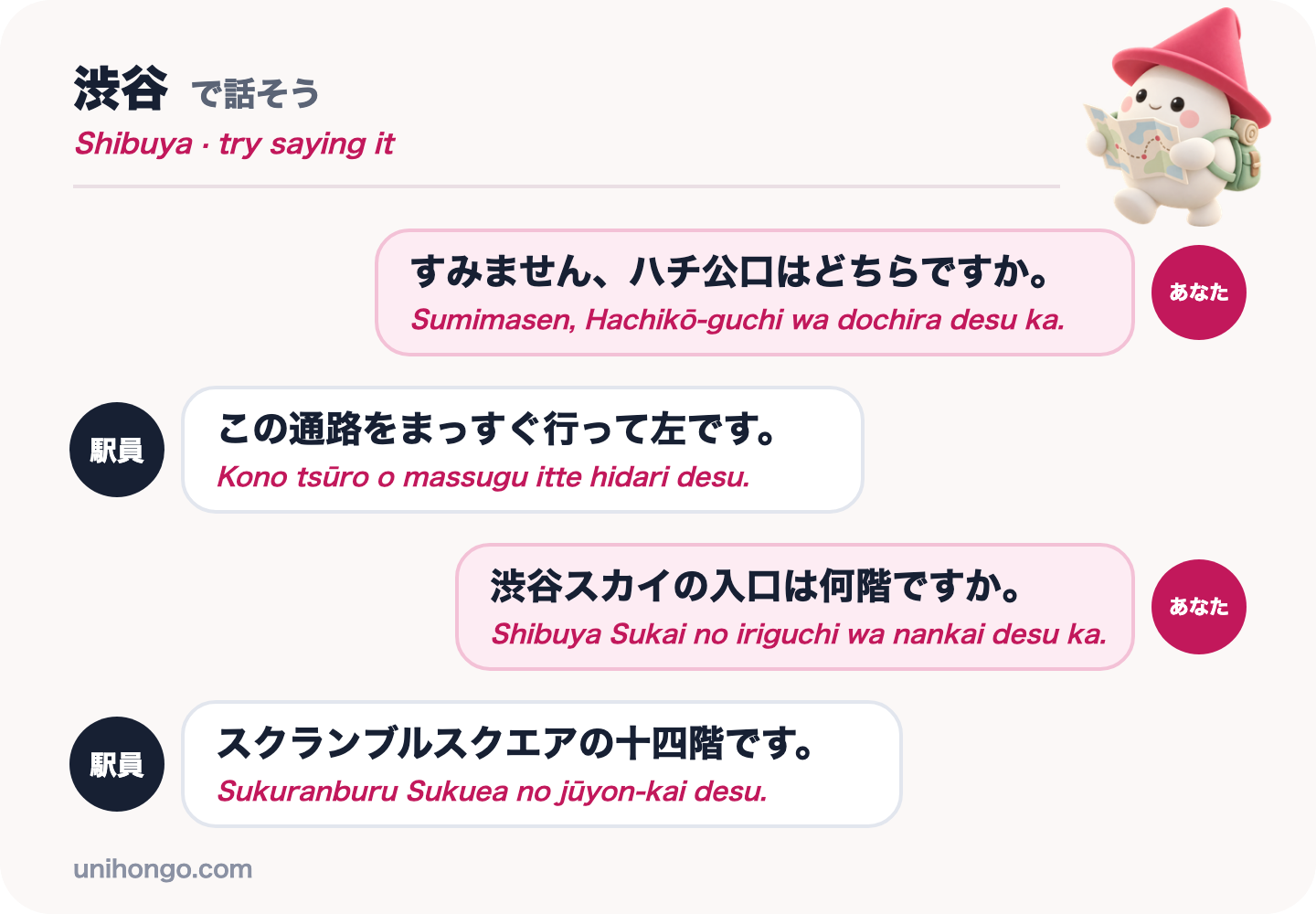
| Japanese | Romaji | Meaning |
|---|---|---|
| すみません、ハチ公口はどちらですか。 | Sumimasen, Hachikō-guchi wa dochira desu ka. | Excuse me, which way is the Hachikō exit? |
| この通路をまっすぐ行って左です。 | Kono tsūro o massugu itte hidari desu. | Go straight along this passage and it is on the left. |
| 渋谷スカイの入口は何階ですか。 | Shibuya Sukai no iriguchi wa nankai desu ka. | Which floor is the Shibuya Sky entrance on? |
| スクランブルスクエアの十四階です。 | Sukuranburu Sukuea no jūyon-kai desu. | It is on the fourteenth floor of Scramble Square. |
Official information
Shibuya Sky publishes its ticket types, time slots, rooftop rules and weather closures, and the Tokyo tourism board covers the wider Shibuya area. Check both before you go, and look for crowd-control notices around Halloween and New Year.