

Why the Tottori Sand Dunes surprise everyone
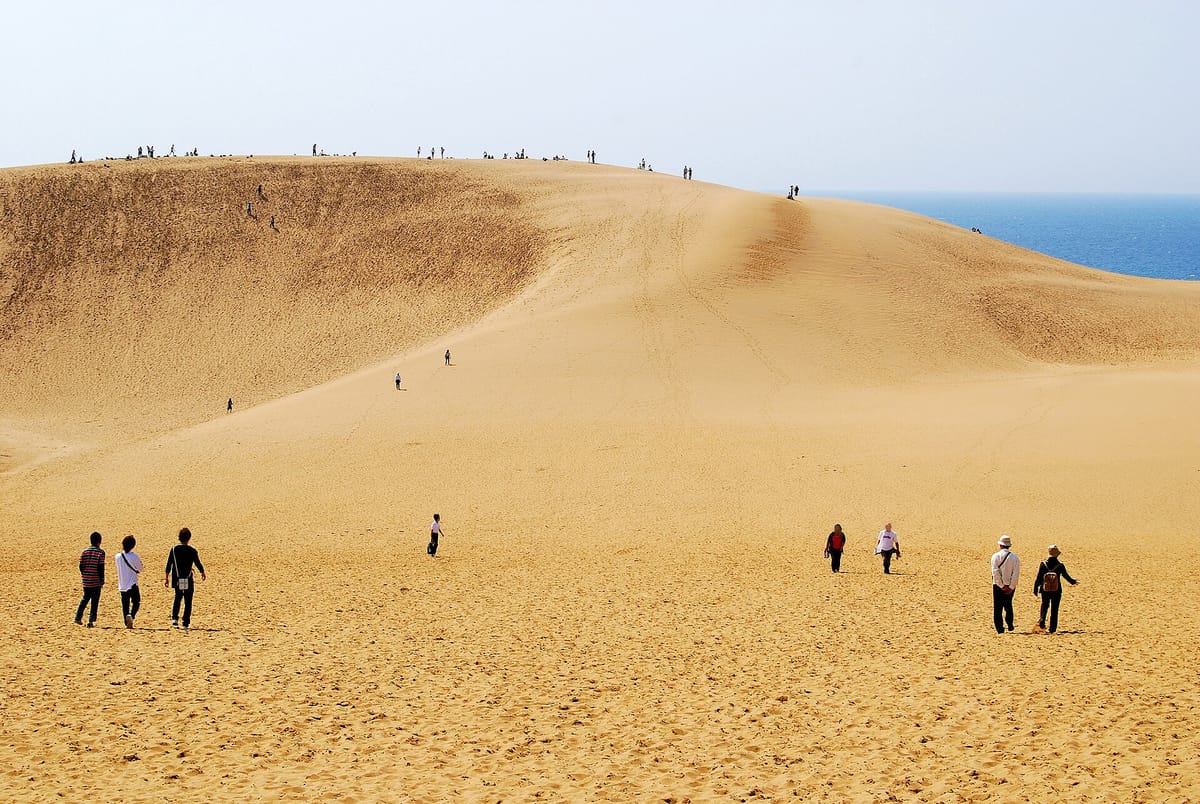
Most people do not expect a desert landscape in Japan, which is why the first view of the dunes is so striking. The sand was carried down by the Sendai River from the Chūgoku Mountains and blown inland by the winds from the sea over thousands of years. Today the dunes are protected within the San'in Kaigan National Park and the San'in Kaigan UNESCO Global Geopark.
The main sightseeing area is compact: from the entrance you cross a wide hollow, which may hold a shallow pond called the Oasis after rain, and climb the long ridge of Uma no Se, the horse's back, to look out over the Sea of Japan. The wind draws ripples, fūmon, across the sand, and on calm mornings the surface is almost untouched.
For a Japanese learner, the dunes are a good place to practise questions about distance and time, and the signs are short: a handful of rules, the names of the ridge and the pond, and the directions to the museum and the lift.
Getting there: buses from Tottori Station
Tottori Station is served by limited express trains from Okayama, Osaka and Kyoto. The bus terminal is at the north exit. Local bus 39, on the Tottori Sakyū line, and buses 32 and 33 run to the dunes in about twenty minutes. On weekends and holidays, the Loop Kirinjishi sightseeing bus, number 09, also runs from the terminal to the dunes and other sights, with a one-day ticket available.
The main stops are Tottori Sakyū, a few minutes' walk from the main entrance and the visitor centre; Sakyū Center Tenbōdai, for the observation hill and the chairlift down to the sand; and Suna no Bijutsukan-mae, for the Sand Museum. From Tottori Airport, a shuttle bus runs to the station, where you change.
| Japanese | Romaji | Meaning |
|---|---|---|
| 鳥取砂丘行きのバスは何番ですか。 | Tottori Sakyū-yuki no basu wa nanban desu ka. | Which number is the bus to the sand dunes? |
| 何番乗り場ですか。 | Nanban noriba desu ka. | Which bus stop number is it? |
| 砂丘センターで降りたいんですが。 | Sakyū Sentā de oritai n desu ga. | I'd like to get off at the Sakyū Center. |
| 一日乗車券はありますか。 | Ichinichi jōshaken wa arimasu ka. | Is there a one-day ticket? |
| 駅に戻るバスはどこから乗りますか。 | Eki ni modoru basu wa doko kara norimasu ka. | Where do I catch the bus back to the station? |
On the sand: what you will see and do
From the entrance, the ridge looks close, but soft sand makes every step slower than you expect. Walk down into the hollow, past the Oasis if it has water, and up the long slope of Uma no Se. From the top, the view drops straight to the beach and the open sea. Many people run down the steep sea-facing side and then find the climb back up is the real exercise.
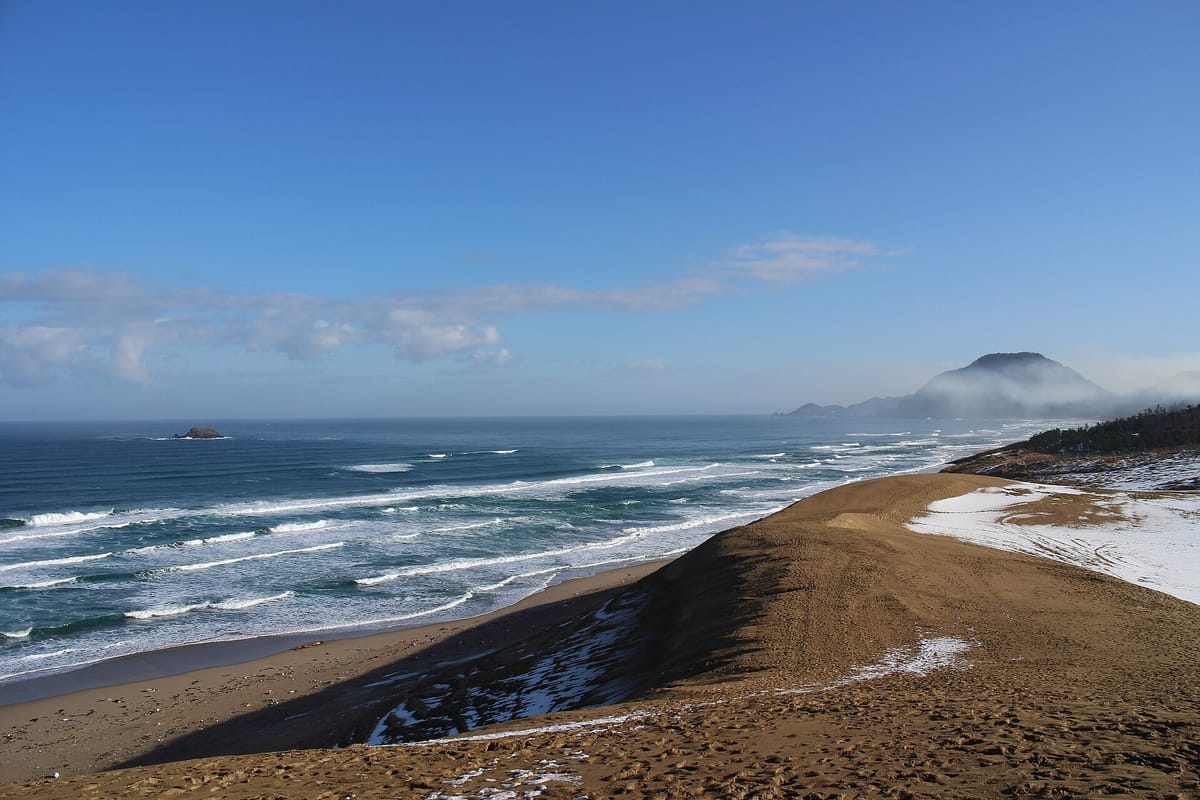
- Uma no Se: the long ridge, about forty-seven metres high, with the view of the sea.
- Oashisu: the seasonal pond in the hollow below the ridge, fed by spring water and rain.
- Tottori Sakyū Visitor Center: maps, displays on the dunes and advice for the day.
- Sakyū Center and the chairlift: an observation hill above the dunes, with a lift down to the sand.
- Camels: camel photo sessions near the entrance; rides are more limited than in the past, especially at weekends.
- Sandboarding and paragliding: lessons are offered by local operators; book ahead.
- Suna no Bijutsukan, the Sand Museum: giant sand sculptures on a new theme each year.
Every season changes the dunes. Spring and autumn are the most comfortable for walking; summer brings strong sun and burning sand; winter can bring snow over the sand, a rare sight worth the cold.
Words on the signs
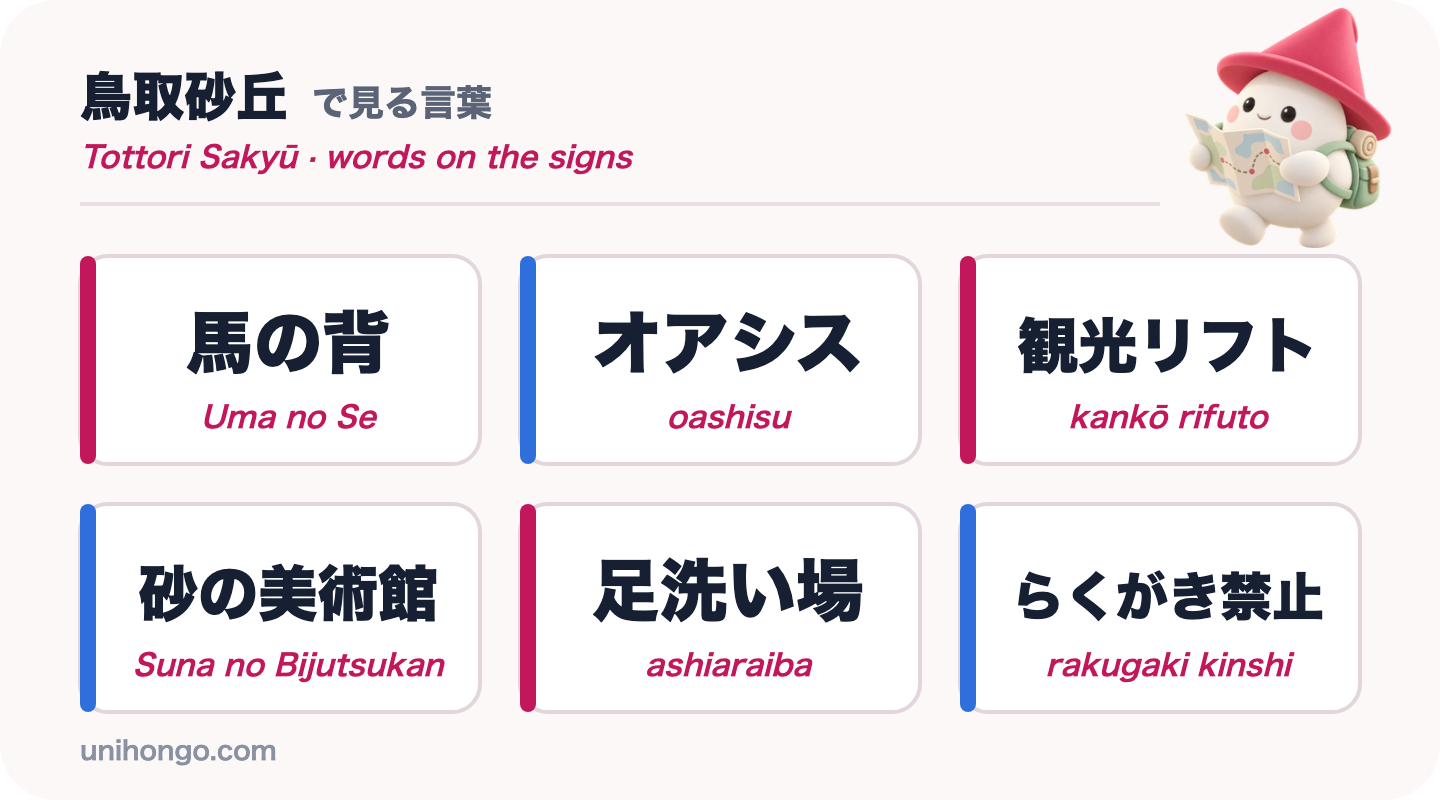
Most signs at the dunes are about where to go and what not to do. 禁止, kinshi, prohibited, is the key word: らくがき禁止, no graffiti, which on the dunes means no writing or drawing in the sand, and the rule against taking sand home, which means the sand stays here. Near the exits, 足洗い場, ashiaraiba, marks the taps for washing sand off your feet and shoes.
| Word | Reading | Meaning |
|---|---|---|
| 馬の背 | Uma no Se | The ridge, literally the horse's back |
| オアシス | oashisu | The Oasis, a seasonal pond |
| 観光リフト | kankō rifuto | Sightseeing chairlift |
| 砂の美術館 | Suna no Bijutsukan | The Sand Museum |
| 足洗い場 | ashiaraiba | Foot-washing station |
| らくがき禁止 | rakugaki kinshi | No graffiti; no writing in the sand |
| 砂丘 | sakyū | Sand dune |
| 風紋 | fūmon | Wind ripples on the sand |
| 熱中症 | necchūshō | Heatstroke |
Japanese for the lift, the camels and the heat
Staff at the visitor centre, the lift and the camel area are friendly and used to visitors. Questions are simple, mostly about distance, time and price. In summer, you will also see warnings about heatstroke, necchūshō, and the sand can reach around sixty degrees, so the conversation may turn to shoes and water.
The chairlift runs between the Sakyū Center's observation hill and the edge of the dunes, a ride of a few minutes each way, with one-way and return tickets. Camel sessions now focus mainly on photographs, particularly at weekends and in holiday periods; ask what is offered on the day.
| Japanese | Romaji | Meaning |
|---|---|---|
| リフトは片道でも乗れますか。 | Rifuto wa katamichi demo noremasu ka. | Can I ride the lift one way? |
| ラクダと写真を撮れますか。 | Rakuda to shashin o toremasu ka. | Can I take a photo with a camel? |
| 今日は乗れますか。 | Kyō wa noremasu ka. | Can I ride today? |
| 砂の美術館はどちらですか。 | Suna no Bijutsukan wa dochira desu ka. | Which way is the Sand Museum? |
| 近くに自動販売機はありますか。 | Chikaku ni jidō hanbaiki wa arimasu ka. | Is there a vending machine nearby? |
| サンダルで歩いても大丈夫ですか。 | Sandaru de aruite mo daijōbu desu ka. | Is it all right to walk in sandals? |
Rules, timing and practical tips
The dunes are a protected natural site, and a few rules keep them that way. Signs at the entrance list them, often with pictures.
- Do not write or draw in the sand, and do not take sand home as a souvenir.
- Swimming is not allowed in the sea below the dunes, and drones need permission.
- Wear shoes in summer: the sand surface gets very hot. Barefoot walks are best on mild days.
- Bring water, a hat and sun cream. There is no shade on the sand.
- Go early in the morning for the smoothest wind ripples and the fewest footprints.
- Use the foot-washing stations on the way out, and shake out your shoes before getting on the bus.
- Tottori's local specialities include nashi pears in late summer and snow crab in winter.
Practise the visit before you go
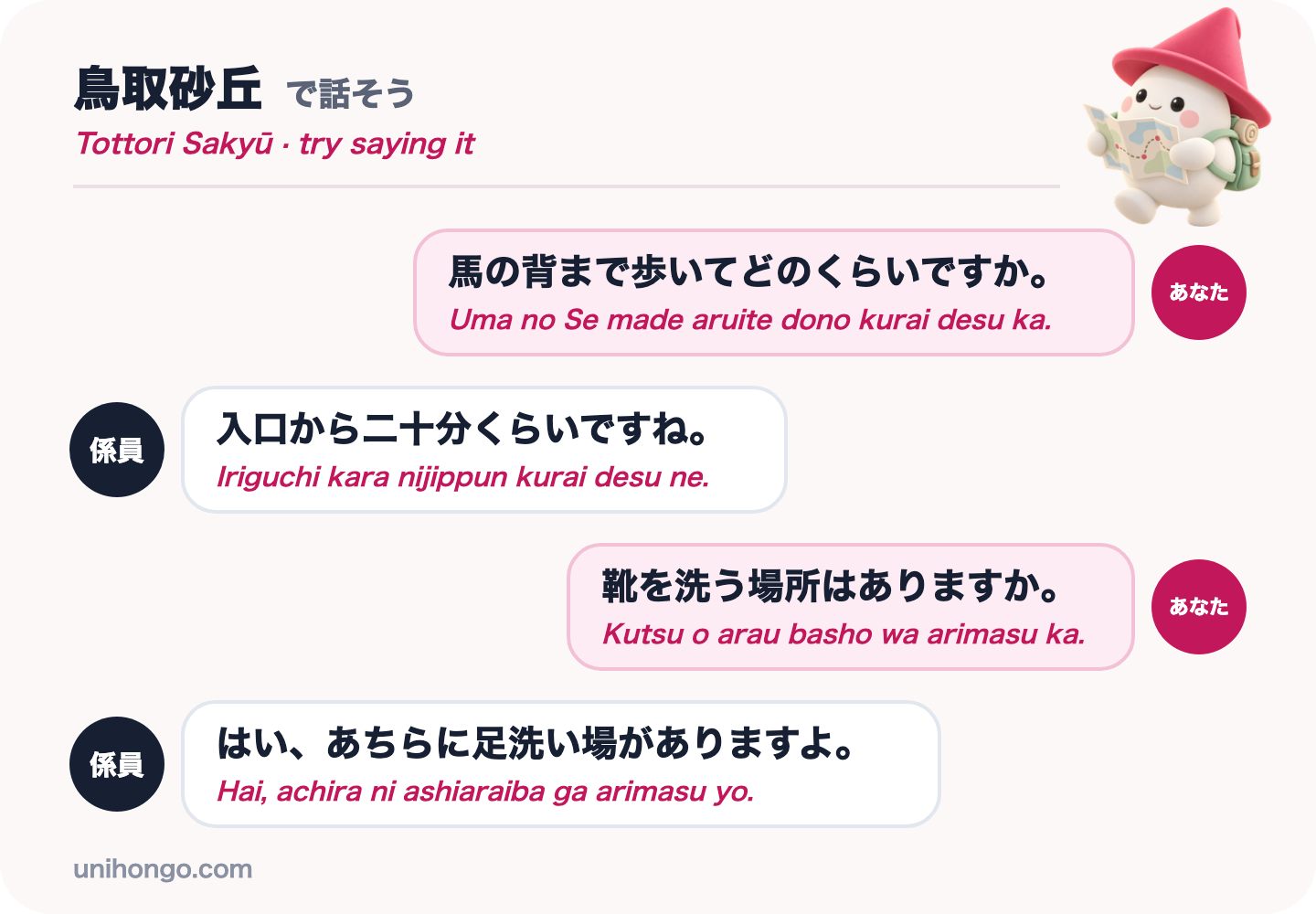
These two questions cover the start and the end of your visit. Listen for kurai, about, in the first answer and achira, over there, in the second, usually with a gesture.
Then practise with a partner who answers back. In Unihongo, choose the Directions topic and ask your AI Sensei to play a staff member at the visitor centre, adding a question about the bus back. Say the lines aloud once before you go, and they will come easily on the sand.
| Japanese | Romaji | Meaning |
|---|---|---|
| 馬の背まで歩いてどのくらいですか。 | Uma no Se made aruite dono kurai desu ka. | How long does it take to walk to Uma no Se? |
| 入口から二十分くらいですね。 | Iriguchi kara nijippun kurai desu ne. | About twenty minutes from the entrance. |
| 靴を洗う場所はありますか。 | Kutsu o arau basho wa arimasu ka. | Is there somewhere to wash my shoes? |
| はい、あちらに足洗い場がありますよ。 | Hai, achira ni ashiaraiba ga arimasu yo. | Yes, there's a foot-washing station over there. |
Official information
Tottori City's tourism site publishes bus routes and stops, the dunes' rules and seasonal information, and the Sakyū Center posts the chairlift's operating hours. Check before you go, especially for the weekend loop bus.