

Why Ōsu is Nagoya's best afternoon
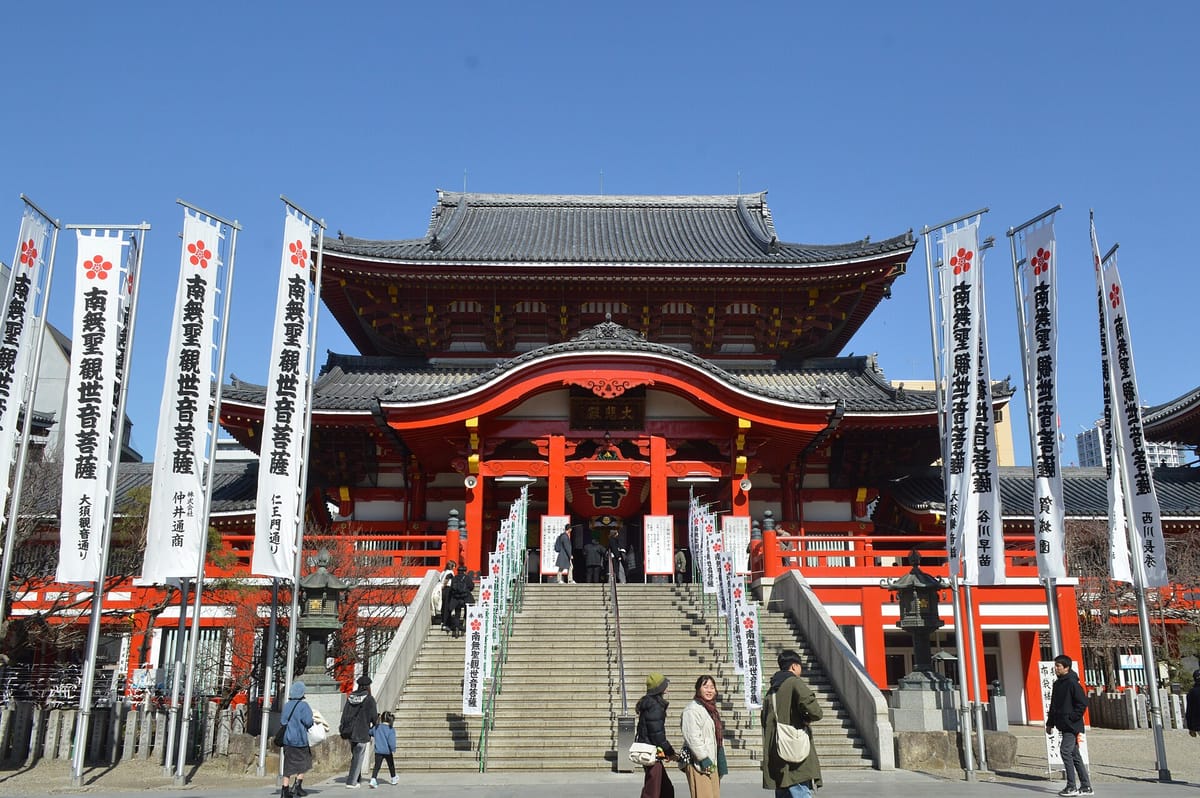
Ōsu Kannon's formal name is Kitanosan Shinpuku-ji Hōshō-in. According to the temple's own history, it was founded in the fourteenth century at Ōsu in Owari, a village in what is now Hashima in Gifu, under the patronage of the emperor Go-Daigo. When Tokugawa Ieyasu laid out the new castle town of Nagoya in 1612, the temple was among the first he moved here, and it brought its name with it. The district around it became Nagoya's quarter for theatres, entertainers and markets.
Its founding priest gathered a large collection of books, and the temple's library is still known to scholars for its ancient manuscripts. Nearby Banshō-ji, the family temple of the Oda clan, is where, according to a famous story, the young Oda Nobunaga threw incense at his father's memorial tablet at the funeral, though that happened before the temple moved to Ōsu.
Ōsu almost faded after the war, when new roads passed it by. In 1978 local people fought back with a festival of their own, and the district revived as a place for young people, collectors and food lovers. For a learner, it is perfect: small shops, short exchanges and staff who talk to customers all day.
Getting there: Ōsu Kannon and Kamimaezu stations
The district sits between two subway stations, and the shopping street federation recommends either. Ōsu Kannon Station on the Tsurumai Line is right beside the temple at the western end. Kamimaezu Station, where the Meijō and Tsurumai lines meet, is at the eastern end. The arcades, bounded by Wakamiya-ōdōri, Fushimi-dōri, Ōsu-dōri and Minami-Ōtsu-dōri, fill the blocks in between.
From Nagoya Station, take the Higashiyama Line one stop to Fushimi and change to the Tsurumai Line for Ōsu Kannon, one stop further. Sakae, the main downtown shopping area, is within walking distance to the north.
| Japanese | Romaji | Meaning |
|---|---|---|
| 大須観音駅は何線ですか。 | Ōsu Kannon-eki wa nanisen desu ka. | Which line is Ōsu Kannon Station on? |
| 伏見で鶴舞線に乗り換えます。 | Fushimi de Tsurumai-sen ni norikaemasu. | I change to the Tsurumai Line at Fushimi. |
| 大須商店街はどの出口ですか。 | Ōsu shōtengai wa dono deguchi desu ka. | Which exit is for the Ōsu shopping streets? |
| 上前津駅まで歩いて何分くらいですか。 | Kamimaezu-eki made aruite nanpun kurai desu ka. | About how many minutes on foot to Kamimaezu Station? |
| 大須観音はどちらですか。 | Ōsu Kannon wa dochira desu ka. | Which way is Ōsu Kannon? |
The temple, the arcades and the fairs: what you will see
Start at Ōsu Kannon, climb the steps to the main hall and look around the courtyard, where pigeons gather and stalls appear on fair days. Then walk east under the arcades. Ōsu Kannon-dōri and Niomon-dōri run parallel towards Banshōji-dōri and Akamon-dōri, and side streets connect them all, so it is easy to wander without a plan.
On the 18th of each month, the fair day of Kannon, an antique market fills the temple grounds from early morning. On the 28th, Banshō-ji and other temples hold their own fair-day events. In October, the Ōsu Daidō Chōnin Matsuri brings street performers, parades and a procession in Edo-period courtesan costume.
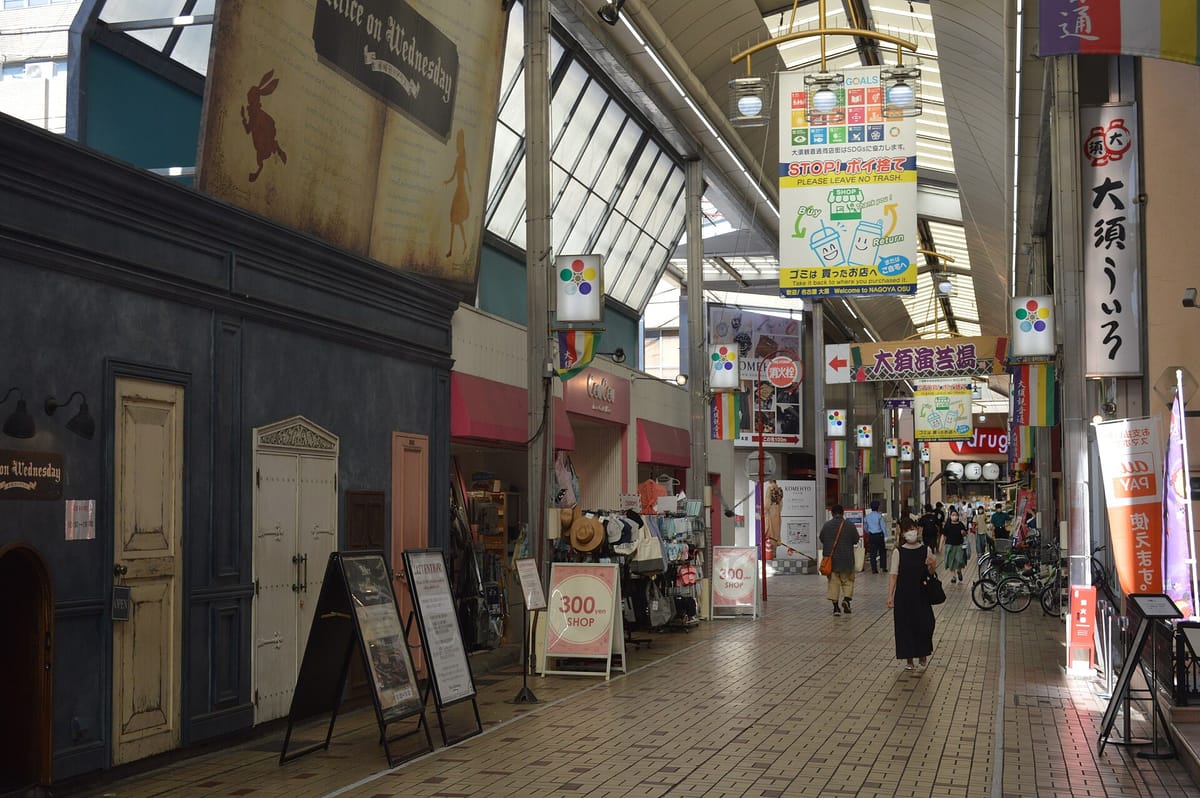
- Ōsu Kannon: the vermilion temple at the western end, with its antique market on the 18th.
- Banshō-ji: the Oda family temple, linked with Nobunaga and his father Nobuhide.
- Vintage and secondhand shops: clothing, kimono, records and cameras.
- Electronics and hobby shops: parts, games and anime goods, especially around Akamon-dōri.
- Street food: fried chicken, skewers, crêpes and dishes from many countries.
- Fureai Hiroba: a small square where volunteer guides, Ōsu annainin, help visitors on weekend afternoons.
Words on the signs in Ōsu
Arcade signs in Ōsu are a good reading workout because they mix everyday words with shop jargon. 古着, furugi, is secondhand clothing, literally old clothes, and you will see it over dozens of doorways. 骨董市, kottōichi, is an antiques market, and 食べ歩き, tabearuki, eating while walking, appears on menus and posters as a selling point.
Street names end in 通, dōri, street, as in 大須観音通 and 万松寺通. The station name 上前津, Kamimaezu, is worth practising too: 上 is read kami here, as in many place names, and 津 is tsu, a harbour.
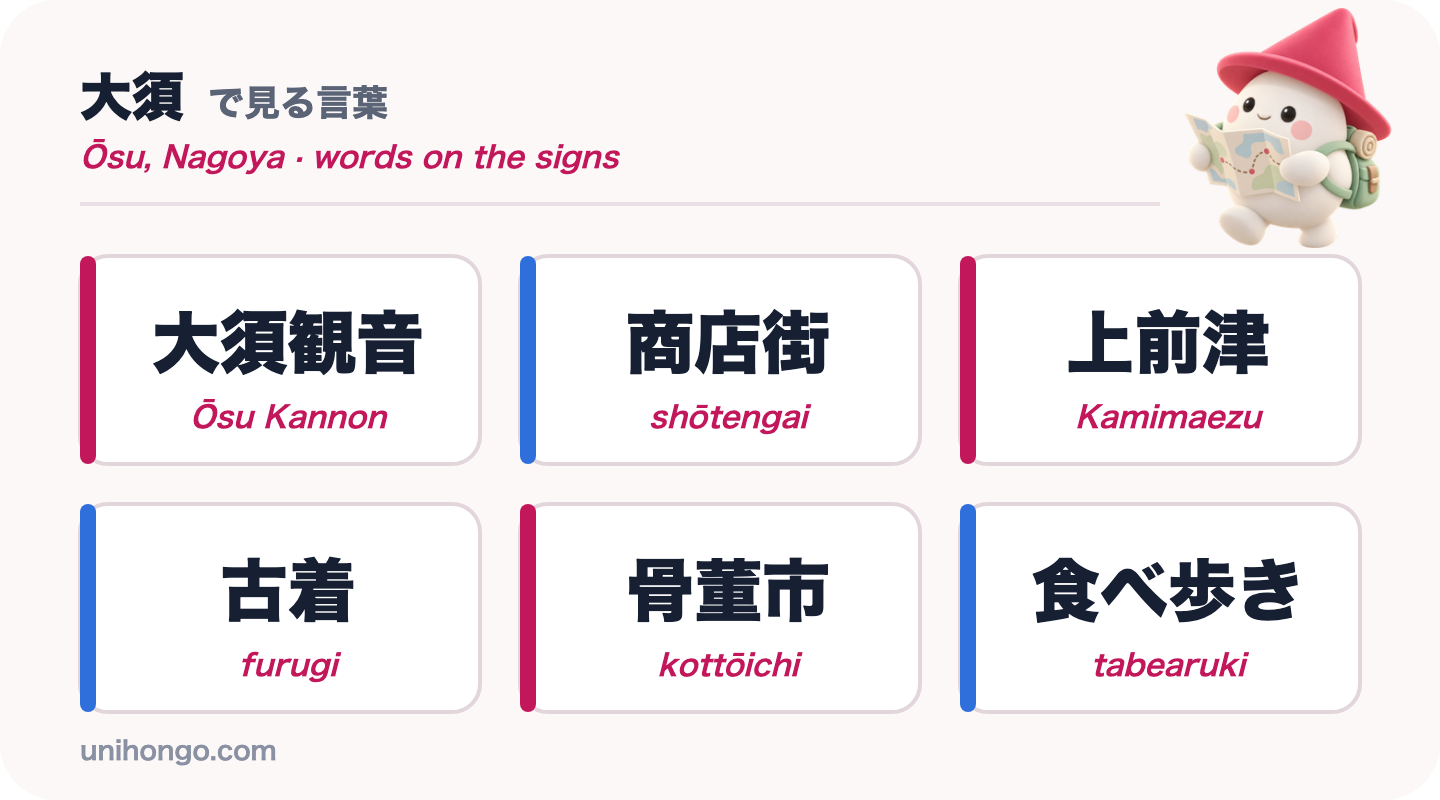
| Word | Reading | Meaning |
|---|---|---|
| 大須観音 | Ōsu Kannon | The Kannon temple at the heart of the district |
| 商店街 | shōtengai | Shopping street or arcade |
| 上前津 | Kamimaezu | Subway station at the eastern end |
| 古着 | furugi | Secondhand clothing |
| 骨董市 | kottōichi | Antiques market |
| 食べ歩き | tabearuki | Eating while walking around |
| 縁日 | ennichi | Temple fair day |
| 万松寺 | Banshō-ji | The Oda family temple |
| 持ち帰り | mochikaeri | Takeaway |
Japanese for street food and vintage shops
Street food stalls in Ōsu work fast. Point if you must, but saying the item and a number is quicker and friendlier. Many stalls ask whether you are eating there, because they want you to eat by the stall and hand back the skewer or paper. Nagoya's own dishes, such as tebasaki chicken wings and miso katsu, are also easy to find in and around the arcades.
In vintage clothing shops, sizes and fitting rooms are the main topics. Staff are used to questions, and asking to try something on is normal.
| Japanese | Romaji | Meaning |
|---|---|---|
| これを二つください。 | Kore o futatsu kudasai. | Two of these, please. |
| 一番人気はどれですか。 | Ichiban ninki wa dore desu ka. | Which is the most popular? |
| 辛くないのはどれですか。 | Karakunai no wa dore desu ka. | Which one isn't spicy? |
| 試着してもいいですか。 | Shichaku shite mo ii desu ka. | May I try it on? |
| もう少し大きいサイズはありますか。 | Mō sukoshi ōkii saizu wa arimasu ka. | Do you have a slightly bigger size? |
| カードは使えますか。 | Kādo wa tsukaemasu ka. | Can I pay by card? |
Etiquette and practical tips
Ōsu is relaxed, but the arcades are narrow and crowded at weekends, and a few habits keep things pleasant.
- Eat beside the stall where you bought the food, or step aside out of the flow of people.
- Return skewers and wrappers to the stall, or carry your rubbish; public bins are few.
- Visit on the 18th for the antique market, arriving in the morning for the best choice.
- Weekday afternoons are calmer than weekends, when the arcades fill with shoppers.
- Ask before photographing shopfronts or staff, and keep cameras out of fitting rooms and small shops.
- Carry some cash for small stalls and market sellers, even though many shops take cards.
Practise ordering at a street stall
The vendor's question, koko de tabete ikimasu ka, are you eating here, uses -te iku, do something before going on. The visitor's reply uses -ba ii desu ka to ask what you should do with your rubbish, a pattern that works for any how-should-I question. Practise the four lines below until they come out without reading.
Then practise with a partner. In Unihongo, choose the Festival Food topic and ask your AI Sensei to play a vendor in the Ōsu arcades, or choose Shopping to rehearse a vintage clothing shop. Saying the lines once before you go makes the real stall feel easy.
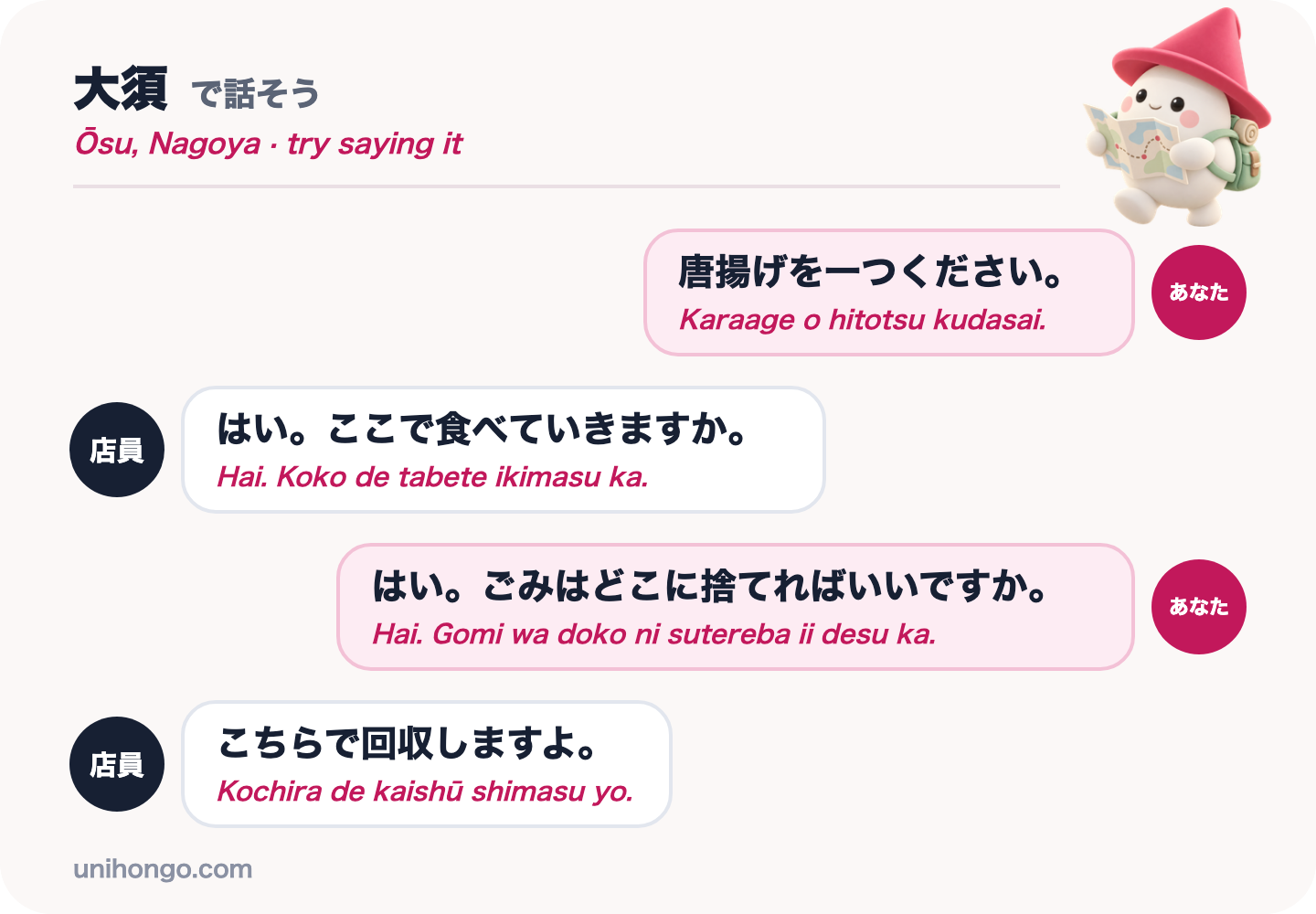
| Japanese | Romaji | Meaning |
|---|---|---|
| 唐揚げを一つください。 | Karaage o hitotsu kudasai. | One fried chicken, please. |
| はい。ここで食べていきますか。 | Hai. Koko de tabete ikimasu ka. | Sure. Are you eating here? |
| はい。ごみはどこに捨てればいいですか。 | Hai. Gomi wa doko ni sutereba ii desu ka. | Yes. Where should I put my rubbish? |
| こちらで回収しますよ。 | Kochira de kaishū shimasu yo. | We'll take it here. |
Official information
The Ōsu shopping street federation publishes a shop guide, access details, the fair days and festival information in Japanese, and Ōsu Kannon posts its own events and history. Check them for this month's fairs and this year's festival dates.