

Why Dōtonbori is Osaka at its loudest
Dōtonbori takes its name from the canal it runs beside. The waterway was dug in the early 1600s, a project started by a local man called Yasui Dōton, and the name simply means Dōton's canal, bori being a moat or canal. Theatres followed the canal, and for centuries this was Osaka's entertainment quarter of kabuki and puppet plays. The Shōchikuza theatre still stands on the street, but today the performance is mostly the food and the signs.
And what signs they are. Shops here compete with three-dimensional billboards: a giant mechanical crab waving its legs over a crab restaurant, dragons, grinning faces, and above the canal the huge illuminated Glico running man, arms raised as he crosses the finish line. Taking a photo of him from Ebisubashi bridge is the Osaka equivalent of standing on Shibuya Crossing.
For a Japanese learner, Dōtonbori is a noisy, friendly classroom. Staff call out irasshaimase, welcome, from every doorway, menus are written in big, simple characters, and many shopkeepers speak Kansai-ben, the Osaka dialect you rarely hear in textbooks. You will read food words, order at a counter and hear a different flavour of Japanese within a single block.
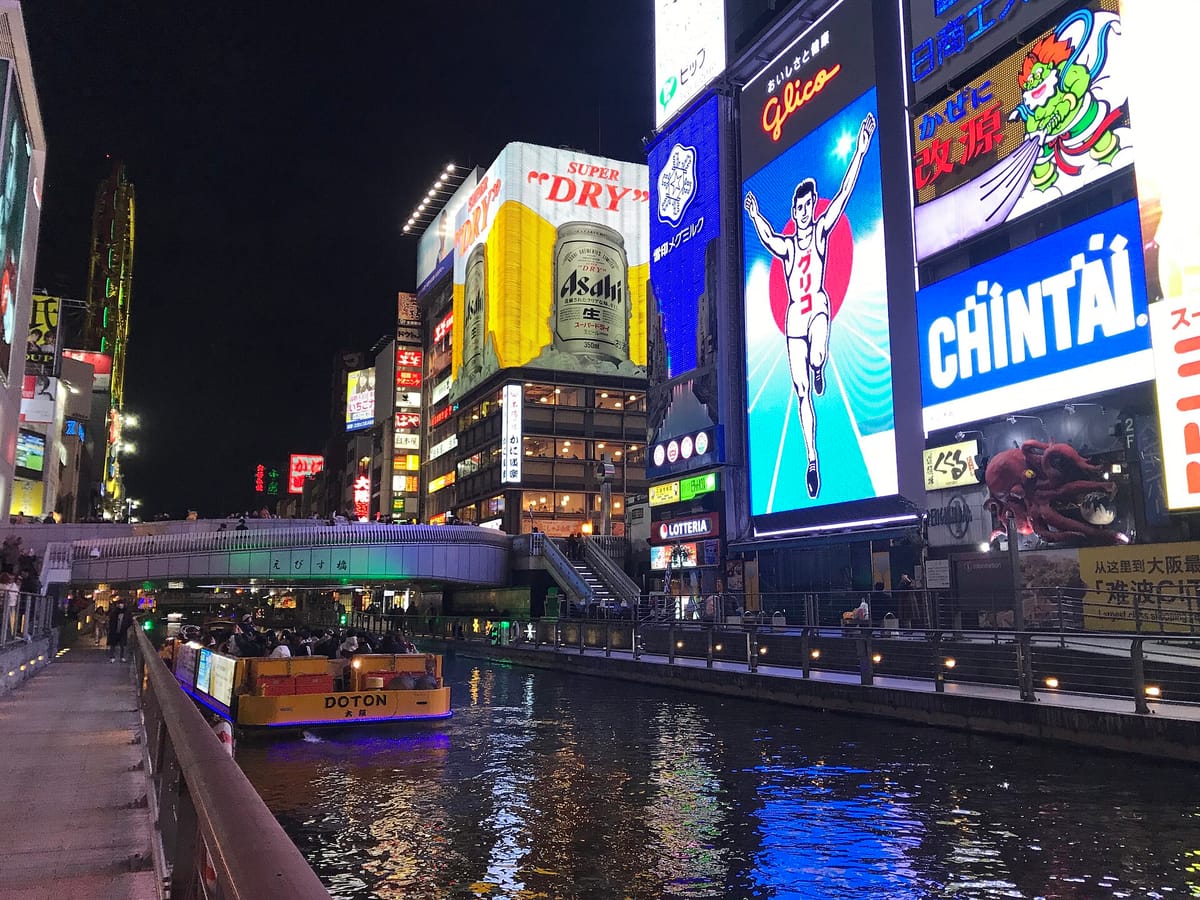
Getting there: Namba, Shinsaibashi and Nippombashi stations
Namba is the main gateway. The Osaka Metro Midōsuji Line runs straight from Umeda, next to JR Osaka Station, to Namba Station in about ten minutes, and the Yotsubashi and Sennichimae lines also stop at Namba. Nankai trains from Kansai Airport arrive at Nankai Namba, and Kintetsu and Hanshin trains at Osaka-Namba. From any of them it is a short walk north to the canal; follow the signs for 道頓堀 or simply the crowd.
If you are coming from the north, Shinsaibashi Station on the Midōsuji Line lets you walk down the covered Shinsaibashi-suji shopping arcade, which ends right at Ebisubashi bridge. Nippombashi Station, on the Sakaisuji and Sennichimae lines and the Kintetsu line, brings you to the quieter eastern end, close to Kuromon Market. The underground passages around Namba are large, so it helps to ask for the exit you want.
| Japanese | Romaji | Meaning |
|---|---|---|
| 道頓堀はどの出口が近いですか。 | Dōtonbori wa dono deguchi ga chikai desu ka. | Which exit is closest to Dōtonbori? |
| 戎橋はどちらですか。 | Ebisubashi wa dochira desu ka. | Which way is Ebisubashi bridge? |
| なんば駅まで歩いて何分くらいですか。 | Namba-eki made aruite nanpun kurai desu ka. | About how many minutes' walk is it to Namba Station? |
| 御堂筋線は何番線ですか。 | Midōsuji-sen wa nanbansen desu ka. | Which platform is the Midōsuji Line? |
| この近くにコインロッカーはありますか。 | Kono chikaku ni koin rokkā wa arimasu ka. | Are there coin lockers near here? |
From Ebisubashi to Hōzen-ji: what you will see
Most visitors start on Ebisubashi, the bridge where Shinsaibashi-suji meets the canal, and look west to the Glico sign. From there you can walk along the main Dōtonbori street on the south bank, which is where the big signs and food stalls are, or drop down to the Tombori River Walk, a paved promenade at water level that is calmer and better for photos of the reflections.
The contrast worth making time for is Hōzen-ji, a small temple a couple of minutes south of the main street. It is reached through Hōzen-ji Yokochō, two narrow stone-paved alleys of lanterns and small restaurants that feel far older than the neon around them. In the temple yard stands Mizukake Fudō, a statue of the Buddhist guardian Fudō Myōō so thickly covered in moss that it glows green. Visitors ladle water over it as they pray, which is how the moss has grown.
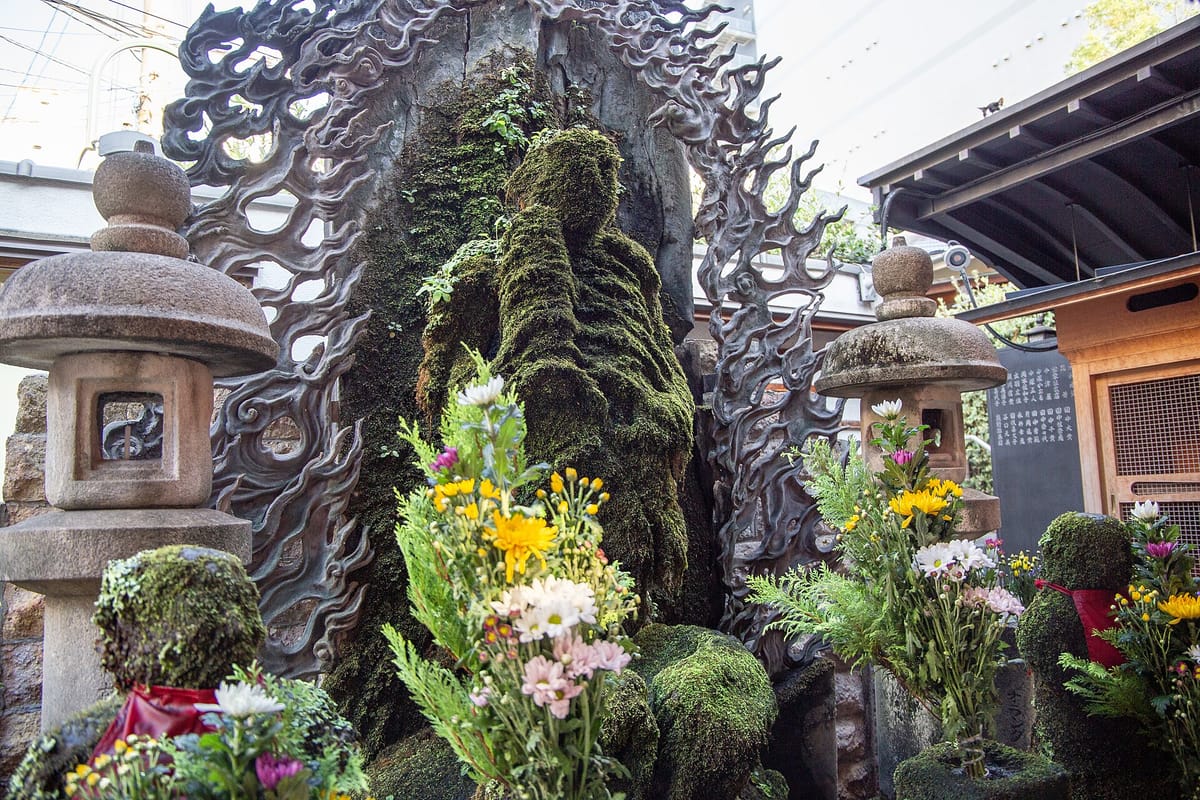
- Ebisubashi: the bridge and meeting point, with the Glico running man opposite.
- Dōtonbori street: the main stretch of food stalls, restaurants and giant signs.
- Tombori River Walk: the canal-side promenade below street level.
- Tombori River Cruise: a short boat ride of about twenty minutes along the canal, boarding near the Don Quijote building.
- Ebisu Tower: the elongated Ferris wheel on the side of the Don Quijote store.
- Hōzen-ji and Hōzen-ji Yokochō: the moss-covered Fudō statue and the lantern-lit alleys around it.
- Kuidaore Tarō: the drum-playing clown figure that has become a mascot of the street.
Words on the signs and menus
Most of what you read in Dōtonbori is food. Takoyaki are balls of batter with a piece of octopus inside, grilled in a dimpled iron pan and topped with sauce, mayonnaise, green laver and bonito flakes. Okonomiyaki is a savoury pancake of cabbage and batter, often cooked on a hot plate at your table. Kushikatsu, deep-fried skewers, are the third Osaka classic, and you will see their shared-sauce warning on many shop fronts.
The busiest stalls have a queue, and staff hold up a board reading 最後尾, saikōbi, to show where the end of the line is. Join behind it rather than at the front. At the canal, 乗船場, jōsenjō, marks the pier where the cruise boats board.
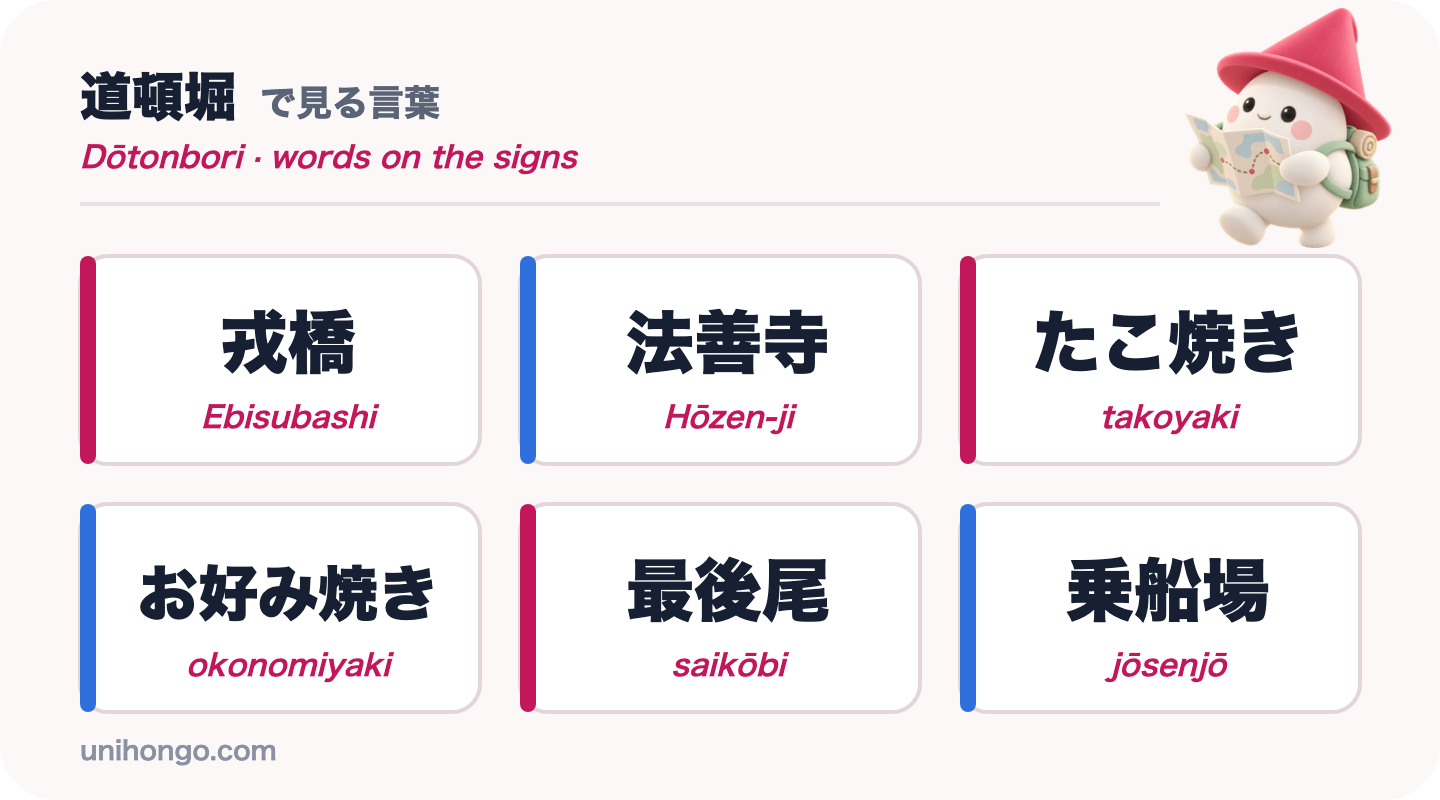
| Word | Reading | Meaning |
|---|---|---|
| 道頓堀 | Dōtonbori | The canal and the street beside it |
| 戎橋 | Ebisubashi | The bridge facing the Glico sign |
| 法善寺 | Hōzen-ji | The small temple with the mossy Fudō statue |
| たこ焼き | takoyaki | Octopus dumplings grilled in a round-dimpled pan |
| お好み焼き | okonomiyaki | Savoury cabbage pancake |
| 串カツ | kushikatsu | Deep-fried skewers |
| 最後尾 | saikōbi | End of the queue |
| 乗船場 | jōsenjō | Boat boarding pier |
| 食い倒れ | kuidaore | Eating until you drop, Osaka's motto |
Ordering takoyaki and okonomiyaki, with a little Kansai dialect
Street stalls in Dōtonbori usually sell takoyaki by the box, with a choice of how many pieces and which toppings. The sentence pattern is the same one you use anywhere in Japan: the item, how many, then kudasai. Numbers of pieces take the counter ko, and a box of six is rokko-iri, six-piece pack. Many stalls have a bench or a standing counter where you can eat straight away; ask before you sit. At an okonomiyaki restaurant the staff will often cook for you on the hot plate, but some places let you cook yourself, so ask if you are not sure.
Osaka speaks Kansai-ben, the dialect of the Kansai region, and Dōtonbori is where visitors hear it most. You do not need to speak it: standard Japanese is understood everywhere and is the polite choice for a visitor. But recognising a few words turns fast talk into something you can follow. In the rows below, the first four are standard Japanese to say; the last four are Kansai dialect you will hear, each marked, with the standard form in the English. You may also hear honma ni?, really?, where standard Japanese says hontō ni?
| Japanese | Romaji | Meaning |
|---|---|---|
| たこ焼き、八個入りをください。 | Takoyaki, hakko-iri o kudasai. | Takoyaki, the eight-piece box, please. |
| ここで食べてもいいですか。 | Koko de tabete mo ii desu ka. | May I eat here? |
| おすすめはどれですか。 | Osusume wa dore desu ka. | Which one do you recommend? |
| お好み焼きは焼いてもらえますか。 | Okonomiyaki wa yaite moraemasu ka. | Will you cook the okonomiyaki for us? |
| おおきに。 | Ōkini. | Thank you. (Kansai dialect; standard: arigatō gozaimasu) |
| めっちゃおいしい! | Meccha oishii! | Really delicious! (Kansai dialect; standard: totemo oishii) |
| これ、なんぼ? | Kore, nanbo? | How much is this? (Kansai dialect; standard: kore wa ikura desu ka) |
| あかん。 | Akan. | No good, not allowed. (Kansai dialect; standard: dame desu) |
Etiquette and timing in Dōtonbori
Dōtonbori is relaxed, but it is also packed, and a few habits help everyone move.
- Eat at the stall or its bench rather than walking through the crowd with hot food; return your tray or box where the stall asks.
- Carry your rubbish until you find a bin, or hand it back to the stall where you bought the food; street bins are rare.
- Do not stop in the middle of Ebisubashi for long photo sessions at peak times; step to the railing.
- Join queues at the saikōbi board, not at the front.
- Keep your voice down in Hōzen-ji Yokochō: it is a place of worship and small restaurants, not part of the party.
- Come after dark for the lights, and on a weekday if you can.
Practise the takoyaki counter before you go
This is the exchange you will almost certainly have in Dōtonbori. Notice the last line: ōkini is Kansai for thank you, and atsui kara kii tsukete na is the Osaka way of saying it's hot, so be careful, where standard Japanese would say atsui node ki o tsukete kudasai. Read the four lines until you can say your part without looking.
Then practise with someone who answers back. In Unihongo, choose the Festival Food topic and ask your AI Sensei to run a takoyaki stall with a little Kansai dialect, or open the Regional Dialects topic to hear more Osaka speech. Saying the order out loud once makes it easy on the night.
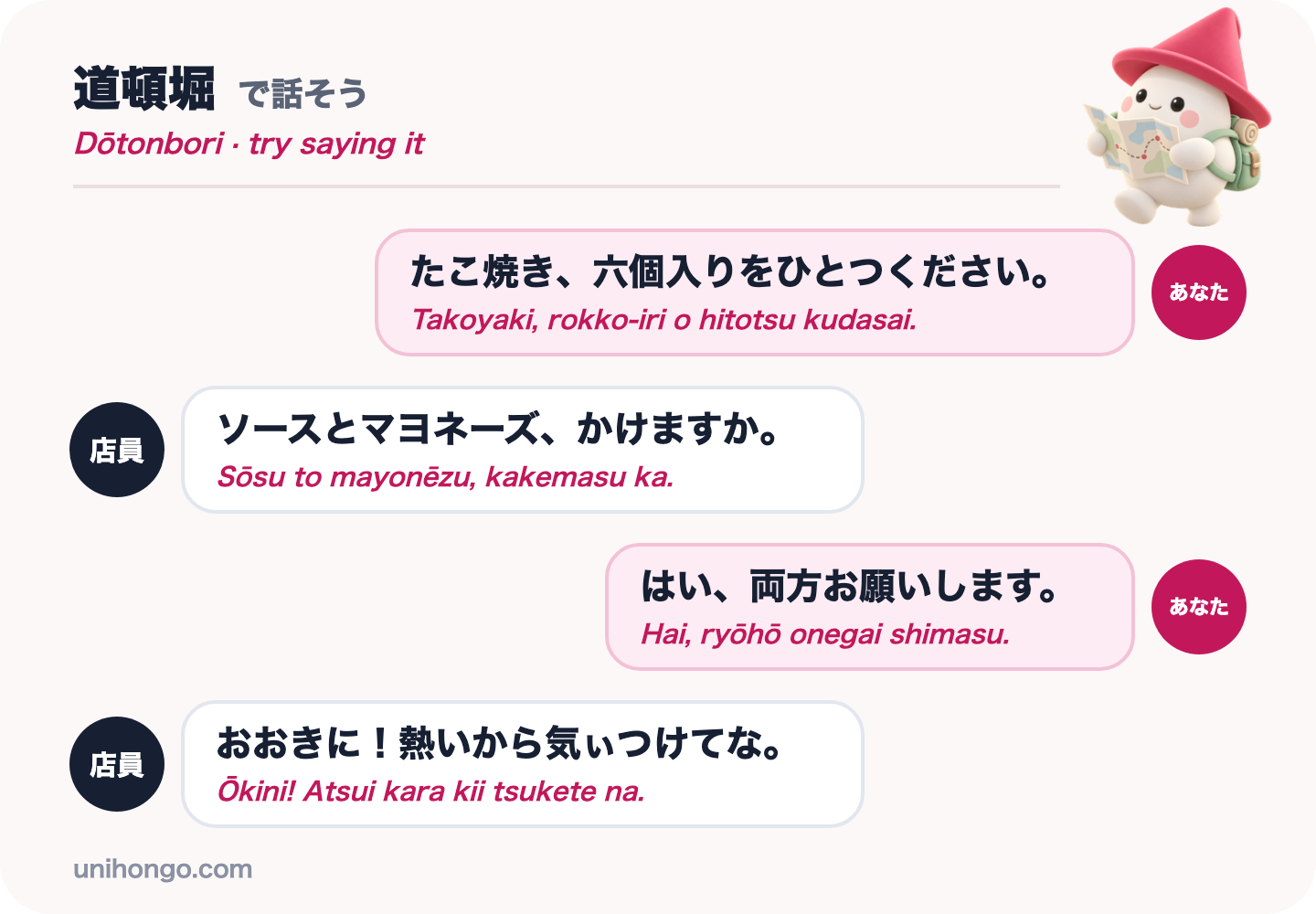
| Japanese | Romaji | Meaning |
|---|---|---|
| たこ焼き、六個入りをひとつください。 | Takoyaki, rokko-iri o hitotsu kudasai. | One box of six takoyaki, please. |
| ソースとマヨネーズ、かけますか。 | Sōsu to mayonēzu, kakemasu ka. | Would you like sauce and mayonnaise on them? |
| はい、両方お願いします。 | Hai, ryōhō onegai shimasu. | Yes, both, please. |
| おおきに!熱いから気ぃつけてな。 | Ōkini! Atsui kara kii tsukete na. | Thanks! They're hot, so be careful. (Kansai dialect) |
Official information
Osaka's official tourism site covers Dōtonbori and the river cruise, including boarding times and any suspensions for weather or events. Check before you go, especially if you want to ride the boat at a particular time.