
What a depachika is and how the floor is laid out
Most large department stores in Japan give their basement floor, or two, to food. It is not a supermarket and not a food court. It is a hall of small branded counters, each with its own staff, its own glass case and its own till: Japanese sweets in one zone, Western cakes in another, then prepared dishes, bento, bread, tea and sake. Stores built over railway stations connect the hall almost directly to the ticket gates, so commuters shop for dinner on the way home.
Almost everything is sold to take away, o-mochikaeri (お持ち帰り), and you pay at each counter separately. These are the words on the signs.
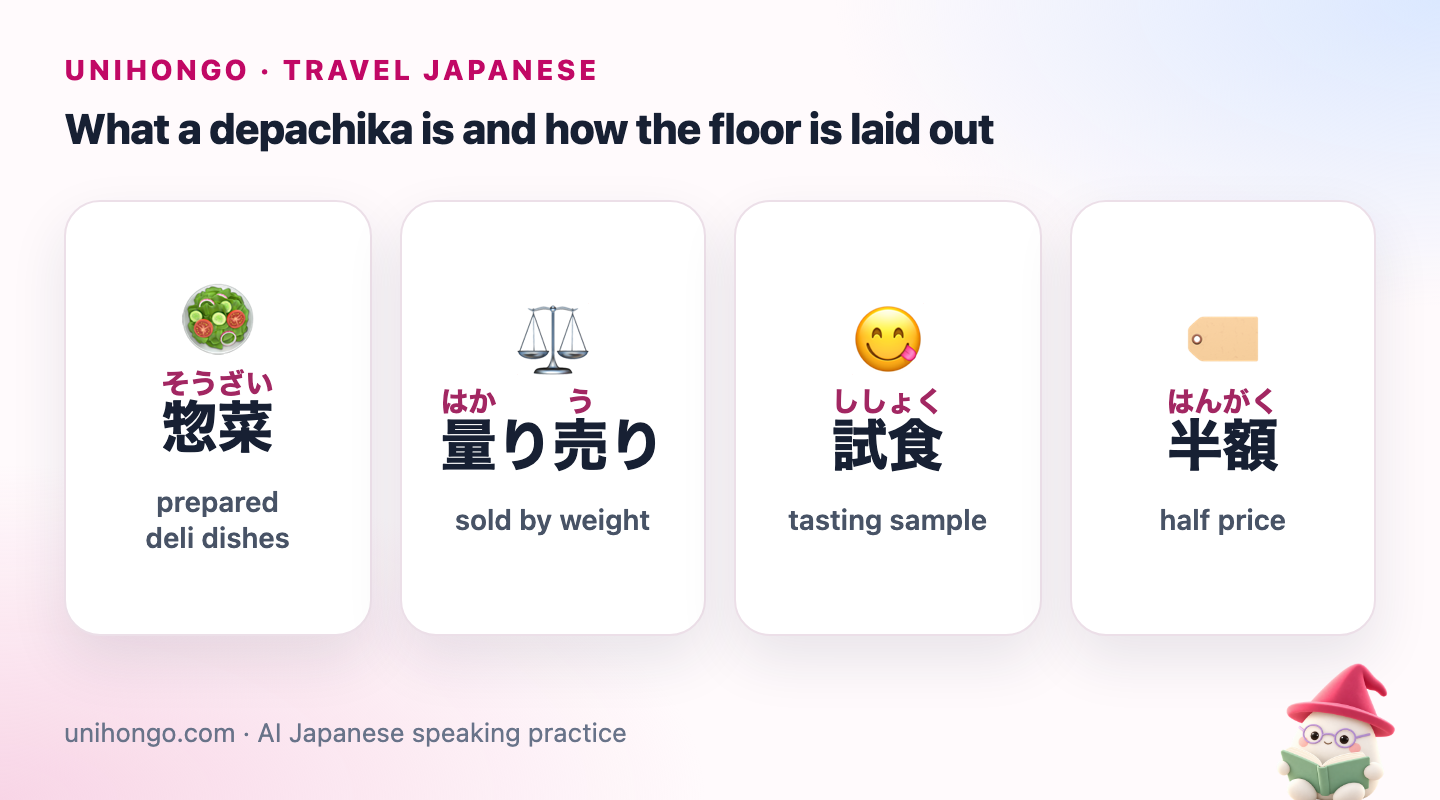
| Japanese | Romaji | Meaning |
|---|---|---|
| 惣菜 | sōzai | prepared deli dishes |
| 量り売り | hakari-uri | sold by weight |
| 試食 | shishoku | tasting sample |
| 半額 | hangaku | half price |
| 弁当 | bentō | boxed meal |
| 和菓子 | wagashi | Japanese sweets |
| 洋菓子 | yōgashi | Western-style cakes and sweets |
Sōzai and bento: buying by the piece
Sōzai (惣菜), usually said o-sōzai, are ready-made dishes: salads, fried chicken, croquettes, grilled fish, simmered vegetables, dumplings. Many are sold by the piece or the pack, and you simply point and give a number. The clerk finishes with a set question, and a set answer closes the order.
| Japanese | Romaji | Meaning |
|---|---|---|
| これを二つください。 | Kore o futatsu kudasai. | Two of these, please. |
| コロッケを三個ください。 | Korokke o sanko kudasai. | Three croquettes, please. |
| このお弁当を一つお願いします。 | Kono o-bentō o hitotsu onegai shimasu. | One of these bento, please. |
| 以上でよろしいですか。 | Ijō de yoroshii desu ka. | Will that be all? |
| はい、以上です。 | Hai, ijō desu. | Yes, that is all. |
Hakari-uri: ordering by weight
Hakari-uri (量り売り) means selling by measuring. Dishes sit in large trays, the price card shows the price for 100 grams, written 100g, and you say how many grams you want. One hundred grams of a salad is a small side for one person; two hundred is a comfortable portion. The clerk scoops, weighs, and often lands a little over, then asks whether that is all right.
| Japanese | Romaji | Meaning |
|---|---|---|
| 100グラムください。 | Hyaku guramu kudasai. | 100 grams, please. |
| これを200グラムお願いします。 | Kore o nihyaku guramu onegai shimasu. | 200 grams of this, please. |
| 少し多いですが、よろしいですか。 | Sukoshi ōi desu ga, yoroshii desu ka. | It is a little over. Is that all right? |
| はい、大丈夫です。 | Hai, daijōbu desu. | Yes, that is fine. |
| 一人分はどのくらいですか。 | Hitoribun wa dono kurai desu ka. | How much is a portion for one? |
Shishoku: accepting or declining a sample
Shishoku (試食) is a tasting sample, offered on a toothpick or a small spoon, most often at sweets, pickle and tea counters. Taking one creates no duty to buy. Take one piece, step aside to eat it, and either buy or thank the clerk and move on.
| Japanese | Romaji | Meaning |
|---|---|---|
| ご試食いかがですか。 | Go-shishoku ikaga desu ka. | Would you like to try a sample? |
| 試食できますか。 | Shishoku dekimasu ka. | May I try it? |
| おいしいですね。 | Oishii desu ne. | It is delicious. |
| ちょっと考えます。 | Chotto kangaemasu. | I will think about it. |
Time sales and discount stickers
Fresh dishes cannot be sold the next day, so towards closing time staff begin marking them down. A taimu sēru (タイムセール) is a limited-time sale, often announced by a clerk calling out across the floor. On the packs themselves, look for stickers.
Waribiki (割引) is a discount counted in tenths: niwaribiki (2割引) is two tenths off, 20 per cent, and sanwaribiki (3割引) is 30 per cent. Hangaku (半額) is half price. Some stickers use a percentage instead, followed by biki (引き), off.
| Japanese | Romaji | Meaning |
|---|---|---|
| タイムセール | taimu sēru | limited-time sale |
| 2割引 | niwaribiki | 20 per cent off |
| 値引き | nebiki | price reduction |
| 売り切れ | urikire | sold out |
| 何時まで開いていますか。 | Nanji made aite imasu ka. | What time are you open until? |
At the till: gifts, carrying time and ice packs
Paying at a sweets or cake counter brings a run of polite questions that visitors rarely expect. They come in a fairly fixed order: is it for you or a gift, how long will you carry it, and do you need extra bags.
| Japanese | Romaji | Meaning |
|---|---|---|
| ご自宅用ですか。 | Go-jitaku-yō desu ka. | Is it for yourself? |
| はい、自宅用です。 | Hai, jitaku-yō desu. | Yes, it is for myself. |
| いいえ、贈り物です。 | Iie, okurimono desu. | No, it is a gift. |
| お持ち歩きのお時間は? | O-mochiaruki no o-jikan wa? | How long will you be carrying it? |
| 一時間ぐらいです。 | Ichi-jikan gurai desu. | About one hour. |
| 保冷剤をお付けします。 | Horeizai o o-tsuke shimasu. | I will add an ice pack. |
| 紙袋をもう一枚いただけますか。 | Kamibukuro o mō ichimai itadakemasu ka. | Could I have one more paper bag? |
Jitaku-yō (自宅用), for home use, gets you simple packing. Say it is a gift and the clerk will wrap it, and may offer a spare bag so that you can hand the gift over in a clean one. The carrying-time question decides how many horeizai (保冷剤), ice packs, go in with a cake; answer with a number and jikan, hours, or fun, minutes.
Temiyage: the gift you bring when you visit
Many depachika sweets are bought as temiyage (手土産), the small gift you carry when you visit someone's home or office. It differs from omiyage (お土産), a souvenir brought back from a trip. A good temiyage is individually wrapped, easy to share, and comes in a count that suits the household or the team. Ask how many pieces are in the box and how long it keeps.
| Japanese | Romaji | Meaning |
|---|---|---|
| 手土産 | temiyage | a gift to bring when visiting |
| 個包装 | kohōsō | individually wrapped |
| 手土産におすすめはどれですか。 | Temiyage ni osusume wa dore desu ka. | Which do you recommend as a visiting gift? |
| 何個入りですか。 | Nanko-iri desu ka. | How many pieces are in it? |
| 日持ちはどのくらいですか。 | Himochi wa dono kurai desu ka. | How long does it keep? |