

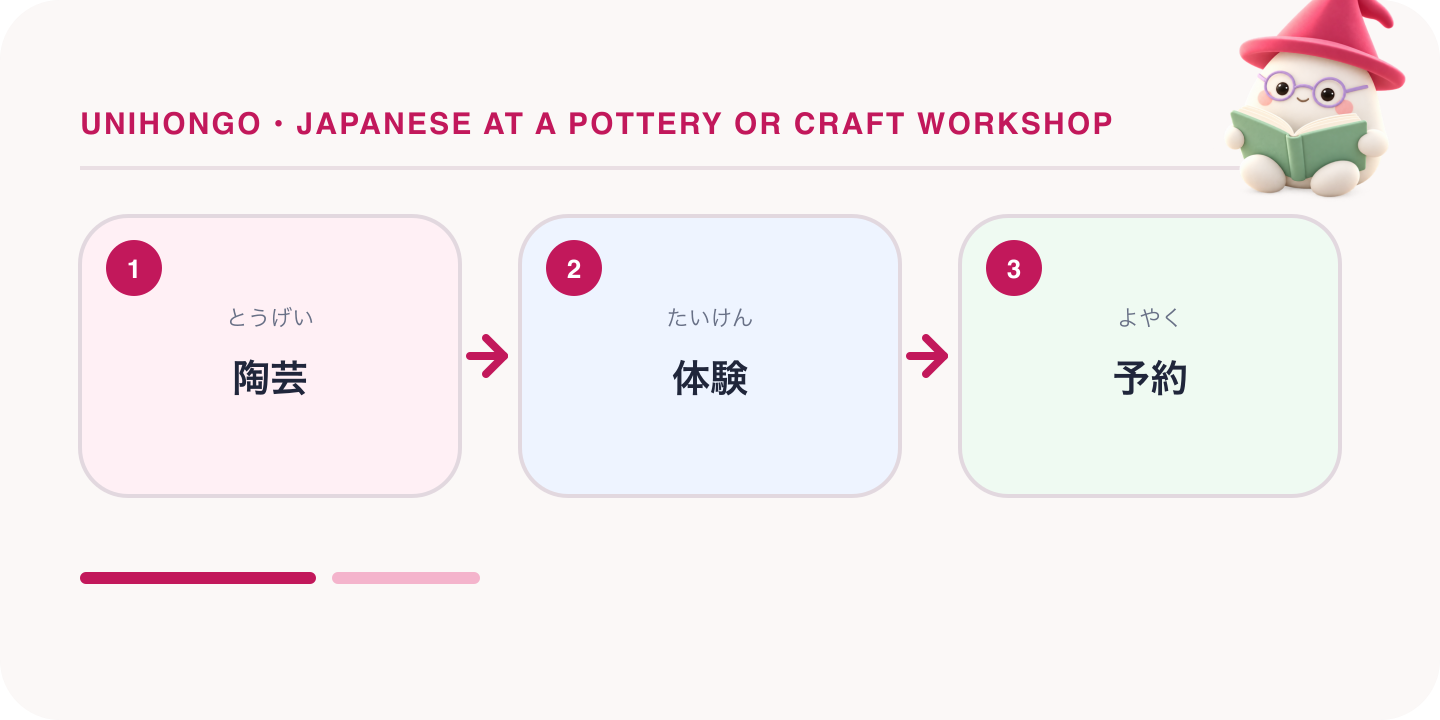
Booking a taiken
Booking is where you learn what you are actually getting. Studios differ on almost everything: whether the fee covers the clay, glazing, firing and shipping, how many pieces you make, whether you choose the glaze colour, how long the session runs, and whether children can join. Ask each of these when you book, and ask whether the session is in Japanese only. Many studios run on a set timetable, so give a date and a time slot rather than a vague afternoon.
The same pattern as any Japanese booking applies: say what you want, give the date, the number of people and your name, and let them ask the rest. Tell them if anyone in the group is a child or has a disability that affects sitting at a wheel, and ask about cancellation, because some studios charge for late changes.
| Japanese | Romaji | Meaning |
|---|---|---|
| 陶芸体験を予約したいんですが。 | Tōgei taiken o yoyaku shitai n desu ga. | I'd like to book a pottery experience. |
| 日曜日の午前中、二名でお願いします。 | Nichiyōbi no gozenchū, nimei de onegai shimasu. | Sunday morning, for two people, please. |
| 料金には焼成と送料も含まれていますか。 | Ryōkin ni wa shōsei to sōryō mo fukumarete imasu ka. | Does the fee include firing and shipping? |
| 所要時間はどのくらいですか。 | Shoyō jikan wa dono kurai desu ka. | How long does it take? |
| 子どもも参加できますか。 | Kodomo mo sanka dekimasu ka. | Can children take part too? |
| 日本語だけでも大丈夫ですか。 | Nihongo dake demo daijōbu desu ka. | Is it okay if it's in Japanese only? |
| キャンセル料はかかりますか。 | Kyanseru-ryō wa kakarimasu ka. | Is there a cancellation fee? |
Arriving and the questions staff ask
When you arrive, give your name and the booking time at the reception. Staff will ask you to put your bags in a locker or on a shelf, hand you an apron, epuron, or gloves for dyeing, and ask a few setting-up questions. For pottery they ask what you want to make, a cup, a bowl or a plate, and later which glaze colour. For indigo they ask what item you want to dye, a handkerchief, a tote bag or a scarf, and which pattern technique. For calligraphy they ask which character or word you want to write.
Payment is often taken at the start, sometimes at the end; ask if unsure. Many studios have a raised floor, so you may be asked to remove your shoes and put on slippers.
| Japanese | Romaji | Meaning |
|---|---|---|
| 十時に予約したスミスです。 | Jūji ni yoyaku shita Sumisu desu. | I'm Smith, I have a booking at ten. |
| 何を作りたいですか。 | Nani o tsukuritai desu ka. | What would you like to make? |
| お茶碗を作ってみたいです。 | O-chawan o tsukutte mitai desu. | I'd like to try making a rice bowl. |
| 色はどれにしますか。 | Iro wa dore ni shimasu ka. | Which colour would you like? |
| 荷物はこちらに置いてください。 | Nimotsu wa kochira ni oite kudasai. | Please put your bags here. |
| 指輪と時計は外してください。 | Yubiwa to tokei wa hazushite kudasai. | Please take off rings and watches. |
The instructor's core phrases
Instructors teach with their hands and a very small vocabulary, repeated constantly. Kō shite, do it like this, comes with a demonstration; sō sō, that's it, means you have got it; chigau or sō ja nakute means not quite. Yukkuri, slowly, is said more than any other word at a pottery wheel, and motto, more, combines with anything: motto tsuyoku, harder, motto yowaku, softer, motto ue, higher up.
Kore o motte, hold this, and ryōte de, with both hands, set up the posture. At the wheel you will hear oyayubi, thumb, and hiji o koshi ni tsukete, keep your elbows against your hips, and at the indigo vat you will hear tsukete, dip it, and shibotte, wring it out. Calligraphy teachers use fude o tatete, keep the brush upright, and ikki ni, in one stroke. Listen for the verb ending in te, which is the instruction, and ignore the rest until you have done it.
| Japanese | Romaji | Meaning |
|---|---|---|
| こうしてください。 | Kō shite kudasai. | Do it like this. |
| これを持って。 | Kore o motte. | Hold this. |
| ゆっくり、ゆっくり。 | Yukkuri, yukkuri. | Slowly, slowly. |
| もう少し強く押してください。 | Mō sukoshi tsuyoku oshite kudasai. | Press a little harder. |
| そうそう、上手です。 | Sō sō, jōzu desu. | That's it, well done. |
| 肘を腰につけてください。 | Hiji o koshi ni tsukete kudasai. | Keep your elbows against your hips. |
| 一気に書いてください。 | Ikki ni kaite kudasai. | Write it in one go. |
| 布を藍に浸けて、絞ってください。 | Nuno o ai ni tsukete, shibotte kudasai. | Dip the cloth in the indigo and wring it out. |
Asking for help and checking your work
Beginners lose most of their pieces by not asking soon enough. The moment the clay wobbles or the colour looks wrong, say sumimasen and describe it: it has gone thin, it is too wet, the pattern moved. Instructors expect this and will often put their hands over yours to fix it; some ask first with sawatte mo ii desu ka, may I touch, and the answer is hai, onegai shimasu.
You can also ask for a judgement: kore de ii desu ka, is this all right, or mō sukoshi usuku shita hō ga ii desu ka, should I make it a bit thinner. In calligraphy, ask which stroke to fix rather than asking whether the whole character is good. In dyeing, ask how many more dips will give the depth you want, because indigo darkens with each dip and looks lighter when dry.
| Japanese | Romaji | Meaning |
|---|---|---|
| すみません、ちょっと教えてください。 | Sumimasen, chotto oshiete kudasai. | Sorry, could you show me? |
| 形が崩れてしまいました。 | Katachi ga kuzurete shimaimashita. | The shape has collapsed. |
| これでいいですか。 | Kore de ii desu ka. | Is this all right? |
| もう少し薄くした方がいいですか。 | Mō sukoshi usuku shita hō ga ii desu ka. | Should I make it a little thinner? |
| あと何回浸ければいいですか。 | Ato nankai tsukereba ii desu ka. | How many more times should I dip it? |
| この線を直したいです。 | Kono sen o naoshitai desu. | I'd like to fix this stroke. |
| もう一度やってもいいですか。 | Mō ichido yatte mo ii desu ka. | May I try again? |
Words on the price board and the shelves
Studios post a board with the options, fees and what is included, and the same words appear on the website and the booking form. These are the ones that decide what you pay and what you get.
| Word | Reading | Meaning |
|---|---|---|
| 体験 | taiken | Hands-on experience session |
| 陶芸 | tōgei | Pottery |
| 手びねり | tebineri | Hand building |
| ろくろ | rokuro | Potter's wheel |
| 釉薬 | yūyaku | Glaze |
| 焼成 | shōsei | Firing |
| 藍染め | aizome | Indigo dyeing |
| 書道 | shodō | Calligraphy |
| 和紙漉き | washi-suki | Washi paper making |
| 所要時間 | shoyō jikan | Time required |
| 送料別 | sōryō betsu | Shipping not included |
| お渡し | o-watashi | Handover of the finished piece |
Next to o-watashi you will often see a number of weeks, the time until firing is complete, and next to sōryō you will see whether shipping is per piece or per parcel. If the board says kokunai nomi, domestic only, the studio does not ship abroad, and you will need a hotel address or a friend in Japan.
Care, shipping and paying
A pottery piece leaves your hands wet and unfinished; the studio dries it, applies your chosen glaze and fires it, and the finished piece is ready weeks later. Before you leave, write your name, address and phone number on the form, confirm the glaze colour and ask when it will be sent. Domestic shipping by parcel service is standard; shipping overseas, fees and customs paperwork vary by studio, so ask rather than assume. If you are still in Japan when it is ready, many studios will send it to your hotel.
Indigo, calligraphy and washi usually go home the same day. Ask how to care for them: indigo cloth needs a first wash on its own in cold water, and calligraphy should dry flat before it is rolled. Payment methods vary, and small studios may be cash only.
| Japanese | Romaji | Meaning |
|---|---|---|
| 完成はいつ頃になりますか。 | Kansei wa itsu goro ni narimasu ka. | Roughly when will it be finished? |
| 海外に送ることはできますか。 | Kaigai ni okuru koto wa dekimasu ka. | Can you send it overseas? |
| ホテルに送ってもらえますか。 | Hoteru ni okutte moraemasu ka. | Could you send it to my hotel? |
| 送料はいくらですか。 | Sōryō wa ikura desu ka. | How much is shipping? |
| 洗い方を教えてください。 | Araikata o oshiete kudasai. | Please tell me how to wash it. |
| カードは使えますか。 | Kādo wa tsukaemasu ka. | Can I use a card? |
Thanking the instructor
Craft teachers are usually the people who make the work you see in the shop, and a proper thank you at the end matters to them. Arigatō gozaimashita is the minimum; tanoshikatta desu, that was fun, and iroiro oshiete itadaite arigatō gozaimashita, thank you for teaching me so much, are what regulars say. If you buy something from the shop afterwards, it is both a thank you and the best souvenir.
- Say arigatō gozaimashita to the teacher directly, not only to the reception
- Add a specific compliment: setsumei ga wakariyasukatta desu, the explanation was clear
- Ask for a photo with your piece: shashin o totte mo ii desu ka
- Buy a small item from the shop if you can; craftspeople live on those sales
- Post your finished piece later and tag the studio if they have a social account
- Send a short message when the parcel arrives: buji ni todokimashita
Tipping is not expected at a Japanese workshop, and an offered tip usually causes awkwardness. Your words and a purchase from the shop are the thanks that land.
When something goes wrong
The usual problems are a collapsed piece, a stained sleeve, a pattern that did not come out and a parcel that has not arrived. For a collapsed piece, ask whether you can start again; most studios allow one restart within the time, some charge for extra clay. Indigo stains on skin fade in a few days; on clothes they rarely come out, which is why the apron matters. If the parcel is late, contact the studio with your name and the date of the session, and ask for the tracking number.
If a finished piece arrives broken, tell the studio; policies on replacement differ, but a photo of the damage is always the first thing they will ask for. If you were unhappy with the session itself, say so calmly and specifically; craft studios are small businesses and take feedback seriously.
| Japanese | Romaji | Meaning |
|---|---|---|
| 失敗してしまいました。もう一度できますか。 | Shippai shite shimaimashita. Mō ichido dekimasu ka. | It went wrong. Can I do it again? |
| 袖に藍がついてしまいました。 | Sode ni ai ga tsuite shimaimashita. | I've got indigo on my sleeve. |
| まだ荷物が届いていないんですが。 | Mada nimotsu ga todoite inai n desu ga. | The parcel hasn't arrived yet. |
| 追跡番号を教えてもらえますか。 | Tsuiseki bangō o oshiete moraemasu ka. | Could you give me the tracking number? |
| 届いた作品が割れていました。 | Todoita sakuhin ga warete imashita. | The piece arrived broken. |