

Why Ikebukuro deserves more than a transfer
Many visitors only pass through Ikebukuro on the Yamanote Line or on the way to somewhere else. That is a pity, because it is one of Tokyo's most enjoyable ordinary districts: less polished than Shinjuku, less crowded with tourists than Shibuya, and full of big shops, cheap eats, cinemas, theatres and anime culture.
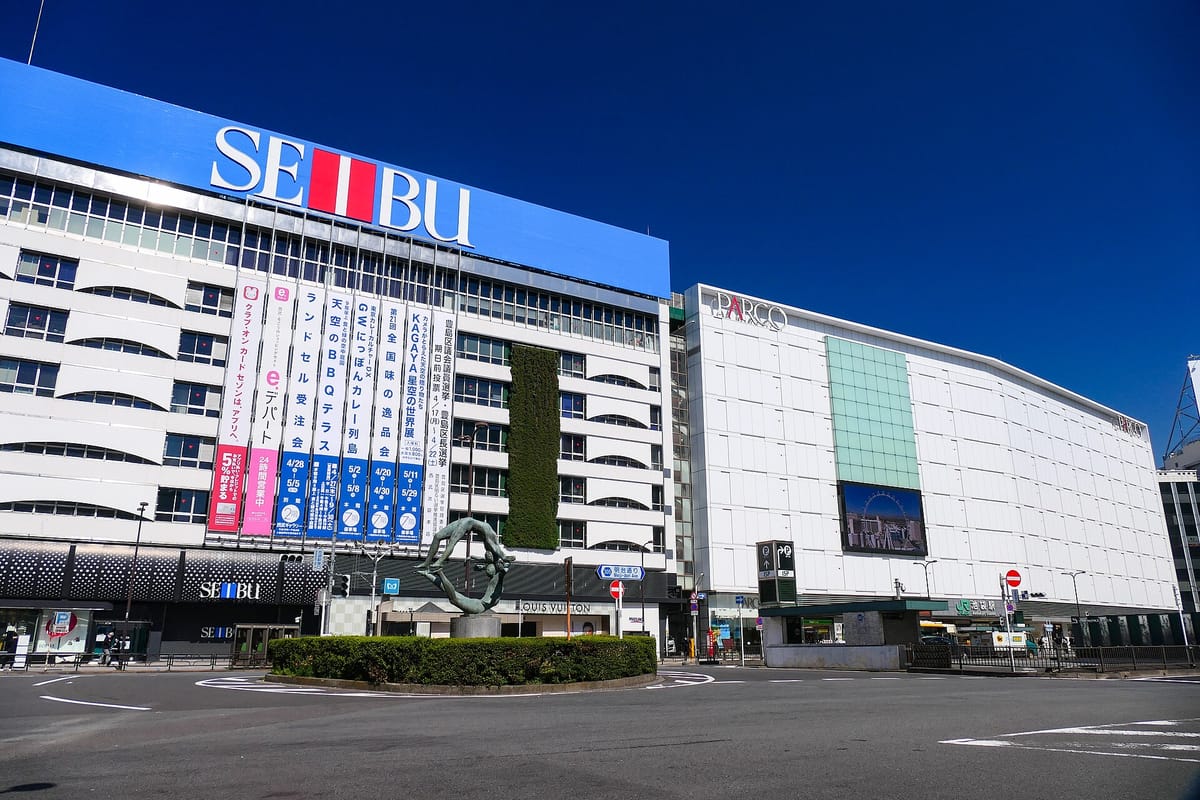
It is also a lesson in how Tokyo grew. Railway companies built lines out to the suburbs from here in the early twentieth century, then built department stores next to their terminals to catch the passengers. Tōbu and Seibu still face each other across the station, and the rivalry between them shaped the district.
For a Japanese learner, Ikebukuro is a crash course in station Japanese. Exits, lines, transfers and underground passages are all signed in Japanese first, and asking the way is part of daily life even for Tokyo residents.
Getting there: Ikebukuro Station and its exits
Ikebukuro Station is served by the JR Yamanote, Saikyō and Shōnan-Shinjuku lines, the Tokyo Metro Marunouchi, Yūrakuchō and Fukutoshin lines, and the private Tōbu Tōjō and Seibu Ikebukuro lines. Shinjuku is about eight minutes away by JR, and Tokyo Station about seventeen minutes on the Marunouchi Line or twenty-four on the Yamanote Line.
The key is knowing your exit. The east exit, higashi-guchi, leads to the Seibu department store, Sunshine City, Otome Road and most shopping streets. The west exit, nishi-guchi, leads to the Tōbu department store, the Tokyo Metropolitan Theatre and Ikebukuro Nishiguchi Park. Inside the station, the owl statue Ikefukurō, installed in 1987 in the passage on the east side, is the classic place to meet; tell friends Ikefukurō no mae de, in front of Ikefukurō.
| Japanese | Romaji | Meaning |
|---|---|---|
| サンシャインシティは何口ですか。 | Sanshain Shiti wa nani-guchi desu ka. | Which exit is Sunshine City? |
| 東口はどちらですか。 | Higashi-guchi wa dochira desu ka. | Which way is the east exit? |
| 丸ノ内線への乗り換えはどこですか。 | Marunouchi-sen e no norikae wa doko desu ka. | Where do I transfer to the Marunouchi Line? |
| いけふくろうはどこにありますか。 | Ikefukurō wa doko ni arimasu ka. | Where is the Ikefukurō owl statue? |
| いけふくろうの前で待ち合わせしましょう。 | Ikefukurō no mae de machiawase shimashō. | Let's meet in front of Ikefukurō. |
What you will see: Sunshine City, Otome Road and Zōshigaya
Plan the day around the two sides of the station. The east side is for Sunshine City and anime shopping; the west side for parks, theatres and food; and Zōshigaya, south of the centre, for a quiet hour in old Tokyo.
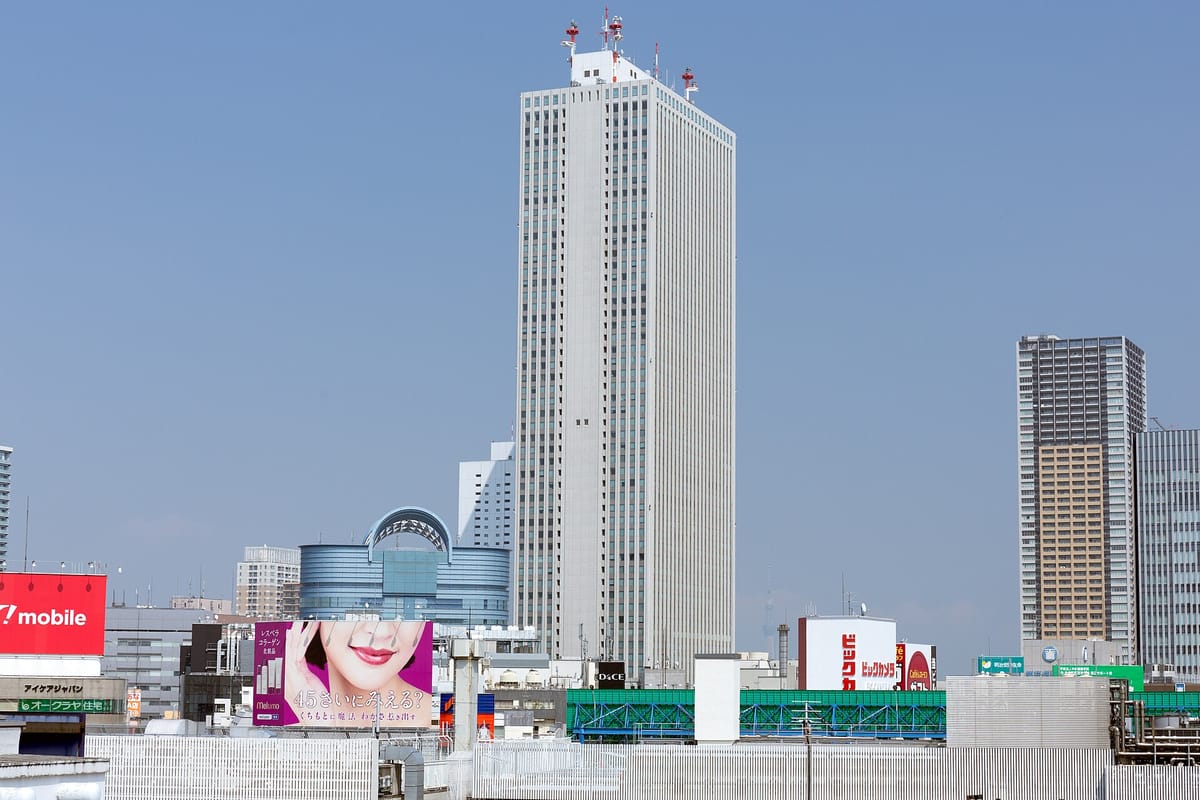
- Sunshine 60 Observatory, Tenbou-Park: an indoor observation floor on the 60th floor of the Sunshine 60 tower, about 251 metres above sea level, with 360-degree views.
- Sunshine Aquarium: on the roof of the neighbouring World Import Mart building, with sea lions and penguins that seem to swim over your head.
- Namja Town and the Manten planetarium: an indoor theme park with food corners and a planetarium in the same complex.
- Pokémon Center Mega Tokyo: one of Japan's largest Pokémon shops, inside Sunshine City.
- Otome Road, 乙女ロード: anime, manga and fan goods shops just north of Sunshine City, with Animate's flagship store near the east exit.
- Ikebukuro Nishiguchi Park: a plaza by the west exit with the ring-shaped Global Ring Theater stage, next to the Tokyo Metropolitan Theatre.
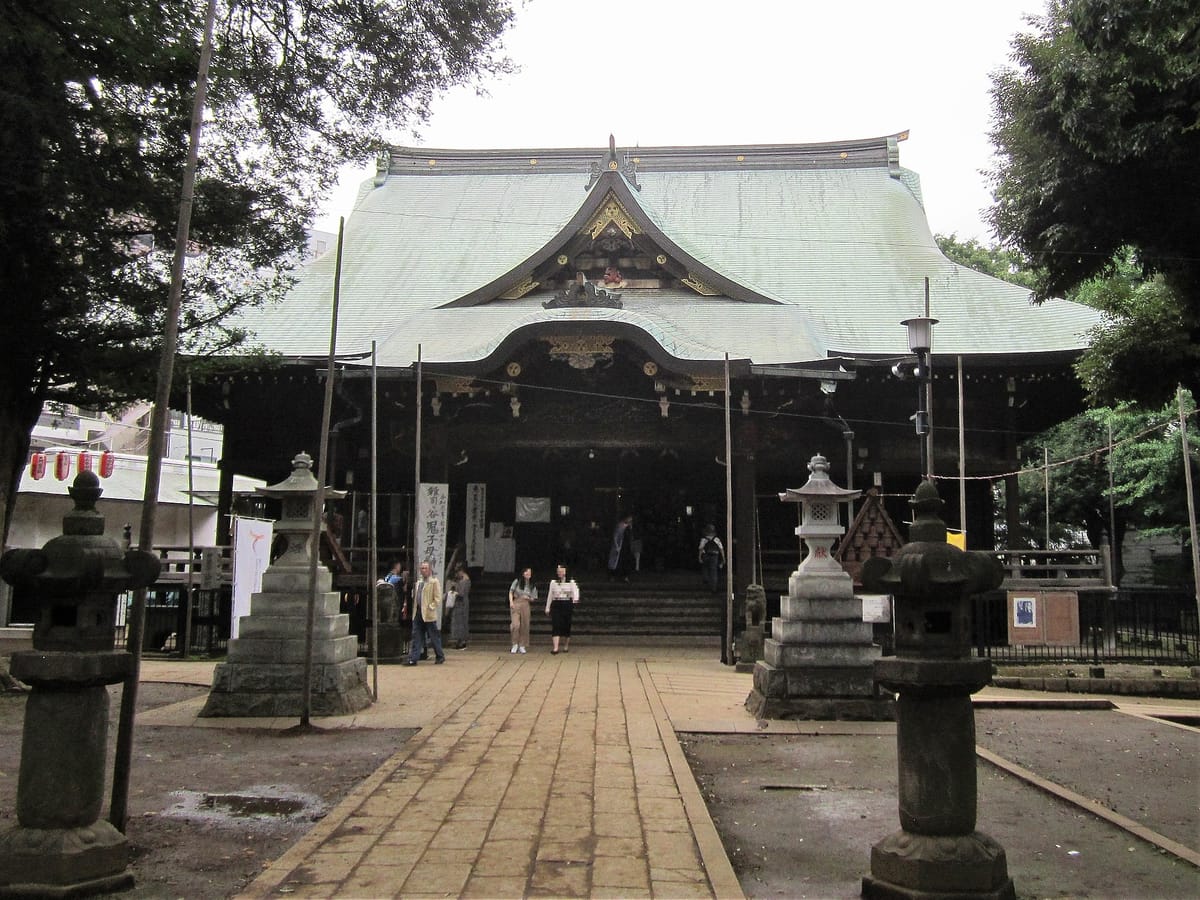
- Zōshigaya Kishimojin-dō, 雑司ヶ谷鬼子母神堂: a wooden temple hall to Kishimojin, protector of childbirth and children, reached on foot or by the Toden Arakawa tram.
- Jiyū Gakuen Myōnichikan: a school building designed by Frank Lloyd Wright, a short walk from the west side of the station.
Exits, railways and the words on the signs
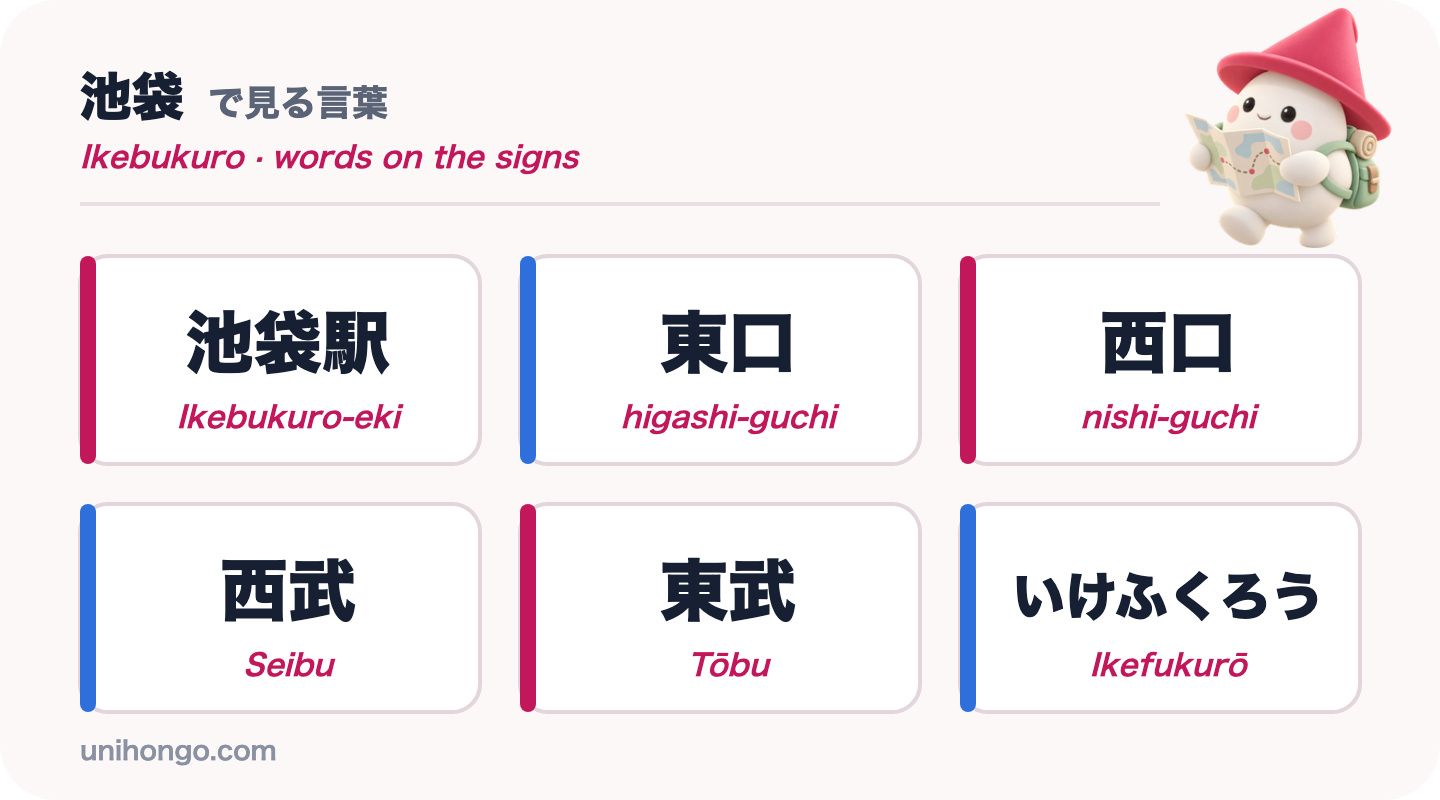
The two most important signs in Ikebukuro are the exits, and the trick is that the railway names point the wrong way. 西武, Seibu, contains 西, west, but its department store is at the east exit, 東口. 東武, Tōbu, contains 東, east, but its store is at the west exit, 西口. If you can read these four kanji, you will never walk out of the wrong side.
Inside the station, follow the colour-coded line signs and the word 乗り換え, norikae, transfer. Underground passages connect the exits, and the owl statue いけふくろう, written in friendly hiragana, is a landmark in its own right.
| Word | Reading | Meaning |
|---|---|---|
| 池袋駅 | Ikebukuro-eki | Ikebukuro Station |
| 東口 | higashi-guchi | East exit, for Seibu and Sunshine City |
| 西口 | nishi-guchi | West exit, for Tōbu and Nishiguchi Park |
| 西武 | Seibu | The Seibu railway and department store |
| 東武 | Tōbu | The Tōbu railway and department store |
| いけふくろう | Ikefukurō | The owl statue meeting point in the station |
| 乗り換え | norikae | Transfer between lines |
| 乙女ロード | Otome Rōdo | Otome Road, the anime shopping street |
| 展望台 | tenbōdai | Observation deck |
Japanese for the station and the anime shops
In a station this size, the right question saves a lot of walking. Ask staff at a ticket gate or an information counter, and use the name of your destination with nani-guchi or dono deguchi, which exit. For transfers, ask for the line by name followed by norikae.
In anime and character shops, the useful questions are about what is in stock, whether an item is limited to the shop, and whether there is a purchase limit on popular goods. Shops often sell blind-packed items, where you do not know which character you will get; the Japanese word for these is often ランダム, randamu, random.
| Japanese | Romaji | Meaning |
|---|---|---|
| この近くに東武デパートはありますか。 | Kono chikaku ni Tōbu depāto wa arimasu ka. | Is the Tōbu department store near here? |
| 池袋駅から歩いて何分くらいですか。 | Ikebukuro-eki kara aruite nanpun kurai desu ka. | About how many minutes' walk from Ikebukuro Station? |
| このグッズはまだありますか。 | Kono guzzu wa mada arimasu ka. | Do you still have this merchandise? |
| ここだけの限定商品はありますか。 | Koko dake no gentei shōhin wa arimasu ka. | Do you have any items sold only here? |
| 一人何個まで買えますか。 | Hitori nanko made kaemasu ka. | How many can one person buy? |
| 展望台のチケットはどこで買えますか。 | Tenbōdai no chiketto wa doko de kaemasu ka. | Where can I buy tickets for the observation deck? |
Crowds, timing and practical tips
Ikebukuro is busy but easy-going. A few habits make it smoother.
- Decide your exit before you leave the train; the wrong exit can mean a long walk round the station.
- Keep to the flow in passages, and stand still on escalators; in Tokyo, people traditionally line up on the left.
- Visit Sunshine City's aquarium and observatory on a weekday if you can; weekends and school holidays are busy.
- In anime shops, check whether photography is allowed before taking pictures of displays.
- Carry a transport IC card; you will likely use several lines and the tram in one day.
- For a quiet break, walk or take the tram to Zōshigaya, where the temple grounds are shaded by old trees.
- In the evening, the streets east of the station fill up with restaurants and bars; watch your belongings in crowds as anywhere.
Practise the station before you go
This exchange practises a question you will use at every big Japanese station, nani-guchi desu ka, and the easy small talk that can follow. Notice n desu ne, which turns a plain statement into an interested, friendly comment.
Then practise with a partner who answers back. In Unihongo, try the Ask the Way to the Station mission and ask your AI Sensei to play station staff at Ikebukuro, or choose the Shopping topic to rehearse an anime shop on Otome Road. Saying the lines aloud once before you go makes them come out at the ticket gate.
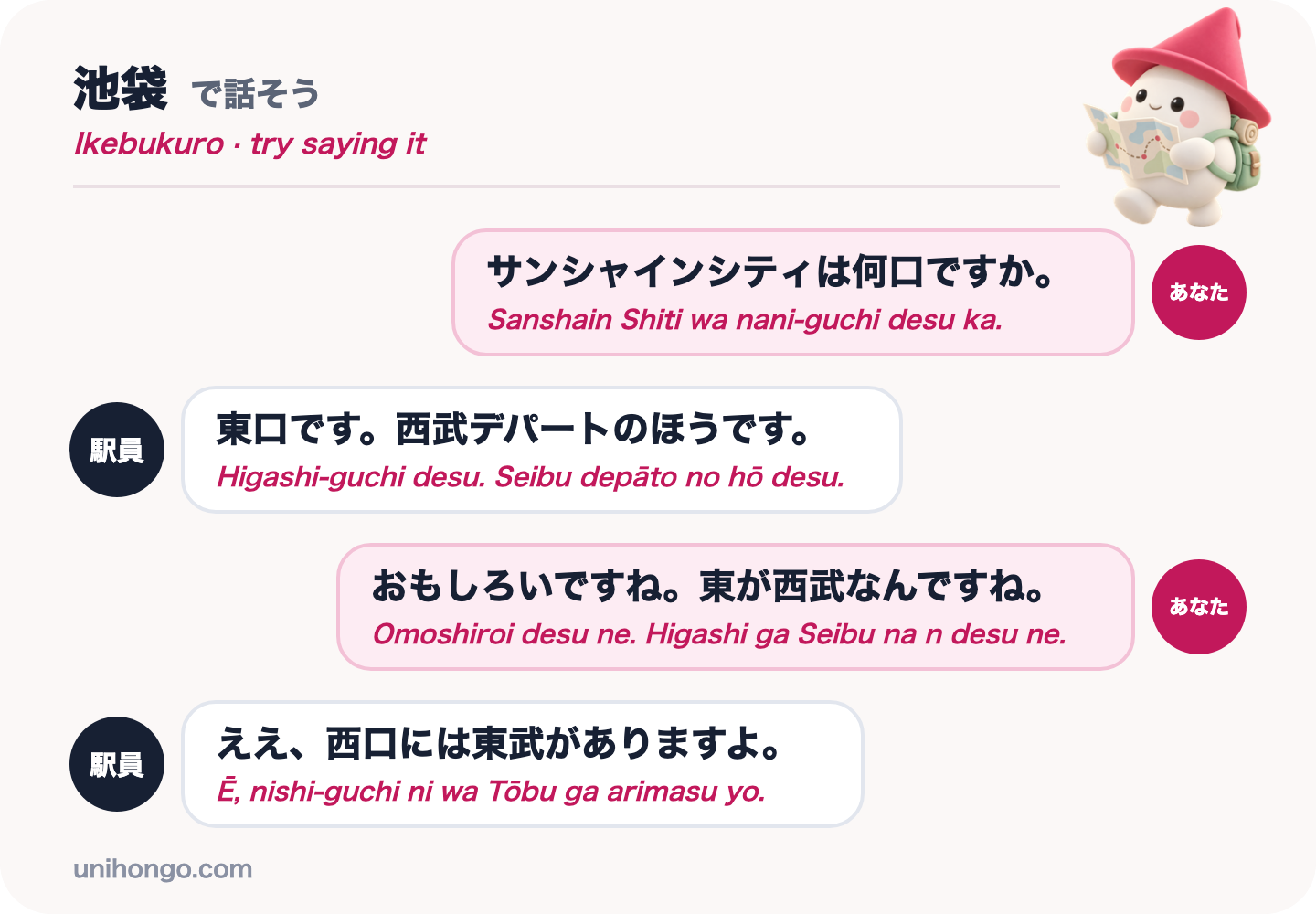
| Japanese | Romaji | Meaning |
|---|---|---|
| サンシャインシティは何口ですか。 | Sanshain Shiti wa nani-guchi desu ka. | Which exit is Sunshine City? |
| 東口です。西武デパートのほうです。 | Higashi-guchi desu. Seibu depāto no hō desu. | The east exit. The Seibu department store side. |
| おもしろいですね。東が西武なんですね。 | Omoshiroi desu ne. Higashi ga Seibu na n desu ne. | That's funny. So Seibu is on the east side. |
| ええ、西口には東武がありますよ。 | Ē, nishi-guchi ni wa Tōbu ga arimasu yo. | Yes, and Tōbu is at the west exit. |
Official information
Opening hours and ticket prices for the observatory, aquarium and other Sunshine City attractions are published on the complex's own site. The Tokyo Convention and Visitors Bureau covers the wider Ikebukuro area.