

Why Ueno Park deserves a full day
The hill of Ueno was once the precinct of Kan'ei-ji, a vast temple built in the seventeenth century to protect Edo Castle and to serve the Tokugawa shoguns. Much of it was destroyed in the Battle of Ueno in 1868, and a few years later the land became one of Japan's first public parks. Museums, a zoo and exhibition halls followed, and the park became the place where modern Japan went to learn and to look.
It still is. Within a ten-minute walk you can move from national treasures of Japanese art to Rodin sculptures and French painting, from a full-size blue whale model to the gold leaf of a shogun's shrine. Between visits, the pond, the temples and the tree-lined avenue make it a pleasant place to simply walk, and in spring it is one of the city's great cherry-blossom parties.
For a learner, the museums are ideal. Ticket counters are calm, the phrases are the same at each one, and the labels in the Tokyo National Museum give you Japanese and English side by side, so you can match kanji to meaning as you go.
Getting there: Ueno Station and the Park exit
JR Ueno Station, on the Yamanote, Keihin-Tōhoku and other lines as well as the shinkansen, has an exit called the Park exit, 公園口, Kōen-guchi, which opens directly onto the road facing the park. From there the Tokyo Metropolitan Festival Hall and the National Museum of Western Art are just across the road. The Tokyo Metro Ginza and Hibiya lines also stop at Ueno, and the Keisei line from Narita Airport ends at Keisei Ueno Station, on the south edge of the park near Shinobazu Pond.
If you arrive by subway or on the Keisei line, follow the signs for 上野公園 and climb the steps up to the park near the Saigō Takamori statue. The Ameyoko market street, under the railway to the south of the station, is a good place for lunch before or after.
| Japanese | Romaji | Meaning |
|---|---|---|
| 公園口はどちらですか。 | Kōen-guchi wa dochira desu ka. | Which way is the Park exit? |
| 東京国立博物館へはどう行けばいいですか。 | Tōkyō Kokuritsu Hakubutsukan e wa dō ikeba ii desu ka. | How do I get to the Tokyo National Museum? |
| 動物園の入口はどこですか。 | Dōbutsuen no iriguchi wa doko desu ka. | Where is the zoo entrance? |
| 不忍池はこちらですか。 | Shinobazu no Ike wa kochira desu ka. | Is Shinobazu Pond this way? |
| 京成上野駅は近いですか。 | Keisei Ueno-eki wa chikai desu ka. | Is Keisei Ueno Station close? |
Museums, the zoo, the pond and the shrines
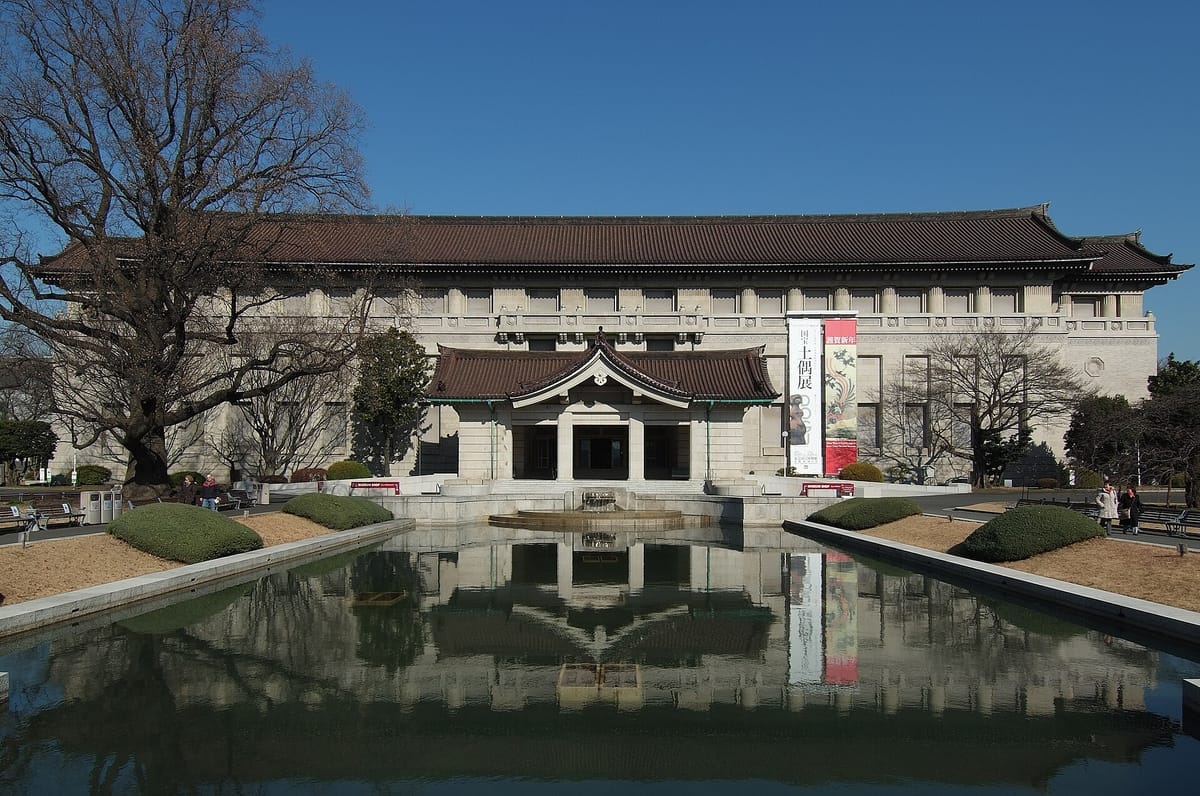
The Tokyo National Museum, founded in 1872, is the oldest and largest museum in Japan. Its Honkan, the main building, shows Japanese art in a rotating display, from Jōmon pottery to samurai armour, swords, lacquer, screens and kimono, and neighbouring buildings cover Asian art, archaeology and the treasures of Hōryū-ji. The National Museum of Western Art, in a building designed by Le Corbusier and listed as a UNESCO World Heritage Site, has Rodin sculptures in its forecourt. The National Museum of Nature and Science covers dinosaurs, space and the natural history of Japan.
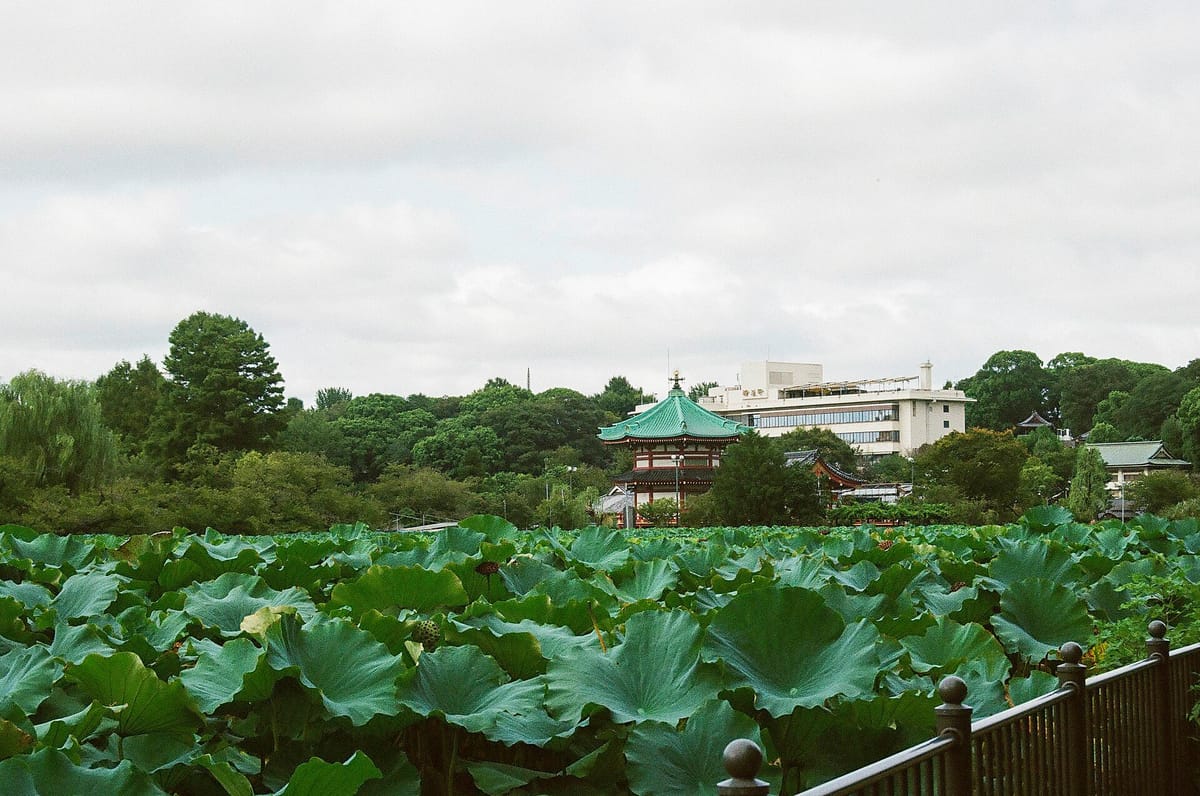
Between the museums, Ueno Zoo, opened in 1882, is the oldest zoo in Japan. On the west side of the park, Ueno Tōshōgū, a shrine to Tokugawa Ieyasu, glitters with gold leaf, and the Kiyomizu Kannon-dō looks out over Shinobazu Pond, whose island holds the Bentendō hall. In summer the pond is covered in lotus leaves; in spring the main avenue turns pink with cherry blossom.
- Tōkyō Kokuritsu Hakubutsukan (東京国立博物館): the Tokyo National Museum.
- Kokuritsu Seiyō Bijutsukan (国立西洋美術館): the National Museum of Western Art.
- Kokuritsu Kagaku Hakubutsukan (国立科学博物館): the National Museum of Nature and Science.
- Ueno Dōbutsuen (上野動物園): Ueno Zoo, the oldest zoo in Japan.
- Ueno Tōshōgū (上野東照宮): the gilded shrine to Tokugawa Ieyasu.
- Kiyomizu Kannon-dō (清水観音堂): a temple hall overlooking the pond.
- Shinobazu no Ike (不忍池): the lotus pond, with Bentendō on its island.
The words on the park signs
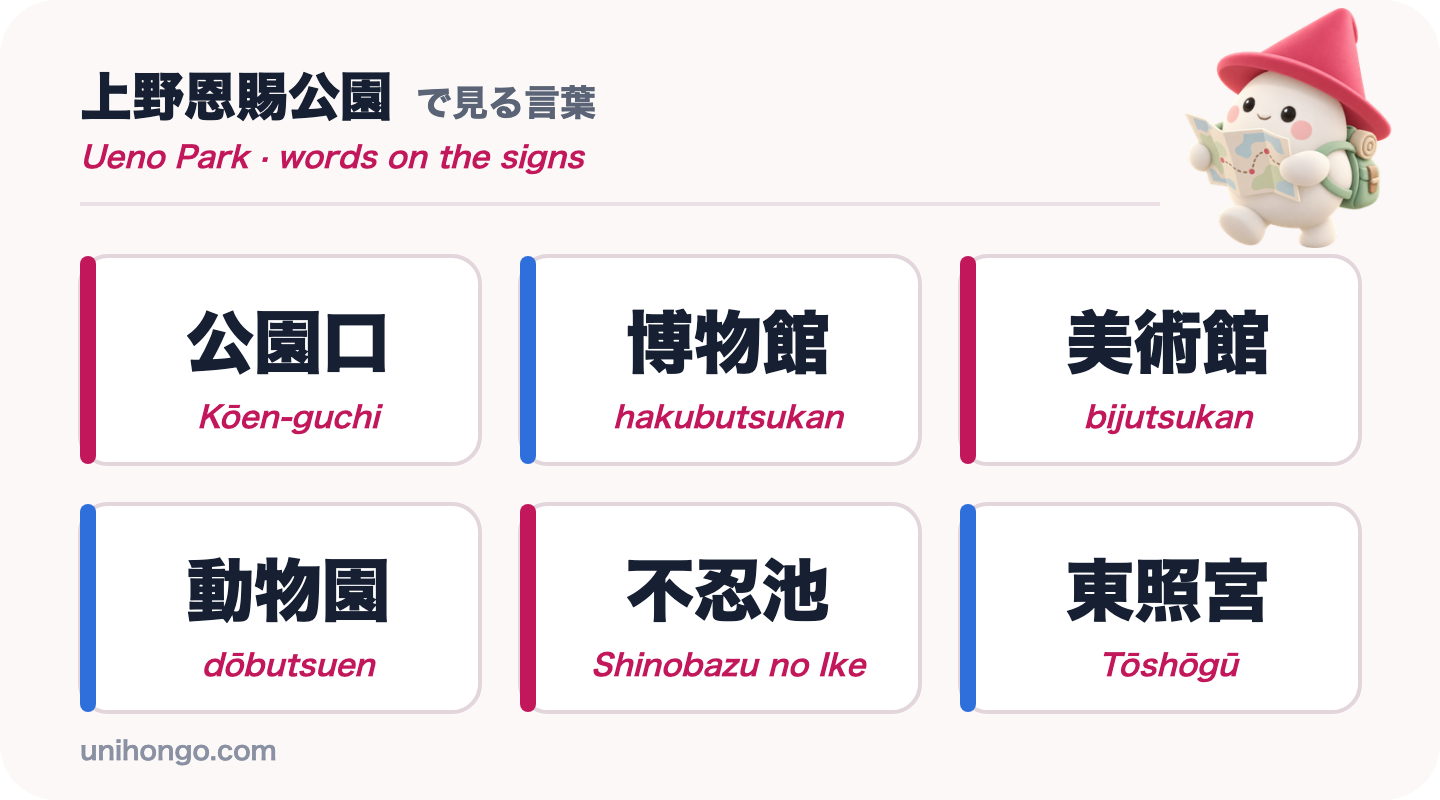
Ueno's signposts are built from a few useful endings. 館, kan, is a building or hall, and it appears in 博物館, museum, and 美術館, art museum. 園, en, is a garden or park, as in 動物園, zoo, literally animal garden, and 公園, park. Learn these endings and most of the map makes sense.
At the museums, the ticket words matter. 総合文化展, sōgō bunka-ten, is the Tokyo National Museum's name for its regular collection, and 特別展, tokubetsu-ten, is a special exhibition, which usually needs a separate ticket.
| Word | Reading | Meaning |
|---|---|---|
| 公園口 | Kōen-guchi | Park exit of Ueno Station |
| 博物館 | hakubutsukan | Museum |
| 美術館 | bijutsukan | Art museum |
| 動物園 | dōbutsuen | Zoo |
| 不忍池 | Shinobazu no Ike | Shinobazu Pond |
| 東照宮 | Tōshōgū | Shrine to Tokugawa Ieyasu |
| 総合文化展 | sōgō bunka-ten | Regular collection at the Tokyo National Museum |
| 特別展 | tokubetsu-ten | Special exhibition |
| 休館日 | kyūkanbi | Day the museum is closed |
Japanese at the museum counter
Buying a museum ticket takes three pieces of information: how many, what type of visitor and which exhibition. Adults are otona, university students daigakusei and children kodomo, and tickets are counted with mai. Many counters also have ticket machines with an English button, but asking at the desk is good practice.
Inside, the most common questions are about lockers, audio guides and whether you can take photos. Photo rules differ by gallery and exhibition, so look for the camera symbols or ask.
| Japanese | Romaji | Meaning |
|---|---|---|
| 大人二枚お願いします。 | Otona nimai onegai shimasu. | Two adults, please. |
| 特別展のチケットは別ですか。 | Tokubetsu-ten no chiketto wa betsu desu ka. | Is the ticket for the special exhibition separate? |
| 荷物はロッカーに預けられますか。 | Nimotsu wa rokkā ni azukeraremasu ka. | Can I leave my bag in a locker? |
| 英語の音声ガイドはありますか。 | Eigo no onsei gaido wa arimasu ka. | Is there an English audio guide? |
| ここは写真を撮ってもいいですか。 | Koko wa shashin o totte mo ii desu ka. | Can I take photos here? |
| 再入場はできますか。 | Sainyūjō wa dekimasu ka. | Can I re-enter? |
Hanami, timing and practical tips
Ueno Park changes with the seasons, and a few habits make a museum day smoother.
- Pick one or two museums per day; the Tokyo National Museum alone can fill a morning.
- Check each museum's closing day and hours before you go; they differ from building to building.
- In cherry-blossom season, go early on a weekday, and follow the park's rules on where picnic sheets may be spread.
- Visit Shinobazu Pond in summer, when the lotus leaves cover the water and the flowers bloom in the mornings.
- Use the lockers in the museums or at the station for large bags.
- Eat in Ameyoko or the cafés around the park; most museums do not allow food in the galleries.
Practise the visit before you go
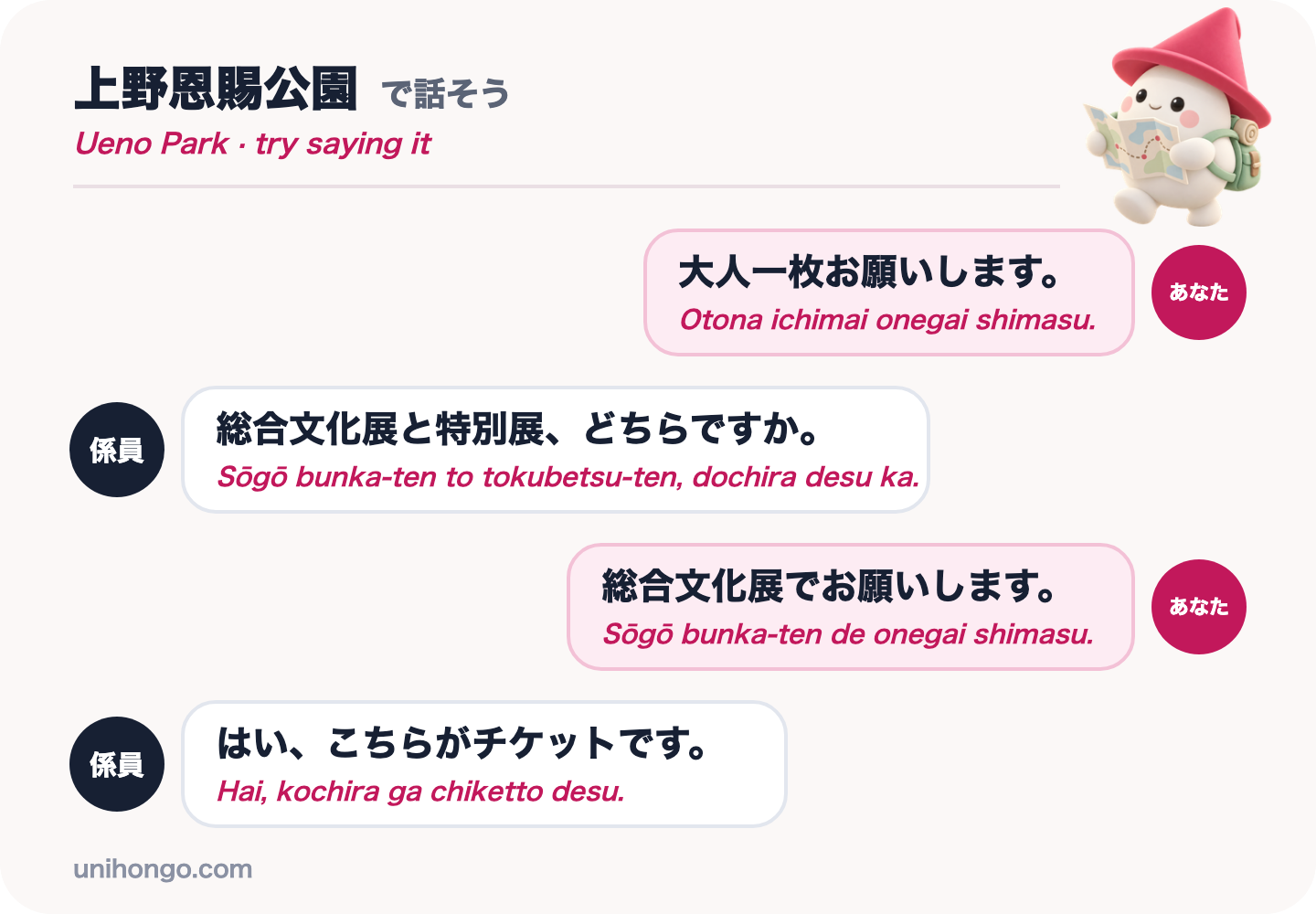
The dialogue below is the whole of most museum purchases. Listen for dochira desu ka, which one, and answer with the name of the exhibition plus de onegai shimasu. The same pattern works at the zoo and at any other counter in the park.
Then practise with someone who answers back. In Unihongo, choose the Sightseeing topic and ask your AI Sensei to play a ticket seller at the Tokyo National Museum. A couple of rounds of asking and answering makes the real counter feel easy.
| Japanese | Romaji | Meaning |
|---|---|---|
| 大人一枚お願いします。 | Otona ichimai onegai shimasu. | One adult, please. |
| 総合文化展と特別展、どちらですか。 | Sōgō bunka-ten to tokubetsu-ten, dochira desu ka. | The regular collection or the special exhibition? |
| 総合文化展でお願いします。 | Sōgō bunka-ten de onegai shimasu. | The regular collection, please. |
| はい、こちらがチケットです。 | Hai, kochira ga chiketto desu. | Here is your ticket. |
Official information
Each museum and the zoo publishes its own hours, closing days and exhibition schedule. Check the ones you plan to visit, and the Tokyo tourism board's Ueno page for the wider area.