

Why Matsue Castle is worth the trip
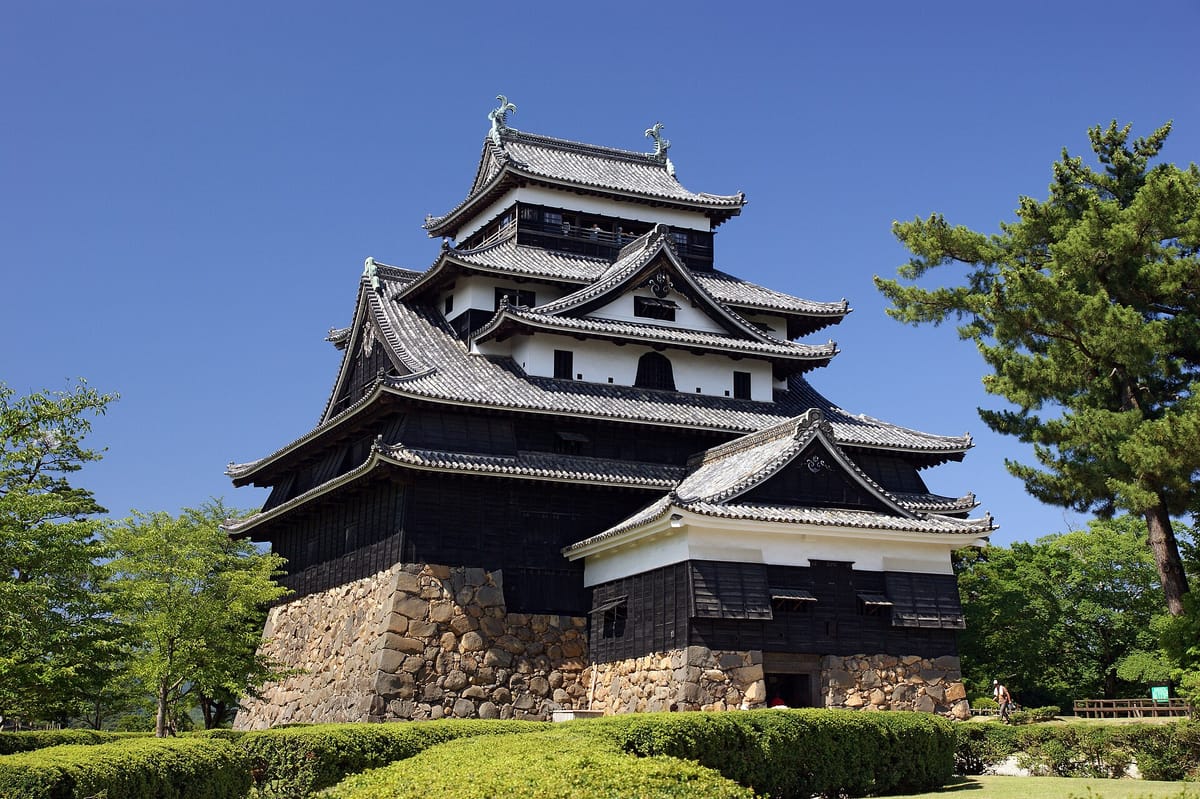
Most castles you see in Japan are concrete reconstructions. Matsue is the real thing. The keep was built by Horio Yoshiharu, a general who had served Toyotomi Hideyoshi, and completed in 1611. In the 1870s, when the new Meiji government ordered castles pulled down, the keep was sold for its timber, but local people bought it back and it was saved. Its dark wooden walls and layered roofs give it a sturdy, practical look, and its gables are said to spread like the wings of a plover, which is why it is also called Chidori-jō, Plover Castle.
The keep's age was confirmed only recently. In 2012 wooden prayer tablets were rediscovered carrying the date Keichō 16, that is 1611, and in 2015 the keep became a National Treasure. Inside, it has a feature found in no other surviving keep: a well, dug so the garrison could hold out under siege.
Matsue itself is a calm, walkable city of water, and a good place to practise Japanese. The castle staff, the boatmen and the shopkeepers on the samurai street speak clearly and are used to visitors.
Getting there: Matsue Station and the Lake Line bus
Matsue Station is on the JR San'in Line, reached by limited express from Okayama. The Lake Line, 松江レイクライン, a retro-style loop bus, runs from the station through the city and stops near the castle's main entrance at Ōtemae. It also stops at the samurai street and the Lafcadio Hearn Memorial Museum. A one-day pass covers the Lake Line and city buses.
On foot, the castle is about thirty minutes north of Matsue Station through the city centre, crossing the Ōhashi River. If you come by the Ichibata Railway from Izumo, Matsue Shinjiko Onsen Station is about fifteen minutes' walk from the castle.
| Japanese | Romaji | Meaning |
|---|---|---|
| 松江城に行くバスはどれですか。 | Matsue-jō ni iku basu wa dore desu ka. | Which bus goes to Matsue Castle? |
| 大手前で降りればいいですか。 | Ōtemae de orireba ii desu ka. | Should I get off at Ōtemae? |
| 一日乗車券はどこで買えますか。 | Ichinichi jōshaken wa doko de kaemasu ka. | Where can I buy a one-day pass? |
| お城まで歩いて何分くらいですか。 | O-shiro made aruite nanpun kurai desu ka. | About how many minutes to the castle on foot? |
| このバスは塩見縄手に止まりますか。 | Kono basu wa Shiomi Nawate ni tomarimasu ka. | Does this bus stop at Shiomi Nawate? |
Inside the keep and around the grounds
You enter the castle grounds up stone steps past the site of the main gate, Ōtemon, and through the ninomaru, the second enclosure, to the honmaru, where the keep stands. As in most original keeps, you take off your shoes at the entrance and carry them in a bag provided. Inside, the floors are dark polished wood, and each level is reached by very steep stairs, closer to ladders than staircases.
The lower floors display armour, weapons and the story of the keep's construction, and you can look down into the well in the basement. At the top, an open lookout gives views in every direction over the city, the moats and Lake Shinji. Take your time on the way down; going backwards on the steepest stairs is perfectly acceptable.
- Ōtemon ato: the site of the main gate, where the climb begins.
- Ninomaru: the second enclosure, with the Kōunkaku, a Meiji-era western-style guesthouse.
- Honmaru: the innermost enclosure around the keep.
- Tenshu: the keep itself, with the well, the prayer tablets and the top-floor lookout.
- Matsue Jinja: a shrine in the castle grounds.
- Shiomi Nawate: the samurai street along the northern moat, with a preserved samurai residence.
- Koizumi Yakumo Kyūkyo and Memorial Museum: Lafcadio Hearn's former home and the museum about him on Shiomi Nawate.
The Horikawa moat boat
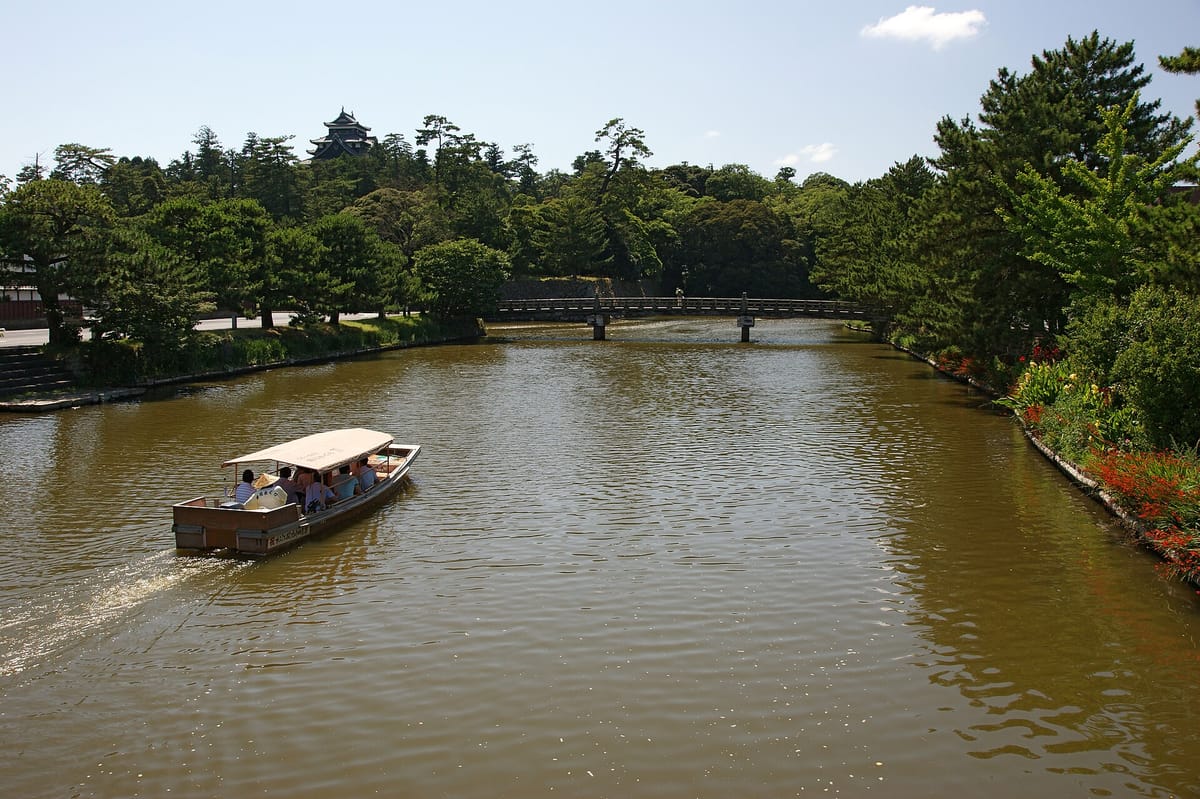
The Horikawa sightseeing boat, Horikawa Yūransen, is the best way to understand how the castle was defended. The flat, covered boats follow a loop of about 3.7 kilometres along the moats and canals, past stone walls, pine trees and the samurai street, in about fifty minutes. The boatman steers and chats as you go.
Seventeen bridges cross the route, and a few are so low that the boat's roof is lowered and passengers duck down to pass beneath them. There are three boarding points round the castle, and a one-day ticket lets you get off, explore and get on again. In winter the boats are fitted with kotatsu, heated tables with a quilt over your knees.
| Japanese | Romaji | Meaning |
|---|---|---|
| 遊覧船の乗り場はどこですか。 | Yūransen no noriba wa doko desu ka. | Where is the boarding point for the sightseeing boat? |
| 大人二枚お願いします。 | Otona nimai onegai shimasu. | Two adults, please. |
| このチケットで一日乗れますか。 | Kono chiketto de ichinichi noremasu ka. | Can I ride all day with this ticket? |
| 次の船はすぐ出ますか。 | Tsugi no fune wa sugu demasu ka. | Does the next boat leave soon? |
| 頭に気をつけてください。 | Atama ni ki o tsukete kudasai. | Please mind your head. |
| 冬はこたつがありますか。 | Fuyu wa kotatsu ga arimasu ka. | Are there kotatsu in winter? |
Words on the signs
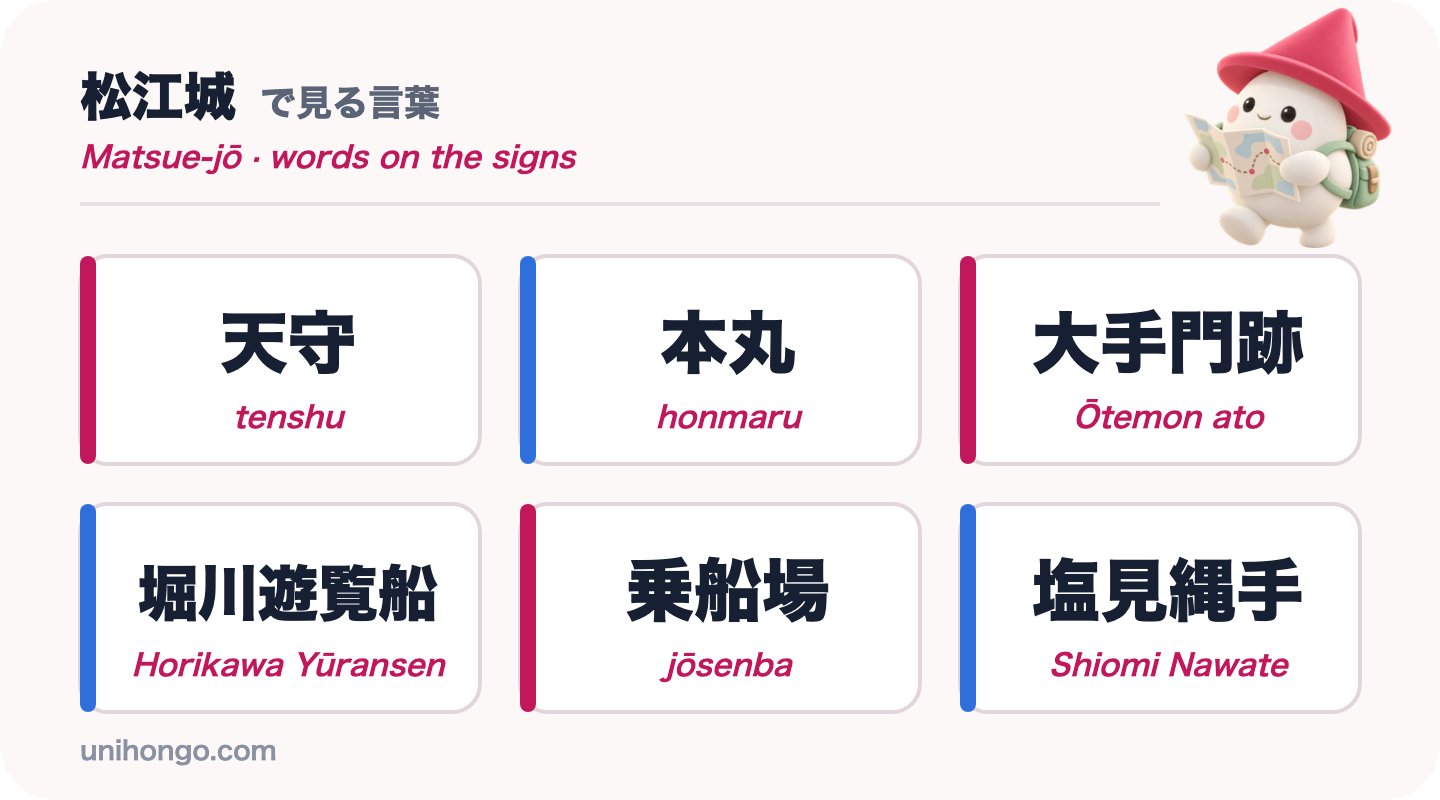
Castle vocabulary is compact. 丸, maru, round, names each enclosure: 本丸 honmaru, the innermost, and 二の丸 ninomaru, the second. 門, mon, is a gate, and 跡, ato, marks the site where something used to stand. For the boat, 乗船場, jōsenba, is where you board, built from 乗, ride, 船, boat, and 場, place.
| Word | Reading | Meaning |
|---|---|---|
| 天守 | tenshu | Castle keep |
| 本丸 | honmaru | Innermost enclosure |
| 二の丸 | ninomaru | Second enclosure |
| 大手門跡 | Ōtemon ato | Site of the main gate |
| 堀川遊覧船 | Horikawa Yūransen | The moat sightseeing boat |
| 乗船場 | jōsenba | Boat boarding point |
| 塩見縄手 | Shiomi Nawate | The samurai street by the northern moat |
| 国宝 | kokuhō | National Treasure |
| 井戸 | ido | Well |
Etiquette, timing and practical tips
Matsue is relaxed, but the keep is an old wooden building and the boats are small, so a little care helps.
- Wear socks and clothes you can climb in. The stairs in the keep are steep, and you walk them in socks.
- Carry a small bag rather than a large backpack in the keep; the stairs are narrow.
- Buy castle tickets online at busy times to skip the queue at the entrance.
- On the boat, stay seated and keep hands inside, especially under the low bridges.
- End the day at Lake Shinji. The sunset over the lake is Matsue's famous view.
- Matsue has a long tea culture from its Edo-period lord Matsudaira Fumai. Try matcha with a local wagashi sweet.
Practise the moat boat before you go
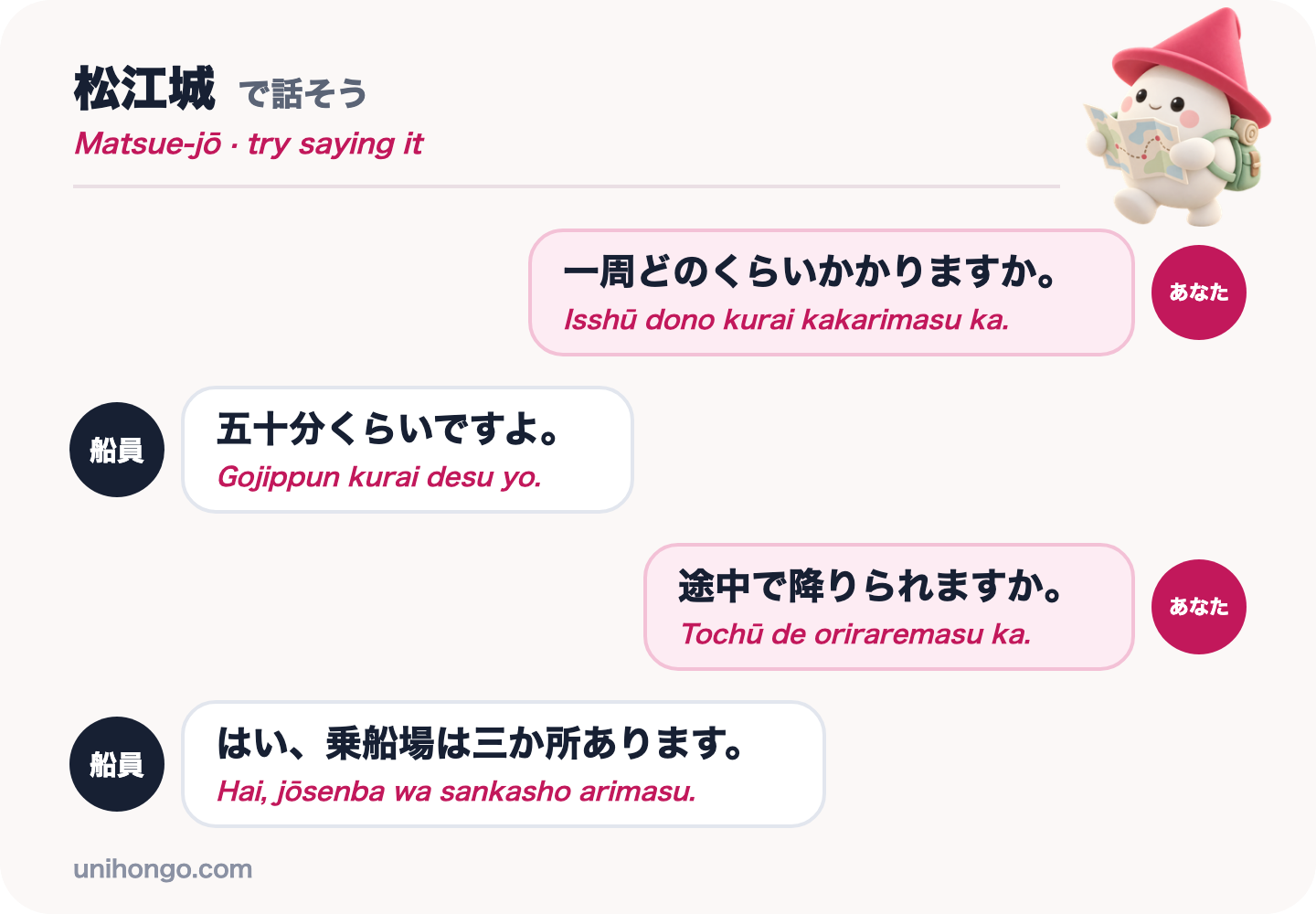
The boatmen love to talk, and this is the exchange that starts the conversation. Listen for kurai, about, in the answer, and for sankasho, three places, a counter you will hear for locations of all kinds.
Then practise with a partner who answers back. In Unihongo, choose the Sightseeing topic and ask your AI Sensei to play a Horikawa boatman, adding questions about the bridges and the castle. Say the lines once before you go, and they will come out naturally on the pier.
| Japanese | Romaji | Meaning |
|---|---|---|
| 一周どのくらいかかりますか。 | Isshū dono kurai kakarimasu ka. | How long does one loop take? |
| 五十分くらいですよ。 | Gojippun kurai desu yo. | About fifty minutes. |
| 途中で降りられますか。 | Tochū de oriraremasu ka. | Can I get off on the way? |
| はい、乗船場は三か所あります。 | Hai, jōsenba wa sankasho arimasu. | Yes, there are three boarding points. |
Official information
The castle's official site publishes opening hours, web tickets and news of the planned repair of the keep, and the boat operator posts its schedule and boarding points. Check both before you go.