

Why the great wisteria of Ashikaga is worth the trip
The park began in 1968 as Hayakawa-en, a garden in Ashikaga already known for a wisteria that covered a trellis the size of 250 tatami mats. When the city grew around it, the garden moved to its present site in 1997 and reopened as Ashikaga Flower Park. The hardest part of the move was the wisteria. Its old trunks were wrapped in plaster bandages, an idea borrowed from medical casts, and lifted by crane in four stages in 1996, in a project led by Tsukamoto Konami, Japan's first woman to qualify as a tree doctor, jumokui.
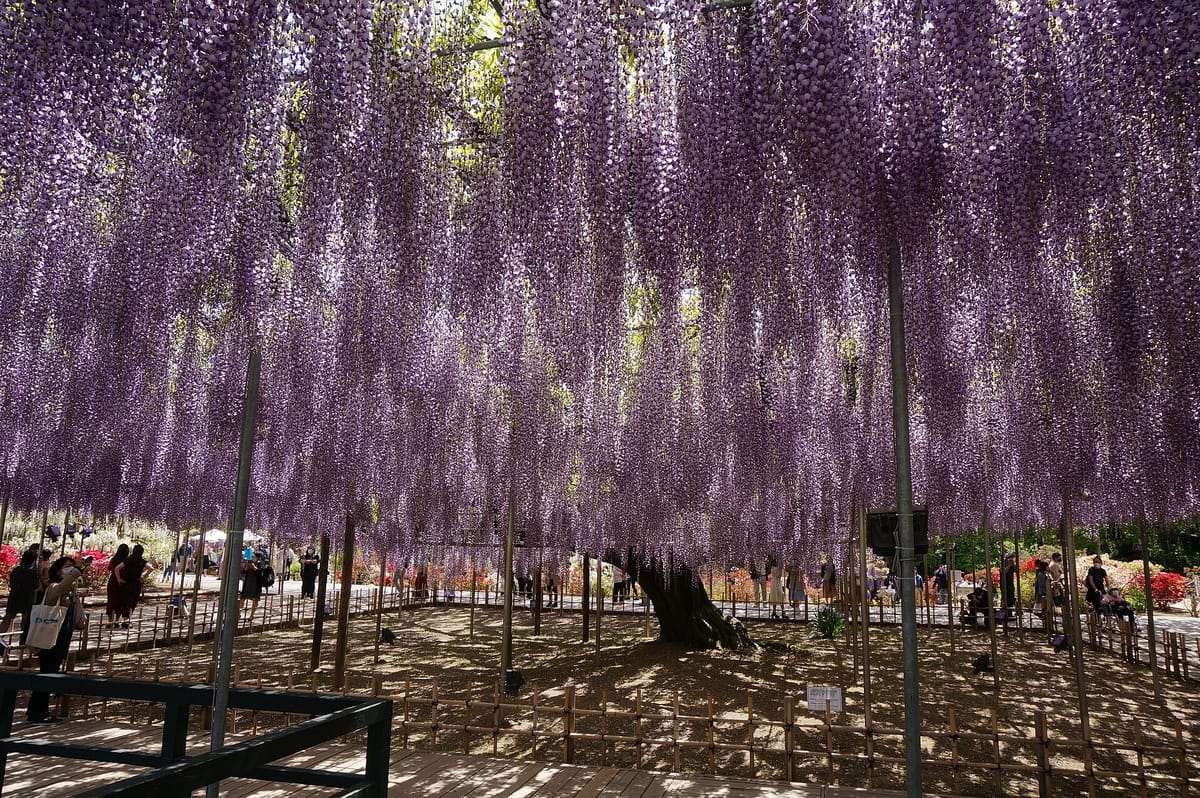
It worked. The great wisteria, said to be around 160 years old, now spreads over a trellis of roughly a thousand square metres, often described as the size of 600 tatami mats, and it is one plant, not a grove. Standing under it when it flowers is like walking under a purple ceiling, with the scent of the blossom all around you. Four great wisteria and the 80-metre white wisteria tunnel are designated natural monuments of Tochigi prefecture.
For a Japanese learner, the park is a lesson in one kanji. 藤, wisteria, is on every sign, and it teaches a trap you will meet all over Japan: fuji, wisteria, and Fuji, the mountain, sound the same but are written 藤 and 富士. Learn to read 藤 here and you will spot it in surnames such as Satō, 佐藤, and Katō, 加藤, for the rest of your trip.
Getting there: Ashikaga Flower Park Station on the Ryōmō Line
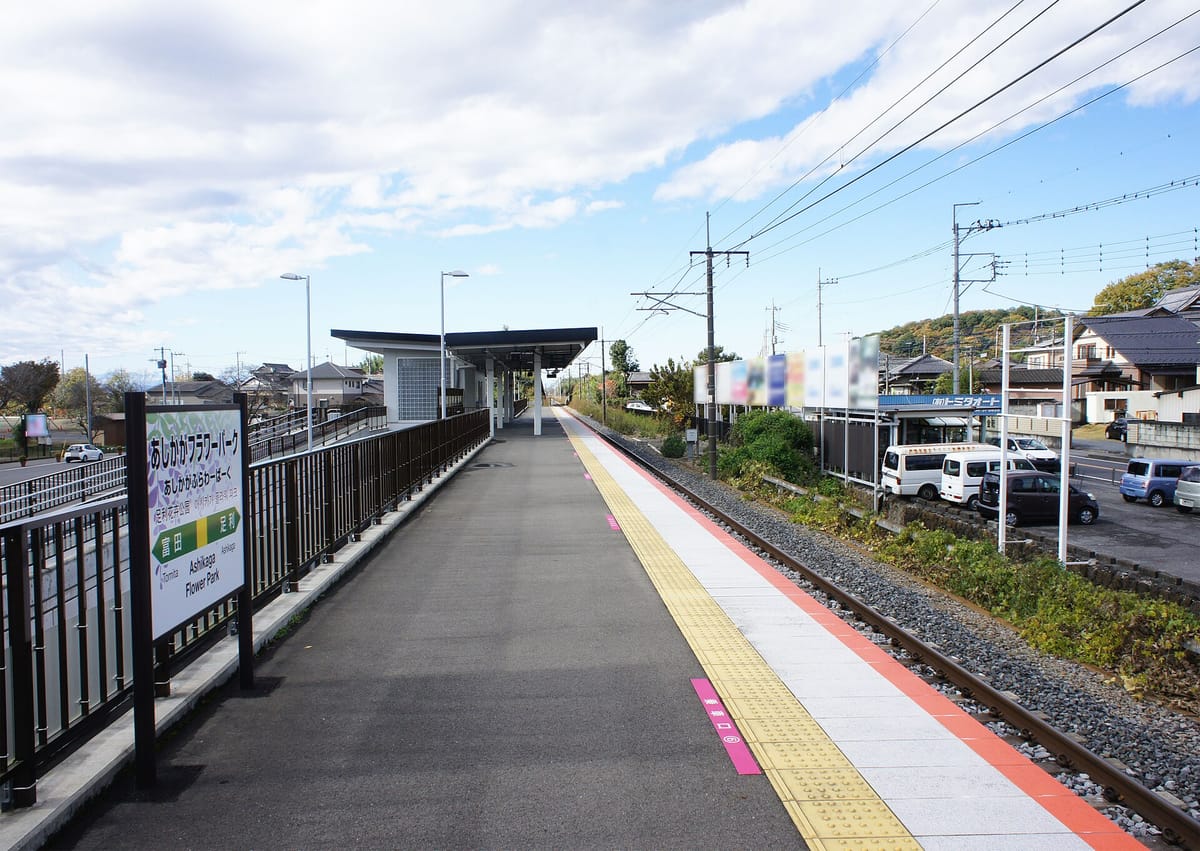
The park has its own station. Ashikaga Flower Park Station, Ashikaga Furawā Pāku-eki, on the JR Ryōmō Line, opened in 2018 and sits about a minute's walk from the park. From Tokyo, take the Tōhoku Shinkansen or a JR Utsunomiya Line train to Oyama and change there to the Ryōmō Line towards Takasaki; the whole trip takes around an hour and a half by shinkansen. Tomita Station, one stop along, is the older way in and about a thirteen-minute walk. The new station has a single platform and is usually unstaffed, so buy your return ticket or top up your IC card before you arrive, while Ashikaga, the next stop west, serves the city centre.
The Tōbu Railway is the other option: limited express or local trains run from Asakusa to Ashikagashi, from where it is a taxi ride of around twenty minutes. The park itself warns that trains are very crowded when everyone leaves in the evening during the wisteria and illumination seasons, and asks visitors to top up their IC cards in advance so the ticket gates do not jam.
| Japanese | Romaji | Meaning |
|---|---|---|
| あしかがフラワーパーク駅まで一枚お願いします。 | Ashikaga Furawā Pāku-eki made ichimai onegai shimasu. | One ticket to Ashikaga Flower Park Station, please. |
| 両毛線は何番線ですか。 | Ryōmō-sen wa nanbansen desu ka. | Which platform is the Ryōmō Line? |
| この電車はフラワーパーク駅に止まりますか。 | Kono densha wa Furawā Pāku-eki ni tomarimasu ka. | Does this train stop at Flower Park Station? |
| 小山で乗り換えですか。 | Oyama de norikae desu ka. | Do I change at Oyama? |
| 帰りの電車は何時ですか。 | Kaeri no densha wa nanji desu ka. | What time is the train back? |
What flowers when: the order of the wisteria
The wisteria season, fuji no hana monogatari, the tale of the wisteria flowers, lasts about a month because the varieties bloom one after another rather than all at once. Early in the festival the pale pink usubeni fuji flower first. The great purple wisteria follows, usually at its best from late April into early May, alongside the long-clustered naga fuji and the double-flowered yae fuji. The white wisteria and the yellow kibana fuji come last, into mid-May.
The park's evening opening turns the same trellises into a night garden: lamps below the flowers light them from underneath, and some displays are reflected in still water. Azaleas, tsutsuji, bloom in bright red and pink banks under the wisteria at the same time, and rhododendrons follow in May.
- Ōfuji: the great wisteria trellises, the heart of the park and its oldest plants.
- Usubeni fuji: pale pink wisteria, the first to flower each spring.
- Shirofuji no tonneru: the 80-metre tunnel of white wisteria, a prefectural natural monument.
- Kibana fuji: the yellow tunnel, actually laburnum, a different plant that the park calls yellow wisteria.
- Yae kokuryū fuji: a double-flowered dark purple variety, one of the four great wisteria.
- Tsutsuji: azalea beds that flower beneath and around the wisteria in late April.
- Evening opening: lit wisteria after dark during the festival, reflected in the water in places.
Words on the signs at Ashikaga Flower Park
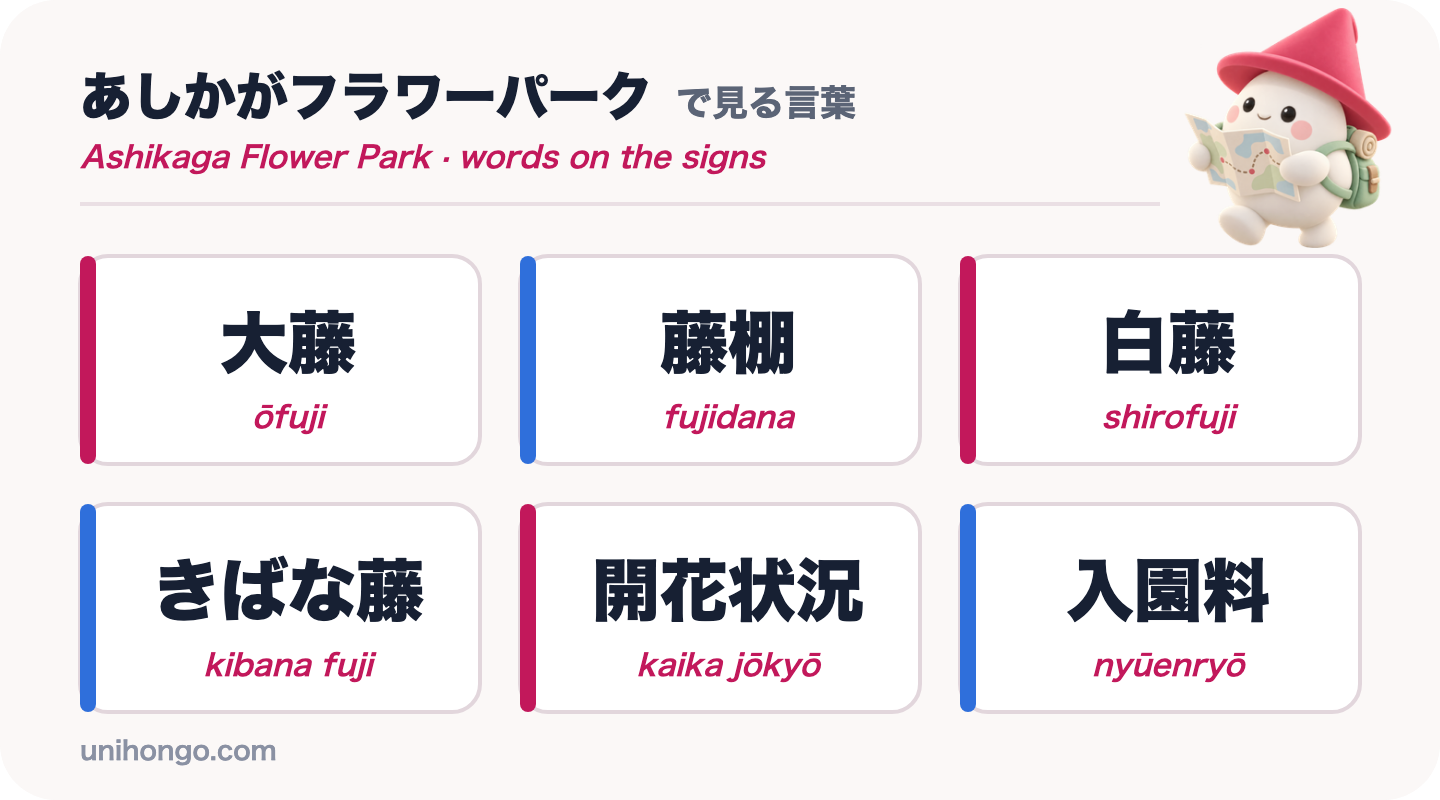
Most of the signs in the park name a plant or a trellis, and they use the same kanji over and over. 藤 is wisteria and 棚 is a shelf or trellis, so 藤棚 is a wisteria trellis. 大 in front makes it great, and a colour in front tells you the variety: 白 for white, きばな, yellow flower, written in kana, for the yellow one.
Two practical words matter at the gate. 開花状況, kaika jōkyō, is the bloom report, posted at the entrance and on the website, and 入園料, nyūenryō, is the entry fee, which at this park moves up and down with that report. If you see a board listing today's fee next to today's bloom, that is what it is telling you.
| Word | Reading | Meaning |
|---|---|---|
| 大藤 | ōfuji | The great wisteria |
| 藤棚 | fujidana | Wisteria trellis |
| 白藤 | shirofuji | White wisteria, as in the white tunnel |
| きばな藤 | kibana fuji | Yellow wisteria, the park's name for its laburnum tunnel |
| うす紅藤 | usubeni fuji | Pale pink wisteria, the first to bloom |
| 開花状況 | kaika jōkyō | Bloom report |
| 見頃 | migoro | Best time to see |
| 入園料 | nyūenryō | Entry fee |
| 再入園 | sai-nyūen | Re-entry to the park |
Japanese at the gate: bloom, tickets and the evening lights
Because the fee depends on the flowers, the gate is where the most useful Japanese of the day happens. You can ask how the bloom is, how much the ticket is today and whether you can leave and come back, which matters if you want to see the wisteria by day and lit up in the evening. Attendants are used to crowds and answer quickly, so keep the questions short.
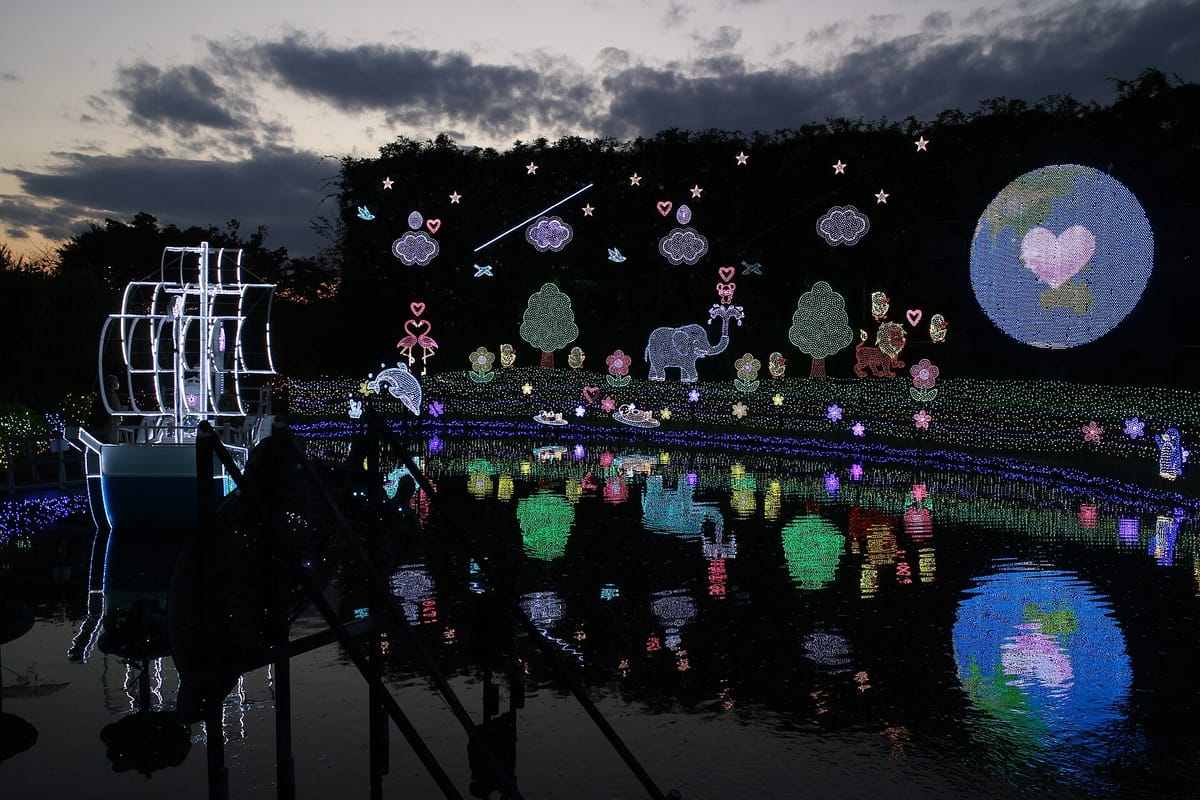
From mid-October to mid-February the park becomes hikari no hana no niwa, the garden of flowers of light, with more than five million lights across the grounds. Evening entry has its own hours and fee, and the lights come on around dusk. The same phrases work for both seasons.
| Japanese | Romaji | Meaning |
|---|---|---|
| 今日の入園料はいくらですか。 | Kyō no nyūenryō wa ikura desu ka. | How much is the entry fee today? |
| 大人二人お願いします。 | Otona futari onegai shimasu. | Two adults, please. |
| 再入園はできますか。 | Sai-nyūen wa dekimasu ka. | Can I leave and come back in? |
| ライトアップは何時からですか。 | Raitoappu wa nanji kara desu ka. | What time does the illumination start? |
| きばな藤はもう咲いていますか。 | Kibana fuji wa mō saite imasu ka. | Is the yellow wisteria out yet? |
| 園内の地図はありますか。 | Ennai no chizu wa arimasu ka. | Do you have a map of the park? |
| 夜も同じチケットで入れますか。 | Yoru mo onaji chiketto de hairemasu ka. | Can I get in at night with the same ticket? |
Etiquette, crowds and timing
At the height of the wisteria season Ashikaga Flower Park is extremely busy, and the paths under the trellises are shared by thousands of people with cameras. A little planning makes the day much calmer.
- Go on a weekday and arrive at opening time, or come for the evening opening when day-trippers have left.
- Check the bloom report the night before. A week too early or too late changes both the view and the fee.
- Do not touch, pull or shake the flower clusters for photos; they bruise easily.
- Tripods and selfie sticks block the narrow paths under the trellis at busy times; keep your camera close.
- Pets are not allowed in the park.
- Buy your return train ticket or top up your IC card on arrival. The station queues at closing time are long.
- If you have time, Ashikaga Gakkō, often called Japan's oldest school, and Banna-ji temple are in central Ashikaga, a short Ryōmō Line ride away.
Practise the visit before you go
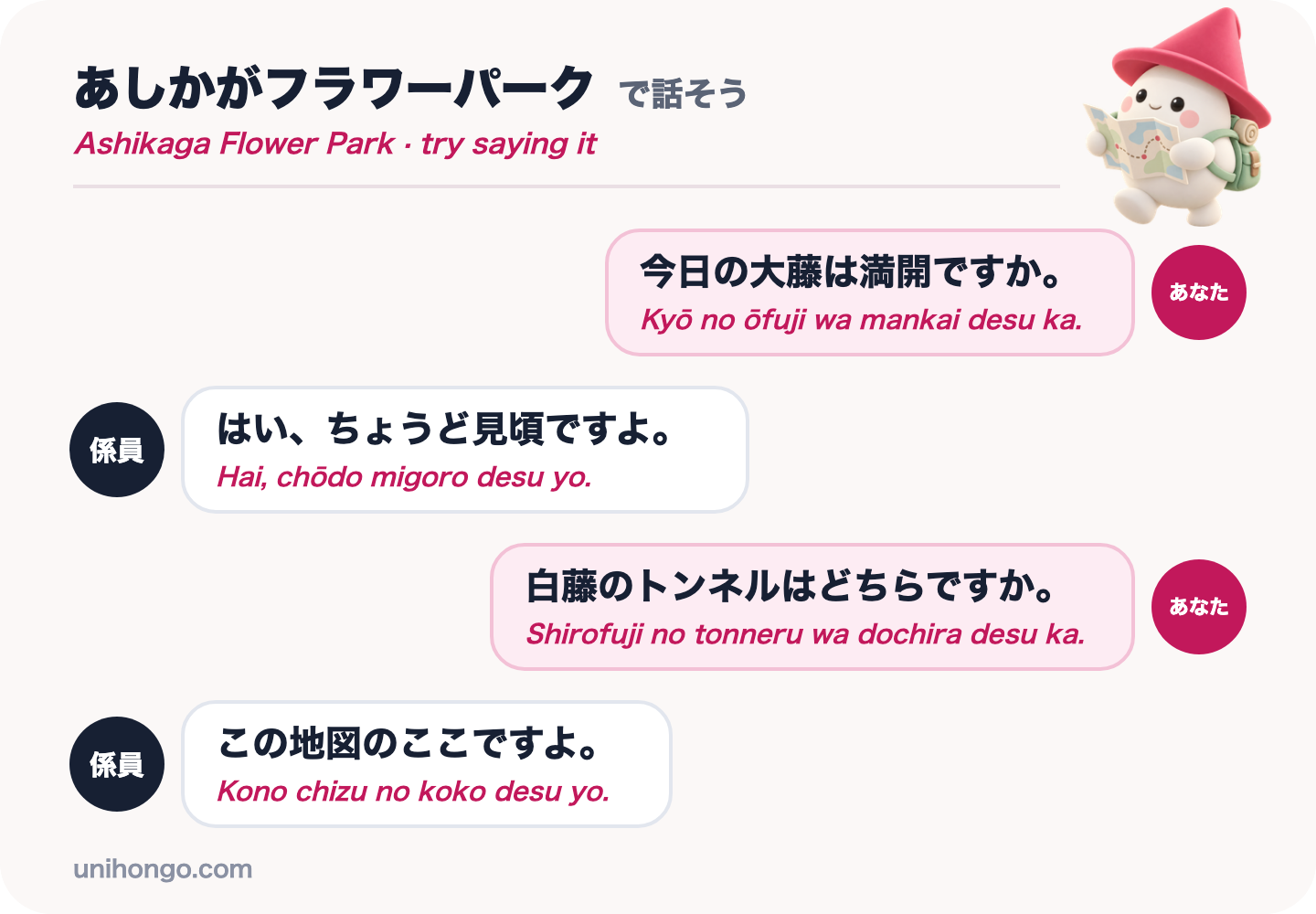
The most useful conversation at the park is a short one with the attendant at the gate or an information desk. Practise the four lines below until you can say them without reading, and listen for the key words in the replies: migoro, the best time, and chizu, the map, which the attendant will probably point at.
Then practise with a partner who answers back. In Unihongo, choose the Sightseeing topic and ask your AI Sensei to play an attendant at Ashikaga Flower Park, or choose Train Tickets to rehearse the change at Oyama and the ticket to Ashikaga Flower Park Station. Saying the lines once before you go is what makes them come out on the day.
| Japanese | Romaji | Meaning |
|---|---|---|
| 今日の大藤は満開ですか。 | Kyō no ōfuji wa mankai desu ka. | Is the great wisteria in full bloom today? |
| はい、ちょうど見頃ですよ。 | Hai, chōdo migoro desu yo. | Yes, it is at its best right now. |
| 白藤のトンネルはどちらですか。 | Shirofuji no tonneru wa dochira desu ka. | Which way is the white wisteria tunnel? |
| この地図のここですよ。 | Kono chizu no koko desu yo. | It is here on this map. |
Official information
Ashikaga Flower Park publishes its daily bloom report, the current entry fee, festival and illumination dates and access advice on its website, with an English section. The Ashikaga city tourism association covers the park and the rest of the city. Check both before you go, especially in wisteria season.