

Why Hama-rikyū is Tokyo's most surprising garden
Hama-rikyū Onshi Teien, 浜離宮恩賜庭園, is a daimyō garden in the old style, built for strolling round ponds, crossing bridges and resting in teahouses. Its history begins in 1654, when Matsudaira Tsunashige, younger brother of the fourth shogun, had part of the shallows filled in and built a villa on the new land. When his son became the sixth shogun, Ienobu, the villa passed to the Tokugawa family and became the Hama Goten, the Beach Palace. Successive shoguns reshaped it until, under the eleventh shogun, Ienari, it looked much as it does today.
After the Meiji Restoration it became an imperial detached palace, a rikyū, which is where the name Hama-rikyū comes from. The Great Kantō Earthquake of 1923 and wartime bombing destroyed most of its buildings, and in November 1945 the Imperial Household gave the garden to the City of Tokyo. It opened to the public in April 1946 and is designated a Special Place of Scenic Beauty and a Special Historic Site, the highest ranks for a garden in Japan. 2026 marks eighty years since it first opened as a public garden.
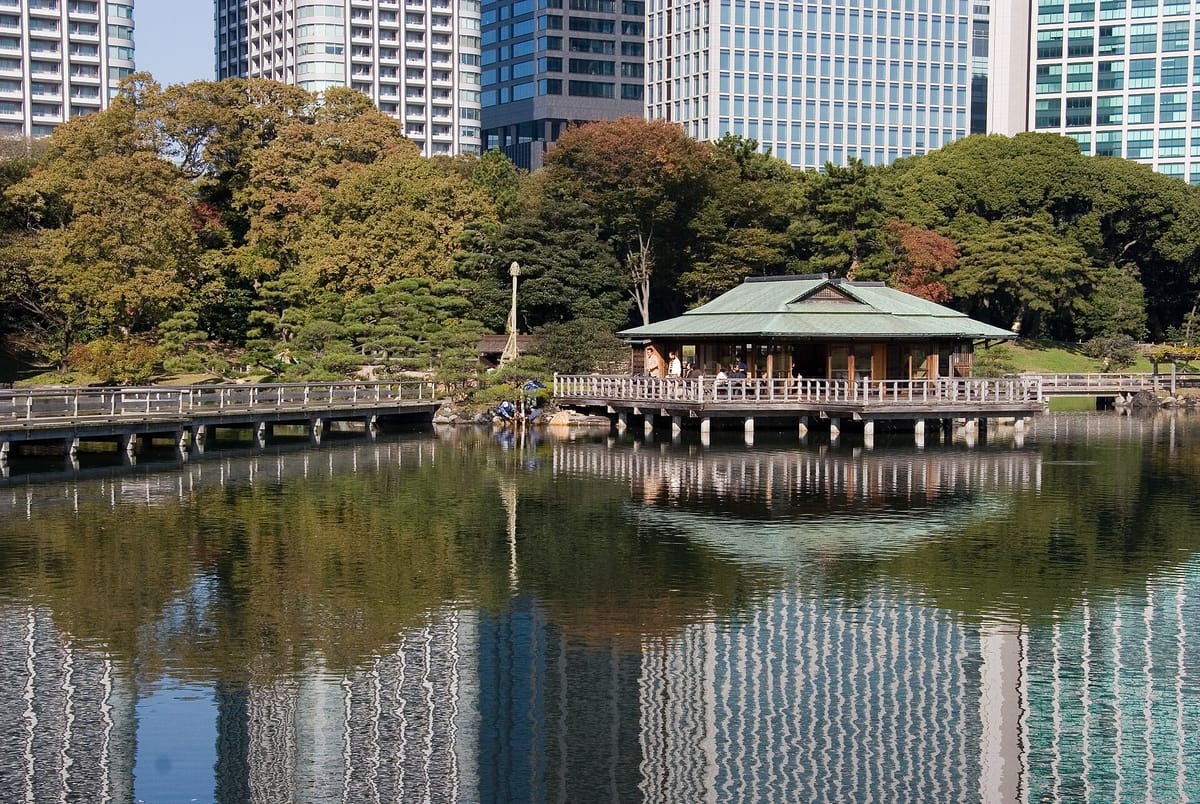
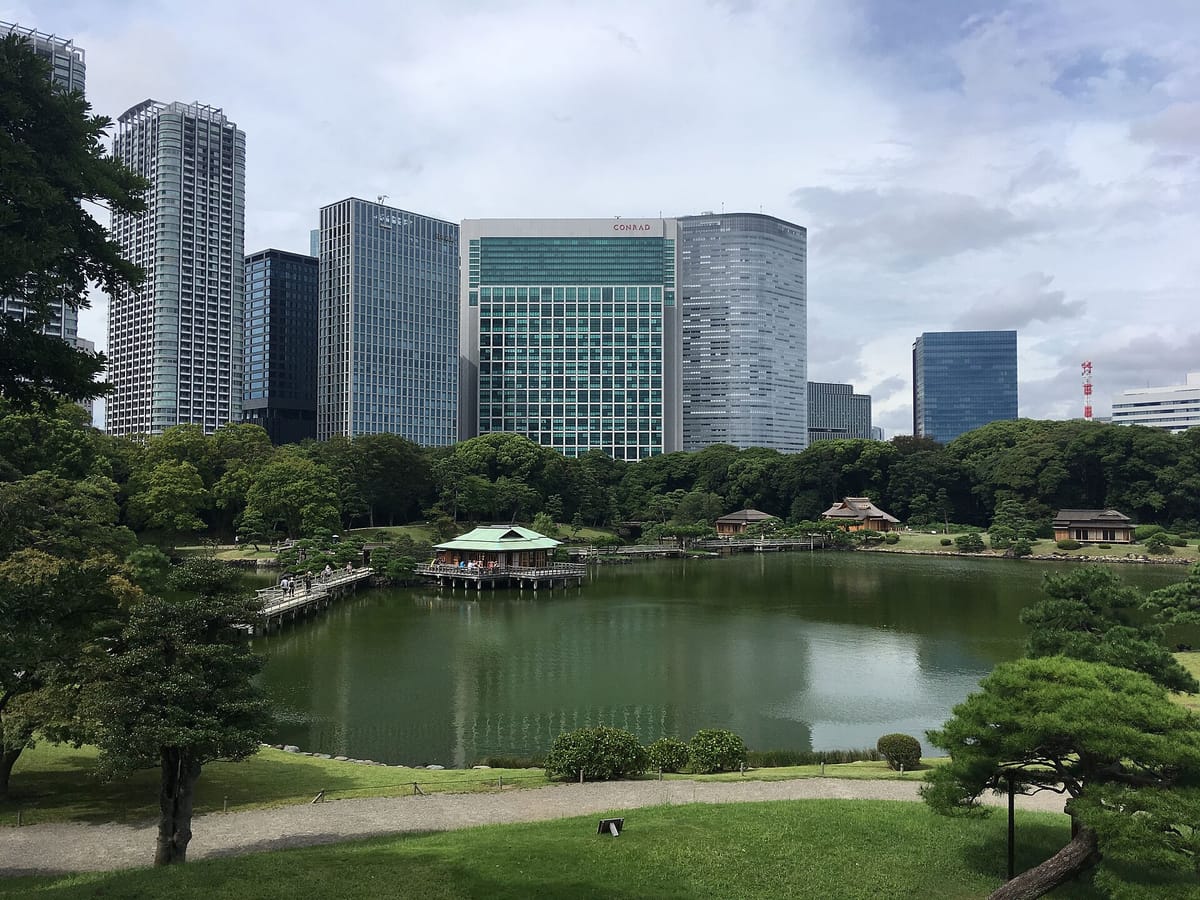
What makes the visit memorable is the contrast. You cross a stone bridge from traffic and offices into pine groves and quiet water, yet the glass towers of Shiodome stay in view above the trees, doubled in the pond. It is the easiest place in central Tokyo to see how a shogun's garden and a modern city fit together.
Getting there: the Ōtemon Gate, Naka-no-gomon and the water bus
The garden has two land entrances. The main one is the Ōtemon Gate, Ōtemon, reached over the Ōtemon Bridge on the north-east side. It is about seven minutes on foot from Shiodome Station on the Toei Ōedo Line and the Yurikamome, or from Tsukiji-shijō Station on the Ōedo Line, and about twelve minutes from Shimbashi Station on the JR lines, the Tokyo Metro Ginza Line and the Toei Asakusa Line. The second entrance, the Naka-no-gomon Gate, is on the side facing Shiodome, a few minutes from Shiodome Station and about fifteen minutes from JR Hamamatsuchō.
The most memorable arrival is by water. Tokyo Cruise runs a small number of boats a day from Asakusa down the Sumida River to a pier inside the garden, a trip of about thirty-five minutes, and the garden admission is included in that fare. The pier is currently used only for getting off, so you cannot catch a boat back from the garden; check the timetable and today's operating status before you plan around it. Boats can be cancelled at short notice in bad weather.
| Japanese | Romaji | Meaning |
|---|---|---|
| 浜離宮に行きたいんですが、何番出口ですか。 | Hama-rikyū ni ikitai n desu ga, nanban deguchi desu ka. | I want to go to Hama-rikyū. Which exit number is it? |
| 大手門はどちらですか。 | Ōtemon wa dochira desu ka. | Which way is the Ōtemon Gate? |
| 浅草から水上バスで行けますか。 | Asakusa kara suijō basu de ikemasu ka. | Can I get there by water bus from Asakusa? |
| 浜離宮までの乗船券を一枚ください。 | Hama-rikyū made no jōsenken o ichimai kudasai. | One boat ticket to Hama-rikyū, please. |
| 入園券はどこで買えますか。 | Nyūenken wa doko de kaemasu ka. | Where can I buy an entry ticket? |
The tidal pond, the teahouses and the old pine: what you will see
The centre of the garden is Shioiri no Ike, the tidal pond. Its water comes from Tokyo Bay, and the sluice gate is opened and closed with the tide to control the level, so the pond looks different from one visit to the next. It is the only seawater pond from the Edo period still in use in Tokyo, and sea fish such as mullet, young sea bass, gobies and eels live in it. Look at the rocks along the edge and you may see small crabs and barnacles.
A long wooden bridge, the O-tsutai-bashi, about 120 metres long, crosses the pond by way of a small island to Nakajima, where the teahouse Nakajima no Ochaya stands on stilts over the water. Around the pond, three more teahouses have been rebuilt from historical records: Matsu no Ochaya in 2010, Tsubame no Ochaya in 2015 and Taka no Ochaya in 2018. On the far side, two duck-hunting grounds, kamoba, survive from the late eighteenth century, with narrow channels and small peepholes in the earth banks where hunters once watched the ducks.
- Sanbyakunen no Matsu: the three-hundred-year pine near the Ōtemon Gate, said to have been planted when the sixth shogun rebuilt the garden, with long branches spreading low over the ground.
- Shioiri no Ike: the tidal pond fed by Tokyo Bay, with the Yokobori sluice gate on its seaward side.
- O-tsutai-bashi and Nakajima no Ochaya: the long bridge and the island teahouse serving matcha.
- Matsu, Tsubame and Taka no Ochaya: three teahouses rebuilt in the style of the eleventh shogun's time; guided tours of the interiors run on some days.
- Kamoba: the two duck-hunting ponds, Kōshindō and Shinsenza, with a memorial mound for the ducks nearby.
- Shōgun Oagariba: the stone landing where the shogun stepped off his boat, facing the bay.
- The flower field and plum grove: rape blossoms in spring and cosmos later in the year.
Words on the garden signs
Garden signs in Japan often use slightly old-fashioned, respectful words, and Hama-rikyū is a good place to learn them. The honorific prefix 御 appears again and again. In 御茶屋, ochaya, it makes a teahouse fit for a shogun, and in 中の御門, Naka-no-gomon, it is read go and marks the gate as an honoured one. The same character is read o or go depending on the word, and the signposts usually give the reading in small hiragana.
Nature words are the other half of the vocabulary. 潮 is tide, 池 is pond, 松 is pine and 鴨 is duck, so once you know four kanji you can read most of the names on the map.
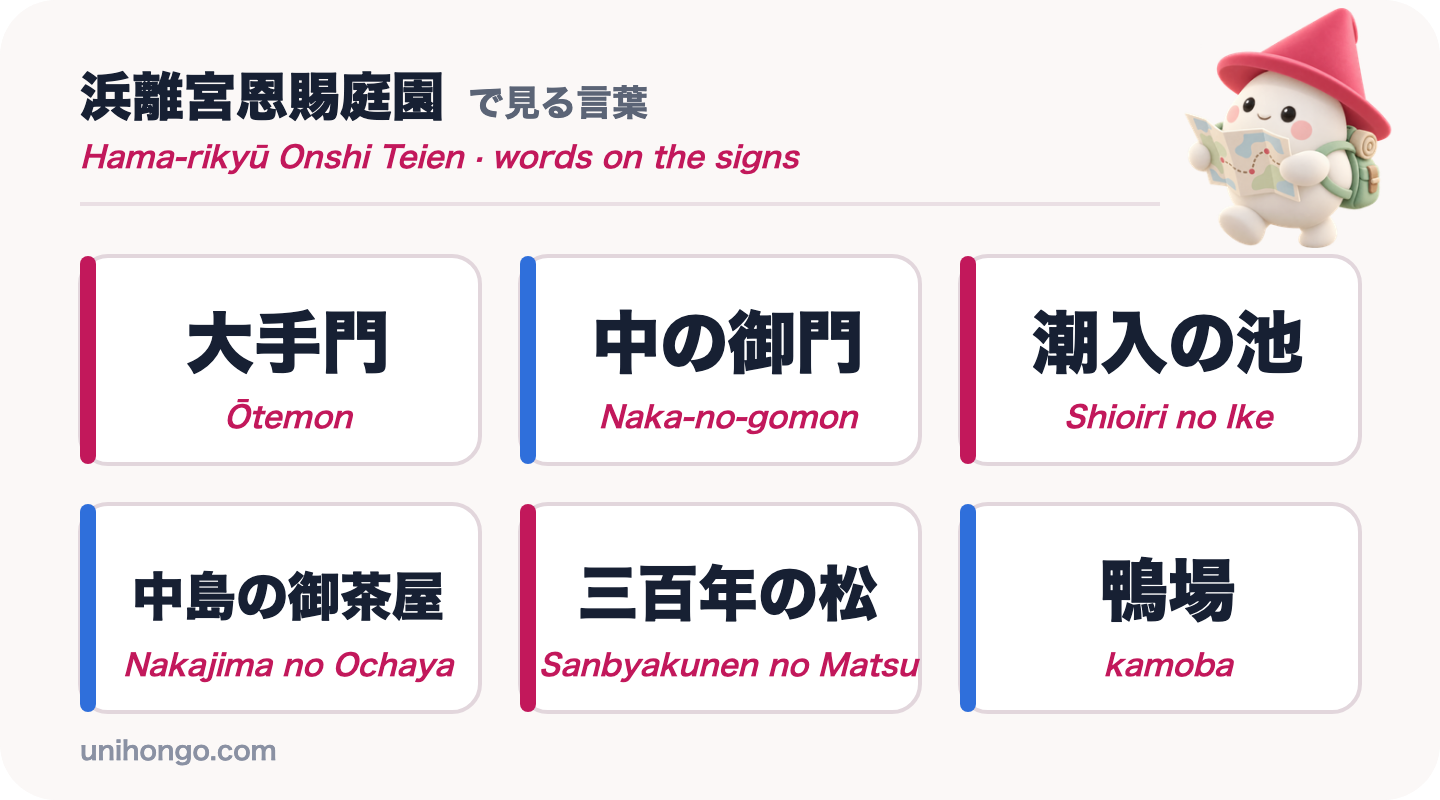
| Word | Reading | Meaning |
|---|---|---|
| 大手門 | Ōtemon | The main gate, on the Shiodome and Shimbashi side |
| 中の御門 | Naka-no-gomon | The second gate, towards Hamamatsuchō |
| 潮入の池 | Shioiri no Ike | The tidal pond fed by seawater |
| お伝い橋 | O-tsutai-bashi | The long wooden bridge across the pond |
| 中島の御茶屋 | Nakajima no Ochaya | The island teahouse serving matcha |
| 三百年の松 | Sanbyakunen no Matsu | The three-hundred-year-old pine |
| 鴨場 | kamoba | Duck-hunting pond |
| 入園券 | nyūenken | Garden entry ticket |
| 水上バス発着場 | suijō basu hatchakujō | Water bus pier |
Japanese at Nakajima teahouse: matcha and sweets
Nakajima no Ochaya is the one place in the garden where you sit down and are served. The set is simple: a bowl of matcha, powdered green tea whisked into a thick froth, and a Japanese sweet, wagashi, to eat first so that its sweetness balances the bitter tea. You order the set, take a seat and drink it with the pond on every side; ask the staff if you are unsure where to pay or sit.
No tea-ceremony training is expected, but a few words and gestures make it more enjoyable. Eat the sweet before the tea. When the bowl arrives, lift it with your right hand, rest it on your left palm, turn it slightly so that you do not drink from the front, and finish it in a few sips. Gochisōsama deshita at the end thanks the staff for the tea.
| Japanese | Romaji | Meaning |
|---|---|---|
| 中島の御茶屋はどちらですか。 | Nakajima no Ochaya wa dochira desu ka. | Which way is Nakajima teahouse? |
| 二人ですが、入れますか。 | Futari desu ga, hairemasu ka. | There are two of us. Can we come in? |
| カードで払えますか。 | Kādo de haraemasu ka. | Can I pay by card? |
| お菓子は先に食べるんですか。 | O-kashi wa saki ni taberu n desu ka. | Do I eat the sweet first? |
| お茶碗はどう持てばいいですか。 | O-chawan wa dō moteba ii desu ka. | How should I hold the tea bowl? |
| とてもおいしかったです。ごちそうさまでした。 | Totemo oishikatta desu. Gochisōsama deshita. | It was delicious. Thank you for the tea. |
Garden etiquette, timing and practical tips
Hama-rikyū is a protected cultural property as well as a park, and its rules are stricter than those of an ordinary city park. They are easy to follow once you know them.
- Picnics are allowed, but picnic sheets only in the two open lawns marked on the map, Uchibori and Yagai-taku; take all rubbish home.
- Alcohol, pets, bicycles, drones, ball games and smoking are not allowed in the garden.
- Stay on the paths and off the fenced lawns and planted areas, and do not climb the trees.
- Free volunteer guided walks run on some days, including tours in English at weekends; they pause in the hottest part of summer.
- Check the official site for this season's hours, and for evening openings during special events such as the moon-viewing nights in autumn.
- The garden is closed only over the New Year holidays, from 29 December to 1 January.
- A joint ticket covers Kyū-Shiba-rikyū Gardens, a smaller Edo garden about fifteen minutes' walk away.
Practise the teahouse before you go
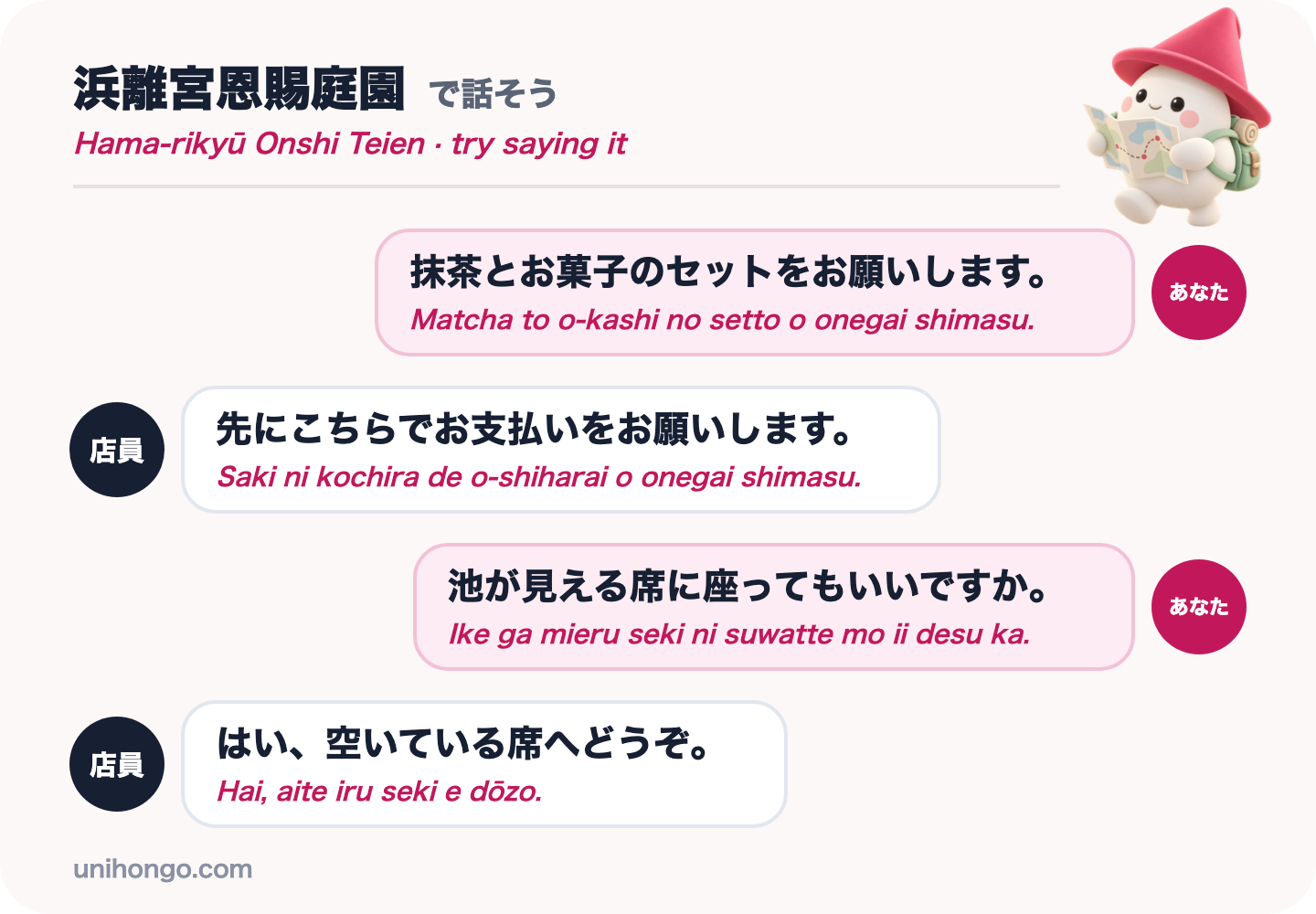
The teahouse conversation is short, but it follows a set order: you order, the attendant tells you what to do next, and you ask about a seat. Practise the four lines below until they come out without reading. In the reply, listen for kochira, here, and dōzo, please go ahead, the two words that tell you where to go.
Then practise with a partner who answers back. In Unihongo, choose the Tea Ceremony topic and ask your AI Sensei to play the teahouse attendant, or choose Directions to rehearse the walk from Shiodome Station to the Ōtemon Gate. Saying the lines once before you arrive makes them easy on the day.
| Japanese | Romaji | Meaning |
|---|---|---|
| 抹茶とお菓子のセットをお願いします。 | Matcha to o-kashi no setto o onegai shimasu. | The matcha and sweet set, please. |
| 先にこちらでお支払いをお願いします。 | Saki ni kochira de o-shiharai o onegai shimasu. | Please pay here first. |
| 池が見える席に座ってもいいですか。 | Ike ga mieru seki ni suwatte mo ii desu ka. | May I sit where I can see the pond? |
| はい、空いている席へどうぞ。 | Hai, aite iru seki e dōzo. | Yes, please take any free seat. |
Official information
The garden is managed by the Tokyo Metropolitan Park Association, which publishes opening hours, event nights, guided tour times and seasonal flower news. Check the water bus timetable and operating status separately with Tokyo Cruise before you plan to arrive by boat.