

Why Nijō Castle is the shoguns' Kyoto
When Tokugawa Ieyasu became shogun in 1603, he ruled from Edo, today's Tokyo, but he needed a residence in Kyoto, where the emperor lived. Nijō Castle was that residence, and a statement of power a short walk from the imperial court. His grandson Iemitsu enlarged it in the 1620s, adding a keep and richly decorated palace buildings for a visit by the emperor.
Unlike the white hilltop castles of Himeji or Matsumoto, Nijō is a flat castle, a palace inside two rings of stone walls and moats. Its keep burned after a lightning strike in 1750 and was never rebuilt, so what draws visitors is the palace architecture. The Ninomaru Palace, with its gilded screens painted by artists of the Kanō school, shows how the shogun wanted visitors to feel: the deeper you went, the grander the rooms, and the more important you had to be to be admitted.
The castle's last great moment came in 1867, when the fifteenth shogun, Tokugawa Yoshinobu, gathered his lords in the Ninomaru Palace's great hall and announced the return of political power to the emperor. For a Japanese learner, that makes it a good place to meet the words of Japanese history: shōgun, tennō, emperor, and taisei hōkan, the return of power.
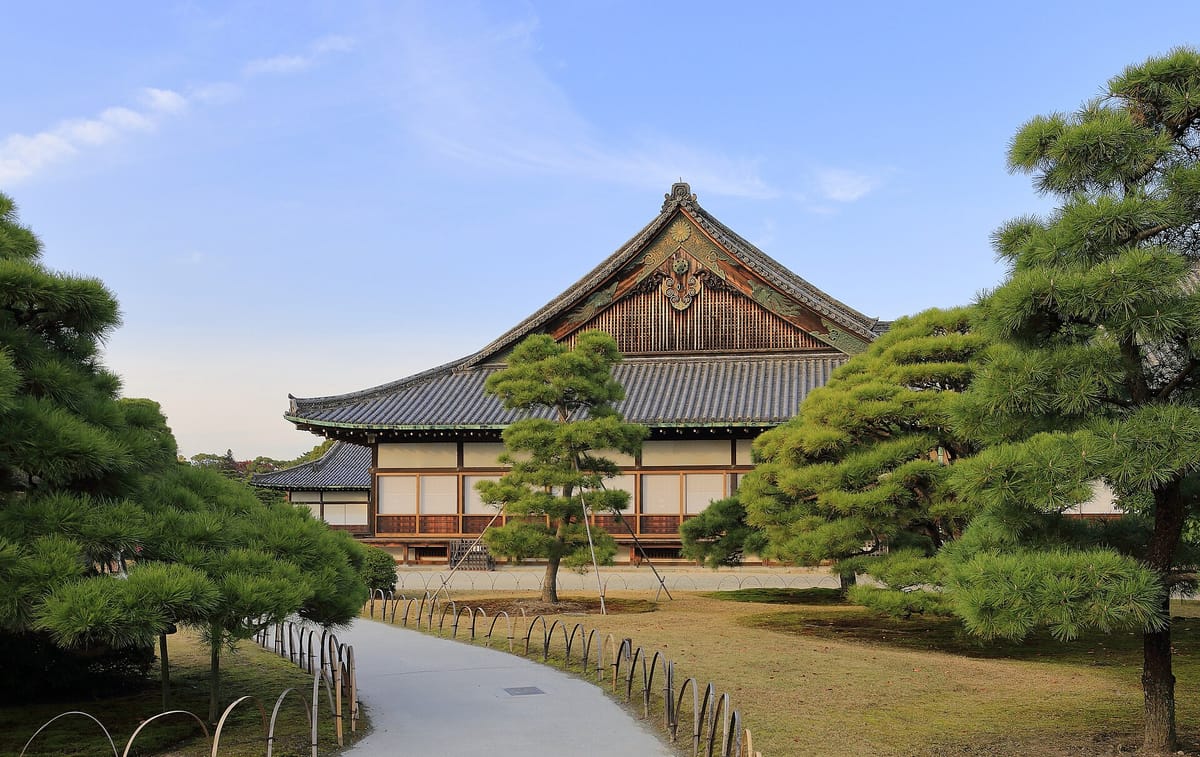
Getting there: Nijōjō-mae Station and the East Gate
The easiest way to arrive is the Tōzai subway line to Nijōjō-mae Station. From Kyoto Station, take the Karasuma line north to Karasuma Oike and change to the Tōzai line for one stop; the castle's main entrance, the Higashi Ōtemon, the great east gate, is just across the road from the station exit. City buses 9, 50 and 101 from Kyoto Station also stop at Nijōjō-mae.
JR and subway Nijō Station is about fifteen minutes' walk to the west, which is useful if you are coming from Arashiyama on the JR Sagano Line. The castle is closed at the end of the year, and the Ninomaru Palace also closes on some days, including Tuesdays in January, July, August and December, so check the calendar on the official site.
| Japanese | Romaji | Meaning |
|---|---|---|
| 二条城は二条城前駅の何番出口ですか。 | Nijō-jō wa Nijōjō-mae-eki no nanban deguchi desu ka. | Which exit of Nijōjō-mae Station is for the castle? |
| 烏丸御池で東西線に乗り換えればいいですか。 | Karasuma Oike de Tōzai-sen ni norikaereba ii desu ka. | Do I change to the Tōzai line at Karasuma Oike? |
| 二条城の入口は東大手門ですか。 | Nijō-jō no iriguchi wa Higashi Ōtemon desu ka. | Is the entrance to Nijō Castle the East Gate? |
| 今日は二の丸御殿に入れますか。 | Kyō wa Ninomaru Goten ni hairemasu ka. | Can I enter the Ninomaru Palace today? |
Through the gates: Ninomaru, Honmaru and the gardens
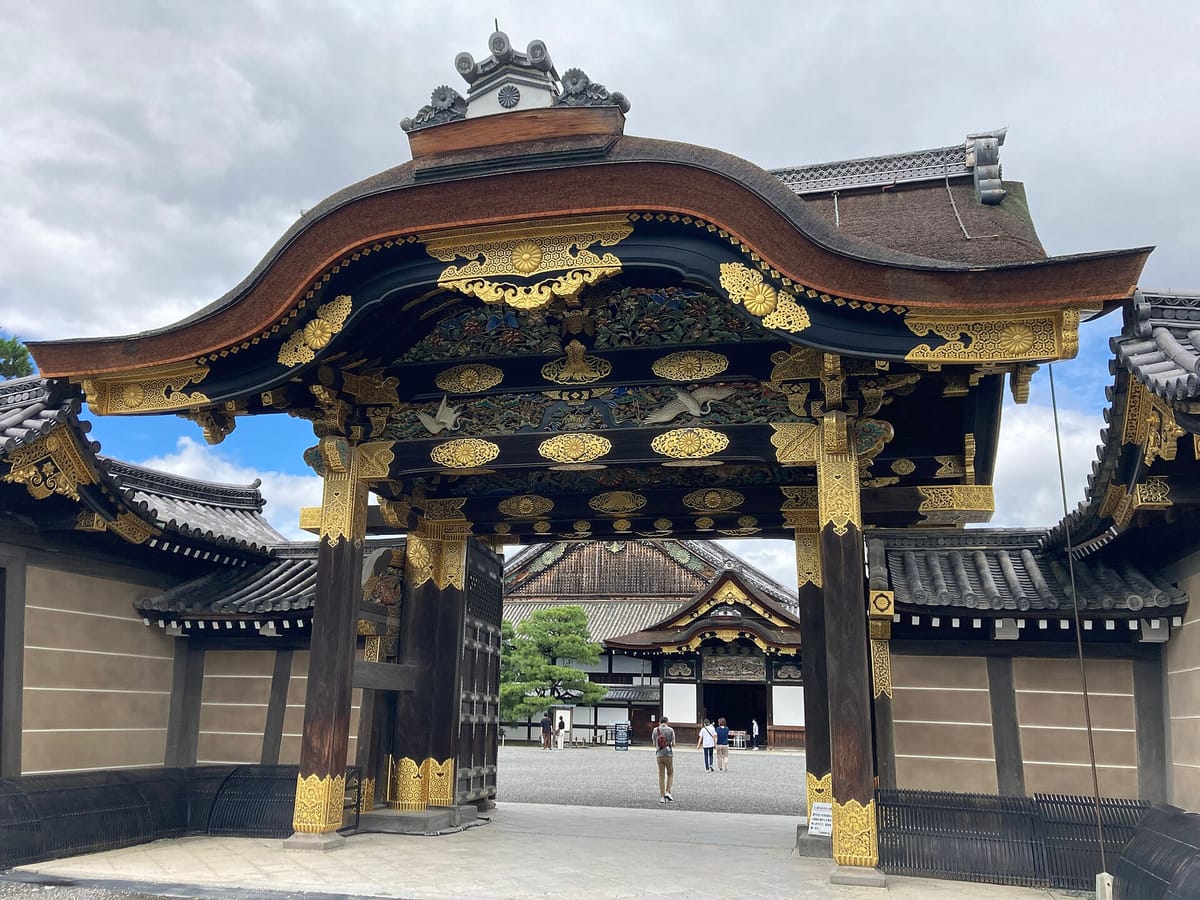
From the East Gate the route leads to the Karamon, a gate covered in carved and gilded decoration, and through it to the Ninomaru Palace. You take off your shoes at the entrance, put them in a locker, and follow a one-way corridor through the halls. The floors chirp with every step, the rooms grow grander as you go, and the Ōhiroma, the great audience hall, has figures in costume placed to recreate a shogun's audience.
After the palace, walk round the Ninomaru garden, a pond garden attributed to the tea master and designer Kobori Enshū, and cross the inner moat into the Honmaru, the inner circle. Here stands the Honmaru Palace, open by reservation, and in the south-west corner the stone foundation of the old keep, which you can climb for a view over the grounds.
- Higashi Ōtemon: the great east gate and main entrance.
- Karamon: the ornate gate before the Ninomaru Palace.
- Ninomaru Goten: the National Treasure palace with painted rooms and nightingale floors.
- Ninomaru garden: a pond garden with rocks and pines beside the palace.
- Honmaru Goten: the inner palace, seen by reservation, with socks required inside.
- Tenshukaku ato: the foundation of the keep, a short climb with a view.
- Seiryū-en: a twentieth-century garden with two teahouses in the north of the grounds.
- Painting Gallery: a small museum where the original sliding-door paintings are shown in rotation.
Words on the signs at Nijō Castle
Castle vocabulary is built from a handful of kanji. 丸, maru, means circle and names each ring of defences: the Honmaru is the main, inner circle and the Ninomaru the second. 御殿, goten, is a palace. 門, mon, is a gate, and 跡, ato, means remains or site, so 天守閣跡 is the site of the keep.
Inside the palace the signs are mostly practical. Look for the shoe lockers at the entrance and the notices that photography is not allowed.
| Word | Reading | Meaning |
|---|---|---|
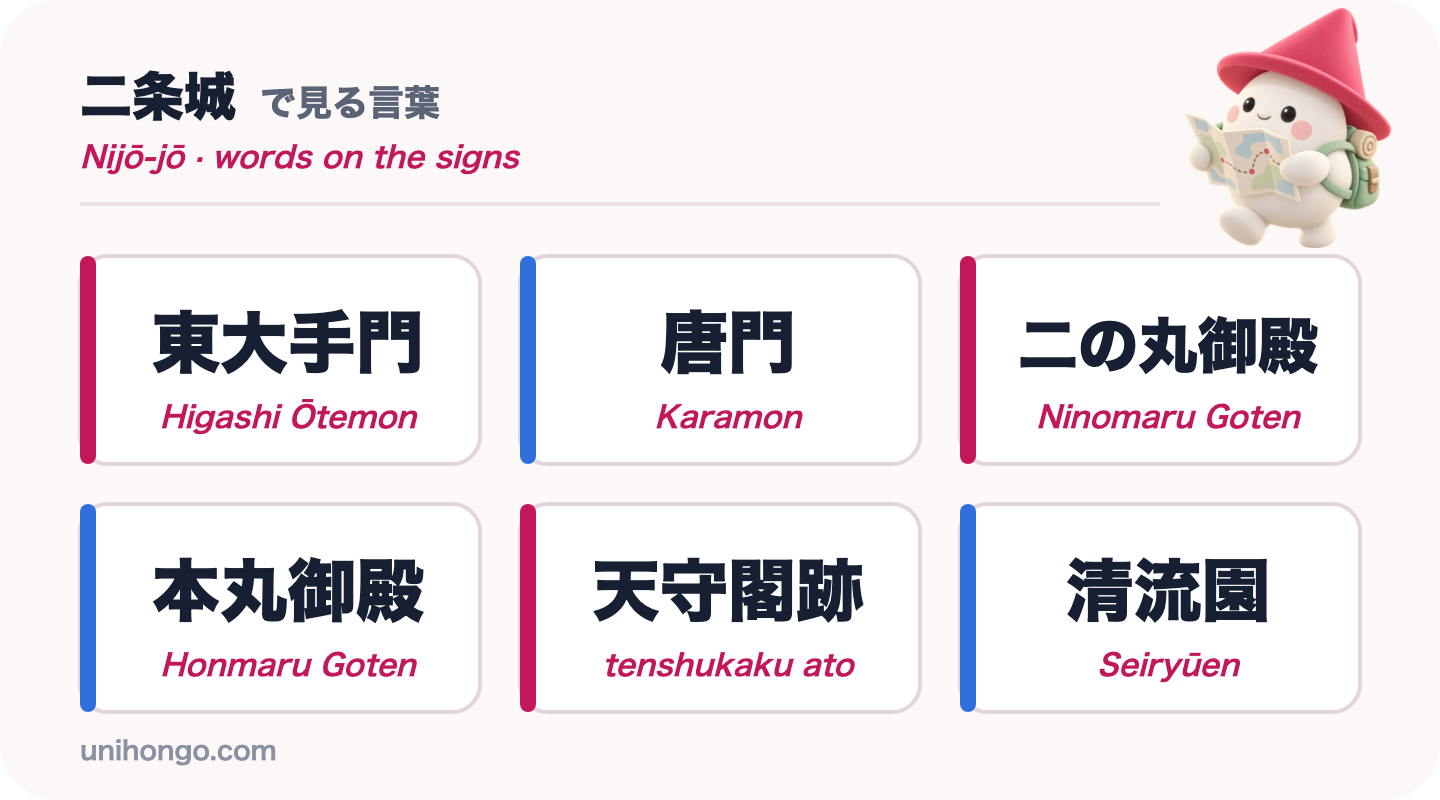
| 東大手門 | Higashi Ōtemon | The great east gate, main entrance |
| 唐門 | Karamon | The ornate gate before the palace |
| 二の丸御殿 | Ninomaru Goten | Palace of the second circle |
| 本丸御殿 | Honmaru Goten | Palace of the inner circle |
| 天守閣跡 | tenshukaku ato | Site of the castle keep |
| 清流園 | Seiryūen | Garden with teahouses in the north of the grounds |
| 鶯張り | uguisubari | Nightingale floor |
| 入城券 | nyūjōken | Castle admission ticket |
| 撮影禁止 | satsuei kinshi | No photography |
Japanese for tickets, shoes and the palace
The ticket window sells admission to the castle grounds, and the Ninomaru Palace requires an additional ticket, often sold together. If you have booked the Honmaru Palace, have your reservation ready on your phone. An audio guide is available if you want commentary as you walk.
Inside, the key moments are the shoe lockers and the rules: no photos and no food or drink in the palaces. The phrases below cover the whole visit.
| Japanese | Romaji | Meaning |
|---|---|---|
| 入城券と二の丸御殿の券をお願いします。 | Nyūjōken to Ninomaru Goten no ken o onegai shimasu. | Admission and a Ninomaru Palace ticket, please. |
| 本丸御殿の予約をしてあります。 | Honmaru Goten no yoyaku o shite arimasu. | I have a reservation for the Honmaru Palace. |
| 音声ガイドを借りられますか。 | Onsei gaido o kariraremasu ka. | Can I borrow an audio guide? |
| 靴箱の鍵はどうすればいいですか。 | Kutsubako no kagi wa dō sureba ii desu ka. | What do I do with the shoe locker key? |
| 御殿の中は撮影禁止ですよね。 | Goten no naka wa satsuei kinshi desu yo ne. | Photography is not allowed inside the palace, right? |
| 天守閣跡には登れますか。 | Tenshukaku ato ni wa noboremasu ka. | Can I climb up to the keep foundation? |
| 休憩所はどこですか。 | Kyūkeijo wa doko desu ka. | Where is the rest area? |
Castle etiquette and timing
Nijō Castle is a protected cultural property, and its rules are set out by the castle itself. Most of them are about protecting the buildings.
- Do not touch the walls, pillars or painted doors, and keep bags from brushing against them.
- No photos or video inside the Ninomaru and Honmaru palaces; outside, photos are fine if you do not block the way.
- Wear socks for the Honmaru Palace, and shoes that are easy to take off for both palaces.
- Eat only in the designated rest areas, not in the palaces or while walking.
- There is no re-entry once you leave the grounds, so see everything before you exit.
- Arrive early in cherry blossom season from late March into April, and in the second half of November for autumn colours.
Practise the palace before you go
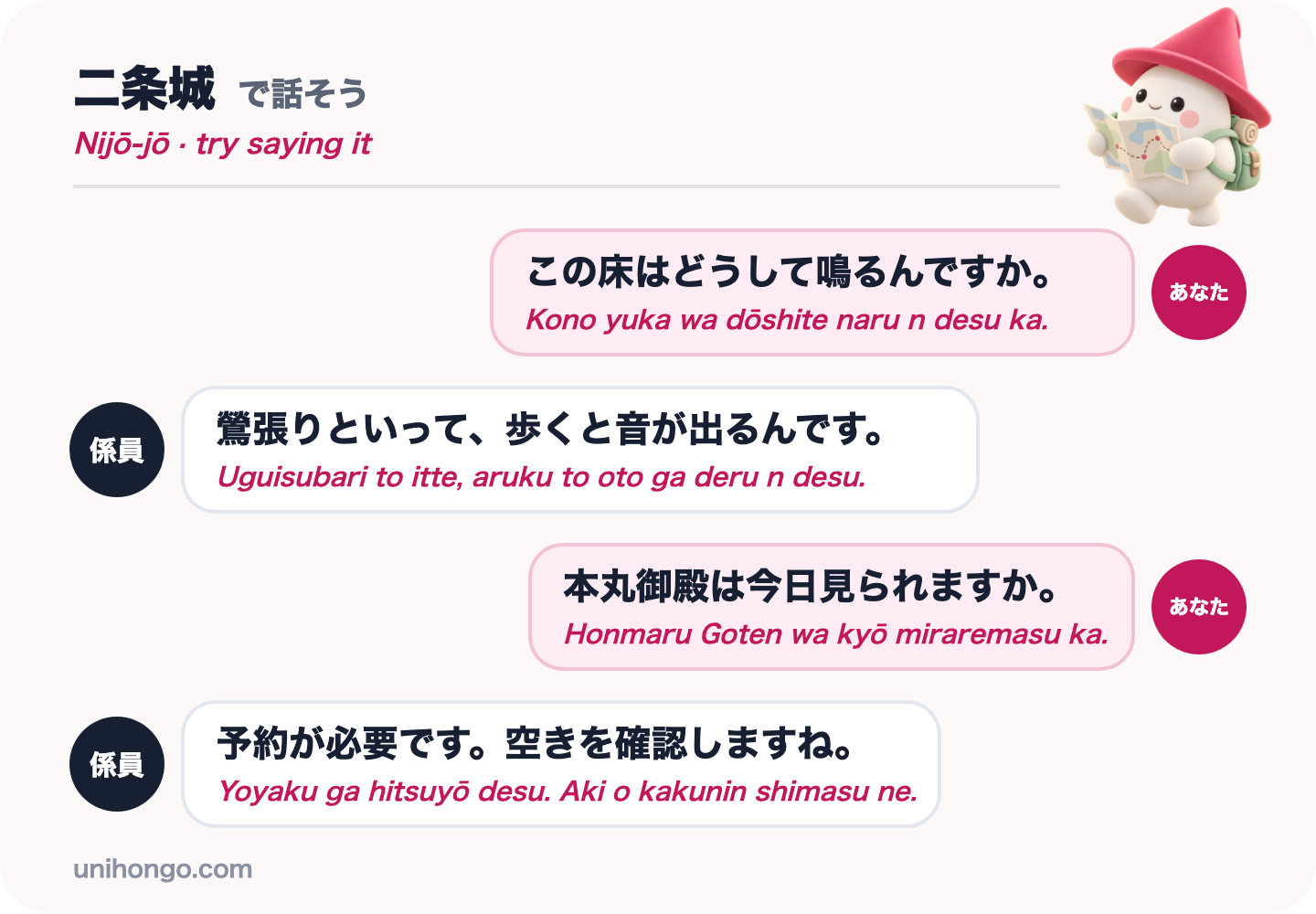
The chirping floor is the first thing every visitor wants to ask about, and the Honmaru Palace booking is the most useful thing to check. Practise the four lines below until you can say them without reading, and listen for uguisubari in the first answer and yoyaku ga hitsuyō, a reservation is needed, in the second.
Then practise with someone who answers back. In Unihongo, choose the Sightseeing topic and ask your AI Sensei to play a guide at Nijō Castle, and ask follow-up questions about the shogun and the painted rooms. Speaking the lines once before you go is what makes them come out naturally in the corridor.
| Japanese | Romaji | Meaning |
|---|---|---|
| この床はどうして鳴るんですか。 | Kono yuka wa dōshite naru n desu ka. | Why does this floor make a sound? |
| 鶯張りといって、歩くと音が出るんです。 | Uguisubari to itte, aruku to oto ga deru n desu. | It is called a nightingale floor; it sounds when you walk on it. |
| 本丸御殿は今日見られますか。 | Honmaru Goten wa kyō miraremasu ka. | Can I see the Honmaru Palace today? |
| 予約が必要です。空きを確認しますね。 | Yoyaku ga hitsuyō desu. Aki o kakunin shimasu ne. | You need a reservation. Let me check for free places. |
Official information
Nijō Castle is run by Kyoto City, and its official English site lists hours, fees, palace closing days, online tickets, the Honmaru Palace reservation and the visitor rules. Check it before you go, especially for the Honmaru Palace.