

Why Daitoku-ji is Kyoto's quietest great temple
Daitoku-ji was founded in the early fourteenth century by the Zen master Shūhō Myōchō, known as Daitō Kokushi, and became one of the most important Zen temples in Japan. It was largely destroyed in the Ōnin War in the fifteenth century and rebuilt through the efforts of the eccentric monk Ikkyū. In the sixteenth century it won the support of warlords such as Toyotomi Hideyoshi, who held Oda Nobunaga's funeral here, and feudal lords founded sub-temples to honour their families.
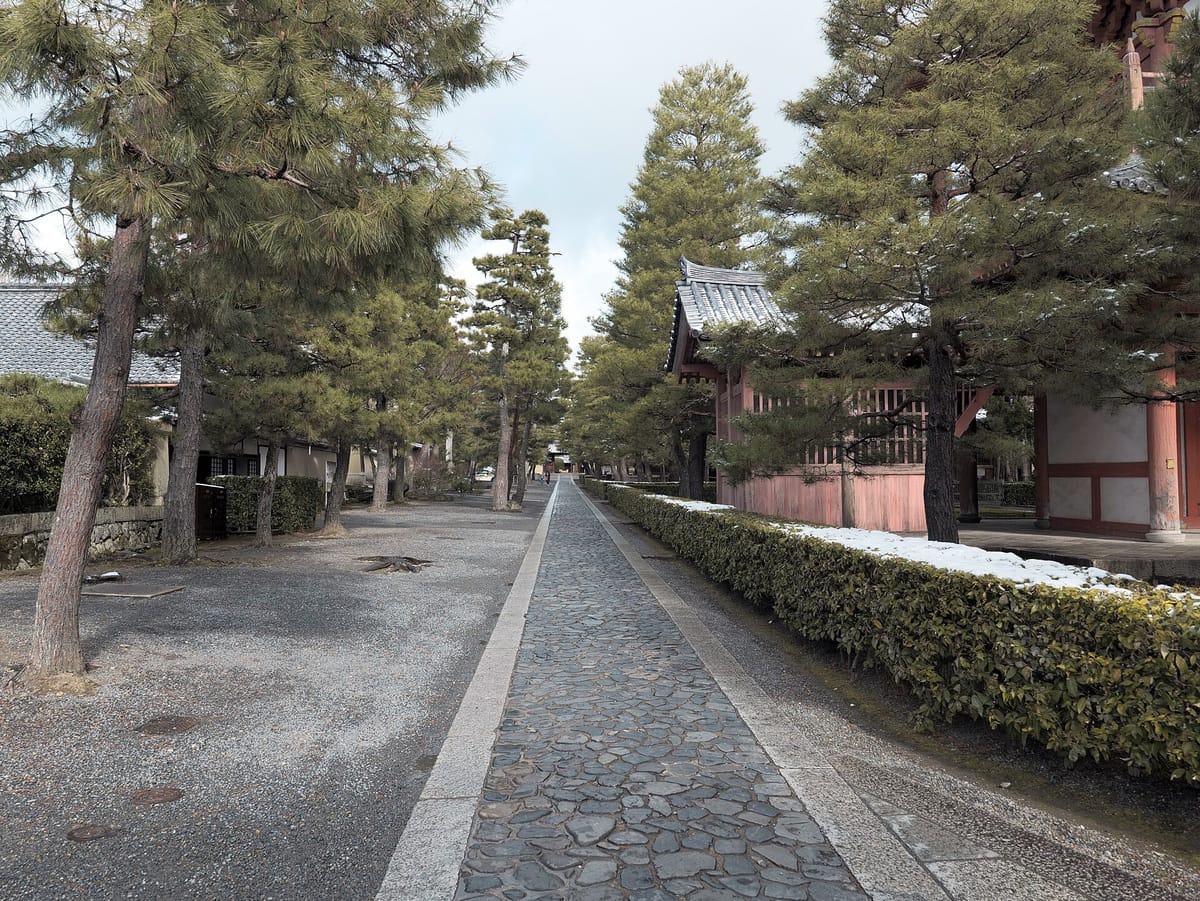
The result is a small walled town of Zen. Stone paths run between earthen walls and closed gates, pine trees lean over the lanes, and behind the walls lie some of the most famous rock gardens in Kyoto. The main halls, the Sanmon gate, the Butsuden and the Hattō, stand in a line through the middle, and are usually seen from outside.
Daitoku-ji is also bound up with the tea ceremony. Sen no Rikyū, the tea master who shaped the way of tea, studied Zen here, and many sub-temples have famous tea rooms. For a learner, it is a place to practise the quiet, polite Japanese of temple receptions, and to hear how little needs to be said.
Getting there: Daitokuji-mae and Kitaōji Station
Daitoku-ji is in Murasakino, in Kyoto's Kita ward, north of the city centre. Kyoto city buses stop at Daitokuji-mae, on Kitaōji-dōri at the south-east corner of the grounds, about five minutes' walk from the main paths. The ride from Kyoto Station takes around 45 minutes, so the subway is often quicker.
From Kitaōji Station on the Karasuma subway line, walk west along Kitaōji-dōri for about fifteen minutes, or take a short bus ride to Daitokuji-mae. Enter through the south or east gates and follow the stone paths; maps at the entrances show which sub-temples are open.
| Japanese | Romaji | Meaning |
|---|---|---|
| 大徳寺前で降りたいです。 | Daitokuji-mae de oritai desu. | I want to get off at Daitokuji-mae. |
| 大徳寺へはこのバスで行けますか。 | Daitoku-ji e wa kono basu de ikemasu ka. | Can I get to Daitoku-ji on this bus? |
| 北大路駅から歩けますか。 | Kitaōji-eki kara arukemasu ka. | Can I walk from Kitaōji Station? |
| 大仙院はどちらですか。 | Daisen-in wa dochira desu ka. | Which way is Daisen-in? |
| 今日拝観できる塔頭はどこですか。 | Kyō haikan dekiru tatchū wa doko desu ka. | Which sub-temples can I visit today? |
The sub-temples you can visit
Start with the Sanmon, the great main gate. Its upper storey, Kinmōkaku, was added with funds from Sen no Rikyū in 1589, and a statue of Rikyū was placed inside. Because Hideyoshi would have had to walk beneath Rikyū's feet to pass through the gate, the statue is said to be one of the reasons Hideyoshi ordered the tea master's death in 1591.
Then choose your sub-temples. Daisen-in, the head of the northern branch, is open every day and has one of the most celebrated dry landscape gardens in Japan, a river of white gravel flowing from rock mountains into a wide sea. Ryōgen-in, the head of the southern branch, has several small gardens, including the Tōtekiko, a tiny courtyard of raked gravel and stones. Zuihō-in, founded for the Christian lord Ōtomo Sōrin, has gardens of raked gravel and a rear garden where the stones are set in the shape of a cross.
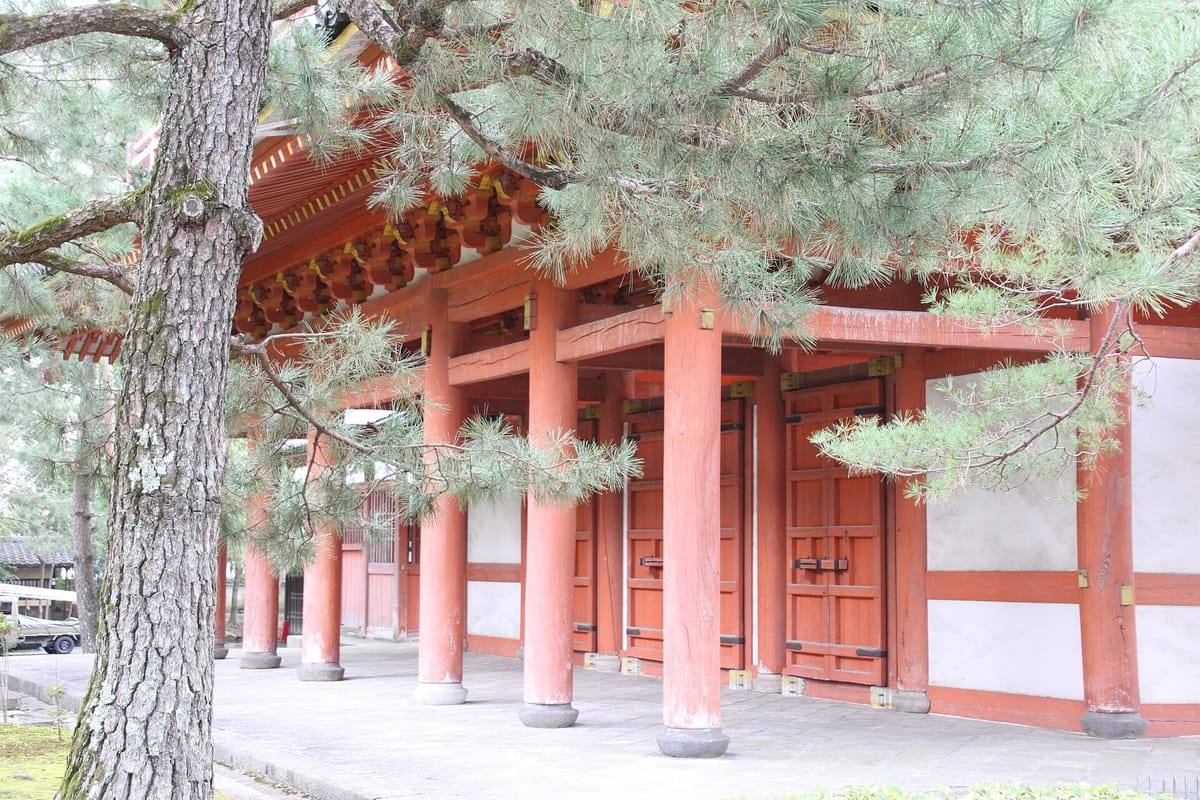
- Sanmon: the main gate, with its upper storey paid for by Sen no Rikyū.
- Daisen-in: open all year, with a famous dry garden of rocks and gravel.
- Ryōgen-in: open all year, with small gardens including the tiny Tōtekiko.
- Zuihō-in: open all year, with a rock garden and a cross-shaped stone garden.
- Kōtō-in: known for its maple-lined approach, closed to visitors until further notice.
- Special openings: other sub-temples open for limited periods, usually in spring and autumn.
- Imamiya Shrine: just north of the temple, with two old shops selling aburi-mochi, grilled rice cakes.
Words on the signs at Daitoku-ji
Gates at Daitoku-ji carry small wooden signs that tell you whether you can go in. 拝観 is visiting, so 拝観受付 means reception for visitors, and a sign reading 拝観休止 or 拝観謝絶 means the sub-temple is not open. The end of each sub-temple's name, 院, in, means a temple building or cloister.
The sign that matters most inside is 撮影禁止, satsuei kinshi. 撮影 is taking photos or filming and 禁止 is prohibited, and you will see the same word in museums, shops and theatres all over Japan.
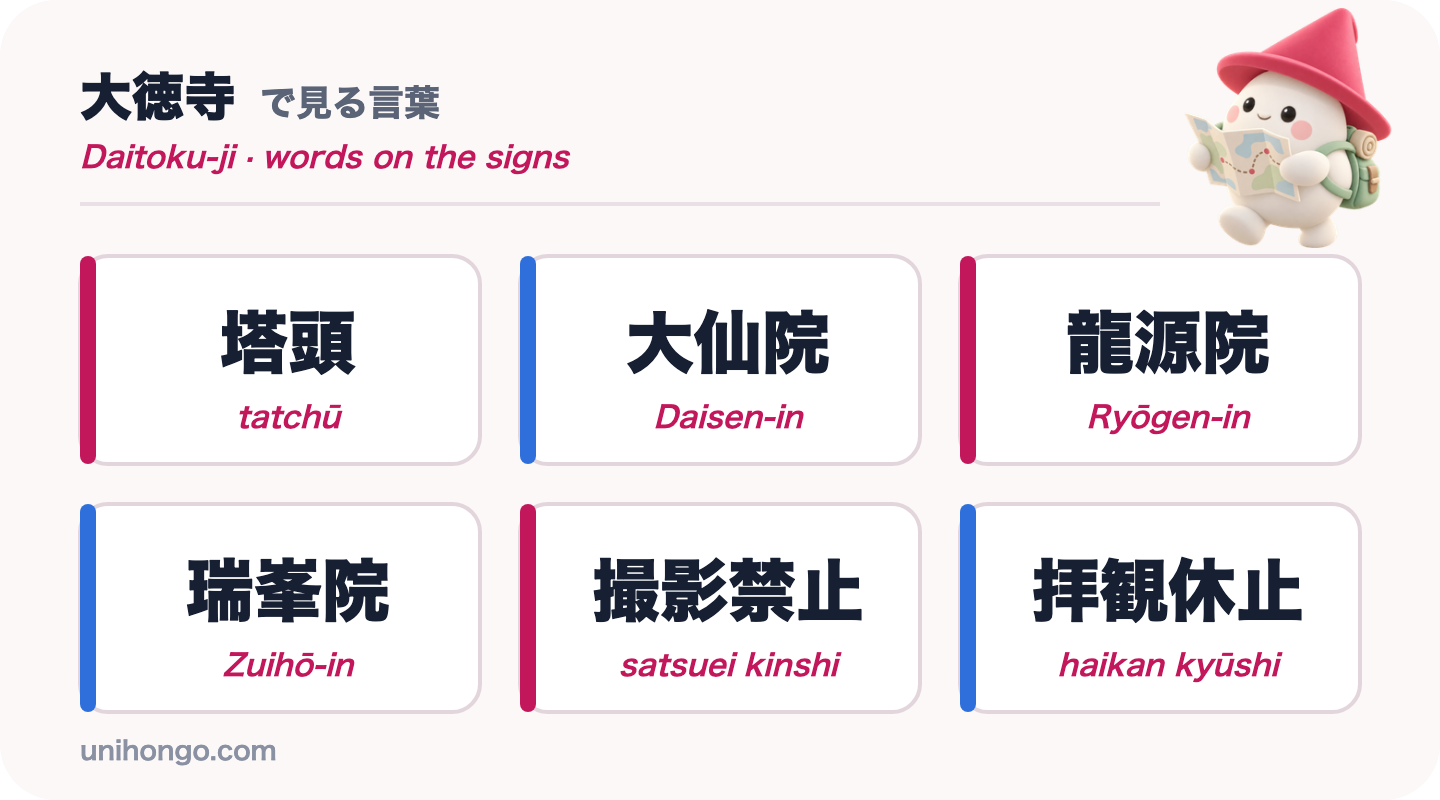
| Word | Reading | Meaning |
|---|---|---|
| 塔頭 | tatchū | Sub-temple within a larger temple |
| 大仙院 | Daisen-in | Sub-temple with a famous dry garden |
| 龍源院 | Ryōgen-in | Sub-temple with small rock gardens |
| 瑞峯院 | Zuihō-in | Sub-temple with a cross-shaped stone garden |
| 撮影禁止 | satsuei kinshi | No photography |
| 拝観休止 | haikan kyūshi | Closed to visitors for now |
| 拝観謝絶 | haikan shazetsu | No visitors, a closed sub-temple |
| 三門 | sanmon | The main gate |
| 枯山水 | karesansui | Dry landscape garden of rocks and gravel |
Japanese at the sub-temple reception
Each open sub-temple has a small reception, uketsuke, just inside the gate, where you pay and take off your shoes. Staff may hand you a leaflet and, at some temples, a monk may give a short explanation of the garden in Japanese. Speak quietly: voices carry in the wooden corridors.
Photo rules vary between sub-temples and have changed over the years, so asking is always better than guessing. A simple question before you take out your phone is polite and will be appreciated.
| Japanese | Romaji | Meaning |
|---|---|---|
| 一人お願いします。 | Hitori onegai shimasu. | One person, please. |
| 靴はここで脱ぎますか。 | Kutsu wa koko de nugimasu ka. | Do I take my shoes off here? |
| 写真を撮ってもいいですか。 | Shashin o totte mo ii desu ka. | May I take photos? |
| お庭はどちらですか。 | O-niwa wa dochira desu ka. | Which way is the garden? |
| お抹茶はいただけますか。 | O-matcha wa itadakemasu ka. | Is it possible to have matcha here? |
| 御朱印をお願いできますか。 | Goshuin o onegai dekimasu ka. | Could I ask for a goshuin? |
Etiquette, timing and practical tips
Daitoku-ji is a working Zen monastery, and its sub-temples are places of practice as well as gardens to visit.
- Keep your voice low on the paths and inside the sub-temples.
- Sit quietly on the veranda to look at a garden; do not step onto the gravel or moss.
- Take off your shoes where asked, and wear clean socks.
- Do not open closed gates or enter sub-temples that are not marked as open.
- Check which sub-temples are open before you go; special openings change each season.
- Come in the morning on a weekday for the quietest gardens.
Practise the visit before you go
At a sub-temple reception, your conversation will be brief and quiet: one question about photos, one about an explanation. The answer may divide the garden from the rooms, so listen for wa ... ga, the pattern that contrasts two things. Practise the four lines below until you can say them without reading.
Then practise with a partner who answers back. In Unihongo, choose the Tea Ceremony topic and ask your AI Sensei to play the receptionist at a Zen sub-temple, then a host serving matcha who explains how to drink it.
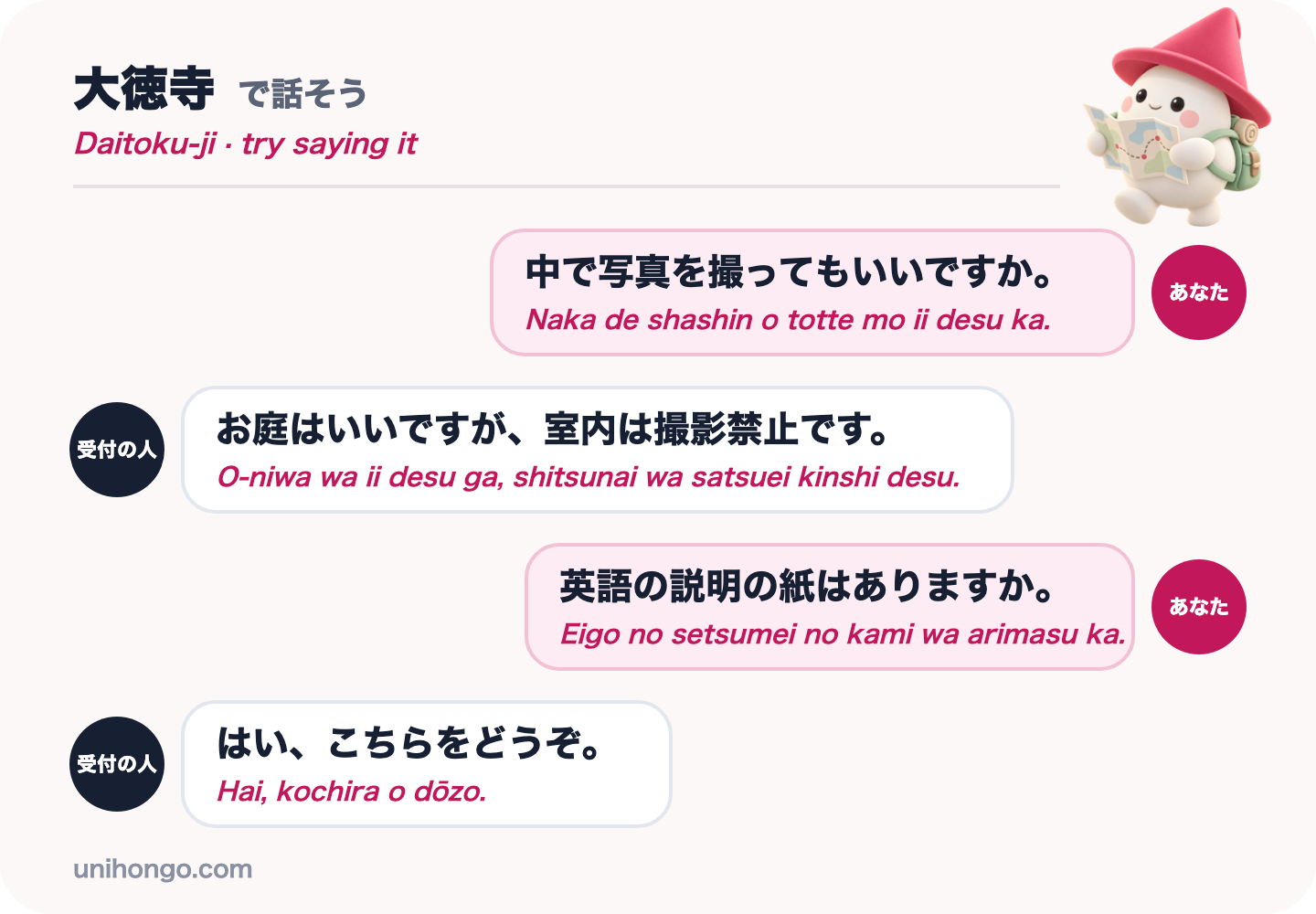
| Japanese | Romaji | Meaning |
|---|---|---|
| 中で写真を撮ってもいいですか。 | Naka de shashin o totte mo ii desu ka. | May I take photos inside? |
| お庭はいいですが、室内は撮影禁止です。 | O-niwa wa ii desu ga, shitsunai wa satsuei kinshi desu. | The garden is fine, but no photos indoors. |
| 英語の説明の紙はありますか。 | Eigo no setsumei no kami wa arimasu ka. | Do you have an explanation sheet in English? |
| はい、こちらをどうぞ。 | Hai, kochira o dōzo. | Yes, here you are. |
Official information
The Kyoto prefectural tourism federation lists Daitoku-ji's open sub-temples and access, and Daisen-in publishes its own visiting information. Check before you go, as sub-temple openings change with the season and with temple events.