

Why the Arashiyama bamboo is worth an early alarm
Arashiyama has been a retreat since the Heian period, when Kyoto's aristocrats came out to the river to view cherry blossoms and autumn leaves, write poetry and go boating. The district still has that holiday feel, with temples, villas and shrines scattered along the foot of the hills and the Katsura River, called the Ōi River here, flowing under the long Togetsukyō bridge.
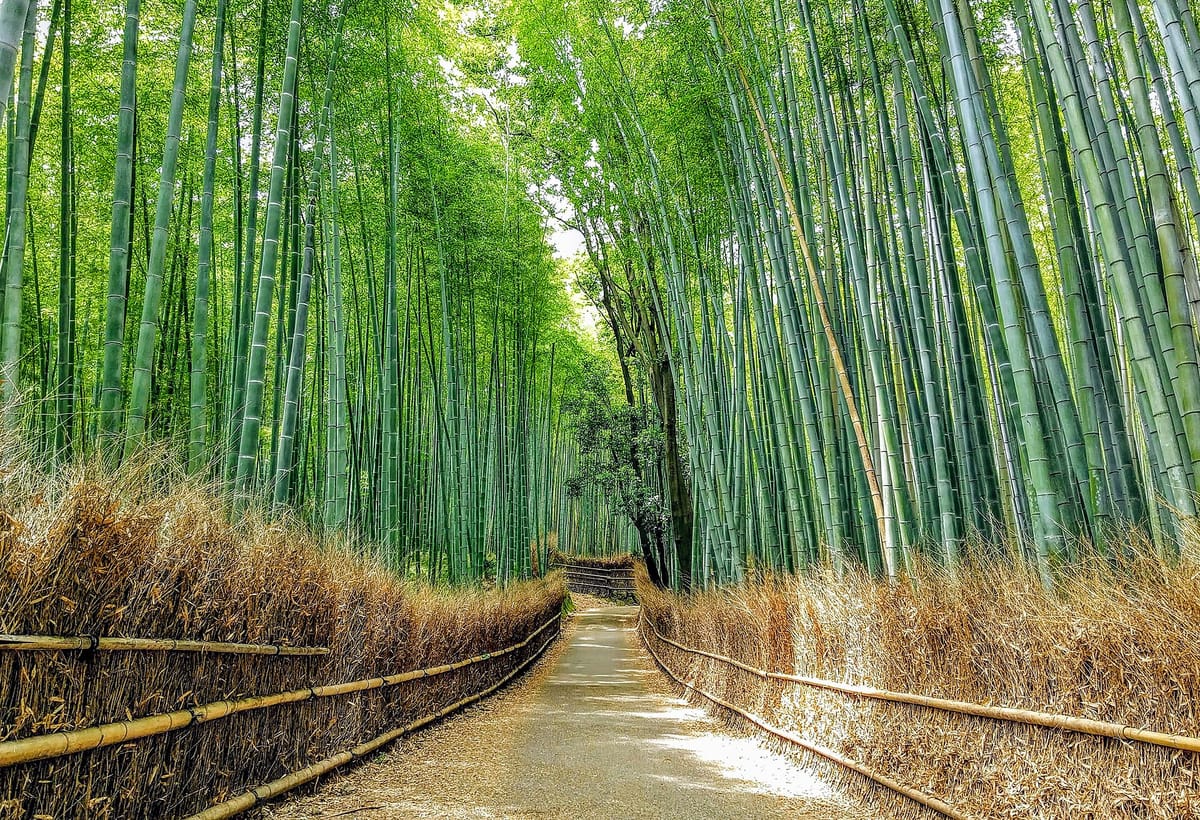
The bamboo grove is the part everyone has seen in photos. The path runs through dense groves of tall bamboo, fenced on both sides with low screens of dried brushwood, called shibagaki. It is not a park or a temple garden but a public lane, so there is no ticket and no closing time, and the atmosphere depends entirely on when you come.
Early in the morning it is one of the most peaceful places in Kyoto. The rest of the day it is lively, and the language around you is part of the show: rickshaw pullers calling out to passers-by, shopkeepers on the main street, and signposts pointing to shrines and villas in a handful of kanji you can learn in one visit.
Getting there: three stations called Arashiyama
The simplest route from Kyoto Station is the JR Sagano Line, also shown as the San-in Line, to Saga-Arashiyama Station, which takes about fifteen minutes by local or rapid train. From the south exit, walk ten minutes or so to the north end of the grove near Nonomiya Jinja. The Sagano Romantic Train, a scenic tourist line along the river gorge, starts from Torokko Saga Station right next door.
The Randen, the Keifuku Electric Railroad, is a one- or two-carriage tram that ends at Arashiyama Station in the middle of the main street. Its main line starts at Shijō-Ōmiya, beside Hankyū's Ōmiya Station, a branch runs up to Kitano Hakubaichō, and the station platform is lined with the Kimono Forest, pillars wrapped in dyed kimono fabric. Hankyū Arashiyama Station is on the south bank of the river; it is handy from Osaka and from central Kyoto via Katsura, and you walk across the Togetsukyō bridge into town.
| Japanese | Romaji | Meaning |
|---|---|---|
| 嵯峨嵐山駅に行く電車は何番線ですか。 | Saga-Arashiyama-eki ni iku densha wa nanbansen desu ka. | Which platform is the train to Saga-Arashiyama Station? |
| 嵐電の嵐山駅はどこですか。 | Randen no Arashiyama-eki wa doko desu ka. | Where is the Randen's Arashiyama Station? |
| 竹林の小径はこの道でいいですか。 | Chikurin no komichi wa kono michi de ii desu ka. | Is this the right way to the bamboo path? |
| 渡月橋までどのくらいかかりますか。 | Togetsukyō made dono kurai kakarimasu ka. | How long does it take to the Togetsukyō bridge? |
| 阪急の駅は橋を渡った先ですか。 | Hankyū no eki wa hashi o watatta saki desu ka. | Is the Hankyū station across the bridge? |
The route: Nonomiya, the bamboo, Ōkōchi Sansō and the river
A good loop starts at the Togetsukyō bridge and the main street, then heads through Tenryū-ji, one of Kyoto's great Zen temples, whose garden has a north gate opening onto the bamboo path. Coming out of the gate, turn left for the densest part of the grove and walk up to the Ōkōchi Sansō villa at the top, then come back down past Nonomiya Jinja towards the JR station, or the other way round.
If you skip Tenryū-ji, you can enter the grove from the main street beside the temple or from Nonomiya Jinja. Beyond Ōkōchi Sansō the path curves round towards the river and Kameyama Park, and from there it is a short walk back down to the bridge.
- Chikurin no Komichi: the bamboo path itself, the photogenic stretch near Nonomiya Jinja and Tenryū-ji.
- Nonomiya Jinja: a small shrine with a torii of unbarked wood, linked to the Tale of Genji and visited for luck in love.
- Tenryū-ji: a large Zen temple with a pond garden; its north gate opens onto the grove.
- Ōkōchi Sansō: the hillside villa and gardens of the film actor Ōkōchi Denjirō, entry including a cup of matcha.
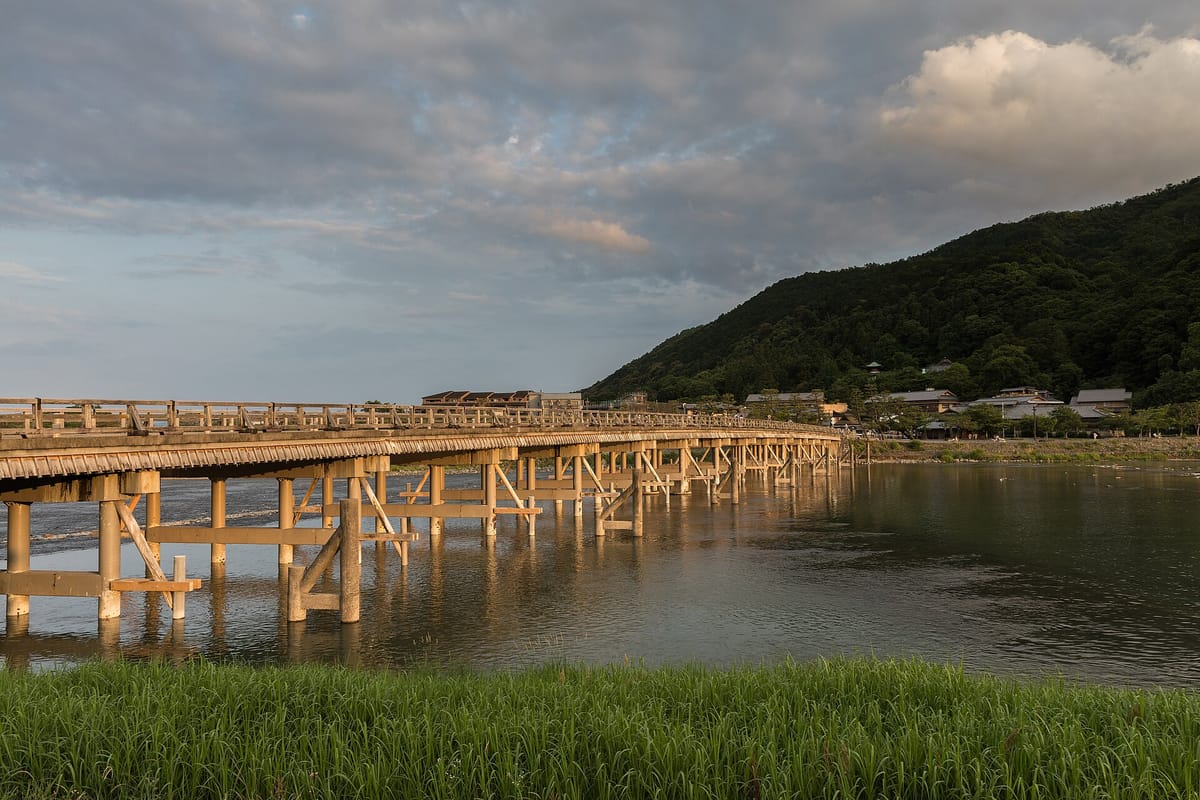
- Togetsukyō: the moon-crossing bridge, the symbol of Arashiyama.
- Randen Arashiyama Station and the Kimono Forest: pillars of dyed fabric along the tram platform.
Words on the signs in Arashiyama
Arashiyama's signposts are mostly place names, and many of them are pure Heian-period poetry. Togetsukyō, 渡月橋, means the bridge the moon crosses, a name said to come from an emperor who watched the moon appear to move across it. Arashiyama itself, 嵐山, is storm mountain.
The table adds the practical words you meet around the stations and the rental shops, including where to leave a bicycle. Bicycles left outside designated areas can be removed, so look for 駐輪場.
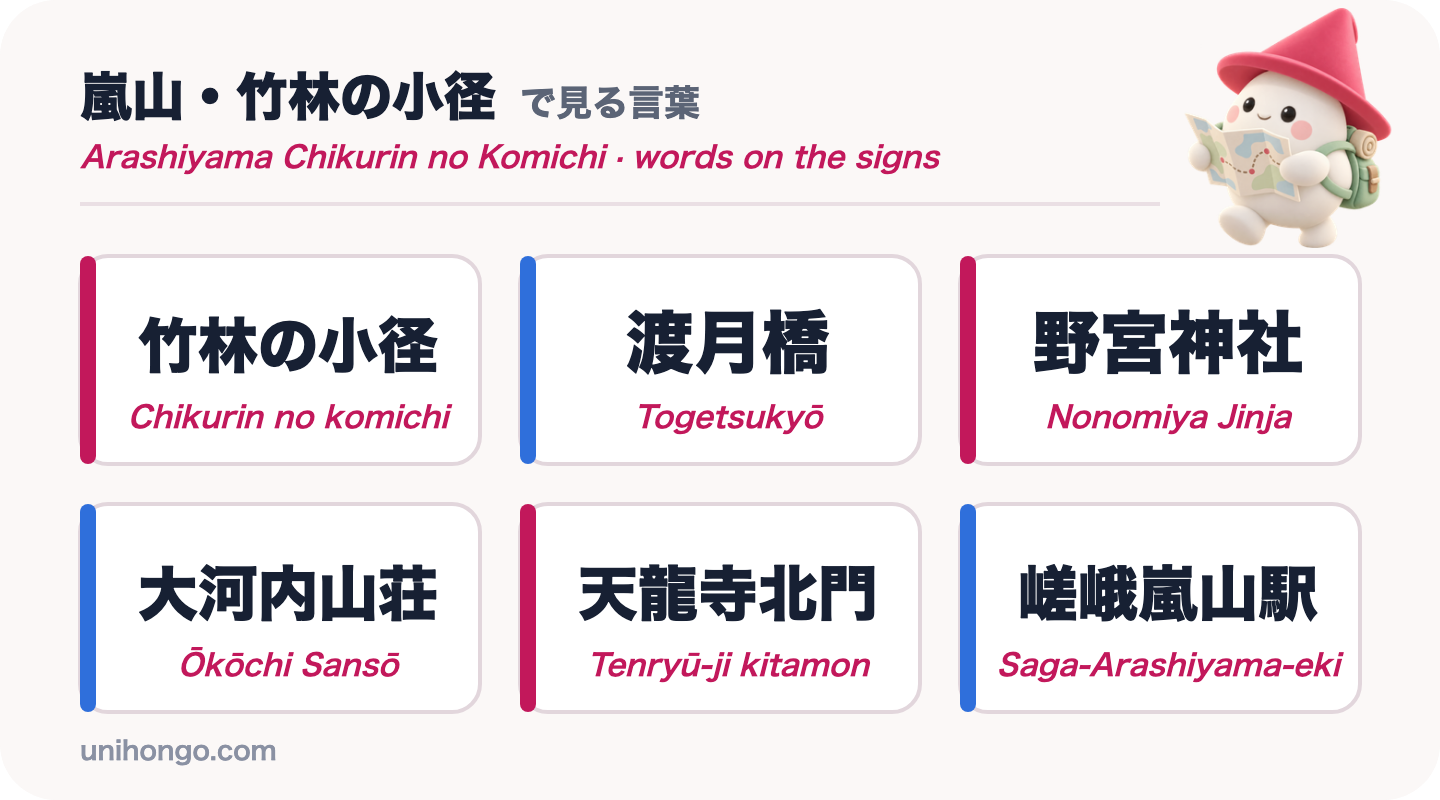
| Word | Reading | Meaning |
|---|---|---|
| 竹林の小径 | Chikurin no komichi | The path through the bamboo grove |
| 渡月橋 | Togetsukyō | The moon-crossing bridge over the river |
| 野宮神社 | Nonomiya Jinja | Small shrine at the north end of the grove |
| 大河内山荘 | Ōkōchi Sansō | The actor's villa and garden at the top of the path |
| 天龍寺北門 | Tenryū-ji kitamon | North gate of Tenryū-ji, opening onto the grove |
| 嵯峨嵐山駅 | Saga-Arashiyama-eki | JR Saga-Arashiyama Station |
| 嵐電 | Randen | The Keifuku tram line to Arashiyama |
| 人力車 | jinrikisha | Rickshaw, pulled by a runner |
| 駐輪場 | chūrinjō | Bicycle parking area |
Japanese for renting a bicycle or riding a rickshaw
Arashiyama and the Sagano area behind it are flat along the river and spread out, which makes a bicycle a practical way to reach the quieter temples further north. Rental shops cluster near the stations; they usually ask you to fill in a form with your name and where you are staying, and tell you what time to bring the bike back. Inside the grove itself it is easier to leave the bike and walk, because the path is narrow and busy.
The other classic way to see the area is by jinrikisha. Pullers in traditional dress wait near the bridge and the grove, offer rides of different lengths, and talk about the sights as they go, often in simple Japanese and a little English. It is a good chance to hear Kyoto place names said properly.
| Japanese | Romaji | Meaning |
|---|---|---|
| 何時までに返せばいいですか。 | Nanji made ni kaeseba ii desu ka. | By what time should I bring it back? |
| 電動自転車はありますか。 | Dendō jitensha wa arimasu ka. | Do you have electric bicycles? |
| 自転車はどこに止めればいいですか。 | Jitensha wa doko ni tomereba ii desu ka. | Where should I park the bicycle? |
| 人力車で竹林の近くまで行けますか。 | Jinrikisha de chikurin no chikaku made ikemasu ka. | Can the rickshaw take us near the bamboo grove? |
| 短いコースはありますか。 | Mijikai kōsu wa arimasu ka. | Do you have a short route? |
| いい写真の場所で止まってもらえますか。 | Ii shashin no basho de tomatte moraemasu ka. | Could you stop at a good spot for photos? |
Etiquette and timing in the grove
The bamboo grove is a living wood and part of a residential area, and it is easily damaged by the number of people who pass through.
- Never carve or write on the bamboo. Scratched names scar the stalks permanently and damaged bamboo has to be cut down.
- Stay on the path and do not climb over the brushwood fences for photos.
- Keep to one side and keep moving at busy times; stop for photos only where there is room.
- If you do bring a bicycle into the lane, get off and push when it is crowded, and give way to rickshaws.
- Arrive around sunrise for photographs without people; by mid-morning the tour groups have arrived.
- Take rubbish with you. There are few bins, and the main street's food stalls expect you to eat at the shop.
Practise the rental shop before you go
The rental counter is the conversation you are most likely to have in Arashiyama. The clerk will need your name and will tell you when the shop closes, so it helps to hear those words once before you go. Practise the four lines below until you can say them without reading.
Then practise with someone who answers back. In Unihongo, choose the Sightseeing topic and ask your AI Sensei to play the owner of a rental shop near Arashiyama Station, or choose the Directions topic to ask the way from the grove to the bridge. Speaking the lines aloud once is what makes them come out naturally on the day.
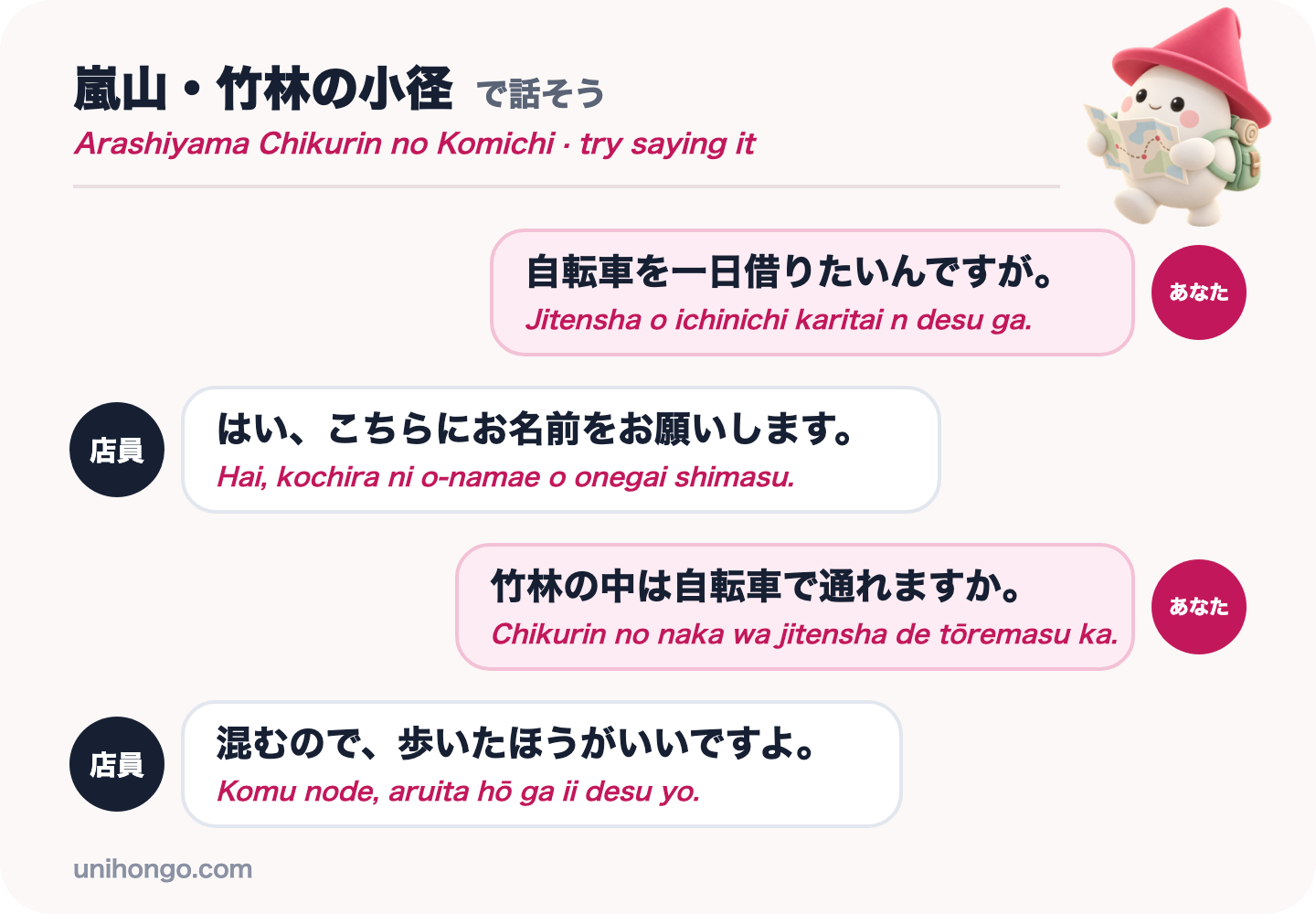
| Japanese | Romaji | Meaning |
|---|---|---|
| 自転車を一日借りたいんですが。 | Jitensha o ichinichi karitai n desu ga. | I would like to rent a bicycle for the day. |
| はい、こちらにお名前をお願いします。 | Hai, kochira ni o-namae o onegai shimasu. | Certainly, please write your name here. |
| 竹林の中は自転車で通れますか。 | Chikurin no naka wa jitensha de tōremasu ka. | Can I ride through the bamboo grove? |
| 混むので、歩いたほうがいいですよ。 | Komu node, aruita hō ga ii desu yo. | It gets crowded, so it is better to walk. |
Official information
The bamboo grove is a public path, so it has no website of its own. Kyoto City's official travel guide covers Arashiyama and its seasonal events and crowd advice; check it before you go.