
Four words of a home stay
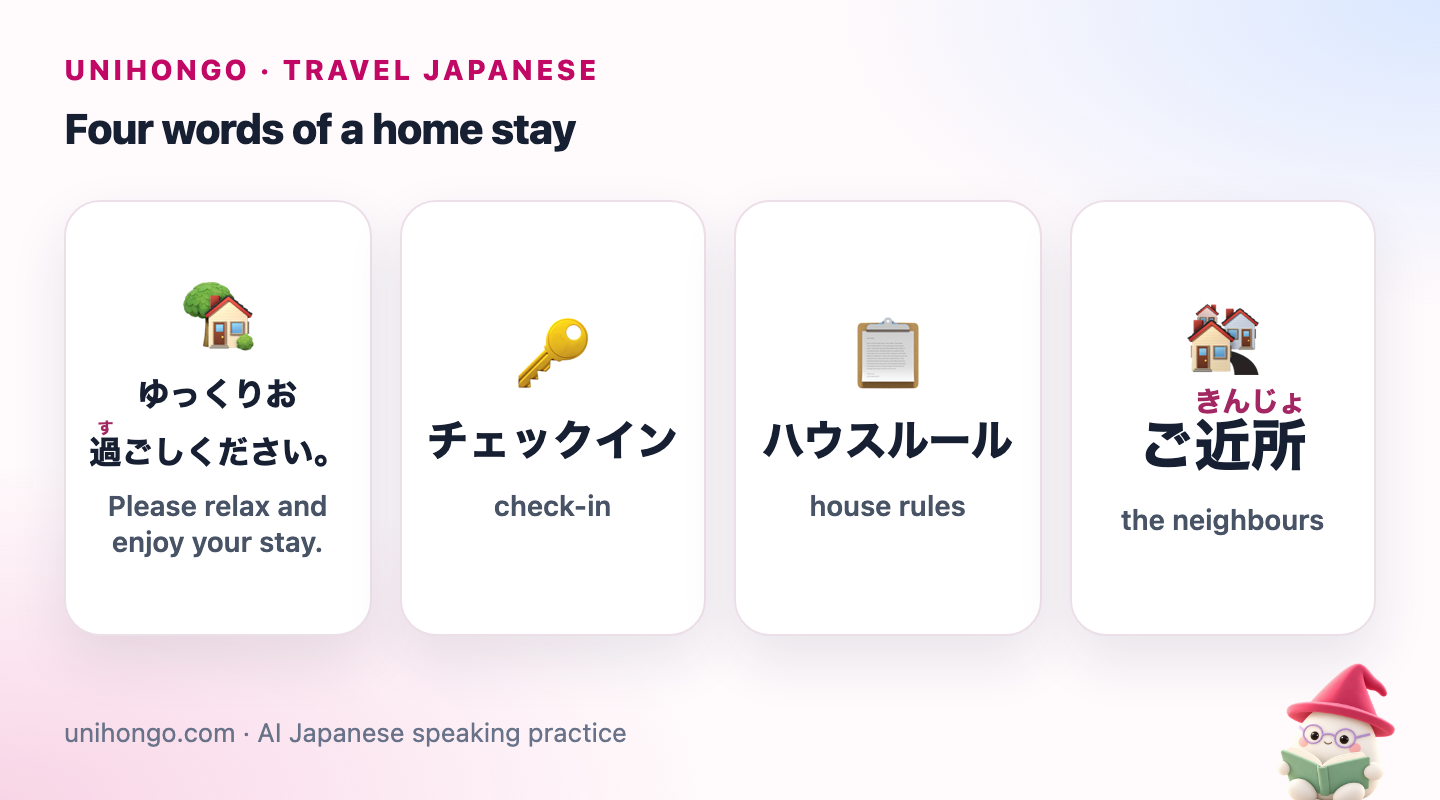
Yukkuri osugoshi kudasai, please relax and enjoy your stay, is the line a host adds at the end of a welcome message, and a guest will see it on many a note left on the table. Chekkuin and hausu rūru are loanwords used exactly as in English. Gokinjo (ご近所), the neighbours, is the word that decides whether a minpaku survives. Around these, minpaku (民泊) names the business itself, and kagi (鍵), the key, is the subject of most pre-arrival messages.
| Japanese | Romaji | Meaning |
|---|---|---|
| ゆっくりお過ごしください。 | Yukkuri osugoshi kudasai. | Please relax and enjoy your stay. |
| チェックイン | chekkuin | check-in |
| ハウスルール | hausu rūru | house rules |
| ご近所 | gokinjo | the neighbours |
| 民泊 | minpaku | private home lodging |
| 鍵 | kagi | key |
Booking and check-in messages
The first messages set the tone. A host thanks the guest for the booking, states the check-in window, asks for an arrival time and explains where the key is; a kī bokkusu (キーボックス), a code-locked key box by the door, is the usual answer. A guest replies with a time, warns about delays, and asks for directions from the station if the map is unclear. Hosts use polite and respectful forms, tōchaku saremasu ka, because the guest is a customer; guests use ordinary polite masu forms.
| Japanese | Romaji | Meaning |
|---|---|---|
| ご予約ありがとうございます。 | Goyoyaku arigatō gozaimasu. | Host: Thank you for your booking. |
| チェックインは午後3時からです。 | Chekkuin wa gogo sanji kara desu. | Host: Check-in is from 3 pm. |
| 何時ごろ到着されますか。 | Nanji goro tōchaku saremasu ka. | Host: Around what time will you arrive? |
| 鍵はキーボックスに入っています。 | Kagi wa kī bokkusu ni haitte imasu. | Host: The key is in the key box. |
| 6時ごろ着きます。 | Rokuji goro tsukimasu. | Guest: I'll arrive around six. |
| 少し遅れそうです。すみません。 | Sukoshi okuresō desu. Sumimasen. | Guest: I'll be a little late. Sorry. |
| 駅からの行き方を教えてください。 | Eki kara no ikikata o oshiete kudasai. | Guest: Please tell me the way from the station. |
House rules in plain Japanese
Good house rules are short, polite and specific. The grammar is the te-form plus kudasai, and times are given with gozen and gogo or the 24-hour clock. The rules that matter in Japan are the ones a foreign guest may not expect: shoes off at the genkan, quiet after about ten because walls are thin, no smoking indoors, and rubbish separated by the local categories. Rubbish rules differ from one city to the next, so a host should write the categories for their own area, and a guest should simply follow the labels on the bins.
| Japanese | Romaji | Meaning |
|---|---|---|
| 靴は玄関で脱いでください。 | Kutsu wa genkan de nuide kudasai. | Please take your shoes off at the entrance. |
| 夜10時以降は静かにお願いします。 | Yoru jūji ikō wa shizuka ni onegai shimasu. | Please be quiet after 10 pm. |
| ゴミは分別してください。 | Gomi wa bunbetsu shite kudasai. | Please separate the rubbish. |
| たばこは外でお願いします。 | Tabako wa soto de onegai shimasu. | Please smoke outside. |
| チェックアウトは午前10時です。 | Chekkuauto wa gozen jūji desu. | Check-out is at 10 am. |
| お風呂の使い方はこちらです。 | Ofuro no tsukaikata wa kochira desu. | Here is how to use the bath. |
| Category | Reading | Typically includes |
|---|---|---|
| 燃えるゴミ | moeru gomi | Food waste, paper scraps, most kitchen rubbish |
| 燃えないゴミ | moenai gomi | Small metal and ceramic items, some plastics in some cities |
| プラスチック | purasuchikku | Plastic packaging, rinsed, where collected separately |
| ペットボトル | petto botoru | Plastic drink bottles, caps and labels removed |
| 缶・びん | kan, bin | Cans and glass bottles |
The categories above are typical, not universal. A host writes the local version; a guest follows the host's labels.
Keeping the neighbours happy
Minpaku complaints in Japan are nearly always about noise, rubbish and strangers in the corridor. A host who introduces the business to the neighbours, gives them a direct contact and reacts quickly to complaints will usually be tolerated; one who does not may face the building association or the city. For a guest, a greeting in the lift and a quick apology after a loud evening go a very long way. Unihongo's Apologise to a Neighbour mission trains exactly this exchange.
| Japanese | Romaji | Meaning |
|---|---|---|
| 近くで民泊を始めました。 | Chikaku de minpaku o hajimemashita. | Host: I've started a minpaku nearby. |
| ご迷惑をおかけしたら、すぐにご連絡ください。 | Gomeiwaku o okake shitara, sugu ni gorenraku kudasai. | Host: If there's any trouble, please tell me at once. |
| こんにちは。旅行で来ています。 | Konnichiwa. Ryokō de kite imasu. | Guest: Hello. We're here on a trip. |
| うるさくしてすみませんでした。 | Urusaku shite sumimasen deshita. | Guest: Sorry for the noise. |
| 気をつけます。 | Ki o tsukemasu. | Guest: We'll be careful. |
Trouble: hot water, Wi-Fi, keys and air conditioning
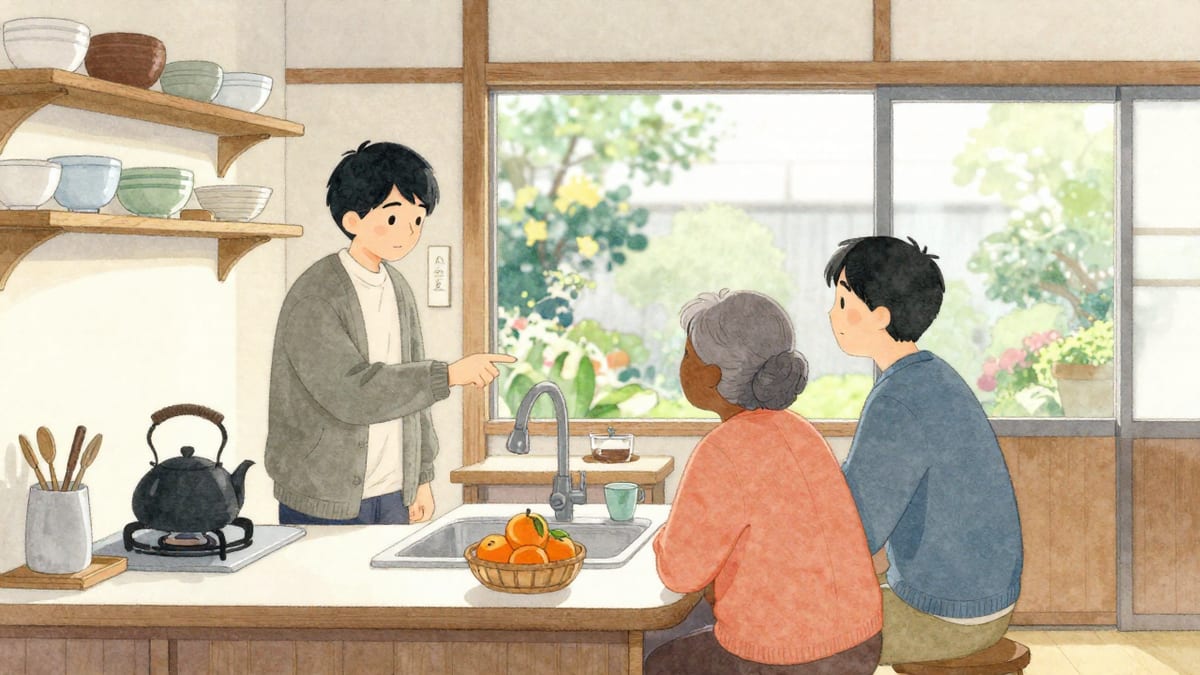
Problems come in a small set: no hot water, no Wi-Fi, a key that will not turn, and an air conditioner with a remote control full of kanji. Guests should report the fact in polite form and ask what to do; hosts reply with a promise to check, an apology, and a time. In many Japanese homes the hot water is switched on at a kitchen panel, and the air conditioner's heating mode is danbō (暖房) and cooling is reibō (冷房), which solves most of the remote-control problems.
Hosts should give every guest a phone number that is answered day and night and, for real emergencies, the national numbers: 119 for ambulance and fire, 110 for police. A short card by the door with the house address in Japanese helps a guest who has to call a taxi or describe where they are. Guests should save the host's number before the first evening, when most hot-water and key problems happen.
| Japanese | Romaji | Meaning |
|---|---|---|
| お湯が出ません。 | Oyu ga demasen. | Guest: There's no hot water. |
| Wi-Fiがつながりません。 | Wi-Fi ga tsunagarimasen. | Guest: The Wi-Fi won't connect. |
| 鍵が開きません。 | Kagi ga akimasen. | Guest: The key won't open the door. |
| エアコンの使い方を教えてください。 | Eakon no tsukaikata o oshiete kudasai. | Guest: How do I use the air conditioner? |
| すぐに確認します。 | Sugu ni kakunin shimasu. | Host: I'll check right away. |
| ご不便をおかけして申し訳ありません。 | Gofuben o okake shite mōshiwake arimasen. | Host: I'm sorry for the inconvenience. |
| 30分ほどで伺います。 | Sanjuppun hodo de ukagaimasu. | Host: I'll be there in about 30 minutes. |
Check-out and reviews
At the end, guests ask about a later check-out or luggage storage, and both sides write a review. Japanese reviews are built from a few adjectives: kaiteki (快適), comfortable; seiketsu (清潔), clean; and benri (便利), convenient. Hosts praise guests as teinei (丁寧), considerate and careful, and note that the room was left clean. Mata tomaritai, I would like to stay again, is the strongest compliment a guest can give.
| Japanese | Romaji | Meaning |
|---|---|---|
| チェックアウトを少し遅くできますか。 | Chekkuauto o sukoshi osoku dekimasu ka. | Guest: Could we check out a little later? |
| 荷物を預かってもらえますか。 | Nimotsu o azukatte moraemasu ka. | Guest: Could you keep our luggage? |
| とても快適でした。 | Totemo kaiteki deshita. | Guest review: It was very comfortable. |
| 清潔で、駅から近かったです。 | Seiketsu de, eki kara chikakatta desu. | Guest review: Clean and close to the station. |
| またぜひ泊まりたいです。 | Mata zehi tomaritai desu. | Guest review: I'd love to stay again. |
| とても丁寧なゲストでした。 | Totemo teinei na gesuto deshita. | Host review: Very considerate guests. |
| お部屋をきれいに使っていただきました。 | Oheya o kirei ni tsukatte itadakimashita. | Host review: They left the room spotless. |
Register and common mistakes
Hosts speak as service providers, with humble forms for their own actions, ukagaimasu, and respectful forms for the guest's, saremasu. Guests need only polite masu forms; keigo from a guest sounds odd. Both sides should avoid casual speech in messages, even when the relationship is friendly, because written casual Japanese from a stranger reads as careless.
- Writing long rules. One sentence per rule; a guest skims.
- Saying sumimasen for a broken boiler. The guest did nothing wrong; report the fact and ask what to do.
- Ignoring the neighbours until there is a complaint. The introduction line is cheap; the complaint is expensive.
- Guessing rubbish categories. Follow the labels or ask; a wrong bag may be left on the street with a sticker.
- Skipping the registration. Japanese law requires hosts to register and follow local rules; check the official portal and your municipality before listing.