

Why Mount Yoshino is Japan's cherry blossom mountain
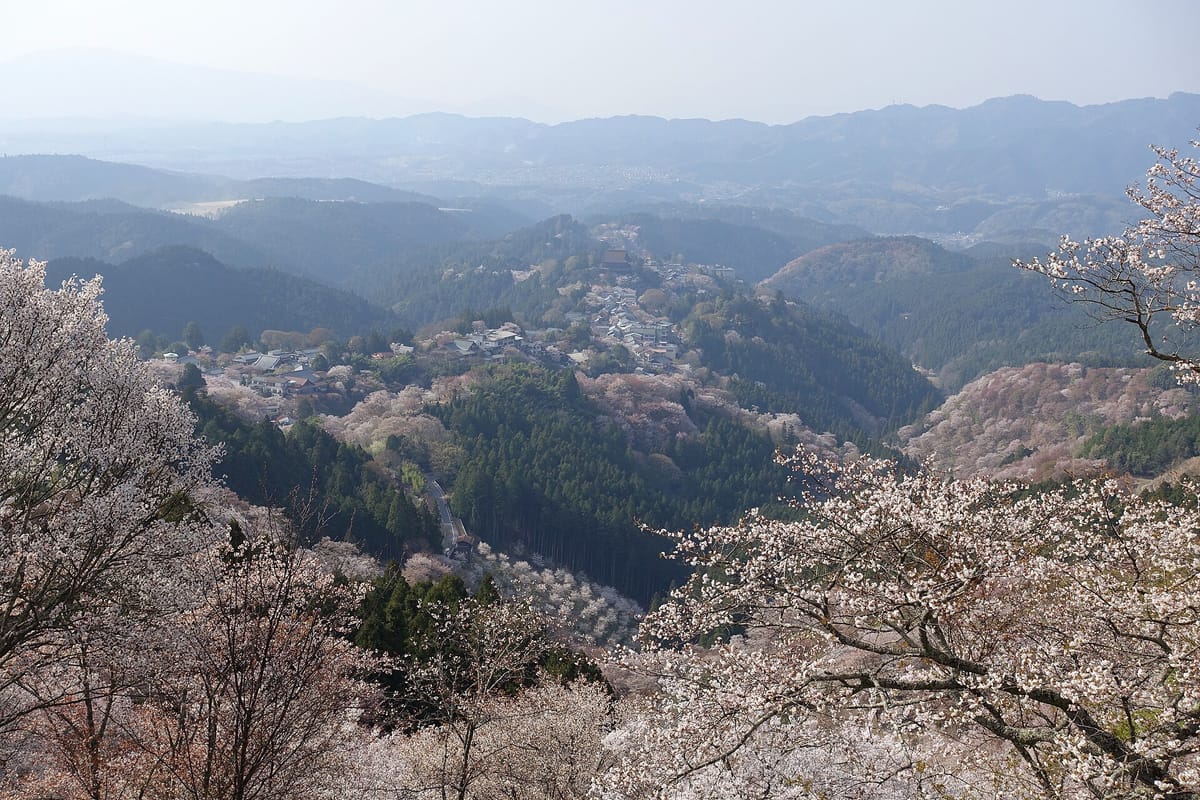
Yoshino has been loved for its cherry blossoms since the Heian period, over a thousand years ago. The trees were first planted as sacred offerings: according to legend, En no Gyōja, the founder of the Shugendō mountain religion, carved the image of the deity Zaō Gongen from cherry wood, and worshippers planted cherry trees on the mountain as an act of devotion. Over the centuries the planting became a forest, and today the mountain holds over thirty thousand trees.
The mountain is also rich in history. Toyotomi Hideyoshi held a famous cherry blossom party here in 1594, and in the fourteenth century Emperor Go-Daigo set up his Southern Court in Yoshino when he fled Kyoto. In 2004, Yoshino and Ōmine became part of the Sacred Sites and Pilgrimage Routes in the Kii Mountain Range World Heritage Site, alongside Kōyasan and the Kumano shrines.
The town runs along a single ridge-top street, lined with inns, sweet shops and temples, and it is small enough that you will keep passing the same shopkeepers. That makes it a good place to try your Japanese: ask the way once, and the person you asked may wave to you again on your way back down.
Getting there: Kintetsu Yoshino Station, the ropeway and the buses
Yoshino Station, Yoshino-eki, is the terminus of the Kintetsu Yoshino Line. Direct express and limited express trains run from Osaka Abenobashi Station, beside JR Tennōji, and take about 75 to 90 minutes; limited express seats need a separate reserved ticket. From Kyoto, take the Kintetsu Kyoto Line to Kashiharajingu-mae and change there. You can also reach the line from JR at Yoshinoguchi Station.
From Yoshino Station, the Yoshino Ropeway climbs from Senbonguchi Station to Yoshinoyama Station in about three minutes. It opened in 1929 and is the oldest ropeway in Japan. It runs every day in the cherry blossom season and other busy periods, but only on some days of the week at other times, with a bus covering the other days. In the blossom season, extra buses run from the station towards Naka Senbon and on towards Oku Senbon, and they can be crowded.
| Japanese | Romaji | Meaning |
|---|---|---|
| 吉野行きの特急券をください。 | Yoshino-yuki no tokkyūken o kudasai. | A limited express ticket to Yoshino, please. |
| 吉野山へはロープウェイで行けますか。 | Yoshinoyama e wa rōpuwei de ikemasu ka. | Can I go up Mount Yoshino by ropeway? |
| 今日はロープウェイは動いていますか。 | Kyō wa rōpuwei wa ugoite imasu ka. | Is the ropeway running today? |
| 中千本行きのバスはどこから出ますか。 | Naka Senbon-yuki no basu wa doko kara demasu ka. | Where does the bus to Naka Senbon leave from? |
| 蔵王堂はどちらですか。 | Zaōdō wa dochira desu ka. | Which way is the Zaōdō? |
Up the mountain: the four senbon areas and Kinpusen-ji
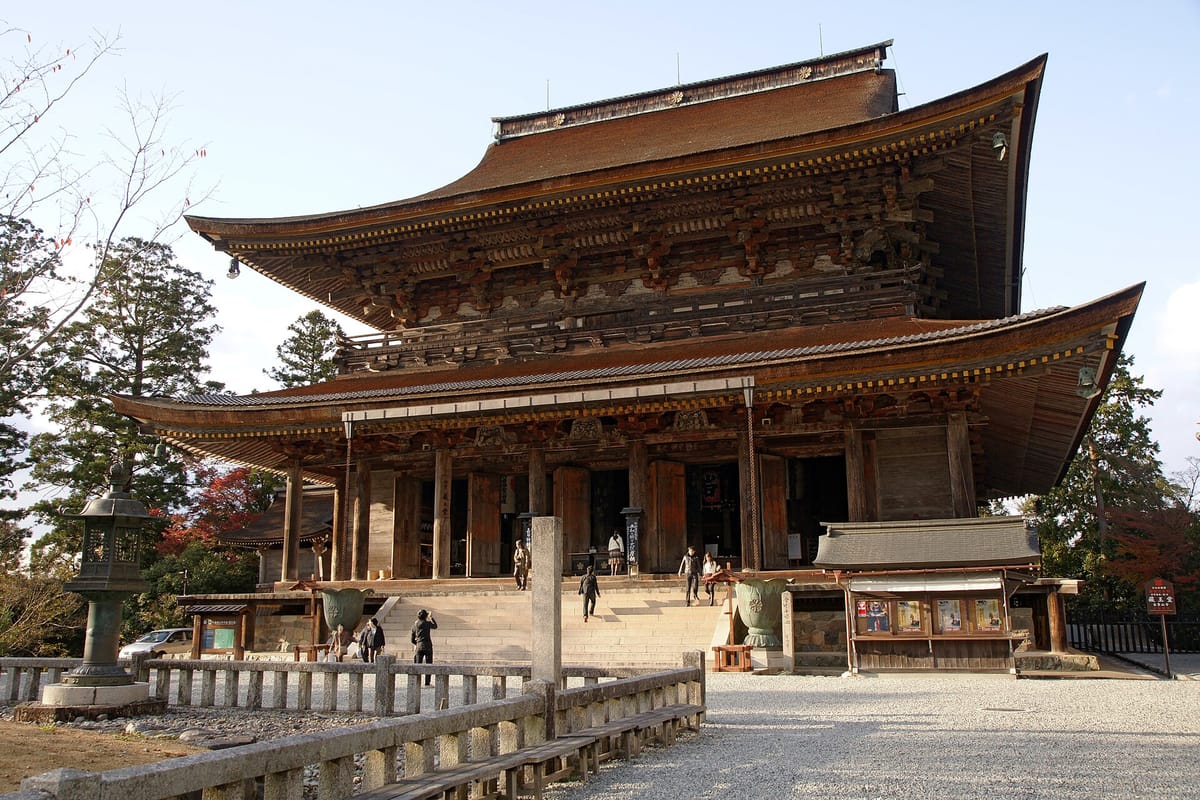
The visit is one long walk uphill. From the top of the ropeway, the main street climbs through Shimo Senbon to Kinpusen-ji, whose Zaōdō rises over the rooftops. The hall, rebuilt in 1592, is the second-largest traditional wooden building in Japan after Tōdai-ji's Great Buddha Hall, and many of its huge pillars are unpainted, still showing the knots and grain of the trees. It houses three huge statues of Zaō Gongen, shown to the public only during occasional special openings; a fire ritual, goma, is held in the hall each morning and is open to visitors.
Beyond the temple the street continues through Naka Senbon, past Yoshimizu Shrine with its view across the valley, and on to Kami Senbon. The temple's great Niōmon gate is under its first major repair since the 1950s and may be covered until around 2030. From the upper ropeway station, the walk to Mikumari Shrine in Kami Senbon takes about an hour, and Oku Senbon is further again, so many visitors take a bus up and walk down.
- Shimo Senbon: the lower slopes around the ropeway, the first to bloom.
- Kinpusen-ji Zaōdō: the vast wooden main hall of the Shugendō religion.
- Kane no Torii: a copper torii near the Niōmon, the first gate on the pilgrims' route to Mount Ōmine.
- Yoshimizu Shrine: a former residence of Emperor Go-Daigo, with a famous view of Naka Senbon.
- Chikurin-in: a temple and inn with a beautiful garden.
- Mikumari Shrine: a quiet shrine with unusual architecture in Kami Senbon.
- Hanayagura viewpoint: a lookout in Kami Senbon over the whole mountain.
- Oku Senbon and Kinpu Shrine: the innermost area, the last to bloom.
Words on the signs in Yoshino
Yoshino's signposts are simple once you know four position words: 下 lower, 中 middle, 上 upper and 奥 inner. Add 千本, a thousand trees, and you can read every area name on the mountain. The same 上 and 下 appear on stairs, lifts and train platforms everywhere in Japan.
The temple's name is worth a second look. 金峯山寺 is Kinpusen-ji, the temple of the golden peak mountain, and 蔵王堂 is the hall of Zaō Gongen, the fierce protective deity of Shugendō. You will also see the word 桜, cherry blossom, on everything from maps to sweets.
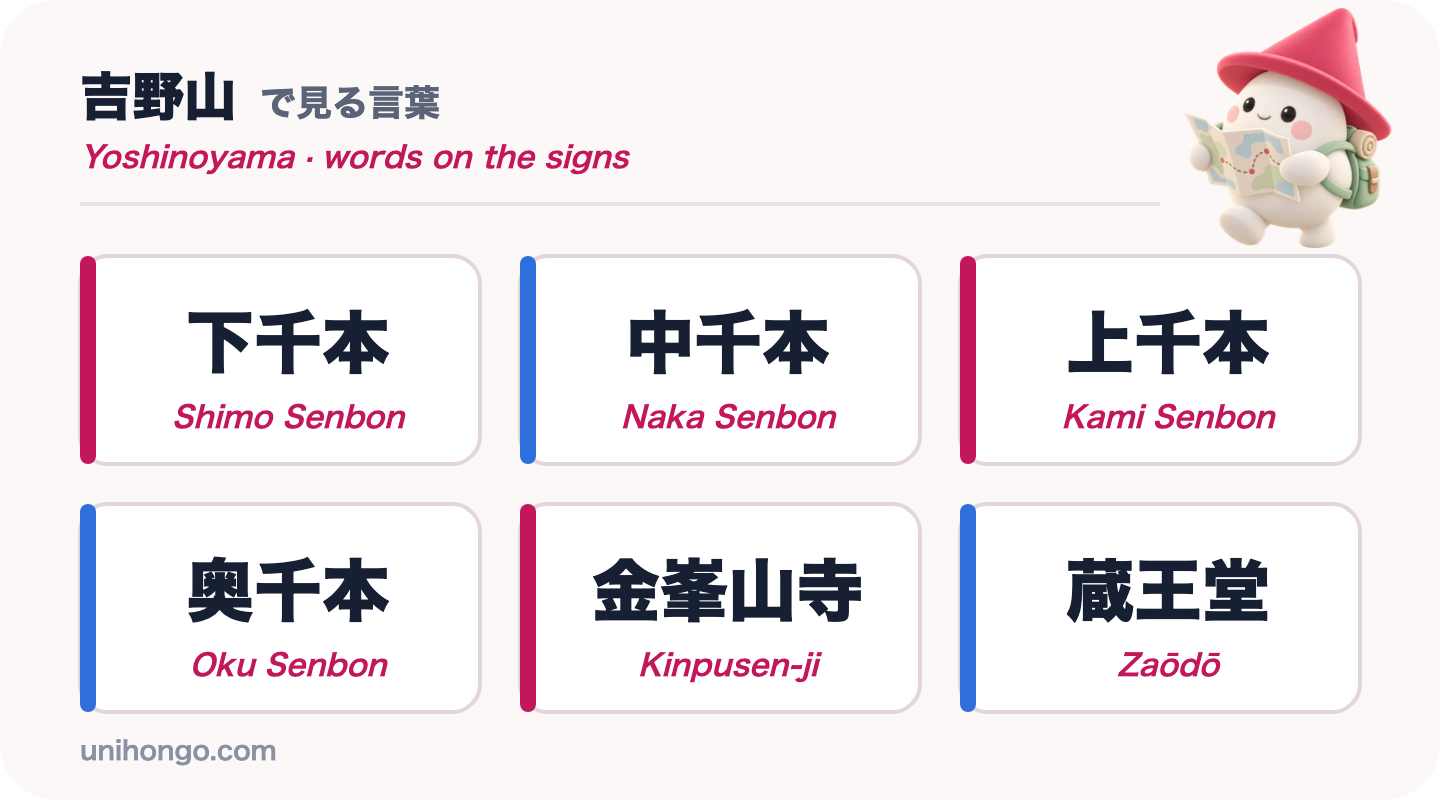
| Word | Reading | Meaning |
|---|---|---|
| 下千本 | Shimo Senbon | The lower thousand trees, first to bloom |
| 中千本 | Naka Senbon | The middle thousand trees |
| 上千本 | Kami Senbon | The upper thousand trees |
| 奥千本 | Oku Senbon | The innermost thousand trees, last to bloom |
| 金峯山寺 | Kinpusen-ji | The head temple of Shugendō |
| 蔵王堂 | Zaōdō | Kinpusen-ji's great main hall |
| 桜 | sakura | Cherry blossom |
| 見頃 | migoro | Best time to see, peak bloom |
| 臨時バス | rinji basu | Extra bus, run in the blossom season |
Japanese for Yoshino's food and sweet shops
The ridge-top street is lined with small shops and restaurants, and two local specialities are worth trying. Yoshino kuzu, the starch of the kudzu root, is made into smooth, translucent sweets and noodles, often served chilled with brown sugar syrup. Kakinoha-zushi, pieces of pressed sushi wrapped in persimmon leaves, is a traditional food of this mountain region of Nara and makes a good picnic under the trees.
Shops are small and busy in spring, so decide what you want before you reach the counter, and point if you need to. The phrases below cover most of what you will say.
| Japanese | Romaji | Meaning |
|---|---|---|
| 葛きりを一つお願いします。 | Kuzukiri o hitotsu onegai shimasu. | One kuzukiri, please. |
| 柿の葉寿司はありますか。 | Kakinoha-zushi wa arimasu ka. | Do you have kakinoha-zushi? |
| 持ち帰りできますか。 | Mochikaeri dekimasu ka. | Can I take it away? |
| これは何が入っていますか。 | Kore wa nani ga haitte imasu ka. | What is in this? |
| 桜の見頃はどのあたりですか。 | Sakura no migoro wa dono atari desu ka. | Where is the blossom at its best? |
| トイレはどこですか。 | Toire wa doko desu ka. | Where is the toilet? |
Etiquette, timing and practical tips
Yoshino is a mountain, a pilgrimage site and a small town all at once, and in spring it is very crowded.
- Go on a weekday in the blossom season if you can, and start early; trains and buses fill by mid-morning.
- Wear good shoes. The main street is steep in places, and the paths to Kami Senbon and Oku Senbon are steeper.
- Do not pick blossoms, shake branches or climb the trees; the cherries are sacred offerings as well as scenery.
- Take your rubbish home, as bins are few on the mountain.
- Book inns months ahead for the blossom season, when the town fills up.
- Check the ropeway and bus timetables before your trip, especially outside the busy seasons.
Practise the visit before you go
On the mountain, your most useful conversation is about distance, and people will answer with time rather than kilometres. Listen for kurai, about, and for the reason they give. Practise the four lines below until you can say them without reading.
Then practise with a partner who answers back. In Unihongo, choose the Seasonal Events topic and ask your AI Sensei to play a Yoshino shopkeeper during hanami season, or choose Directions to rehearse finding the ropeway station on the way home.
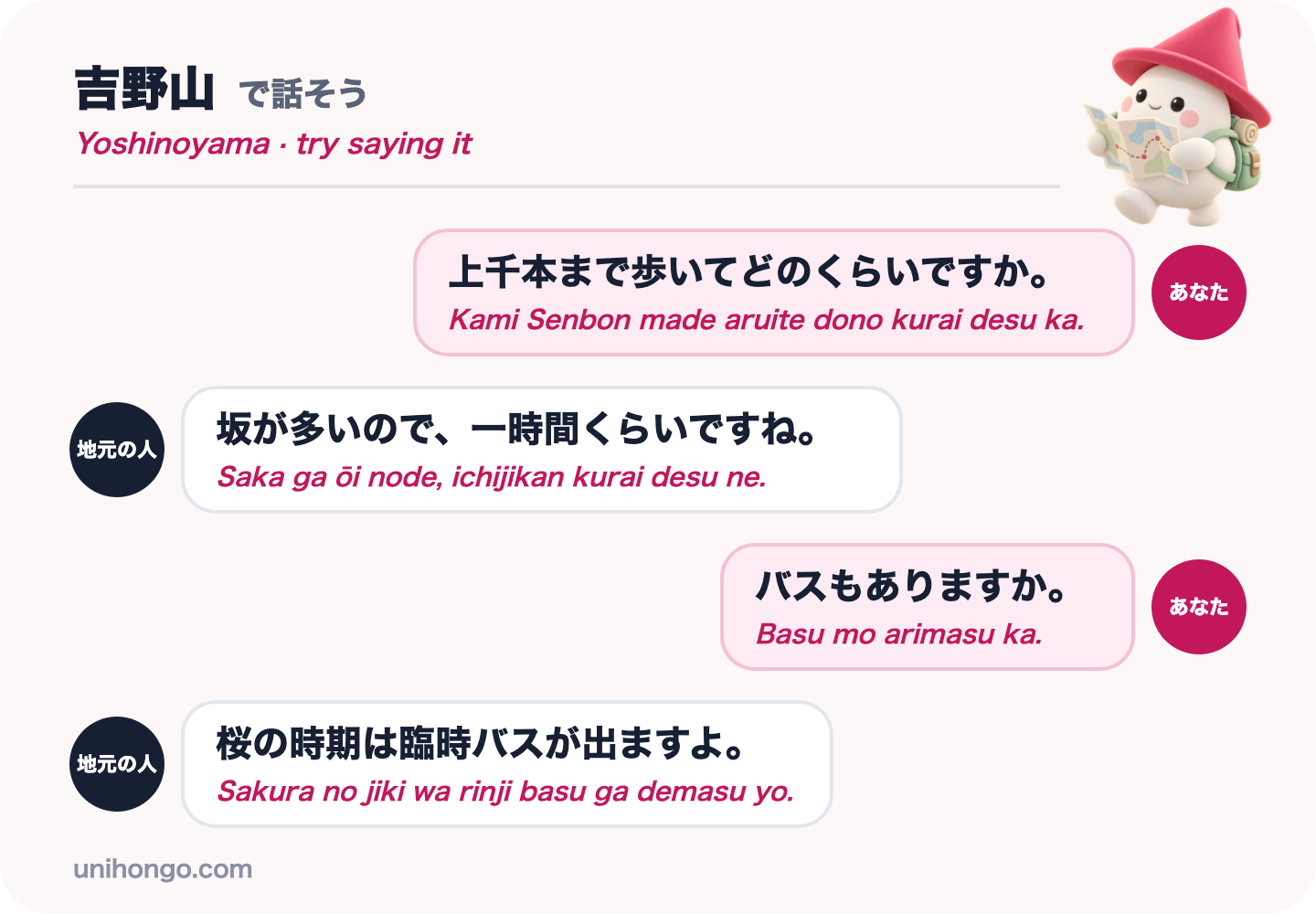
| Japanese | Romaji | Meaning |
|---|---|---|
| 上千本まで歩いてどのくらいですか。 | Kami Senbon made aruite dono kurai desu ka. | How long is it to Kami Senbon on foot? |
| 坂が多いので、一時間くらいですね。 | Saka ga ōi node, ichijikan kurai desu ne. | There are a lot of slopes, so about an hour. |
| バスもありますか。 | Basu mo arimasu ka. | Is there a bus too? |
| 桜の時期は臨時バスが出ますよ。 | Sakura no jiki wa rinji basu ga demasu yo. | In blossom season there are extra buses. |
Official information
Kinpusen-ji announces its special openings of the Zaō Gongen statues and repair news on its website, and the ropeway operator posts its running days and seasonal changes. Check both before you go, especially in spring.