

Why the Cup Noodles Museum is more fun than it sounds
Momofuku Ando founded Nissin Food Products and spent a year in a small shed behind his home in Ikeda, near Osaka, working on a ramen you could make at home just by adding hot water. The result, Chicken Ramen, went on sale in 1958. On a trip to the United States he saw supermarket staff breaking the noodles into a cup and eating them with a fork, and that idea led to Cup Noodles in 1971. Late in life he even developed Space Ramen, instant ramen for astronauts, in 2005.
The museum in Yokohama opened in 2011 and turns that story into a playful, hands-on building aimed at children but enjoyed by adults just as much. Its logo is three exclamation marks side by side, standing for the joy of invention and discovery, and the displays keep returning to the idea that anyone can invent something if they look at everyday things differently.
For a learner, it is a friendly place to practise. Staff at the workshop counters use short, set phrases, the signs are clear, and the food court is a chance to order in Japanese at your own pace. It also sits in the middle of Yokohama's waterfront, so it fits easily into a day around Minato Mirai.
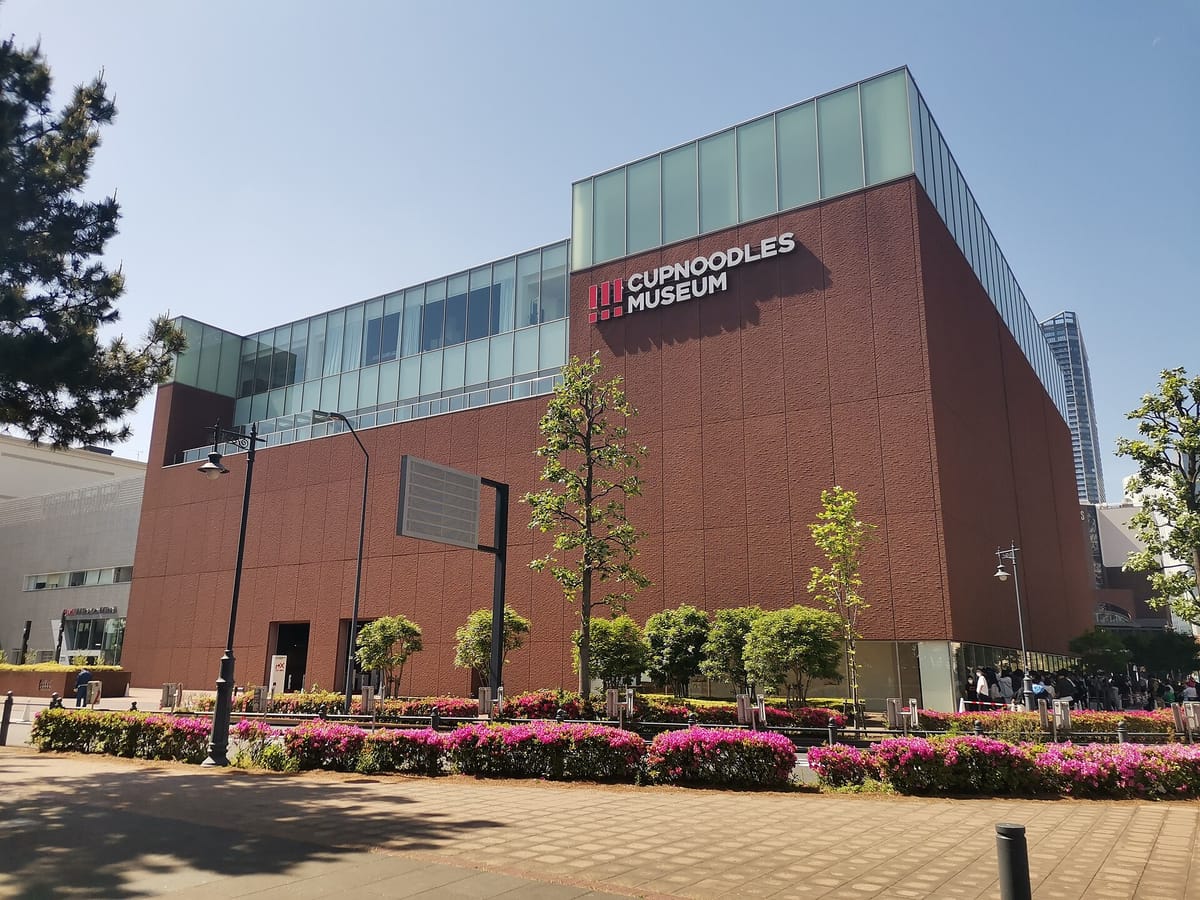
Getting there: Minatomirai, Bashamichi or Sakuragichō
The museum's access page lists two stations on the Minatomirai Line, Minatomirai Station and Bashamichi Station, each about eight minutes' walk away. From JR or the Yokohama Municipal Subway, Sakuragichō Station is about twelve minutes on foot, along the waterfront past the Cosmo World amusement park and over the bridges to the Shinkō area.
The Akai Kutsu tourist loop bus and the Pier Line bus stop near the museum at Kokusaibashi, and on weekends and holidays the Minatomirai 100-yen bus stops at World Porters, about three minutes away. The walk from Sakuragichō is the pleasant one, with the Landmark Tower behind you and the Red Brick Warehouse ahead.
| Japanese | Romaji | Meaning |
|---|---|---|
| カップヌードルミュージアムはどう行けばいいですか。 | Kappu Nūdoru Myūjiamu wa dō ikeba ii desu ka. | How do I get to the Cup Noodles Museum? |
| みなとみらい駅から歩いて何分くらいですか。 | Minatomirai-eki kara aruite nanpun kurai desu ka. | About how many minutes' walk is it from Minatomirai Station? |
| 桜木町駅から歩けますか。 | Sakuragichō-eki kara arukemasu ka. | Can I walk from Sakuragichō Station? |
| 赤レンガ倉庫は近いですか。 | Aka Renga Sōko wa chikai desu ka. | Is the Red Brick Warehouse near? |
| みなとみらい線は何番線ですか。 | Minatomirai-sen wa nanbansen desu ka. | Which platform is the Minatomirai Line? |
Floor by floor: what you will see and do
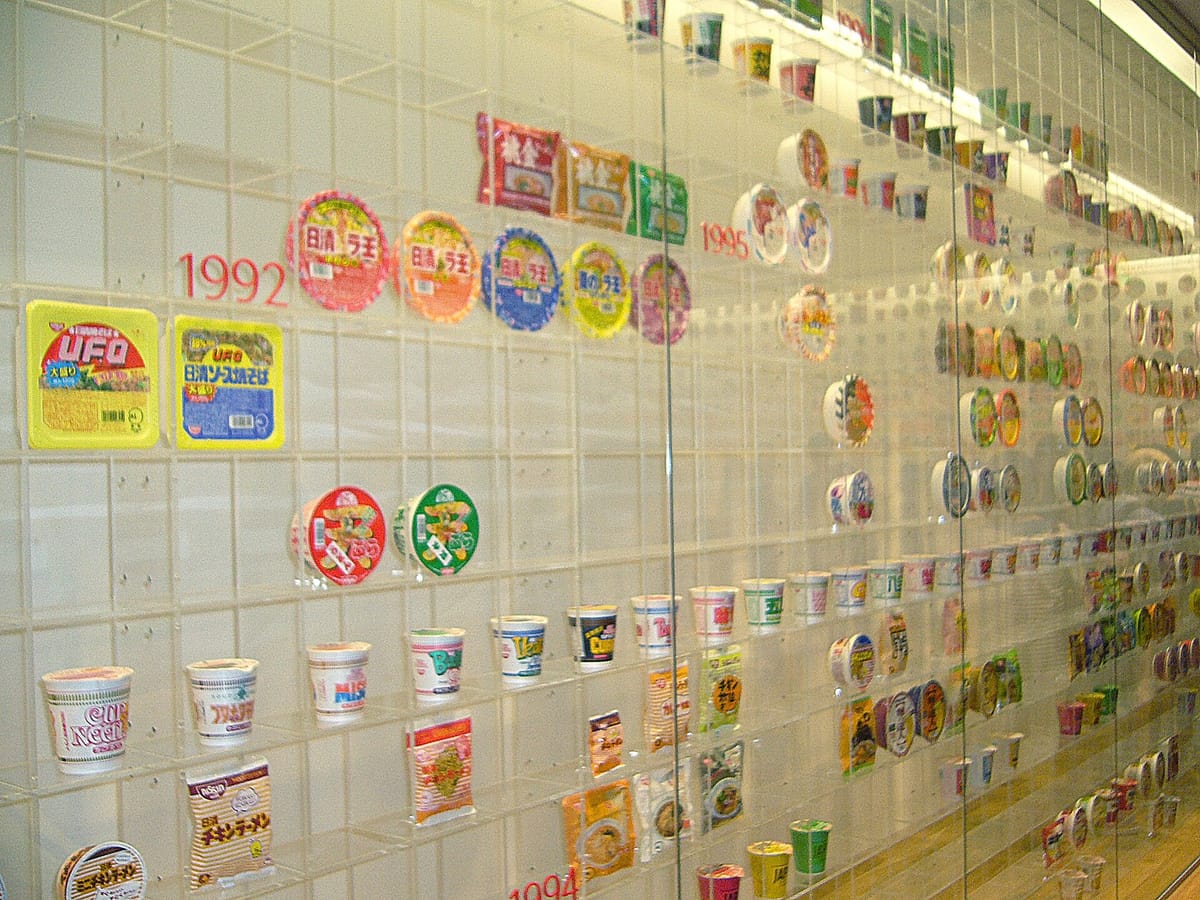
The exhibits tell Momofuku Ando's story in several different ways. The Instant Noodles History Cube is a wall of thousands of packages showing how one product grew into a global food; the Momofuku Ando Story is a fifty-eight-metre illustrated panorama of his life; and Momofuku's Work Shed is a faithful copy of the shed in Ikeda where Chicken Ramen was invented. Momofuku Theater shows a short animated film.
The workshops and the play area are on the third floor, and the NOODLES BAZAAR food court is on the fourth. The bazaar is designed like an Asian night market, with stands selling half-sized bowls of noodles from different countries, so you can try two or three kinds.
- My CUPNOODLES Factory: design your own cup, then choose one soup and four toppings from twelve.
- Chicken Ramen Factory: make Chicken Ramen from flour by hand; reservation required.
- CUPNOODLES Park: an indoor play area where children become noodles going through a factory; age and height limits apply.
- Instant Noodles History Cube: the wall of packages from 1958 onwards.
- Momofuku's Work Shed: a recreation of the shed where instant ramen was born.
- Creative Thinking Boxes: modern art on Momofuku Ando's six key ideas.
- NOODLES BAZAAR: eight stands of world noodles in half-sized bowls.
Words on the signs at the museum
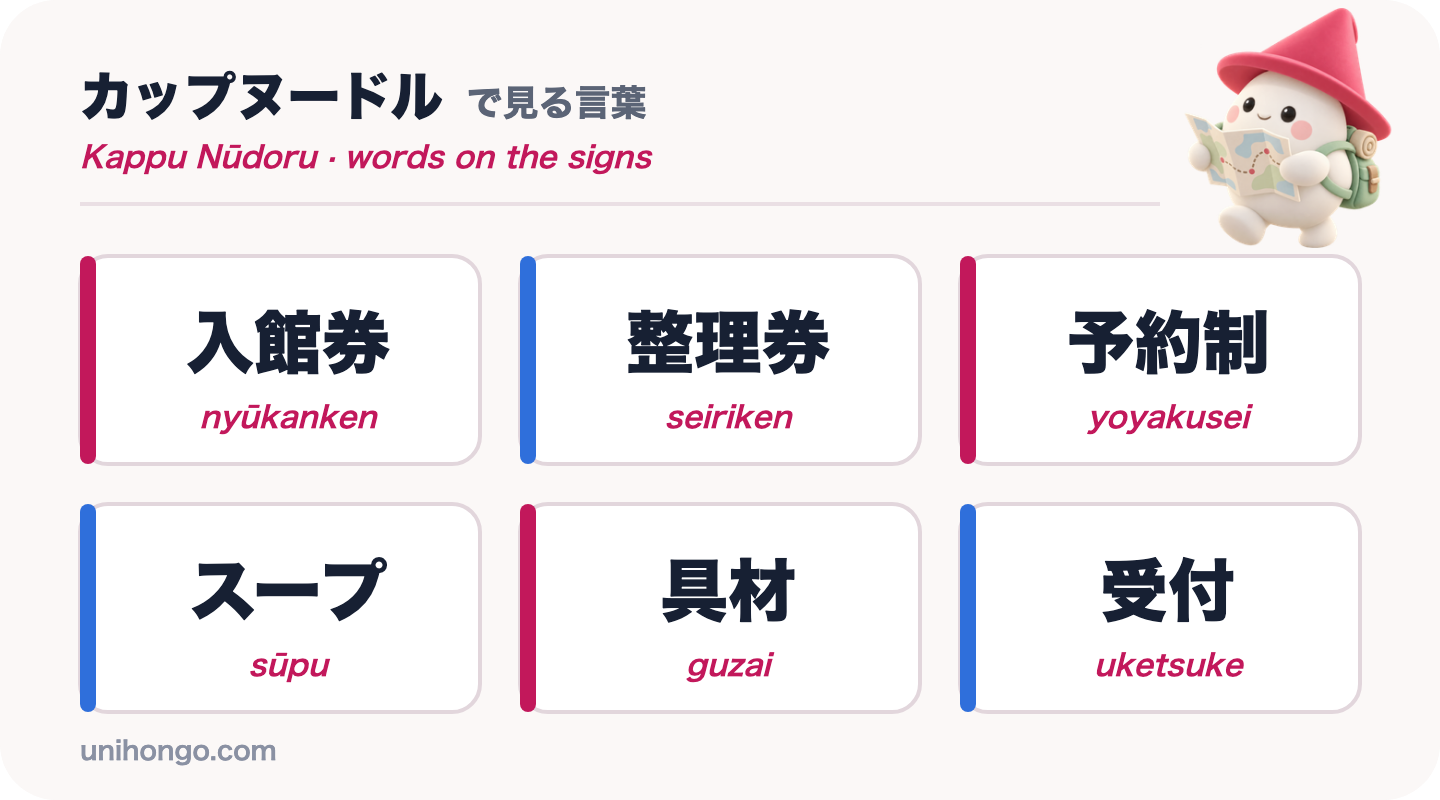
Most of the words you need are about queues and choices. The admission ticket is the nyūkanken, the numbered ticket for My CUPNOODLES Factory is the seiriken, and the Chicken Ramen workshop is marked yoyakusei, by reservation only. At the factory itself, the choices are sūpu, soup, and guzai, the ingredients or toppings.
Many product names on the displays are in katakana, and the museum uses the English spelling CUPNOODLES in its own names. The table below covers the words you will meet from the entrance to the workshop.
| Word | Reading | Meaning |
|---|---|---|
| 入館券 | nyūkanken | Admission ticket |
| 整理券 | seiriken | Numbered ticket for a time slot |
| 予約制 | yoyakusei | Reservation required |
| 受付 | uketsuke | Reception or sign-in counter |
| スープ | sūpu | Soup flavour |
| 具材 | guzai | Ingredients; the toppings in your cup |
| チキンラーメンファクトリー | Chikin Rāmen Fakutorī | The Chicken Ramen workshop |
| チキンラーメン | Chikin Rāmen | Chicken Ramen, the first instant ramen |
| ひよこちゃん | Hiyoko-chan | The chick mascot of Chicken Ramen |
Japanese at the My CUPNOODLES Factory counter
The factory is where you will talk most. After you get your numbered ticket and your slot comes up, you buy a cup from a vending machine, sanitise your hands and decorate the cup with pens at a long table. Then you move along a counter where staff put in the noodles, ask for your soup and toppings, and seal the cup. At the end you pump air into a bag that becomes a cushioned carrier for the trip home.
The toppings are chosen by pointing and saying the name, and staff repeat your choice back to you. The phrases below cover the whole process.
| Japanese | Romaji | Meaning |
|---|---|---|
| マイカップヌードルファクトリーの整理券をください。 | Mai Kappu Nūdoru Fakutorī no seiriken o kudasai. | A numbered ticket for My CUPNOODLES Factory, please. |
| 何時の回が空いていますか。 | Nanji no kai ga aite imasu ka. | Which time slot is available? |
| スープはこれでお願いします。 | Sūpu wa kore de onegai shimasu. | This soup, please. |
| 具材はこれとこれとこれとこれにします。 | Guzai wa kore to kore to kore to kore ni shimasu. | I'll have this, this, this and this topping. |
| このペンを使ってもいいですか。 | Kono pen o tsukatte mo ii desu ka. | May I use this pen? |
| 袋に空気を入れるのを手伝ってもらえますか。 | Fukuro ni kūki o ireru no o tetsudatte moraemasu ka. | Could you help me fill the bag with air? |
Timing, tickets and practical tips
The museum is busiest at weekends and in school holidays, when the numbered tickets for the factory can run out early. A few simple habits help.
- The museum is closed on Tuesdays and at New Year; check the calendar for holiday changes.
- Arrive near opening time if you want a factory slot on the day, or buy the online admission ticket with a factory voucher before midnight the day before.
- Reserve the Chicken Ramen Factory early; bookings open three months ahead and places are limited. Participants work in pairs, so book for an even number.
- Plan your cup design while you wait for your slot; the drawing time goes quickly.
- Eat at the NOODLES BAZAAR on the fourth floor, where each bowl is half size.
- Combine the visit with the Red Brick Warehouse and the Minato Mirai waterfront.
Practise the factory before you go
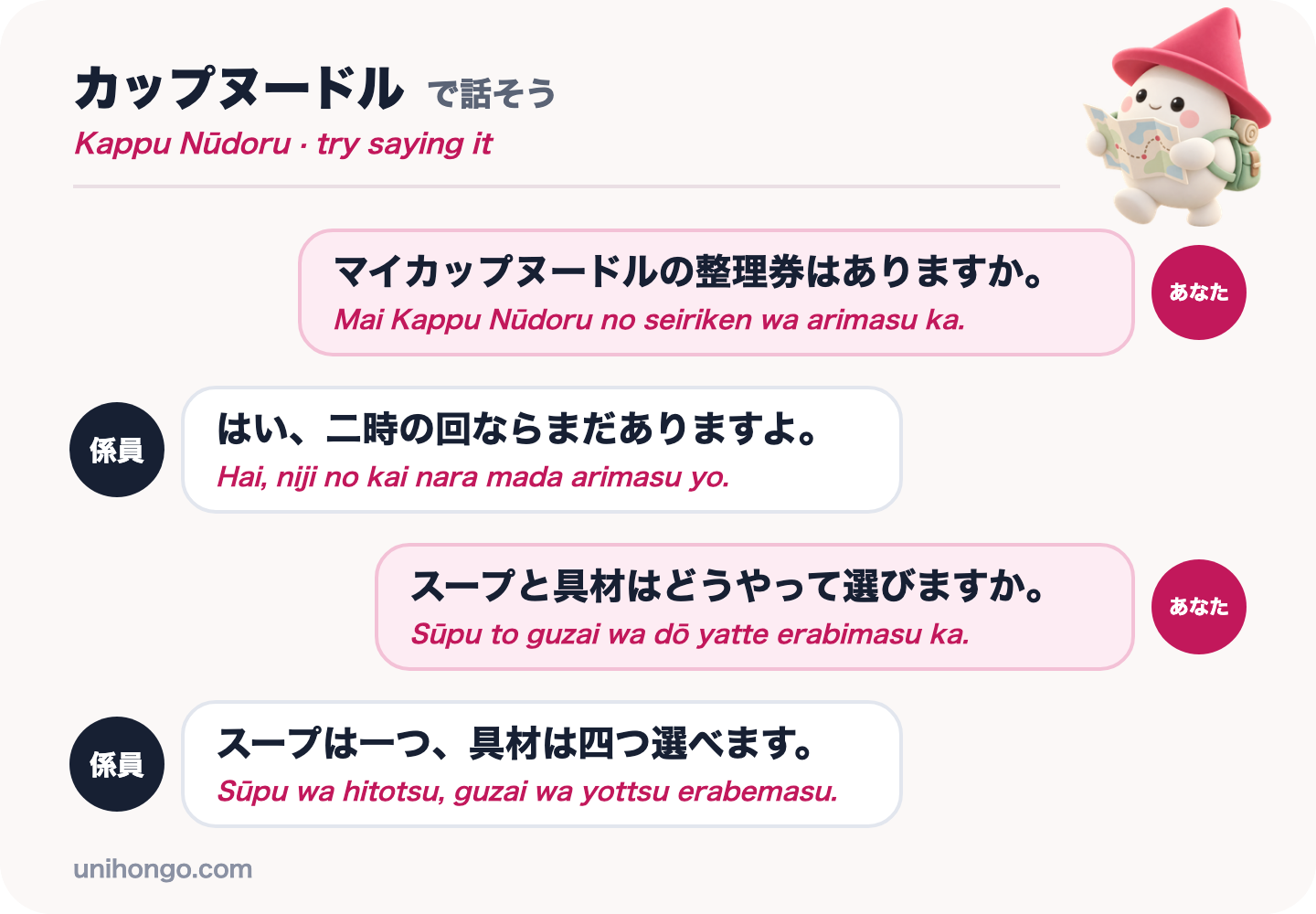
The numbered ticket is the first thing to ask about, and the choice of soup and toppings is the second. Practise the four lines below until you can say them without reading, and listen for the time of the slot, niji no kai, the two o'clock session, and the counters hitotsu and yottsu in the answers.
Then practise with a partner who answers back. In Unihongo, choose the Shopping topic and ask your AI Sensei to play a staff member at the factory, or use the Directions topic to rehearse the walk from the station. Saying the lines once before you go is what makes them easy at the counter.
| Japanese | Romaji | Meaning |
|---|---|---|
| マイカップヌードルの整理券はありますか。 | Mai Kappu Nūdoru no seiriken wa arimasu ka. | Are there numbered tickets for My CUPNOODLES? |
| はい、二時の回ならまだありますよ。 | Hai, niji no kai nara mada arimasu yo. | Yes, there are still some for the two o'clock session. |
| スープと具材はどうやって選びますか。 | Sūpu to guzai wa dō yatte erabimasu ka. | How do I choose the soup and toppings? |
| スープは一つ、具材は四つ選べます。 | Sūpu wa hitotsu, guzai wa yottsu erabemasu. | You can choose one soup and four toppings. |
Official information
The museum publishes its hours, closed days, fees, workshop reservations and any notices on its English website, including news of limited-edition cups. Check it before you go.