

Why stay the night on Kōyasan
Kōyasan is not a single temple but a whole town on a plateau in the mountains of northern Wakayama. The monk Kūkai, remembered as Kōbō Daishi, chose the site in the early ninth century to found a training centre for Shingon, the esoteric school of Buddhism he had brought back from China. Kongōbu-ji is the head temple of the Kōyasan Shingon sect, and the mountain is part of the UNESCO World Heritage site covering the sacred sites and pilgrimage routes of the Kii Mountain Range.
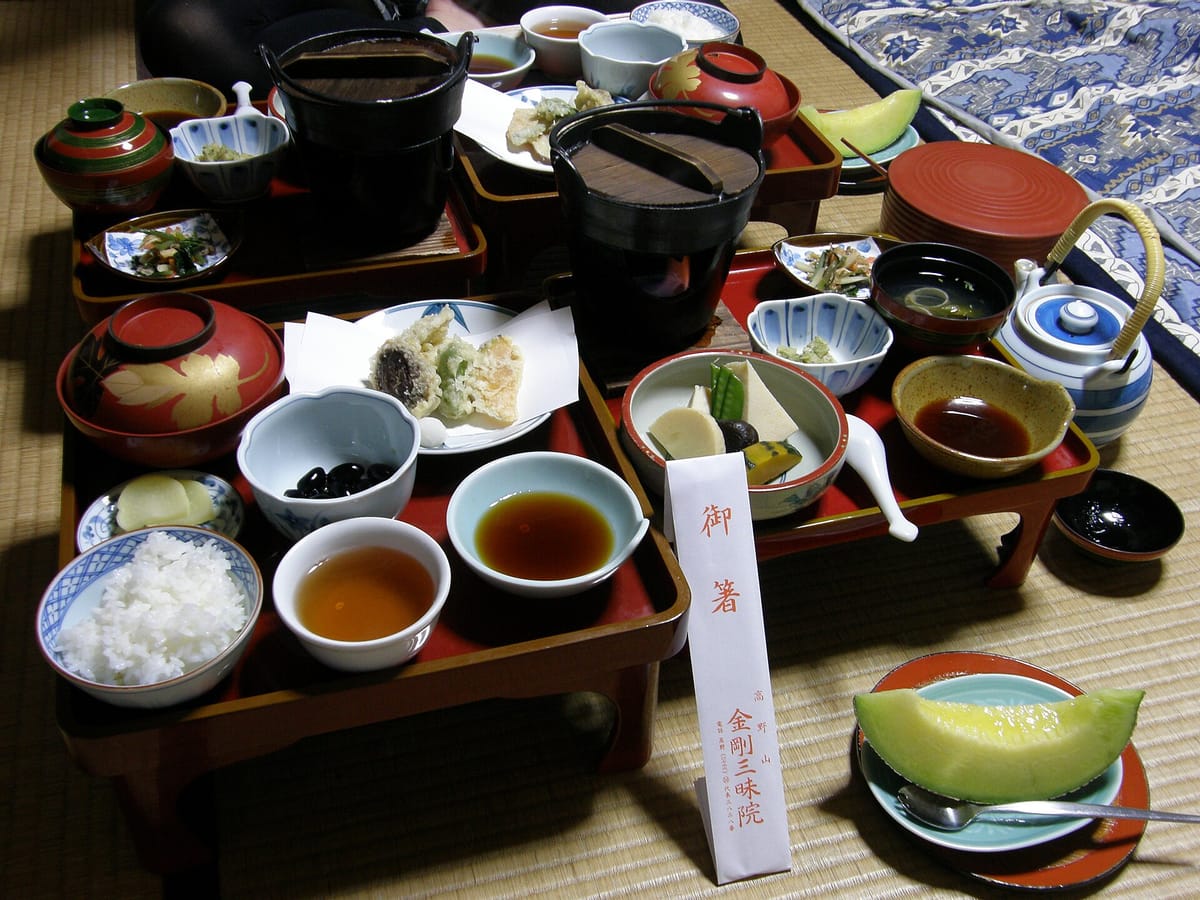
What makes it special is that you can live inside it for a night. More than fifty temples run shukubō, temple lodgings, where you sleep on futon in a tatami room, eat shōjin ryōri, the vegetarian cuisine of Buddhist monks, and are invited to the morning service in the main hall. The town is quiet after dark, the air is noticeably cooler than in Osaka, and the walk through Okunoin, a cemetery of more than two hundred thousand graves under ancient cedars, feels completely different in the early morning.
For a Japanese learner it is also a gentle place to practise polite Japanese. Temple staff speak in careful keigo, the words you meet are repeated on every signpost, and a stay gives you a small, predictable set of situations: checking in, asking about meal times, joining the service and saying thank you when you leave.
Getting there: Nankai Kōya Line, Gokurakubashi and the cable car
The standard route starts at Namba Station in Osaka on the Nankai Kōya Line. A couple of limited express trains a day, the Kōya, run straight to the terminus at Gokurakubashi and need a reserved seat; otherwise take an express to Hashimoto and change to a local train for the winding climb to Gokurakubashi. The whole trip takes roughly one and a half to two hours. There is also a sightseeing train on the mountain section on some days. The Japan Rail Pass is not valid on any of this.
At Gokurakubashi you change to the Nankai cable car, which climbs steeply to Kōyasan Station in about five minutes. From there, local buses run into town; the road from the cable car station is closed to pedestrians, so take the bus. The central stop is Senjuinbashi, a short walk from Kongōbu-ji and the Danjō Garan, and the same buses continue to Okunoin-mae for the cemetery and to the Daimon gate at the western edge of town. Your temple will tell you which stop is nearest.
| Japanese | Romaji | Meaning |
|---|---|---|
| 高野山までの切符をお願いします。 | Kōyasan made no kippu o onegai shimasu. | A ticket to Kōyasan, please. |
| 極楽橋行きは何番線ですか。 | Gokurakubashi-yuki wa nanbansen desu ka. | Which platform is the train for Gokurakubashi? |
| 橋本で乗り換えですか。 | Hashimoto de norikae desu ka. | Do I change at Hashimoto? |
| このバスは千手院橋に止まりますか。 | Kono basu wa Senjuinbashi ni tomarimasu ka. | Does this bus stop at Senjuinbashi? |
| 奥之院に行くバスはどれですか。 | Okunoin ni iku basu wa dore desu ka. | Which bus goes to Okunoin? |
| この宿坊に一番近いバス停はどこですか。 | Kono shukubō ni ichiban chikai basutei wa doko desu ka. | Where is the bus stop nearest to this temple lodging? |
Okunoin, the Danjō Garan and Kongōbu-ji
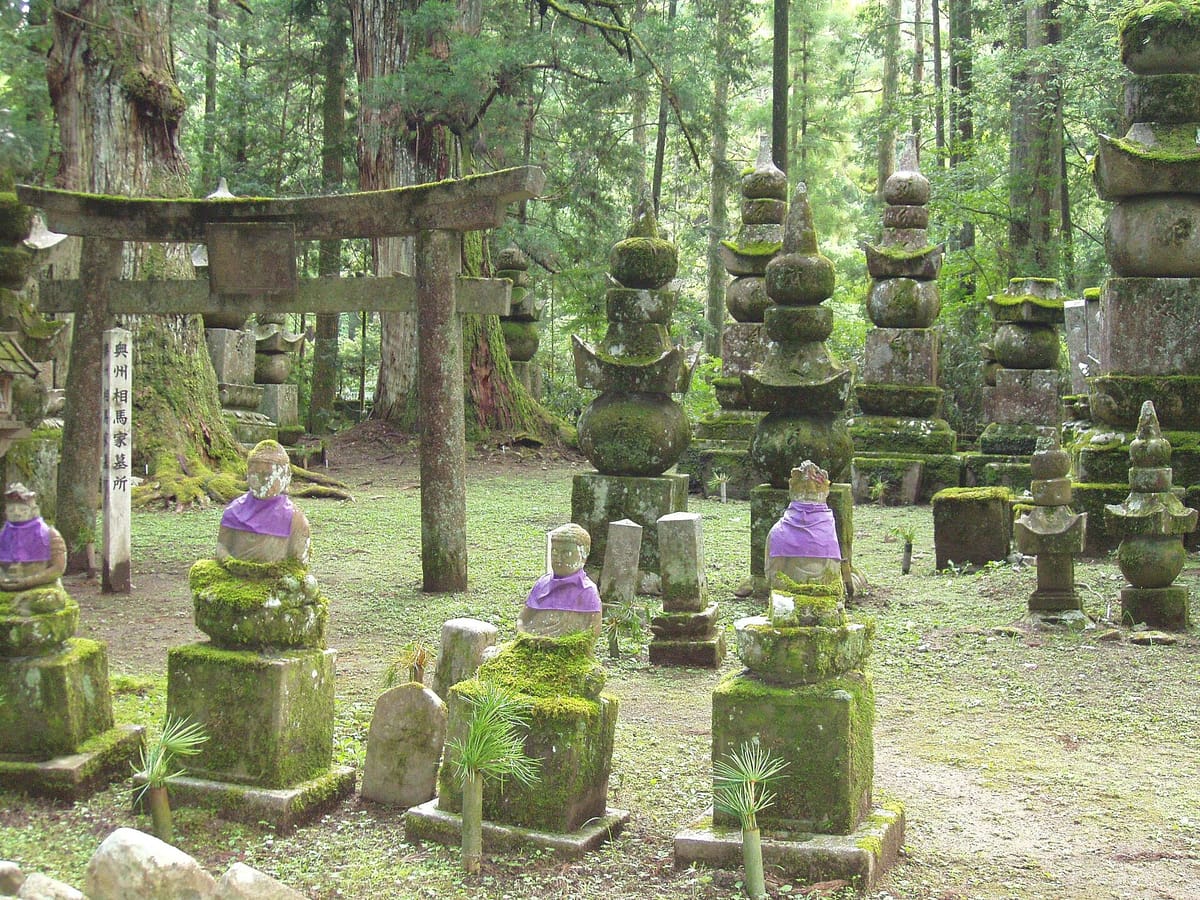
The three places every visitor sees are close together and easy to cover on foot or by bus. Okunoin lies at the eastern end of town. The traditional approach begins at Ichi-no-hashi, the first bridge, and runs for about two kilometres through the cemetery, past the graves of feudal lords, company memorials and rows of Jizō statues, to Gobyōbashi, the last bridge. Beyond it are the Tōrōdō, the lantern hall with more than ten thousand lanterns kept burning, and the mausoleum where Kōbō Daishi is believed to remain in eternal meditation. A shorter path leads in from the Okunoin-mae bus stop if you are short of time.
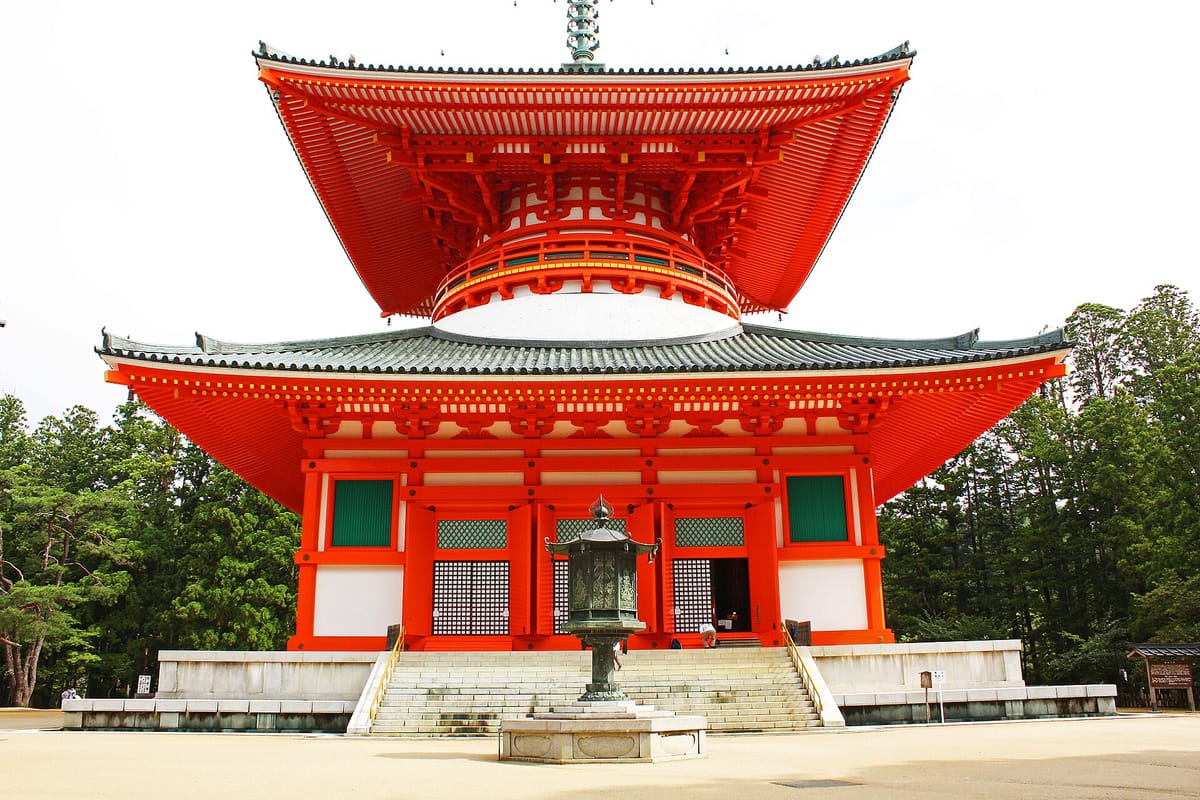
The Danjō Garan, in the middle of town, is the sacred complex Kūkai laid out first. Its landmark is the Konpon Daitō, a vermilion two-tiered pagoda that holds a three-dimensional mandala of Buddhist statues around Dainichi Nyorai. Next to it stand the Kondō, the main hall where major ceremonies are held, and smaller halls and pagodas. The grounds are free to walk; the main hall and the pagoda have a small entry fee.
A few minutes away, Kongōbu-ji is the head temple of the sect, with rooms of painted sliding doors and the Banryūtei, described as the largest rock garden in Japan, where stones from Shikoku stand for a pair of dragons in a sea of clouds. Visitors are offered tea in a large tatami hall. A combination ticket covers these halls together with the Reihōkan museum of temple treasures.
- Ichi-no-hashi: the first bridge and traditional entrance to Okunoin; bow before you cross.
- Mizumuke Jizō: a row of statues near the end of the path where visitors pour water for the departed.
- Tōrōdō: the lantern hall in front of the mausoleum.
- Konpon Daitō: the vermilion pagoda of the Danjō Garan.
- Kongōbu-ji: head temple, painted sliding doors and the Banryūtei rock garden.
- Reihōkan: the museum of Kōyasan's Buddhist art.
- Daimon: the great gate at the western entrance to the mountain.
Words on the signs at Kōyasan
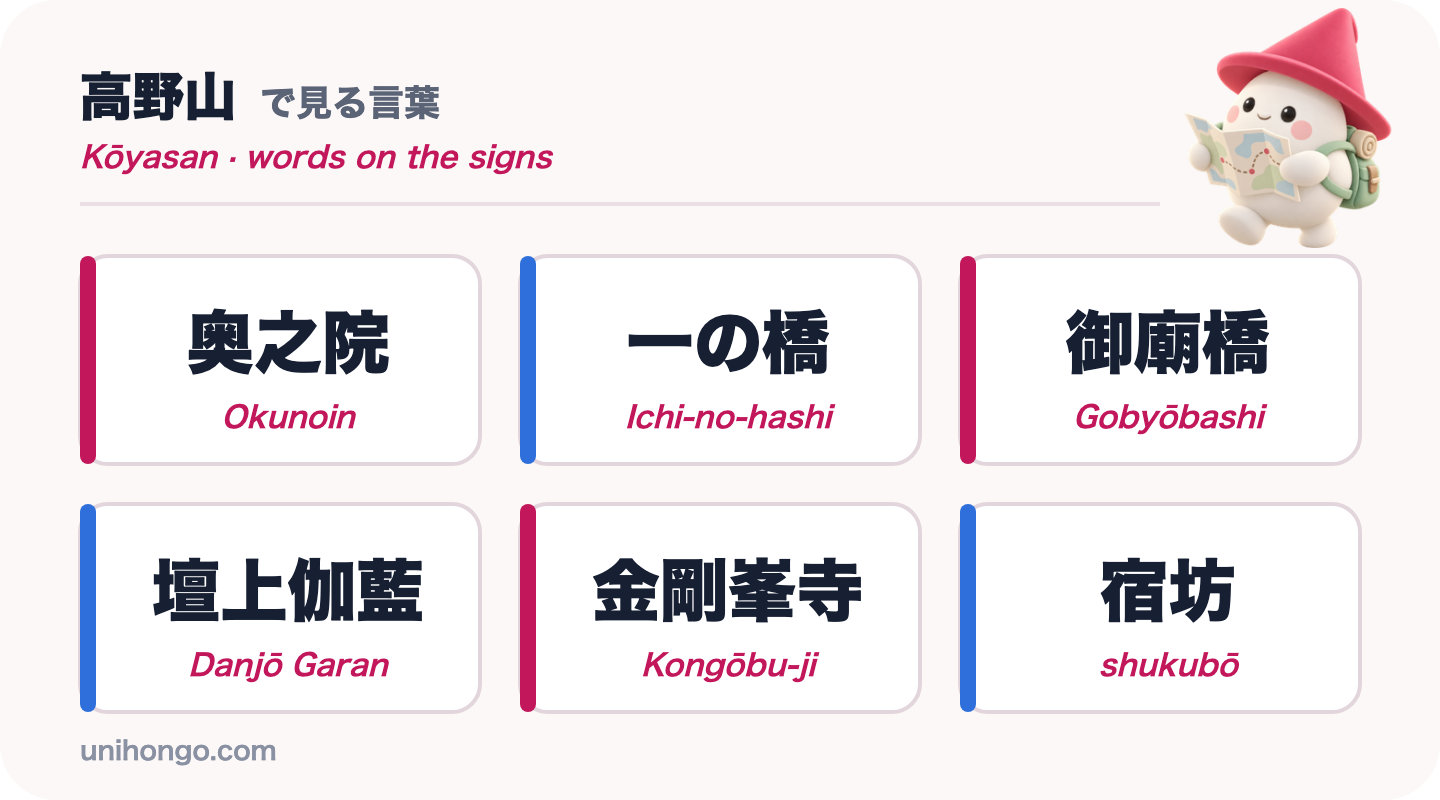
Signposts on Kōyasan are mostly in kanji with some English, and they repeat a small set of names. Once you can recognise 奥之院 and 伽藍 you can find your way between the two ends of town, and 宿坊 on a gatepost tells you that a temple takes guests.
Two signs matter more than the rest at Okunoin. At Gobyōbashi you will see 撮影禁止, no photography, and a request not to eat or drink. Inside the temple lodging, look for the words for the bath and for the dining room, and for 本堂, the main hall, where the morning service takes place.
| Word | Reading | Meaning |
|---|---|---|
| 奥之院 | Okunoin | The cemetery and Kōbō Daishi's mausoleum at the east end of town |
| 一の橋 | Ichi-no-hashi | The first bridge, the traditional entrance to Okunoin |
| 御廟橋 | Gobyōbashi | The last bridge, before the lantern hall and mausoleum |
| 燈籠堂 | Tōrōdō | The lantern hall |
| 壇上伽藍 | Danjō Garan | The central sacred complex with the great pagoda |
| 根本大塔 | Konpon Daitō | The vermilion two-tiered pagoda |
| 金剛峯寺 | Kongōbu-ji | Head temple of the Kōyasan Shingon sect |
| 宿坊 | shukubō | Temple lodging |
| 撮影禁止 | satsuei kinshi | No photography |
| 本堂 | hondō | Main hall of a temple |
Japanese for your temple stay: check-in, dinner and the morning service
A shukubō stay follows a fixed rhythm, and knowing it makes the Japanese easy to predict. You arrive in the afternoon, well before dinner, and a member of the temple shows you to a tatami room and explains the times. Dinner comes early in the evening: shōjin ryōri contains no meat or fish, and Kōyasan is known for goma-dōfu, a silky sesame tofu, and kōya-dōfu, freeze-dried tofu simmered in broth. Some temples also offer meditation, sutra copying or a goma fire ritual, usually for an extra fee and booked ahead.
Next morning the morning service, o-tsutome, starts early, often around six, in the main hall. Guests are welcome to sit at the back and listen to the chanting; you do not need to join in. Breakfast follows, and check-out is in the morning. The phrases below cover the whole stay, in the polite form that suits a temple.
| Japanese | Romaji | Meaning |
|---|---|---|
| 今日から一泊で予約しているスミスです。 | Kyō kara ippaku de yoyaku shite iru Sumisu desu. | I'm Smith, I have a reservation for one night from today. |
| 夕食は何時からですか。 | Yūshoku wa nanji kara desu ka. | What time is dinner? |
| お風呂は何時まで入れますか。 | O-furo wa nanji made hairemasu ka. | Until what time can I use the bath? |
| ごまにアレルギーがあります。 | Goma ni arerugī ga arimasu. | I'm allergic to sesame. |
| 写経を体験したいんですが、できますか。 | Shakyō o taiken shitai n desu ga, dekimasu ka. | I'd like to try sutra copying. Is that possible? |
| お勤めの間、写真を撮ってもいいですか。 | O-tsutome no aida, shashin o totte mo ii desu ka. | May I take photos during the service? |
| とてもおいしかったです。ごちそうさまでした。 | Totemo oishikatta desu. Gochisōsama deshita. | It was delicious. Thank you for the meal. |
| お世話になりました。 | O-sewa ni narimashita. | Thank you for looking after me. |
Etiquette, timing and practical tips
Kōyasan is a working monastery town, and temple lodgings are not hotels. A few habits make the stay easier for you and for the monks.
- Arrive before the time the temple gives you, usually late afternoon; dinner is served early and on schedule.
- Take your shoes off at the entrance and wear the slippers provided, but never on the tatami.
- Keep your voice low in the corridors; walls are thin sliding doors and evenings are quiet.
- Baths are shared and usually separated by gender, with set hours; wash before you get in.
- Bring enough cash: shops and some temples on the mountain may not take cards, and there are only a few ATMs.
- Pack a warm layer. The town is high in the mountains and noticeably cooler than Osaka, especially in the mornings and in winter.
- Bow at Ichi-no-hashi and Gobyōbashi in Okunoin, and put your camera away at Gobyōbashi.
Practise the temple stay before you go
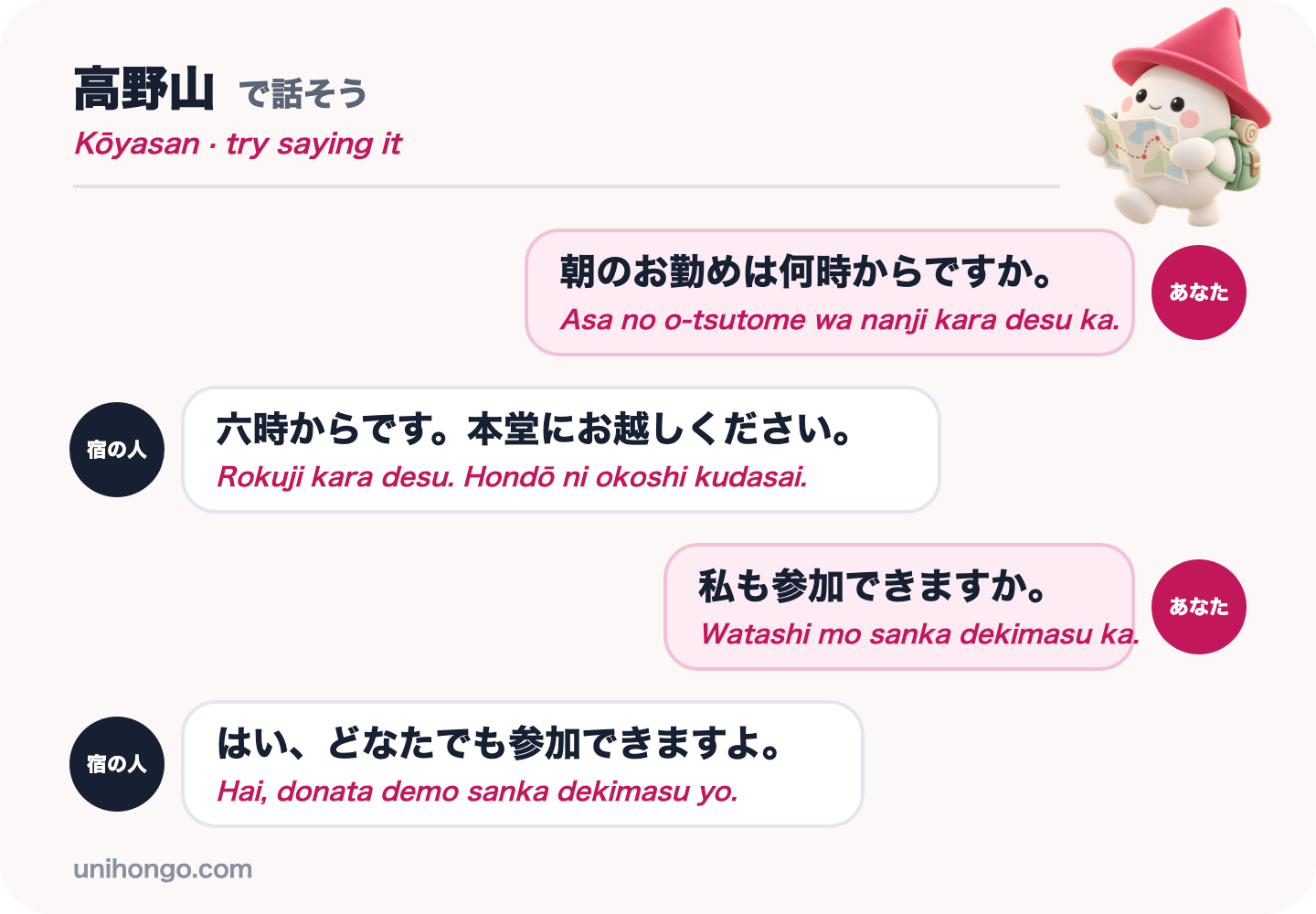
The one conversation you will certainly have is about times. When you check in, the person showing you to your room will run through dinner, the bath and the morning service, and you will want to ask what time the service begins and whether you can join. Practise the four lines below until you can say them without reading, and listen for the hour in the answer: rokuji, six o'clock, or rokuji han, half past six.
Then practise with someone who answers back. In Unihongo, choose the Ryokan Stay topic and ask your AI Sensei to play the host at a Kōyasan temple lodging, or the Cultural Etiquette topic to practise asking what is allowed. Saying the lines aloud once before the trip is what makes them come out at the temple door.
| Japanese | Romaji | Meaning |
|---|---|---|
| 朝のお勤めは何時からですか。 | Asa no o-tsutome wa nanji kara desu ka. | What time does the morning service start? |
| 六時からです。本堂にお越しください。 | Rokuji kara desu. Hondō ni okoshi kudasai. | From six. Please come to the main hall. |
| 私も参加できますか。 | Watashi mo sanka dekimasu ka. | Can I take part too? |
| はい、どなたでも参加できますよ。 | Hai, donata demo sanka dekimasu yo. | Yes, anyone is welcome to join. |
Official information
Temple lodgings, ritual schedules and hall opening times are published by Kongōbu-ji and the Kōyasan Shukubō Association, and train and cable car times by Nankai. Check them before you go, especially in winter and around the Obon lantern festival in August.