

Why Ise Jingū is Japan's most sacred shrine
According to the shrine, Amaterasu Ōmikami was first worshipped inside the imperial palace, until an imperial princess, Yamatohime, travelled the country looking for the right place to enshrine her and received a revelation that it should be Ise, about two thousand years ago. Around five hundred years later, Toyouke Ōmikami was brought to Ise to provide sacred food for Amaterasu, and Gekū was founded. Today Jingū is a complex of 125 shrines, and more than 1,500 rituals are held there every year.
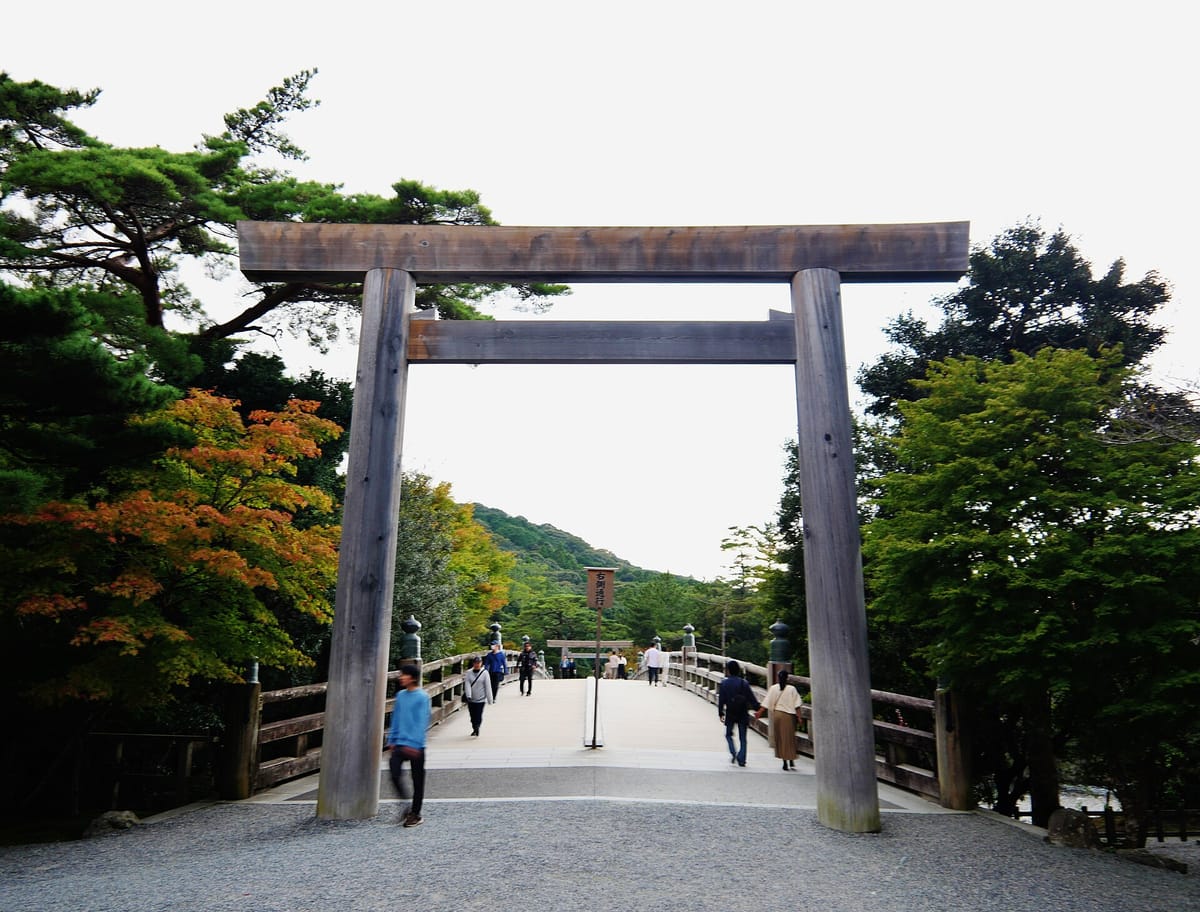
What strikes visitors is the simplicity. The main halls are built of unpainted Japanese cypress with thatched roofs in an ancient style, hidden behind wooden fences in a forest of giant cedars. Every twenty years they are rebuilt on the plot next door and the deity is moved in the Shikinen Sengū, a tradition that goes back to the seventh century; the next is planned for 2033. Even the Uji-bashi, the bridge at the entrance of Naikū, is rebuilt as part of this cycle.
For a Japanese learner, Ise is a lesson in shrine vocabulary and in keigo: signs are formal, staff speak very politely, and the old pilgrims' street outside Naikū is full of shop names, menus and food words that you can practise reading on the spot.
Getting there: Iseshi Station, Ujiyamada and the bus to Naikū
Ise is easy to reach on the Kintetsu Railway. Limited express trains run from Osaka-Namba and Ōsaka-Uehommachi, from Kyoto and from Nagoya to Iseshi Station and Ujiyamada, taking roughly one and a half to two hours depending on where you start; Kintetsu's Shimakaze sightseeing train also runs on this line. JR trains from Nagoya also reach Iseshi Station. The Japan Rail Pass covers the JR route but not Kintetsu.
Gekū is a short walk from Iseshi Station along a shopping street, the omotesandō. Naikū is several kilometres away; local buses run between Gekū-mae and Naikū-mae, and from the stations, in around twenty minutes. The Oharai-machi street and Okage Yokochō are just outside Naikū, by the Uji-bashi.
| Japanese | Romaji | Meaning |
|---|---|---|
| 伊勢市駅までの特急券をお願いします。 | Iseshi-eki made no tokkyūken o onegai shimasu. | A limited express ticket to Iseshi Station, please. |
| 外宮はどちらですか。 | Gekū wa dochira desu ka. | Which way is Gekū? |
| 内宮行きのバスはどこから出ますか。 | Naikū-yuki no basu wa doko kara demasu ka. | Where does the bus to Naikū leave from? |
| このバスは内宮前に止まりますか。 | Kono basu wa Naikū-mae ni tomarimasu ka. | Does this bus stop at Naikū-mae? |
| おはらい町はどこですか。 | Oharai-machi wa doko desu ka. | Where is Oharai-machi? |
Gekū, the Uji-bashi and Naikū: what you will see
At Gekū you cross a small bridge, purify your hands at the temizusha, and walk under the cedars to the shōgū, the main sanctuary. As at Naikū, you pray in front of the gate in the outer fence; the inner courtyards are closed to visitors, and all you see of the main hall is its roof rising behind the fences. Next to it lies the kodenchi, the empty plot where the next hall will be built. Gekū also has smaller shrines on a rise behind the main sanctuary and the Sengūkan, a museum about the rebuilding.
At Naikū the approach begins with the Uji-bashi, a wooden bridge over a hundred metres long across the clear Isuzu River, said to separate the everyday world from the sacred one. After a long gravel path through the forest you reach the Mitarashi, a stone slope down to the river where pilgrims traditionally rinse their hands in the flowing water. The shōgū of Naikū stands at the top of a flight of stone steps; photography is not allowed from the steps onwards.
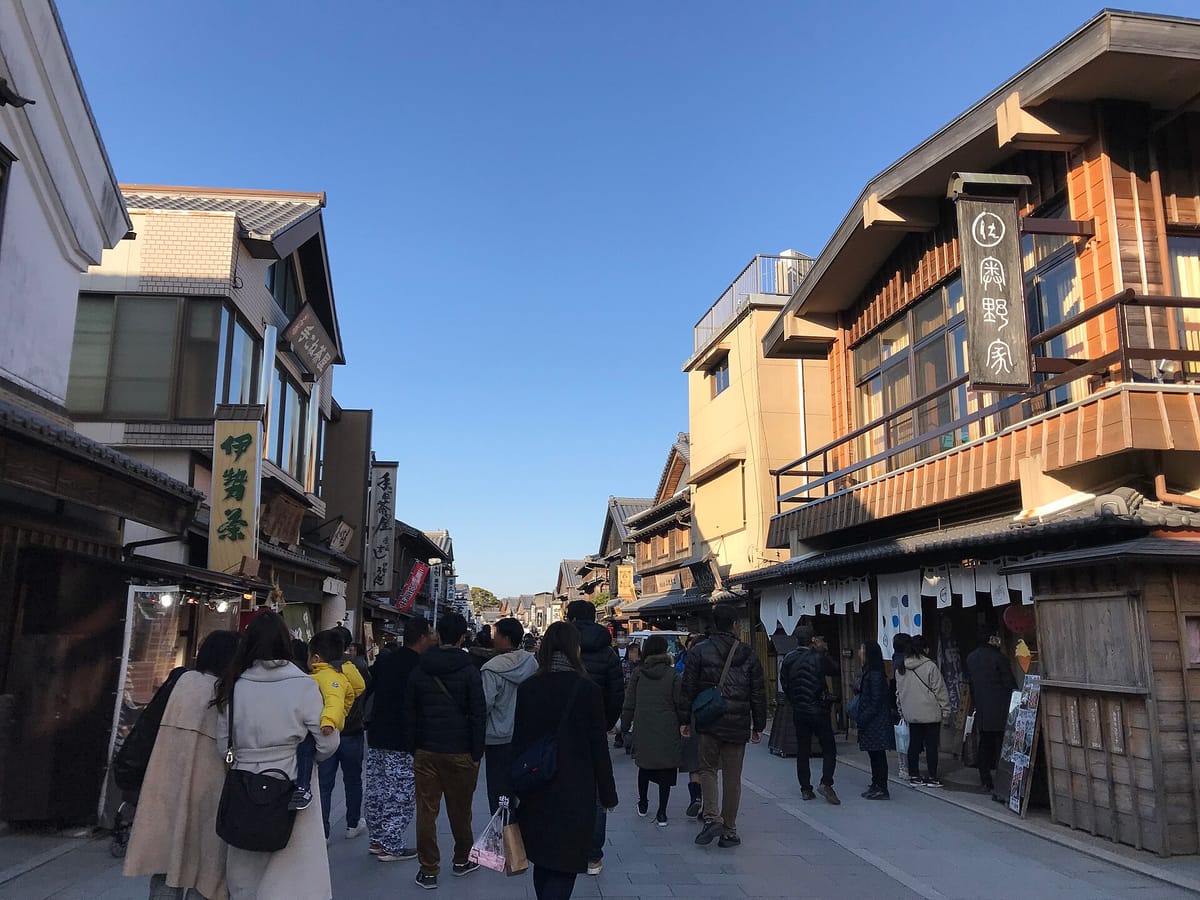
Outside the Uji-bashi, Oharai-machi is a street of wooden shops and restaurants that grew up to serve pilgrims, and Okage Yokochō, a section rebuilt in the style of the Edo and Meiji eras, is packed with food stalls. Ise's classic tastes are akafuku, soft rice cakes under a ridge of sweet bean paste, Ise udon, very thick soft noodles in a dark sweet sauce, and tekone-zushi, marinated bonito on vinegared rice.
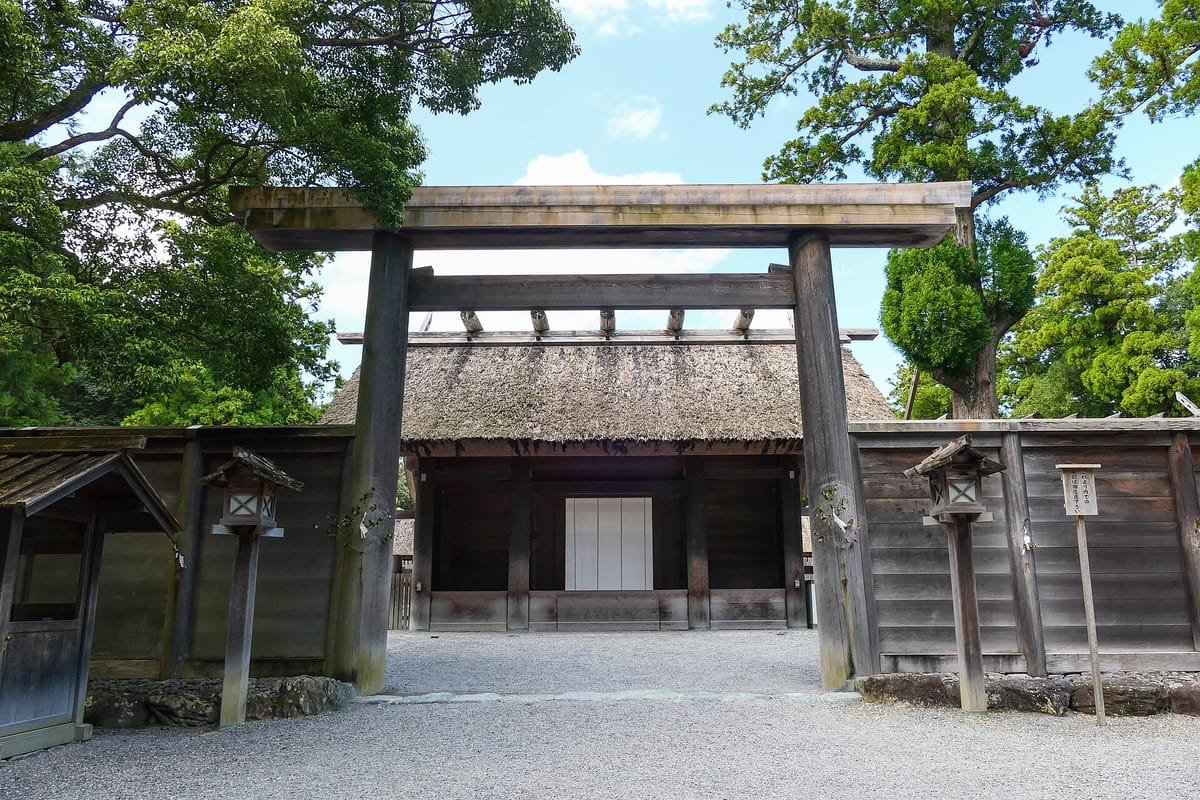
- Gekū shōgū: the main sanctuary of the Outer Shrine; visit first.
- Sengūkan: a museum about the twenty-year rebuilding, beside Gekū.
- Uji-bashi: the long wooden bridge into Naikū over the Isuzu River.
- Mitarashi: where pilgrims rinse their hands in the river.
- Naikū shōgū: the main sanctuary of Amaterasu at the top of the stone steps.
- Kaguraden: the hall where charms and talismans are given out and prayers can be requested.
- Oharai-machi and Okage Yokochō: the old pilgrims' street and food lanes outside Naikū.
Words on the signs at Ise Jingū
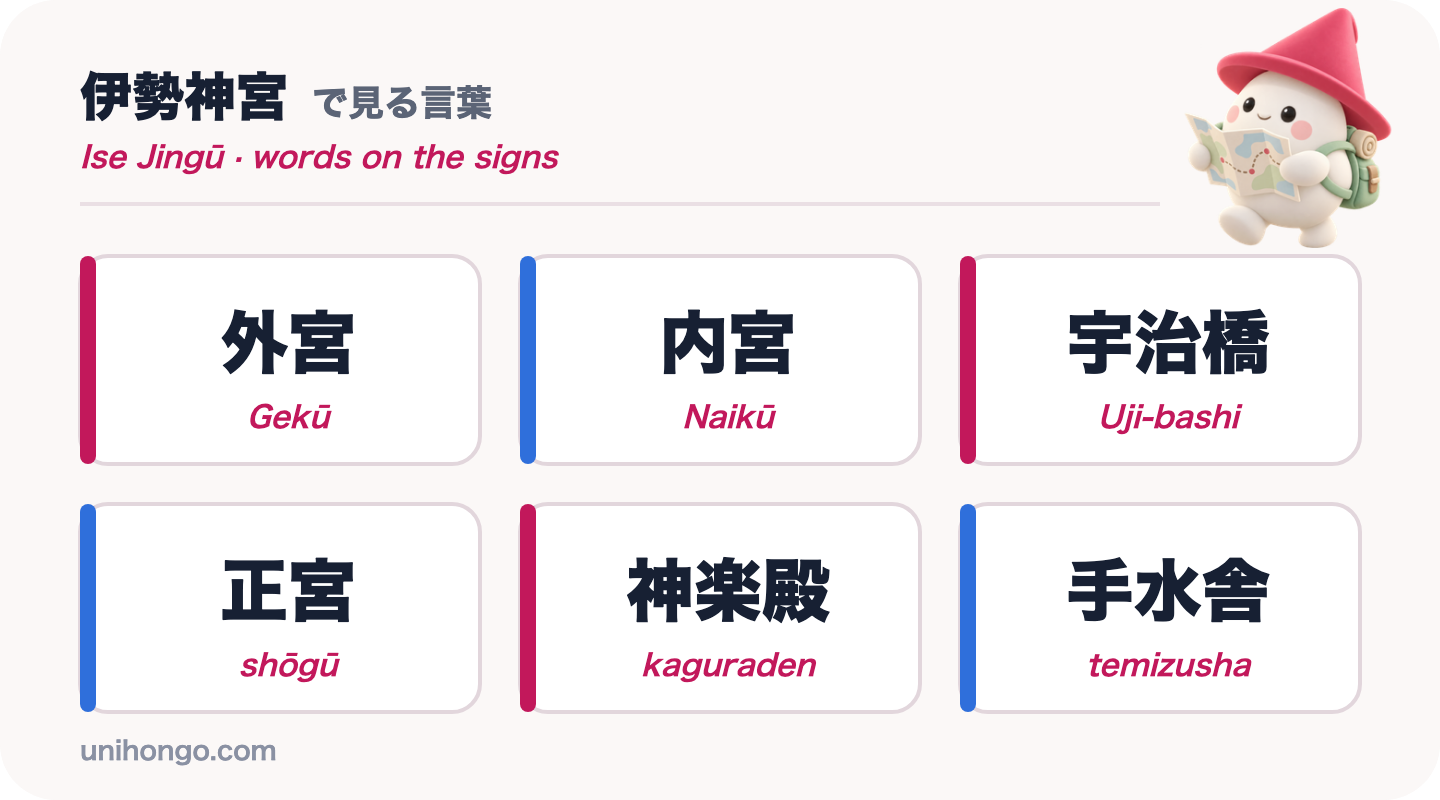
Signs at Ise are short and formal, and the same few words appear at both shrines. 宮 is the key kanji: read gū in Gekū, Naikū and shōgū, and miya in the names of the smaller shrines.
Look also for polite notices asking you not to take photos or not to enter, which often use the soft request form go-enryo kudasai, please refrain.
| Word | Reading | Meaning |
|---|---|---|
| 外宮 | Gekū | The Outer Shrine, dedicated to Toyouke Ōmikami |
| 内宮 | Naikū | The Inner Shrine, dedicated to Amaterasu Ōmikami |
| 宇治橋 | Uji-bashi | The wooden bridge into Naikū |
| 五十鈴川 | Isuzugawa | The river that flows past Naikū |
| 正宮 | shōgū | The main sanctuary of each shrine |
| 神楽殿 | kaguraden | Hall for charms, talismans and prayers |
| 手水舎 | temizusha | Water basin for purifying hands and mouth |
| 御手洗場 | Mitarashi | Riverside place to rinse your hands at Naikū |
| 撮影はご遠慮ください | satsuei wa go-enryo kudasai | Please refrain from taking photos |
| 赤福 | akafuku | Rice cake with sweet bean paste, Ise's famous sweet |
Japanese at the kaguraden and in Oharai-machi
The kaguraden at each shrine is where you receive charms, o-mamori, and talismans, o-fuda, and where you can ask for a goshuin. Ise's o-fuda, called jingū taima, are kept in household altars across Japan. The staff speak very politely, and it sounds respectful to say you would like to receive, itadaku, rather than buy.
In Oharai-machi the Japanese is relaxed and cheerful. Shops call out irasshaimase, menus are on the wall, and many places sell a small portion to eat on the spot. Ordering is mostly kore o kudasai, this one please, with a number.
| Japanese | Romaji | Meaning |
|---|---|---|
| 交通安全のお守りをいただけますか。 | Kōtsū anzen no o-mamori o itadakemasu ka. | May I have a charm for safe travel? |
| 御朱印をお願いできますか。 | Goshuin o onegai dekimasu ka. | Could I ask for a goshuin? |
| 正宮で写真を撮ってもいいですか。 | Shōgū de shashin o totte mo ii desu ka. | May I take photos at the main sanctuary? |
| 赤福を二つください。 | Akafuku o futatsu kudasai. | Two akafuku, please. |
| ここで食べられますか。 | Koko de taberaremasu ka. | Can I eat it here? |
| 伊勢うどんを一つお願いします。 | Ise udon o hitotsu onegai shimasu. | One Ise udon, please. |
| てこね寿司は何の魚ですか。 | Tekone-zushi wa nan no sakana desu ka. | What fish is in the tekone-zushi? |
Etiquette, timing and practical tips
Ise Jingū is the spiritual centre of Shinto and a place where people come to give thanks rather than to ask for favours. A few habits help you blend in.
- Walk on the left at Gekū and on the right at Naikū, as the signs indicate; the centre of the path is for the deities.
- Bow once before you pass under each torii and before you cross the Uji-bashi.
- Rinse your hands and mouth at the temizusha, and at Naikū you can also use the Mitarashi by the river.
- At the main sanctuary, bow twice, clap twice, pray and bow once more; many people simply give thanks here.
- Do not take photos from the stone steps of the main sanctuaries onwards, and put phones away.
- Go early. Naikū and Oharai-machi are crowded from late morning, especially at weekends and New Year.
- Wear comfortable shoes; the gravel paths are long, and the bus ride between the shrines adds up.
Practise the day before you go
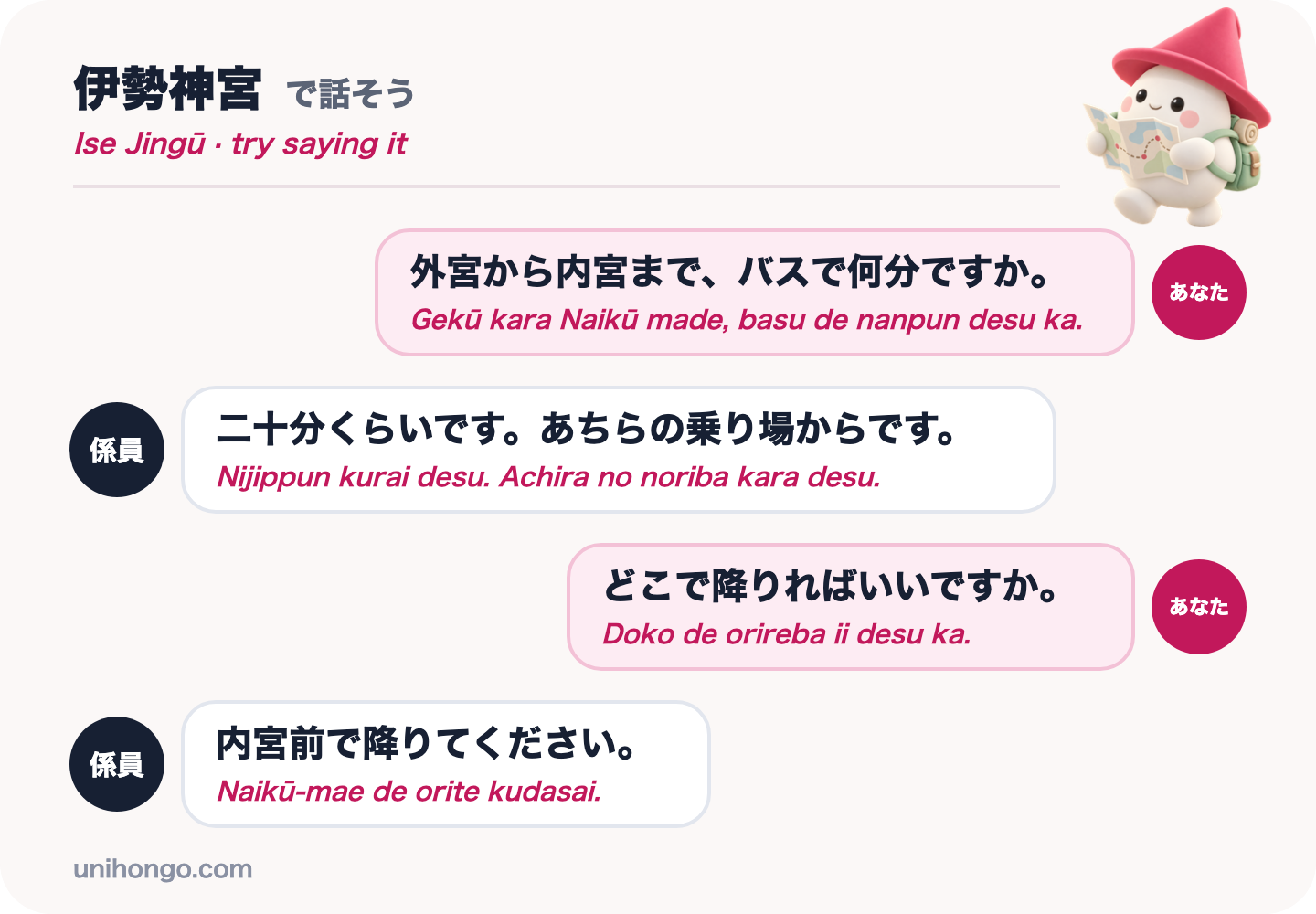
The conversation almost every visitor has is at the bus stop between the two shrines. Staff guiding the queues at busy times can tell you the time and the right stand, and the answer uses kurai, about, with the minutes. Practise the four lines below until they come without reading.
Then practise with a partner who answers back. In Unihongo, choose the Shrine Visit topic and ask your AI Sensei to play an attendant at the kaguraden, or choose the Directions topic to rehearse the bus between Gekū and Naikū. Saying the lines once before the trip is what makes them come out on the day.
| Japanese | Romaji | Meaning |
|---|---|---|
| 外宮から内宮まで、バスで何分ですか。 | Gekū kara Naikū made, basu de nanpun desu ka. | How many minutes is it by bus from Gekū to Naikū? |
| 二十分くらいです。あちらの乗り場からです。 | Nijippun kurai desu. Achira no noriba kara desu. | About twenty minutes. It leaves from the stop over there. |
| どこで降りればいいですか。 | Doko de orireba ii desu ka. | Where should I get off? |
| 内宮前で降りてください。 | Naikū-mae de orite kudasai. | Please get off at Naikū-mae. |
Official information
Ise Jingū publishes visiting hours by season, the ritual calendar, the Shikinen Sengū schedule and access information. Check it before you go, especially at New Year and during major rituals.