
Getting a taxi in the first place
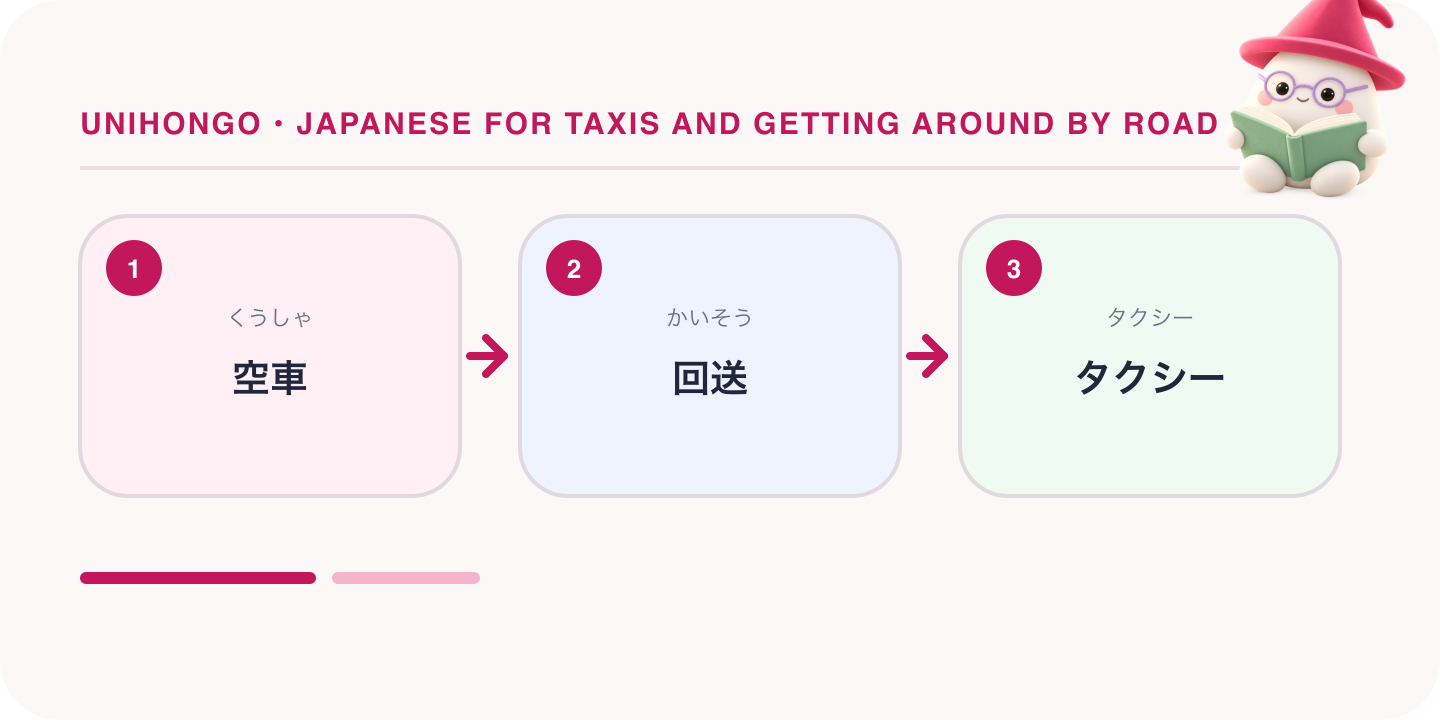
There are three normal ways to get a car: a taxi rank at a station or hotel, a raised hand on a street where taxis pass, or a booking made by a hotel or by app. Availability differs enormously between a city centre at midday and a small town at night, and in quieter areas booking ahead is often the only realistic option. The lit sign in the windscreen tells you whether a passing taxi can stop for you, so learning three short words saves a lot of waving.
| Japanese | Romaji | Meaning |
|---|---|---|
| 空車 | Kūsha | (Sign) Vacant, this taxi is free |
| 賃走 | Chinsō | (Sign) Occupied, it has a passenger |
| 回送 | Kaisō | (Sign) Out of service, it will not stop |
| タクシー乗り場はどこですか。 | Takushī noriba wa doko desu ka. | Where is the taxi rank? |
| タクシーを呼んでもらえますか。 | Takushī o yonde moraemasu ka. | Could you call a taxi for me? |
| 今から一台お願いできますか。 | Ima kara ichi-dai onegai dekimasu ka. | Could I have one now, please? |
| 八時に予約したいです。 | Hachi-ji ni yoyaku shitai desu. | I would like to book one for eight o'clock. |
| ホテルの前で待っています。 | Hoteru no mae de matte imasu. | I will be waiting in front of the hotel. |
| 何分くらいで来ますか。 | Nan-pun kurai de kimasu ka. | Roughly how many minutes until it arrives? |
| 十分ほどで参ります。 | Juppun hodo de mairimasu. | (Staff) It will be there in about ten minutes. |
The door that opens by itself
The rear kerbside door of a Japanese taxi is commonly opened and closed by the driver from the front seat. Stand a step back, wait for it to swing out, get in, and leave it alone when you arrive. Reaching for the handle is the classic visitor reflex and the one thing drivers gently correct all day. Luggage goes in the boot; the driver will usually get out for a heavy case if you ask.
| Japanese | Romaji | Meaning |
|---|---|---|
| ドアは自動で開きます。 | Doa wa jidō de hirakimasu. | (Driver) The door opens automatically. |
| そのままお待ちください。 | Sono mama omachi kudasai. | (Driver) Just wait there, please. |
| 閉めなくて大丈夫です。 | Shimenakute daijōbu desu. | (Driver) You do not need to close it. |
| トランクを開けてもらえますか。 | Toranku o akete moraemasu ka. | Could you open the boot? |
| 荷物が二つあります。 | Nimotsu ga futatsu arimasu. | I have two bags. |
| 後ろに乗ってもいいですか。 | Ushiro ni notte mo ii desu ka. | Is it all right if I sit in the back? |
Giving your destination three ways
You can name a place, read an address, or show a screen, and the third is often the kindest to everyone. Japanese addresses run from large to small and are not laid out along streets, so digits read aloud in a moving car are hard work. A district name plus a landmark gets a driver moving in the right direction immediately, and the exact number can be sorted out at the end.
| Japanese | Romaji | Meaning |
|---|---|---|
| 東京駅までお願いします。 | Tōkyō-eki made onegai shimasu. | To Tokyo Station, please. |
| この住所までお願いします。 | Kono jūsho made onegai shimasu. | To this address, please. |
| ここに行きたいです。画面を見てもらえますか。 | Koko ni ikitai desu. Gamen o mite moraemasu ka. | I want to go here. Could you look at my screen? |
| 住所を読みますね。 | Jūsho o yomimasu ne. | Let me read the address out. |
| さくらホテルという名前です。 | Sakura Hoteru to iu namae desu. | The name is Sakura Hotel. |
| 駅の東口でお願いします。 | Eki no higashi-guchi de onegai shimasu. | The east exit of the station, please. |
| 郵便局の隣です。 | Yūbinkyoku no tonari desu. | It is next to the post office. |
| コンビニの角を右に曲がってください。 | Konbini no kado o migi ni magatte kudasai. | Please turn right at the convenience store corner. |
| この道をまっすぐお願いします。 | Kono michi o massugu onegai shimasu. | Straight along this road, please. |
| 分かりました。行きましょう。 | Wakarimashita. Ikimashō. | (Driver) Understood. Off we go. |
Made onegai shimasu is the single most useful pattern here: any place name plus made onegai shimasu is a complete, polite instruction. Note that made marks the end point of the journey, so it works equally with a station, a hotel name, or kono jūsho for this address.
The driver's questions and your answers
Drivers ask a small number of things, usually in the first thirty seconds and again at the end. They are asked quickly and in casual polite speech, so recognising the shape matters more than the exact words. Omakase shimasu, meaning I leave it to you, is the answer that resolves any route question you do not have an opinion about.
| Driver's question | Romaji | Your answer |
|---|---|---|
| どちらまでですか。 | Dochira made desu ka. | 東京駅までお願いします。 Tōkyō-eki made onegai shimasu. |
| 高速を使いますか。 | Kōsoku o tsukaimasu ka. | はい、お願いします。 Hai, onegai shimasu. |
| 道はどう行きますか。 | Michi wa dō ikimasu ka. | お任せします。 Omakase shimasu. |
| お急ぎですか。 | Oisogi desu ka. | 少し急いでいます。 Sukoshi isoide imasu. |
| 領収書はいりますか。 | Ryōshūsho wa irimasu ka. | お願いします。 Onegai shimasu. |
| エアコンは大丈夫ですか。 | Eakon wa daijōbu desu ka. | 少し弱くしてください。 Sukoshi yowaku shite kudasai. |
| ここでよろしいですか。 | Koko de yoroshii desu ka. | はい、ここで大丈夫です。 Hai, koko de daijōbu desu. |
| お支払いは現金ですか、カードですか。 | Oshiharai wa genkin desu ka, kādo desu ka. | カードでお願いします。 Kādo de onegai shimasu. |
Kōsoku is short for kōsoku dōro, the expressway. Taking it is often faster but adds a toll to the fare, and the driver is asking because the choice costs you money. If you have no preference, say makasemasu or omakase shimasu; if you want the cheaper option, say shitamichi de onegai shimasu, meaning by the ordinary roads.
How long, how much, and which way
| Japanese | Romaji | Meaning |
|---|---|---|
| どのくらいかかりますか。 | Dono kurai kakarimasu ka. | Roughly how long will it take? |
| だいたいいくらになりますか。 | Daitai ikura ni narimasu ka. | Roughly how much will it come to? |
| 高速代は別ですか。 | Kōsokudai wa betsu desu ka. | Is the toll charged separately? |
| 一番早い道でお願いします。 | Ichiban hayai michi de onegai shimasu. | The fastest route, please. |
| 安い方でお願いします。 | Yasui hō de onegai shimasu. | The cheaper way, please. |
| 六時までに着きますか。 | Roku-ji made ni tsukimasu ka. | Will we arrive by six? |
| 二十分くらいですね。 | Nijuppun kurai desu ne. | (Driver) About twenty minutes, I would say. |
| 渋滞しているので、もう少しかかります。 | Jūtai shite iru node, mō sukoshi kakarimasu. | (Driver) There is traffic, so it will take a little longer. |
| 三千円くらいだと思います。 | Sanzen-en kurai da to omoimasu. | (Driver) I think it will be around three thousand yen. |
Fares are metered and the structure differs between companies and regions, including night surcharges and waiting time, so treat any figure a driver gives as an estimate. Asking daitai ikura before you set off is normal and not rude; drivers give a rough number readily, and it lets you decide whether the train is the better idea after all.
Stop here, go a bit further, change of plan
The last two hundred metres are where you actually need to speak. Japanese has a neat pair for this: koko de for here and mō sukoshi saki de for a little further on. Both take tomete kudasai, please stop, or simply onegai shimasu. Drivers cannot always stop exactly where you point, so expect a suggestion in return and accept it with daijōbu desu.
| Japanese | Romaji | Meaning |
|---|---|---|
| ここで止めてください。 | Koko de tomete kudasai. | Please stop here. |
| もう少し先でお願いします。 | Mō sukoshi saki de onegai shimasu. | A little further on, please. |
| 次の信号の手前でお願いします。 | Tsugi no shingō no temae de onegai shimasu. | Just before the next traffic light, please. |
| あの白い建物の前で降ります。 | Ano shiroi tatemono no mae de orimasu. | I will get out in front of that white building. |
| ちょっと待っていてもらえますか。 | Chotto matte ite moraemasu ka. | Could you wait a moment for me? |
| 行き先を変えてもいいですか。 | Ikisaki o kaete mo ii desu ka. | May I change the destination? |
| やっぱり駅までお願いします。 | Yappari eki made onegai shimasu. | Actually, could you take me to the station instead? |
| この辺で大丈夫です。 | Kono hen de daijōbu desu. | Anywhere around here is fine. |
| ここは停められないので、少し先でいいですか。 | Koko wa tomerarenai node, sukoshi saki de ii desu ka. | (Driver) I cannot stop here, is a bit further ahead all right? |
Paying, cards, and the receipt
Payment happens with the door still shut, so have your method ready before you arrive. Large notes are usually fine but a driver at the start of a shift may be short of change, and asking first is polite. If the fare goes on expenses, say ryōshūsho o onegai shimasu; a plain reshīto is a till slip, while a ryōshūsho is the formal receipt with a space for a company name.
| Japanese | Romaji | Meaning |
|---|---|---|
| カードは使えますか。 | Kādo wa tsukaemasu ka. | Can I pay by card? |
| 交通系ICカードでもいいですか。 | Kōtsūkei aishī kādo demo ii desu ka. | Can I use a transport IC card? |
| 現金のみです。 | Genkin nomi desu. | (Driver) Cash only, I am afraid. |
| 一万円札でもいいですか。 | Ichiman-en satsu demo ii desu ka. | Is a ten thousand yen note all right? |
| 細かいのがなくてすみません。 | Komakai no ga nakute sumimasen. | Sorry, I do not have anything smaller. |
| 三千二百円になります。 | Sanzen nihyaku-en ni narimasu. | (Driver) That comes to three thousand two hundred yen. |
| 領収書をお願いします。 | Ryōshūsho o onegai shimasu. | A receipt, please. |
| 宛名は空欄でお願いします。 | Atena wa kūran de onegai shimasu. | Please leave the name field blank. |
| おつりです。ありがとうございました。 | Otsuri desu. Arigatō gozaimashita. | (Driver) Here is your change. Thank you very much. |
| 助かりました。ありがとうございます。 | Tasukarimashita. Arigatō gozaimasu. | That was a great help. Thank you. |
When the driver cannot find the place
This happens to residents too, because small buildings are numbered by block rather than along a street. The useful move is to give the driver something to call or something to see: a phone number, a pin on a map, or a landmark. Getting out a street early is also perfectly acceptable, and often faster than circling.
| Japanese | Romaji | Meaning |
|---|---|---|
| この住所は分かりにくいですね。 | Kono jūsho wa wakarinikui desu ne. | (Driver) This address is a hard one to find. |
| もう一度住所を見せてください。 | Mō ichido jūsho o misete kudasai. | (Driver) Could you show me the address once more? |
| 地図を見せますね。 | Chizu o misemasu ne. | Let me show you the map. |
| ここに電話番号があります。 | Koko ni denwa bangō ga arimasu. | The phone number is here. |
| 電話してもらえますか。 | Denwa shite moraemasu ka. | Could you give them a call? |
| 目印はコンビニです。 | Mejirushi wa konbini desu. | The landmark is a convenience store. |
| この辺で降ります。 | Kono hen de orimasu. | I will get out around here. |
| 大丈夫です。ここから歩きます。 | Daijōbu desu. Koko kara arukimasu. | It is fine. I will walk from here. |
| ご迷惑をおかけしました。 | Gomeiwaku o okake shimashita. | Sorry for the trouble. |
A full ride from the kerb to the receipt
Here is the whole scene in order. Cover the English column and answer the driver aloud; the ride only contains about six sentences of yours, which is why it is such a good first real conversation to have in Japan. Run it once at reading speed, then once at the pace a driver would actually use.
| Japanese | Romaji | Meaning |
|---|---|---|
| どちらまでですか。 | Dochira made desu ka. | (Driver) Where to? |
| この住所までお願いします。画面を見てもらえますか。 | Kono jūsho made onegai shimasu. Gamen o mite moraemasu ka. | To this address, please. Could you look at my screen? |
| はい、分かりました。高速を使いますか。 | Hai, wakarimashita. Kōsoku o tsukaimasu ka. | (Driver) Right, got it. Shall I take the expressway? |
| どのくらい違いますか。 | Dono kurai chigaimasu ka. | How much difference does it make? |
| 十分くらい早いですが、高速代がかかります。 | Juppun kurai hayai desu ga, kōsokudai ga kakarimasu. | (Driver) About ten minutes faster, but there is a toll. |
| じゃあ、下道でお願いします。 | Jā, shitamichi de onegai shimasu. | In that case, the ordinary roads, please. |
| どのくらいかかりますか。 | Dono kurai kakarimasu ka. | Roughly how long will it take? |
| 三十分くらいですね。 | Sanjuppun kurai desu ne. | (Driver) About thirty minutes. |
| 次の信号の手前で止めてください。 | Tsugi no shingō no temae de tomete kudasai. | Please stop just before the next light. |
| ここでよろしいですか。 | Koko de yoroshii desu ka. | (Driver) Is here all right? |
| はい、大丈夫です。カードは使えますか。 | Hai, daijōbu desu. Kādo wa tsukaemasu ka. | Yes, that is fine. Can I pay by card? |
| 使えます。二千八百円です。 | Tsukaemasu. Nisen happyaku-en desu. | (Driver) You can. That is two thousand eight hundred yen. |
| 領収書をお願いします。 | Ryōshūsho o onegai shimasu. | A receipt, please. |
| どうぞ。ありがとうございました。 | Dōzo. Arigatō gozaimashita. | (Driver) Here you are. Thank you very much. |
| ありがとうございました。失礼します。 | Arigatō gozaimashita. Shitsurei shimasu. | Thank you very much. Goodbye. |
Buses, and paying on the way out
Outside the big city centres, many local buses work back to front compared with what most visitors expect. You board at the rear door, take a small numbered ticket from a machine as you get on, and pay when you leave by the front door, matching your ticket number to the fare shown on a display above the driver. City buses with a flat fare often work the other way, boarding at the front and paying on entry. Systems vary by operator and by route, so watch the passenger ahead of you.
Recorded announcements name the next stop, and a button on the handrail tells the driver you want it. If you have no small change, the fare box usually has a note changer, and asking the driver is normal. An IC card works on many routes but not all, and coverage changes, so keep coins for the ones that do not.
| Japanese | Romaji | Meaning |
|---|---|---|
| このバスは京都駅に行きますか。 | Kono basu wa Kyōto-eki ni ikimasu ka. | Does this bus go to Kyoto Station? |
| 整理券をお取りください。 | Seiriken o otori kudasai. | (Recording) Please take a numbered ticket. |
| 降りる時に払いますか。 | Oriru toki ni haraimasu ka. | Do I pay when I get off? |
| 次は市役所前です。 | Tsugi wa Shiyakusho-mae desu. | (Recording) The next stop is Shiyakusho-mae. |
| 次で降ります。 | Tsugi de orimasu. | I am getting off at the next stop. |
| 両替できますか。 | Ryōgae dekimasu ka. | Could I get change? |
| ICカードは使えますか。 | Aishī kādo wa tsukaemasu ka. | Can I use an IC card? |
| 一日乗車券はありますか。 | Ichinichi jōshaken wa arimasu ka. | Is there a one-day pass? |
| 博物館に行きたいのですが、どこで降りればいいですか。 | Hakubutsukan ni ikitai no desu ga, doko de orireba ii desu ka. | I want to go to the museum, where should I get off? |
Hiring a car in a few lines
For rural travel a hire car is often the only sensible option. Traffic drives on the left, and what licence documents a visitor needs differs by the country that issued the licence and changes over time, so confirm with the rental company and the relevant authority well before you travel. At the counter the exchange is short, and the phrases below cover most of it.
| Japanese | Romaji | Meaning |
|---|---|---|
| 予約した山田です。 | Yoyaku shita Yamada desu. | I have a booking under Yamada. |
| 免許証と身分証をお願いします。 | Menkyoshō to mibunshō o onegai shimasu. | (Staff) Your licence and identification, please. |
| 保険もお願いします。 | Hoken mo onegai shimasu. | I would like the insurance as well. |
| ガソリンは満タンで返しますか。 | Gasorin wa mantan de kaeshimasu ka. | Do I return it with a full tank? |
| ETCカードは付いていますか。 | Ītīshī kādo wa tsuite imasu ka. | Does it come with a toll card? |
| カーナビを英語にできますか。 | Kānabi o Eigo ni dekimasu ka. | Can the navigation be set to English? |
| 返却は何時までですか。 | Henkyaku wa nan-ji made desu ka. | By what time do I have to return it? |
| 近くにコインパーキングはありますか。 | Chikaku ni koin pākingu wa arimasu ka. | Is there a paid car park nearby? |