

The first question: eat-in or takeout
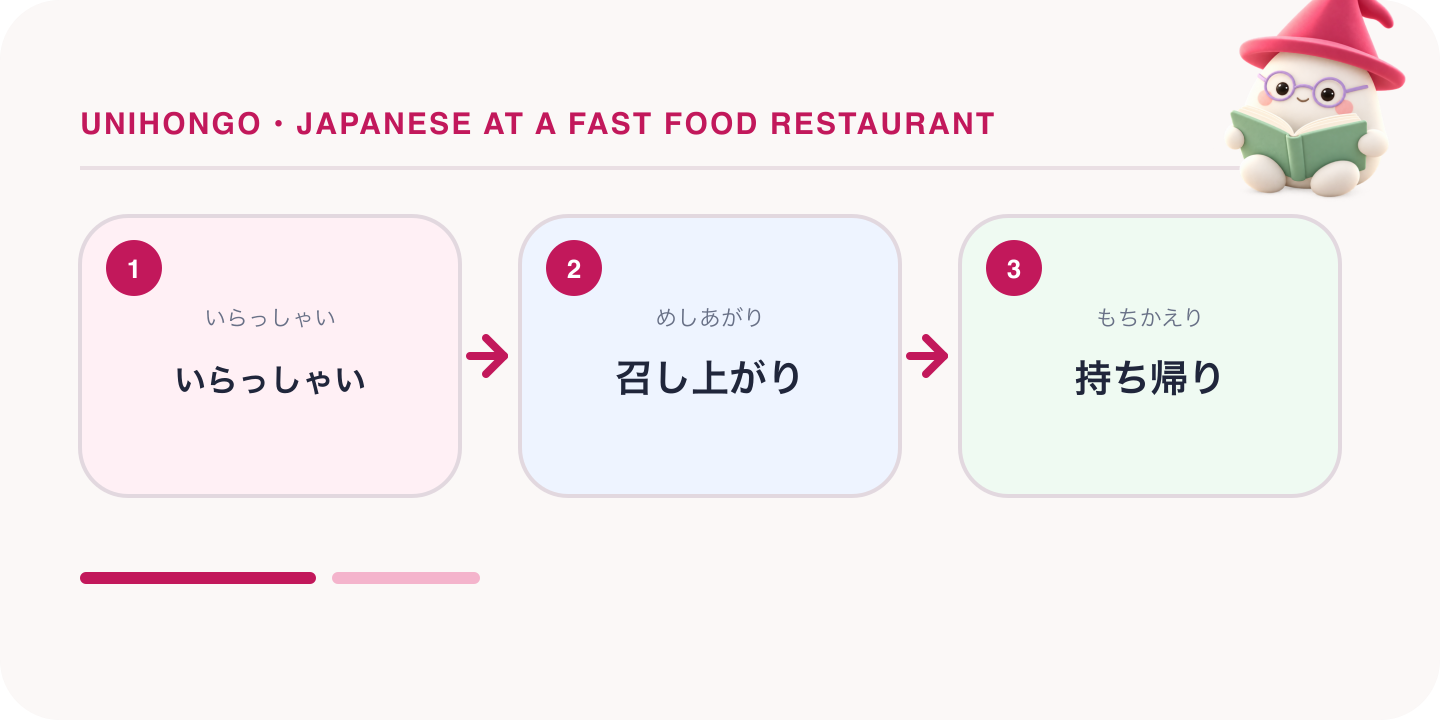
As soon as you reach the counter, you will hear irasshaimase, welcome, and then usually the eat-in question. The polite version is kochira de o-meshiagari desu ka, o-mochikaeri desu ka. O-meshiagari is the honorific form of eat, and o-mochikaeri means taking home.
Answer with tennai de, in the shop, or mochikaeri de, to take away, and add onegai shimasu. The question matters because takeaway food has a lower consumption tax rate than food eaten in, so the total you pay depends on it. Some staff skip straight to the order and ask about eat-in at the end instead.
| Japanese | Romaji | Meaning |
|---|---|---|
| いらっしゃいませ。 | Irasshaimase. | Welcome. |
| こちらでお召し上がりですか、お持ち帰りですか。 | Kochira de o-meshiagari desu ka, o-mochikaeri desu ka. | For here or to take away? |
| 店内でお願いします。 | Tennai de onegai shimasu. | For here, please. |
| 持ち帰りでお願いします。 | Mochikaeri de onegai shimasu. | To take away, please. |
| ご注文はお決まりですか。 | Go-chūmon wa o-kimari desu ka. | Are you ready to order? |
Ordering a set or a single item
Fast food menus in Japan are built around setto, a set of a main item with a side and a drink, and tanpin, the item on its own. Staff may ask setto de yoroshii desu ka to confirm which you want. Point at the menu, name the item, and say the number with hitotsu, futatsu and so on.
Many menus number their sets, so you can say the number instead of the name if the pronunciation of a menu item feels tricky. Seasonal and limited items are marked kikan gentei, limited time, and often shown at the top of the menu board.
| Japanese | Romaji | Meaning |
|---|---|---|
| チーズバーガーのセットをひとつください。 | Chīzubāgā no setto o hitotsu kudasai. | One cheeseburger set, please. |
| 三番のセットをお願いします。 | Sanban no setto o onegai shimasu. | Set number three, please. |
| 単品でお願いします。 | Tanpin de onegai shimasu. | Just the item on its own, please. |
| ポテトだけください。 | Poteto dake kudasai. | Just fries, please. |
| セットでよろしいですか。 | Setto de yoroshii desu ka. | Would you like that as a set? |
| 以上でよろしいですか。 | Ijō de yoroshii desu ka. | Will that be everything? |
| はい、以上です。 | Hai, ijō desu. | Yes, that's all. |
Drinks, sizes and ice
With a set, the next question is the drink: o-nomimono wa nani ni nasaimasu ka. Sizes are usually S, M and L, read esu, emu and eru, and staff may ask saizu wa, the size. Upgrading a set side or drink size may cost extra, and prices vary by chain and branch.
Hot drinks are hotto and iced drinks are aisu, so iced coffee is aisu kōhī and hot tea is hotto tī. For ice, say kōri nuki for no ice or kōri sukuname for less ice.
| Japanese | Romaji | Meaning |
|---|---|---|
| お飲み物は何になさいますか。 | O-nomimono wa nani ni nasaimasu ka. | What would you like to drink? |
| アイスティーのMでお願いします。 | Aisu tī no emu de onegai shimasu. | A medium iced tea, please. |
| サイズはいかがなさいますか。 | Saizu wa ikaga nasaimasu ka. | What size would you like? |
| 氷抜きでお願いします。 | Kōri nuki de onegai shimasu. | No ice, please. |
| 氷少なめで。 | Kōri sukuname de. | Less ice, please. |
| ホットコーヒーにします。 | Hotto kōhī ni shimasu. | I'll have a hot coffee. |
Customising your order
Japanese has a compact pattern for changes: the ingredient plus nuki, without, sukuname, less, or ōme, more, then de onegai shimasu. Not every chain accepts every change, and some changes are only possible on certain items, but asking politely is normal.
If you have an allergy, arerugī, say so clearly and ask about the ingredients. Many chains publish allergen information on paper or online, and staff can often show it to you. Be aware that shared kitchens mean cross-contact is possible.
| Pattern | Reading | Meaning |
|---|---|---|
| ピクルス抜き | pikurusu nuki | No pickles |
| 玉ねぎ抜き | tamanegi nuki | No onion |
| ソース多め | sōsu ōme | Extra sauce |
| マヨネーズ少なめ | mayonēzu sukuname | Less mayonnaise |
| 塩なし | shio nashi | No salt |
| ケチャップ | kechappu | Ketchup |
| アレルギー | arerugī | Allergy |
Useful full sentences: tamago arerugī ga arimasu, I have an egg allergy, and kore ni tamago wa haitte imasu ka, does this contain egg. Swap tamago for komugi, wheat, or nyū, milk, as needed.
Using a self-order kiosk
Touch-screen kiosks, often called serufu ōdā or chūmon kiosuku, let you order without speaking. Look for a language button first. If the screen is Japanese only, the flow is still the same as at the counter: eat-in or takeout, choose items, choose set and drink, confirm, then pay.
At the end, some kiosks take card or electronic payments directly, while others print a slip that you take to the counter to pay in cash. Your receipt shows an order number, chūmon bangō, which is how your food will be called.
| Kiosk word | Reading | Meaning |
|---|---|---|
| 店内 / お持ち帰り | tennai / o-mochikaeri | Eat-in / takeout |
| 注文する | chūmon suru | Order |
| カートに入れる | kāto ni ireru | Add to cart |
| 注文を確認 | chūmon o kakunin | Check your order |
| お支払い方法 | o-shiharai hōhō | Payment method |
| 現金 | genkin | Cash |
| キャッシュレス | kyasshuresu | Cashless (card, IC, QR) |
| 戻る | modoru | Back |
| 取り消し | torikeshi | Cancel |
| 売り切れ | urikire | Sold out |
Paying and waiting for your number
At the counter, staff will tell you the total and ask how you are paying. Cash, cards, transport IC cards and QR payments are common at big chains, but accepted methods differ by branch, so look at the stickers by the till. Cash goes on the small tray, not into the staff member's hand.
You then either wait at the counter or take a number and sit down. Numbers are called out or shown on a screen above the counter, and at some places staff bring the food to your table. When your number comes up, show your receipt.
| Japanese | Romaji | Meaning |
|---|---|---|
| お会計は八百円です。 | O-kaikei wa happyaku-en desu. | Your total is 800 yen. |
| お支払いはどうなさいますか。 | O-shiharai wa dō nasaimasu ka. | How would you like to pay? |
| カードでお願いします。 | Kādo de onegai shimasu. | By card, please. |
| 番号札を持ってお席でお待ちください。 | Bangō-fuda o motte o-seki de o-machi kudasai. | Please take this number and wait at your seat. |
| 百二十三番でお待ちのお客様。 | Hyaku nijū san-ban de o-machi no o-kyakusama. | Customer with number 123. |
| お待たせいたしました。 | O-matase itashimashita. | Thank you for waiting. |
Seats, trays and rubbish
- At busy times people sometimes save a seat before ordering, but some branches ask customers to order first; follow any sign by the entrance.
- Take napkins, straws and sauces from the self-service station only as you need them.
- When you finish, carry your tray to the return area, called henkyakuguchi or similar.
- Pour leftover ice and drink into the liquid bin if there is one, then sort cups, lids and paper into the labelled bins.
- Leave the tray on the stack and say gochisōsama deshita on the way out if you like.
- Eating while walking outside is generally avoided; if you take out, eat at home, at your hotel or somewhere you can sit.
When something goes wrong
Mistakes are fixed quickly if you say so at the counter straight away. Sumimasen followed by a short description is all you need. Staff will usually apologise and swap the item.
| Japanese | Romaji | Meaning |
|---|---|---|
| すみません、注文と違います。 | Sumimasen, chūmon to chigaimasu. | Excuse me, this isn't what I ordered. |
| ポテトが入っていません。 | Poteto ga haitte imasen. | The fries aren't in here. |
| 飲み物はアイスで頼みました。 | Nomimono wa aisu de tanomimashita. | I ordered the drink iced. |
| 注文を変更できますか。 | Chūmon o henkō dekimasu ka. | Can I change my order? |
| 申し訳ございません。すぐにお取り替えします。 | Mōshiwake gozaimasen. Sugu ni o-torikae shimasu. | We're very sorry. We'll replace it right away. |
| ストローをもらえますか。 | Sutorō o moraemasu ka. | Could I have a straw? |