

Finding a booth and reading the signs
Purikura booths are usually grouped together in a corner or on one floor of a game centre, gēmu sentā or gēsen for short, and sometimes in shopping centres. Each machine has a large panel describing its style, such as natural, cute or dramatic, and a screen outside where you pay and choose settings.
Before you go in, check the sign at the entrance of the purikura area. Many venues ask groups of men without women not to enter the area, to keep it comfortable for other customers. The rule varies by venue, and couples or mixed groups are usually welcome.
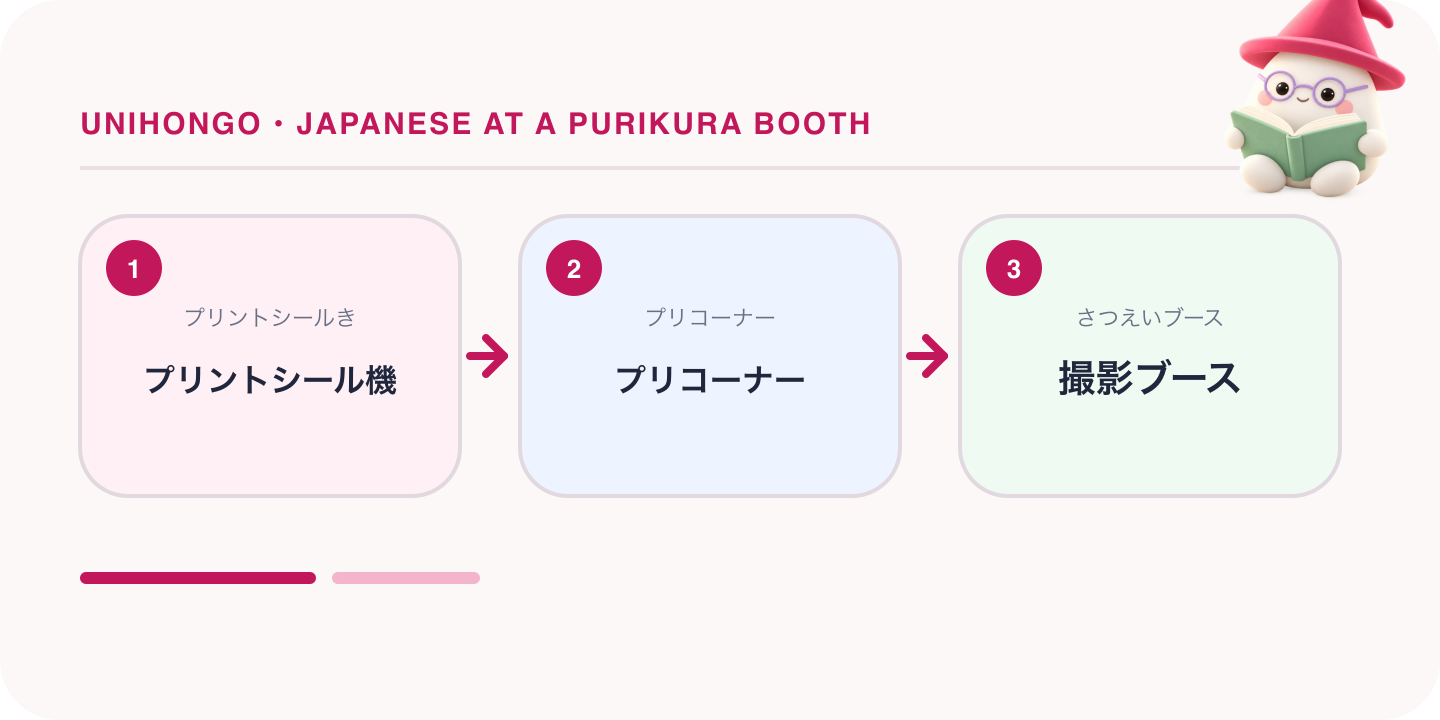
| Sign | Reading | Meaning |
|---|---|---|
| プリントシール機 | purinto shīru ki | Photo sticker machine |
| プリコーナー | puri kōnā | Purikura area |
| 撮影ブース | satsuei būsu | Photo booth |
| 落書きブース | rakugaki būsu | Decorating booth |
| 男性のみのご入場はご遠慮ください | dansei nomi no gonyūjō wa goenryo kudasai | Men only groups, please do not enter |
| 料金 | ryōkin | Price |
| 調整中 | chōseichū | Out of service, being adjusted |
The start screen: people, course and background
After paying, the outside screen starts talking. It asks how many people are in the group, which shooting course you want, and sometimes which background or mood to use. The prompts are casual and usually end in ~te ne, a friendly way of saying please do, or ~yō, let's.
A timer runs in the corner of the screen. If you do not choose in time, the machine picks for you and moves on, so tap confidently. Many machines let you switch the language, but not all, and the voice often stays in Japanese.
| Japanese | Romaji | Meaning |
|---|---|---|
| お金を入れてね。 | Okane o irete ne. | Put your money in. |
| 人数を選んでね。 | Ninzū o erande ne. | Choose the number of people. |
| 撮影コースを選んでね。 | Satsuei kōsu o erande ne. | Choose a shooting course. |
| 背景を選んでね。 | Haikei o erande ne. | Choose a background. |
| 明るさを選んでね。 | Akarusa o erande ne. | Choose the brightness. |
| 撮影ブースに入ってね。 | Satsuei būsu ni haitte ne. | Go into the photo booth. |
| 残り時間 | nokori jikan | Time remaining |
Inside the booth: countdown and pose prompts
Inside the booth, the screen shows a live preview and an example pose, and the voice tells you what to do before each shot. The countdown is usually a quick san, ni, ichi, or the machine says iku yo, here we go, just before the flash. After each shot you see the photo for a moment before the next prompt.
The poses change with fashions, but the instructions use a small set of verbs: yoru, to move closer, mukeru, to turn, and tsukuru, to make a shape with your hands. Copy the example on the screen and you will be close enough.
| Japanese | Romaji | Meaning |
|---|---|---|
| いくよー!3、2、1! | Iku yō! San, ni, ichi! | Here we go! Three, two, one! |
| みんなで寄ってね。 | Minna de yotte ne. | Everyone, squeeze together. |
| カメラを見てね。 | Kamera o mite ne. | Look at the camera. |
| 手でハートを作ってね。 | Te de hāto o tsukutte ne. | Make a heart with your hands. |
| ほっぺに手を当ててね。 | Hoppe ni te o atete ne. | Put your hands on your cheeks. |
| ピースしてね。 | Pīsu shite ne. | Make a peace sign. |
| 次は全身だよ。 | Tsugi wa zenshin da yo. | Next is a full-body shot. |
| アップで撮るよ。 | Appu de toru yo. | Taking a close-up. |
Pose vocabulary and body words
Machines often name a pose and show it at the same time. Knowing the body words helps you react quickly, because you have only a few seconds. Kao is face, te is hand, ago is chin and hoppe is the casual word for cheek. Zenshin means full body and appu means a close-up of the face.
Some courses include a shot where the machine asks for a funny face, hengao, or a pose picked by the group, jiyū pōzu. There is no right answer, so use the moment for whatever pose your group likes.
| Word | Reading | Meaning |
|---|---|---|
| ポーズ | pōzu | Pose |
| 全身 | zenshin | Full body |
| アップ | appu | Close-up |
| 顔 | kao | Face |
| ほっぺ | hoppe | Cheek (casual) |
| あご | ago | Chin |
| 変顔 | hengao | Funny face |
| 自由ポーズ | jiyū pōzu | Free pose |
| 小顔 | kogao | Small-face effect |
Rakugaki: decorating your photos
When shooting ends, the voice tells you to move to the decorating booth, often on the other side of the machine. Here you choose photos and decorate them on a touch screen with a stylus pen, tacchi pen. This stage is called rakugaki, doodling, and it has its own countdown, usually shown clearly at the top of the screen.
Tools are grouped in tabs: pen for drawing and writing, sutanpu for stamps, moji for text, and furēmu for frames. Many machines have ready-made text such as the date or phrases like zutto nakayoshi, best friends forever. Keshigomu is the eraser and modoru is undo.
| Japanese | Romaji | Meaning |
|---|---|---|
| 落書きブースに移動してね。 | Rakugaki būsu ni idō shite ne. | Move to the decorating booth. |
| 落書きする写真を選んでね。 | Rakugaki suru shashin o erande ne. | Choose the photos to decorate. |
| ペン | pen | Pen tool |
| スタンプ | sutanpu | Stamps |
| 文字 | moji | Text |
| 消しゴム | keshigomu | Eraser |
| 戻る | modoru | Undo, back |
| あと30秒だよ! | Ato sanjū-byō da yo! | 30 seconds left! |
Editing words: skin, eyes and brightness
Most machines let you adjust faces before or during decorating. Popular settings change the size of the eyes, me no ōkisa, smooth skin, bihada, and brightness, akarusa. The word you will hear young people use is moreru, to come out looking good in a photo, and a machine may promise that you will look moreru with its effects.
Settings are usually a slider or a row of choices from natural to strong. If your group wants a more natural look, choose the option labelled nachuraru or the weakest setting.
| Word | Reading | Meaning |
|---|---|---|
| 目の大きさ | me no ōkisa | Eye size |
| 美肌 | bihada | Smooth skin effect |
| 明るさ | akarusa | Brightness |
| 肌の色 | hada no iro | Skin tone |
| ナチュラル | nachuraru | Natural |
| 盛れる | moreru | To come out looking great |
| 補正 | hosei | Correction, adjustment |
| やり直し | yarinaoshi | Redo |
Printing and choosing a layout
Near the end of decorating, the machine asks you to choose a layout, bunkatsu, which decides how many photos fit on the sticker sheet and at what size. After you confirm, the sheet prints and drops into the outlet, toridashiguchi, usually on the outside of the machine. Wait for the voice before walking away, since printing takes a moment.
Many purikura areas have a table with scissors, hasami, so you can cut the sheet and share the stickers among your group. Return the scissors when you finish.
| Japanese | Romaji | Meaning |
|---|---|---|
| 分割を選んでね。 | Bunkatsu o erande ne. | Choose a layout. |
| プリント中だよ。 | Purintochū da yo. | Printing now. |
| シールが出てくるまで待ってね。 | Shīru ga dete kuru made matte ne. | Wait until the stickers come out. |
| 取り出し口からシールを取ってね。 | Toridashiguchi kara shīru o totte ne. | Take your stickers from the outlet. |
| はさみを借りてもいいですか。 | Hasami o karite mo ii desu ka. | May I borrow the scissors? |
Sending photos to your phone
Many machines offer keitai sōshin or sumaho sōshin, sending the photos to your phone. You usually scan a QR code on the screen or enter an email address during decorating. Some machines send one image for free and ask you to join the maker's service to download more or to get extra shots. What is free, what is paid and how long images stay available depend on the model.
If something goes wrong, such as the machine stopping mid-session or the stickers not printing, find a staff member in the game centre. Many venues have a call button or a counter, and staff can reset the machine or help.
| Japanese | Romaji | Meaning |
|---|---|---|
| 携帯に送る | keitai ni okuru | Send to phone |
| QRコードを読み取ってね。 | Kyū-āru kōdo o yomitotte ne. | Scan the QR code. |
| メールアドレスを入力してね。 | Mēru adoresu o nyūryoku shite ne. | Enter your email address. |
| 機械が止まってしまいました。 | Kikai ga tomatte shimaimashita. | The machine has stopped. |
| シールが出てきません。 | Shīru ga dete kimasen. | The stickers haven't come out. |
| お金を入れたのに始まりません。 | Okane o ireta noni hajimarimasen. | I put money in but it didn't start. |
Purikura is also a small listening lesson. The machine speaks the same friendly, casual Japanese that friends use with each other, full of ~te ne and ~yo, so it is a good way to hear how young people talk.