

Why Mount Takao is Tokyo's favourite hike
Mount Takao is popular above all because it is so close: the trailhead is a single train ride from Shinjuku, and the whole mountain lies within Tokyo. At 599 metres it is small, but its forests are rich, protected for centuries as temple land, and its paths are lined with shrines, stone statues and tea houses.
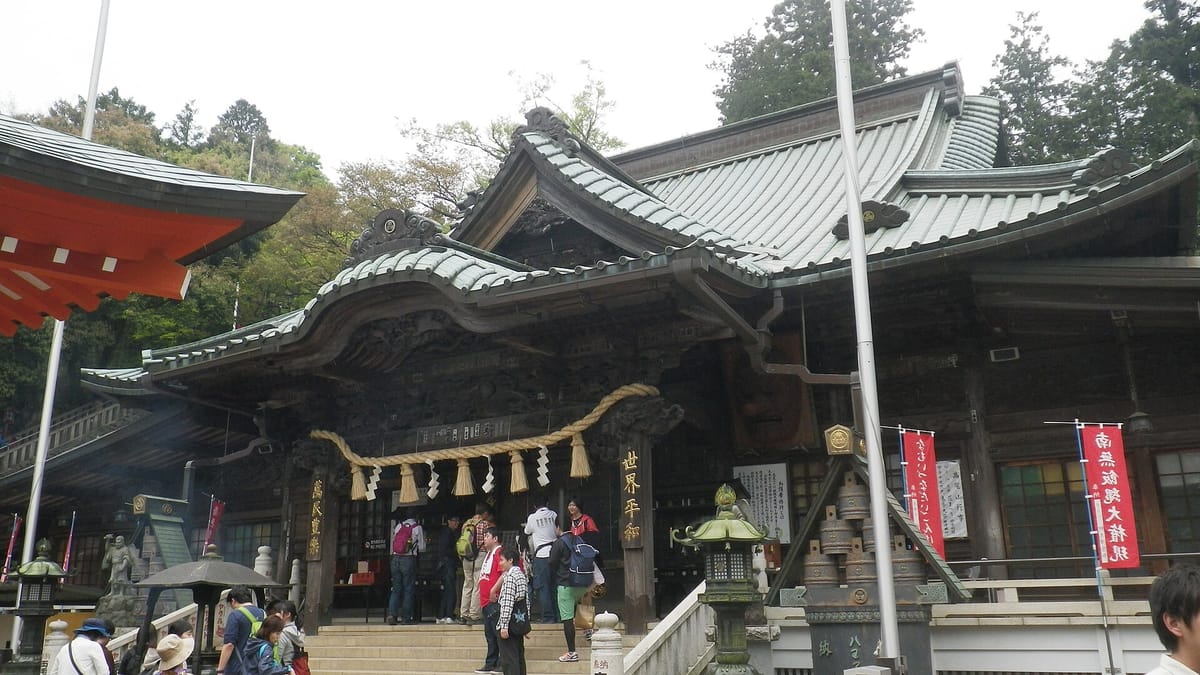
The mountain is sacred to Yakuō-in, a temple said to have been founded in the eighth century and now a centre of Shugendō, the mountain worship that mixes Buddhist and Shinto practice. Its halls near the summit are bright with carving and colour, and tengu statues stand guard beside them. Fire rituals are held regularly in the main hall, and in March the temple holds a fire-walking festival at the foot of the mountain.
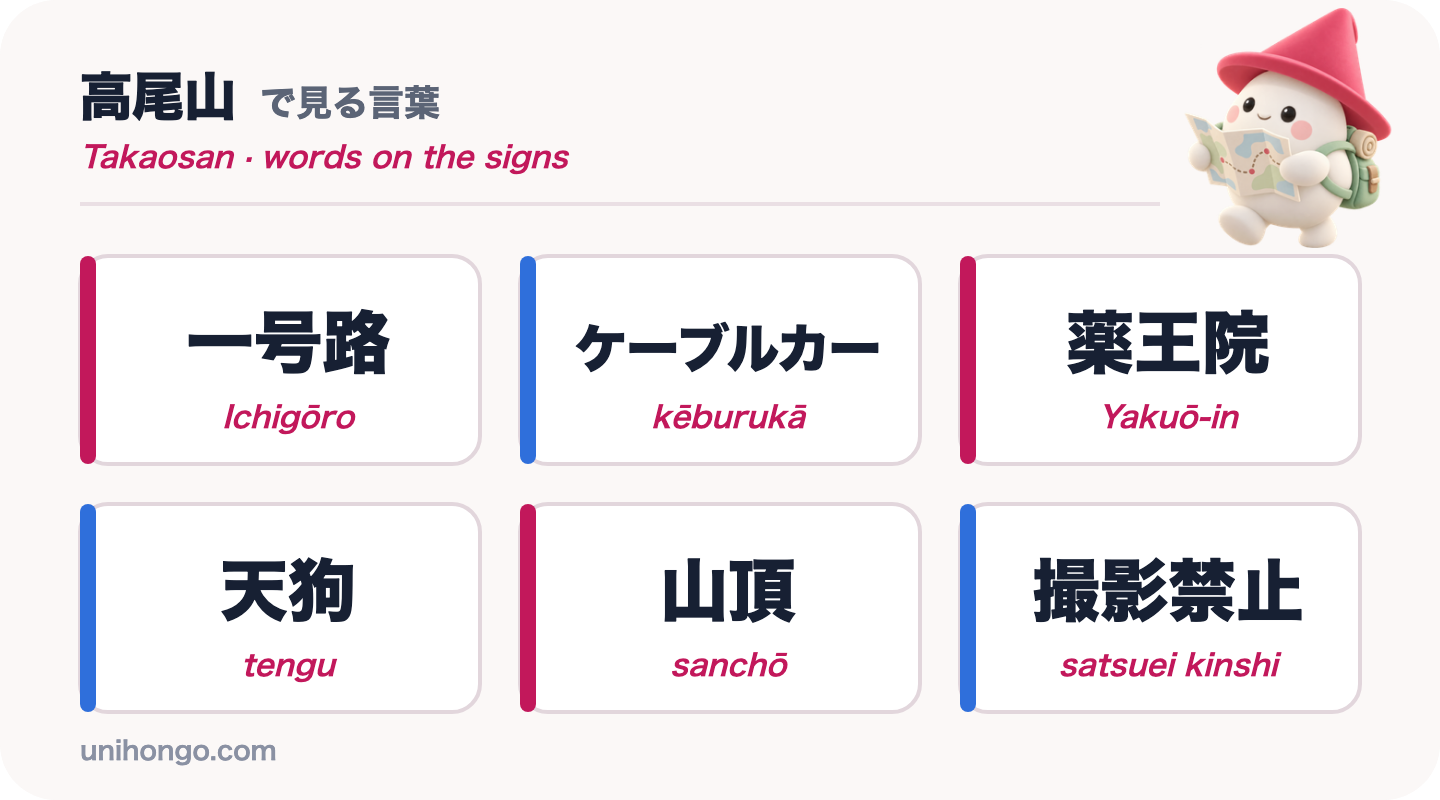
For a learner, Takao is a friendly mountain. The trail signs are clear and numbered, staff at the cable car are used to questions, and walkers greet each other on the way. It is also full of memorable words: 天狗, 山頂, 一号路, which you will read dozens of times on the way up.
Getting there: Keio line to Takaosanguchi
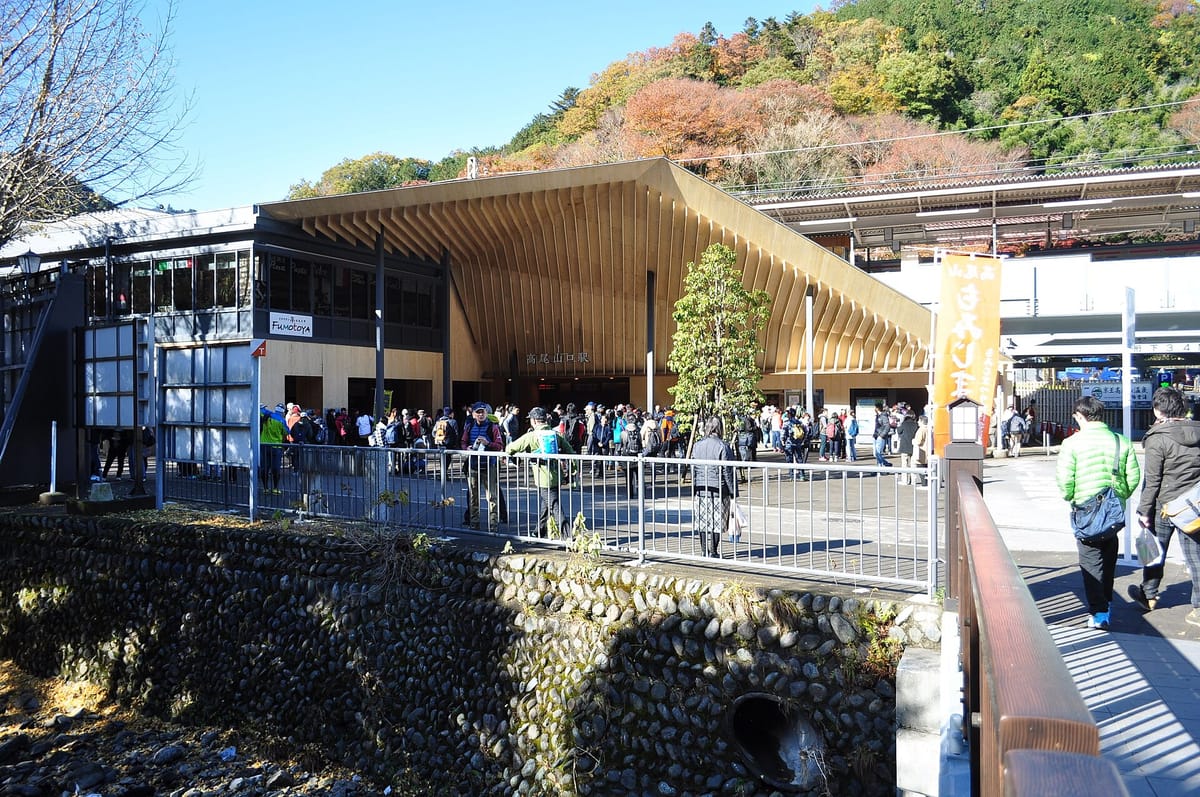
The Keio line is the simple, cheap way to Takao. Limited express trains from Keio Shinjuku Station, on the underground level of Shinjuku Station, reach Takaosanguchi Station, Takaosanguchi-eki, in about 50 minutes; on some trains you may need to change at Kitano, so check the destination on the platform board. The station at the foot of the mountain was rebuilt in 2015 with a timber canopy designed by the architect Kuma Kengo. With a JR pass, take the JR Chūō Line to Takao Station and change to the Keio line for the final stop.
From Takaosanguchi, a short walk past soba restaurants and souvenir shops brings you to Kiyotaki Station, the bottom of the cable car, and to the start of trail 1 and trail 6. The chairlift leaves from a separate station next to the cable car. Suica and Pasmo work on the trains; the cable car and chairlift sell tickets at their own windows.
| Japanese | Romaji | Meaning |
|---|---|---|
| 高尾山口行きはどのホームですか。 | Takaosanguchi-yuki wa dono hōmu desu ka. | Which platform is the train to Takaosanguchi? |
| 北野で乗り換えですか。 | Kitano de norikae desu ka. | Do I change at Kitano? |
| ケーブルカーの駅はどちらですか。 | Kēburukā no eki wa dochira desu ka. | Which way is the cable car station? |
| 一号路の入り口はここですか。 | Ichigōro no iriguchi wa koko desu ka. | Is this the start of trail 1? |
| コインロッカーはありますか。 | Koin rokkā wa arimasu ka. | Are there coin lockers? |
Up trail 1: octopus cedar, monkeys, Yakuō-in and the summit
Trail 1, the omote-sandō of the mountain, climbs steadily on a paved path through cedar forest. If you take the cable car, one of the steepest in Japan, or the open chairlift, you rejoin the trail halfway up at Takaosan Station, where an observation deck looks east over the Kantō plain towards central Tokyo.
Walking on, you pass the Tako-sugi, an ancient cedar whose twisted roots look like an octopus, then the monkey park and wild plant garden, which charges a small entry fee. The trail then passes under a gate into the grounds of Yakuō-in, where you climb steps past the tengu statues to the main hall and the Izuna Gongen hall above it. From the temple, a final climb brings you to the summit, sanchō, with a visitor centre, tea houses and, on clear days, a view of Mount Fuji to the west.
Return the same way or choose a quieter numbered trail. Trail 6 follows a stream through the forest, and the Inariyama trail runs along a ridge; both are unpaved and take a little longer. Beyond the summit, a 30-minute walk leads to Itchōdaira, known for its cherry trees.
- Takaosan Station observation deck: the view over Tokyo at the top of the cable car.
- Tako-sugi: the octopus cedar beside trail 1.
- Monkey park and wild plant garden: Japanese macaques and mountain flowers.
- Yakuō-in: the temple halls, the tengu statues and the goshuin counter.
- Summit: the 599-metre top, with Fuji on clear days.
- Takao 599 Museum: a free nature museum near the foot of the mountain.
- Keio Takaosan Onsen Gokurakuyu: the hot spring next to Takaosanguchi Station.
Words on the trail signs
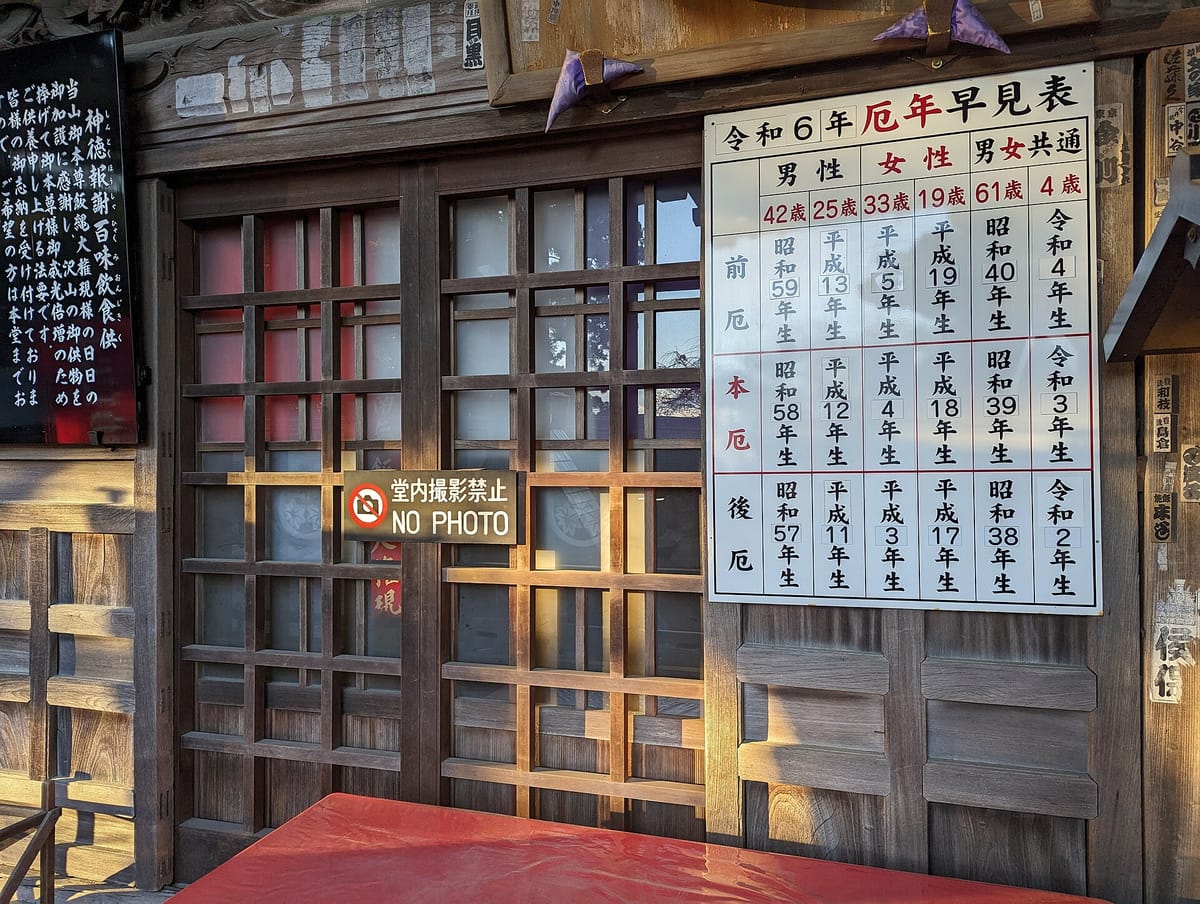
Takao's signposts are some of the clearest in Japan: each trail is numbered, each junction shows the distance and time to the summit, and the temple adds its own signs about prayer and photography. Watch for 撮影禁止, no photography, on the temple halls, where photos inside are not allowed.
The table below lists the words you will read on the way up and at the top.
| Word | Reading | Meaning |
|---|---|---|
| 高尾山口 | Takaosanguchi | Station at the foot of the mountain |
| 清滝駅 | Kiyotaki-eki | Bottom station of the cable car |
| ケーブルカー | kēburukā | Cable car, a funicular |
| リフト | rifuto | Chairlift |
| 一号路 | Ichigōro | Trail number 1 |
| たこ杉 | Tako-sugi | The octopus cedar |
| 薬王院 | Yakuō-in | The mountain temple |
| 天狗 | tengu | Mountain spirit with a long nose or a crow's beak |
| 山頂 | sanchō | Summit |
| 展望台 | tenbōdai | Viewpoint |
| 撮影禁止 | satsuei kinshi | No photography |
Japanese for tickets, trail questions and a soba lunch
At the cable car and chairlift you choose between one way, katamichi, and a return, ōfuku. A return ticket can be used on either the cable car or the chairlift, so many people ride up one and down the other. The chairlift sometimes stops for maintenance or bad weather, so it is worth asking before you plan to use it.
Takao's local lunch is tororo soba, buckwheat noodles topped with grated mountain yam, served in restaurants around the station and on the mountain. On the way down, look for tengu-yaki, small tengu-shaped cakes filled with sweet bean paste.
| Japanese | Romaji | Meaning |
|---|---|---|
| ケーブルカーの往復を二枚ください。 | Kēburukā no ōfuku o nimai kudasai. | Two return tickets for the cable car, please. |
| 行きはケーブルカー、帰りはリフトでもいいですか。 | Iki wa kēburukā, kaeri wa rifuto demo ii desu ka. | Can I go up by cable car and come down by chairlift? |
| 今日はリフトは動いていますか。 | Kyō wa rifuto wa ugoite imasu ka. | Is the chairlift running today? |
| 六号路は今日通れますか。 | Rokugōro wa kyō tōremasu ka. | Is trail 6 open today? |
| 山頂から富士山は見えますか。 | Sanchō kara Fujisan wa miemasu ka. | Can you see Mount Fuji from the summit? |
| とろろそばをひとつお願いします。 | Tororo soba o hitotsu onegai shimasu. | One tororo soba, please. |
Manners, safety and timing on the mountain
Mount Takao receives huge numbers of walkers, and the paths are shared by pilgrims, families and trail runners. These habits keep it pleasant.
- Keep to the left on busy trails and let faster walkers pass; a short konnichiwa to people coming down is normal.
- Take all your rubbish home: there are almost no bins on the mountain.
- Do not feed the monkeys or other wildlife, and stay on the marked trails.
- At Yakuō-in, follow the signs about photography inside the halls, and bow before the main hall.
- Start early on weekends, especially in November; queues for the cable car and trains back can be long by mid-afternoon.
- Carry water, and a light jacket for the summit, which is cooler and windier than Tokyo.
Practise the trail conversation before you go
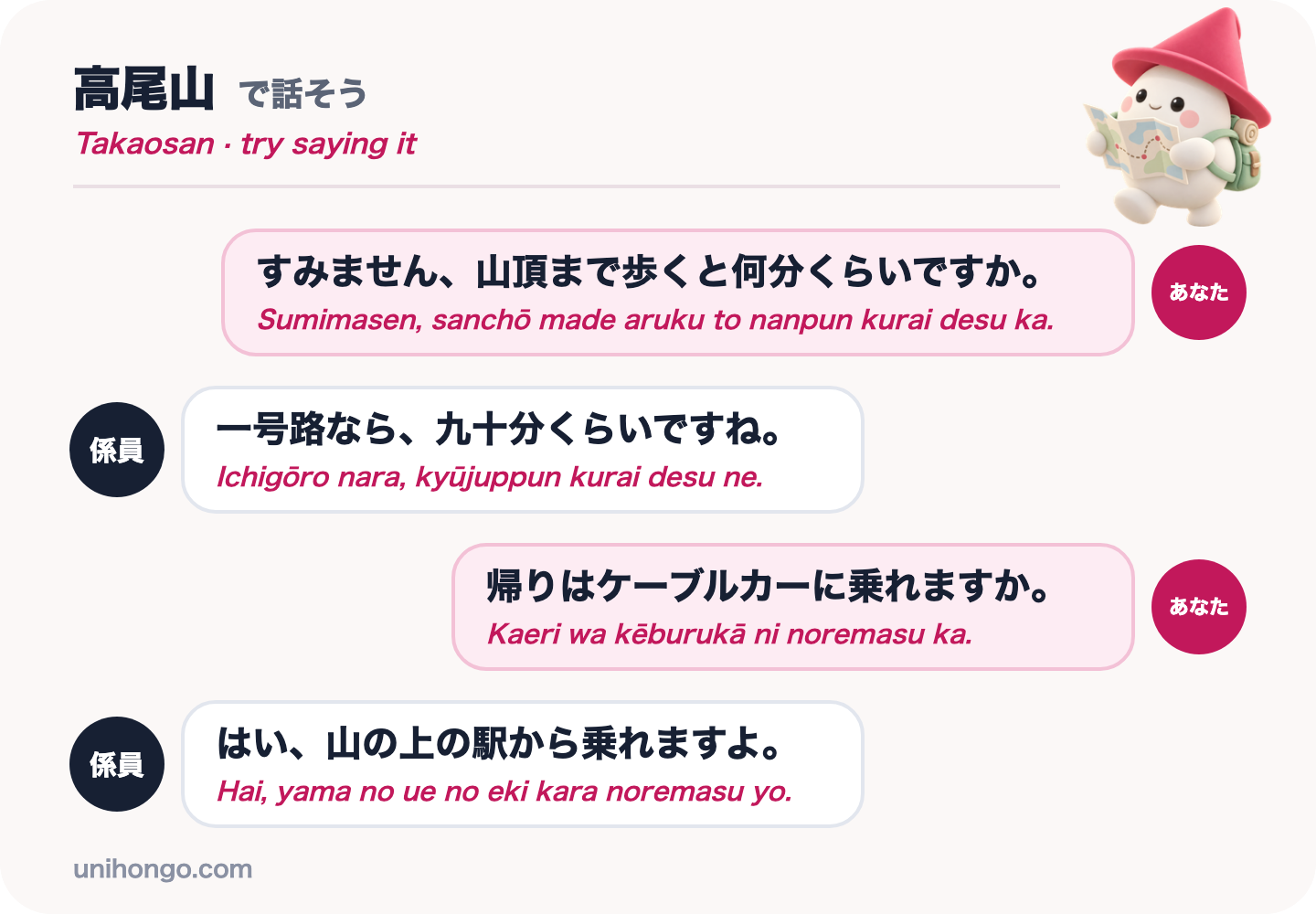
At the foot of the mountain, the two things to confirm are how long the walk takes and how to come back down. The four lines below cover both, and the pattern ... to, nanpun kurai desu ka, if I do this, about how many minutes, works for any walk in Japan. Practise them until the numbers in the answer are easy to catch.
Then rehearse with a partner who answers. In Unihongo, choose the Sightseeing topic and ask your AI Sensei to play a cable car attendant on Mount Takao, or choose Directions to practise asking the way on the trails. A spoken run-through before the trip makes the real exchange much easier.
| Japanese | Romaji | Meaning |
|---|---|---|
| すみません、山頂まで歩くと何分くらいですか。 | Sumimasen, sanchō made aruku to nanpun kurai desu ka. | Excuse me, about how many minutes is it on foot to the summit? |
| 一号路なら、九十分くらいですね。 | Ichigōro nara, kyūjuppun kurai desu ne. | By trail 1, about ninety minutes. |
| 帰りはケーブルカーに乗れますか。 | Kaeri wa kēburukā ni noremasu ka. | Can I take the cable car on the way back? |
| はい、山の上の駅から乗れますよ。 | Hai, yama no ue no eki kara noremasu yo. | Yes, you can board at the station up on the mountain. |
Official information
Cable car and chairlift running times, maintenance closures, trail notices and temple events change through the year. Check the official sites before you go, especially after heavy rain and in the autumn colour season.