

Why the Magome to Tsumago walk is special
Most old highways in Japan have long since become national roads lined with petrol stations. In the Kiso Valley, a few stretches of the Nakasendō survive as footpaths, and the one between Magome and Tsumago is the best known. You start in one Edo-period post town and finish in another, crossing Magome Pass on the way.
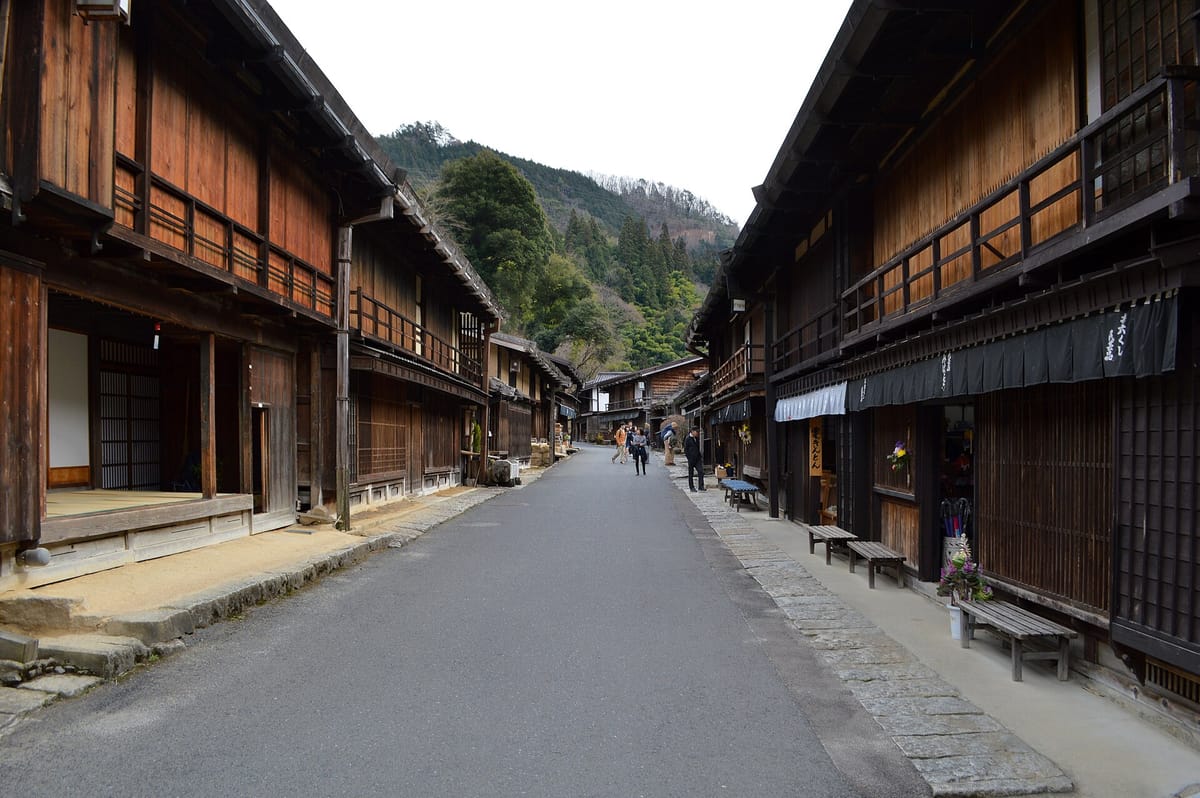
Both towns are living places, not museums. Tsumago was one of the first towns in Japan to protect its streetscape: in 1971 residents adopted a charter based on three promises, not to sell, not to rent and not to destroy their historic buildings, and in 1976 it was among the first places named an Important Preservation District for Groups of Traditional Buildings. Cars are kept off the main street in the daytime, and wires are hidden from view.
For a Japanese learner the walk is a gentle introduction to rural Japan. The tourist offices are used to international walkers, the inns and tea houses are small and friendly, and people along the trail greet every passer-by.
Getting there: Nakatsugawa for Magome, Nagiso for Tsumago
Both ends are on or near the JR Chūō Main Line between Nagoya and Matsumoto. For Magome, get off at Nakatsugawa Station, under an hour from Nagoya on the Shinano limited express, and take the bus from the station for about twenty-five minutes. For Tsumago, get off at Nagiso Station, where local trains stop, and take the bus for about ten minutes, or walk about an hour.
Most walkers start at Magome, walk to Tsumago and then take the bus to Nagiso Station for the train. Buses also run between the two towns, so you can walk one way and ride the other. Services are not frequent, so note the times at the tourist office before you set out.
| Japanese | Romaji | Meaning |
|---|---|---|
| 馬籠行きのバスは何番のりばですか。 | Magome yuki no basu wa nanban noriba desu ka. | Which stop does the bus to Magome leave from? |
| 次の特急は中津川に止まりますか。 | Tsugi no tokkyū wa Nakatsugawa ni tomarimasu ka. | Does the next limited express stop at Nakatsugawa? |
| 南木曽駅までのバスは何時ですか。 | Nagiso-eki made no basu wa nanji desu ka. | What time is the bus to Nagiso Station? |
| 妻籠から馬籠へのバスはありますか。 | Tsumago kara Magome e no basu wa arimasu ka. | Is there a bus from Tsumago to Magome? |
| 観光案内所はどこですか。 | Kankō annaijo wa doko desu ka. | Where is the tourist information centre? |
On the trail: from Magome over the pass to Tsumago
Magome-juku stretches up a steep hillside, its stone-paved street lined with shops selling crafts, chestnut sweets and gohei-mochi, grilled rice cakes on a stick with a sweet sauce. At the top, a viewpoint looks out towards Mount Ena, and then the trail leaves the town and climbs gently through forest and hamlets to Magome Pass at about 790 metres.
From the pass the path descends through cedar woods, past an old rest house and a pair of waterfalls, to the hamlet of Ōtsumago and finally into Tsumago-juku. Signposts give distances in kilometres to each town all the way.
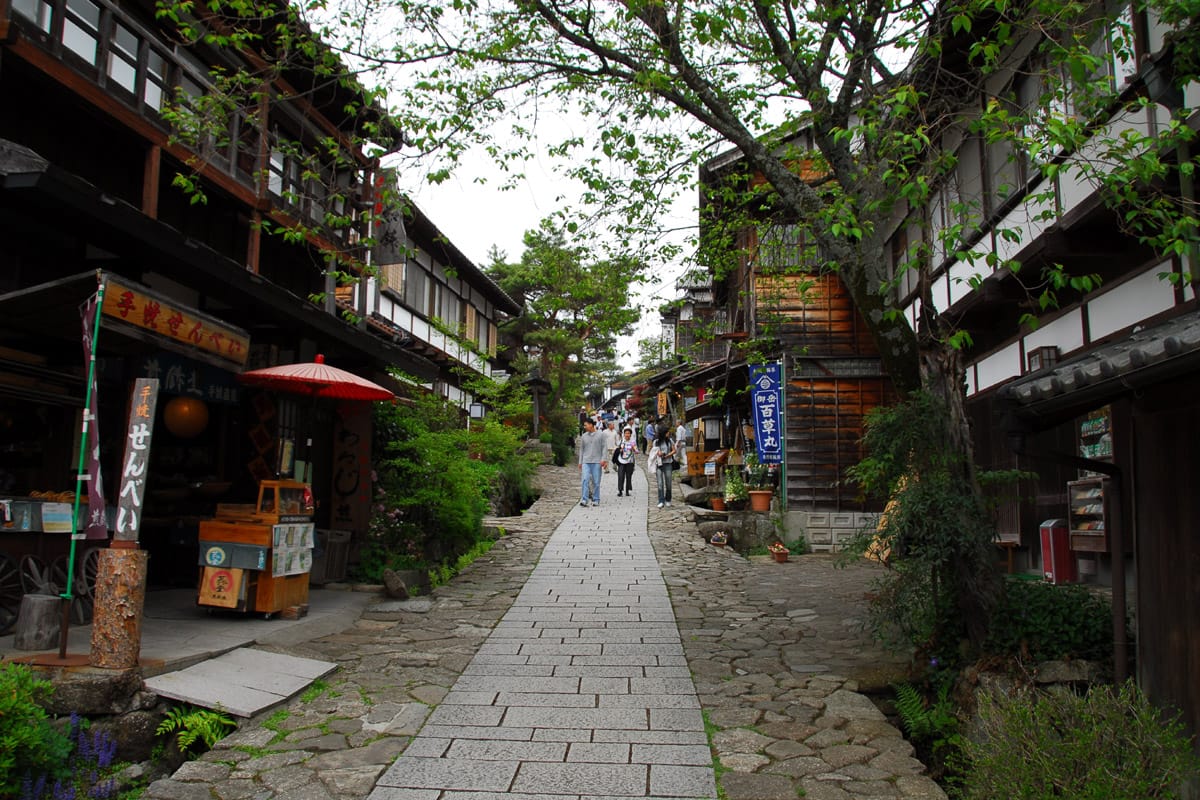
- Magome-juku (馬籠宿): the hillside post town, birthplace of the novelist Shimazaki Tōson, with a museum in his memory.
- Tenbōdai (展望台): the viewpoint at the top of Magome, facing Mount Ena.
- Magome-tōge (馬籠峠): the pass, about 790 metres, where Gifu Prefecture meets Nagano.
- Tateba chaya (立場茶屋): an old roadside rest house on the Tsumago side, a reminder of how travellers once took breaks.
- Odaki and Medaki (男滝・女滝): the male and female waterfalls, a pair of falls just off the trail.
- Ōtsumago (大妻籠): a small hamlet of old inns just before Tsumago.
- Tsumago-juku (妻籠宿): the preserved post town, with the Waki-honjin, a former inn for officials, open as a museum.
Words on the signs along the old road
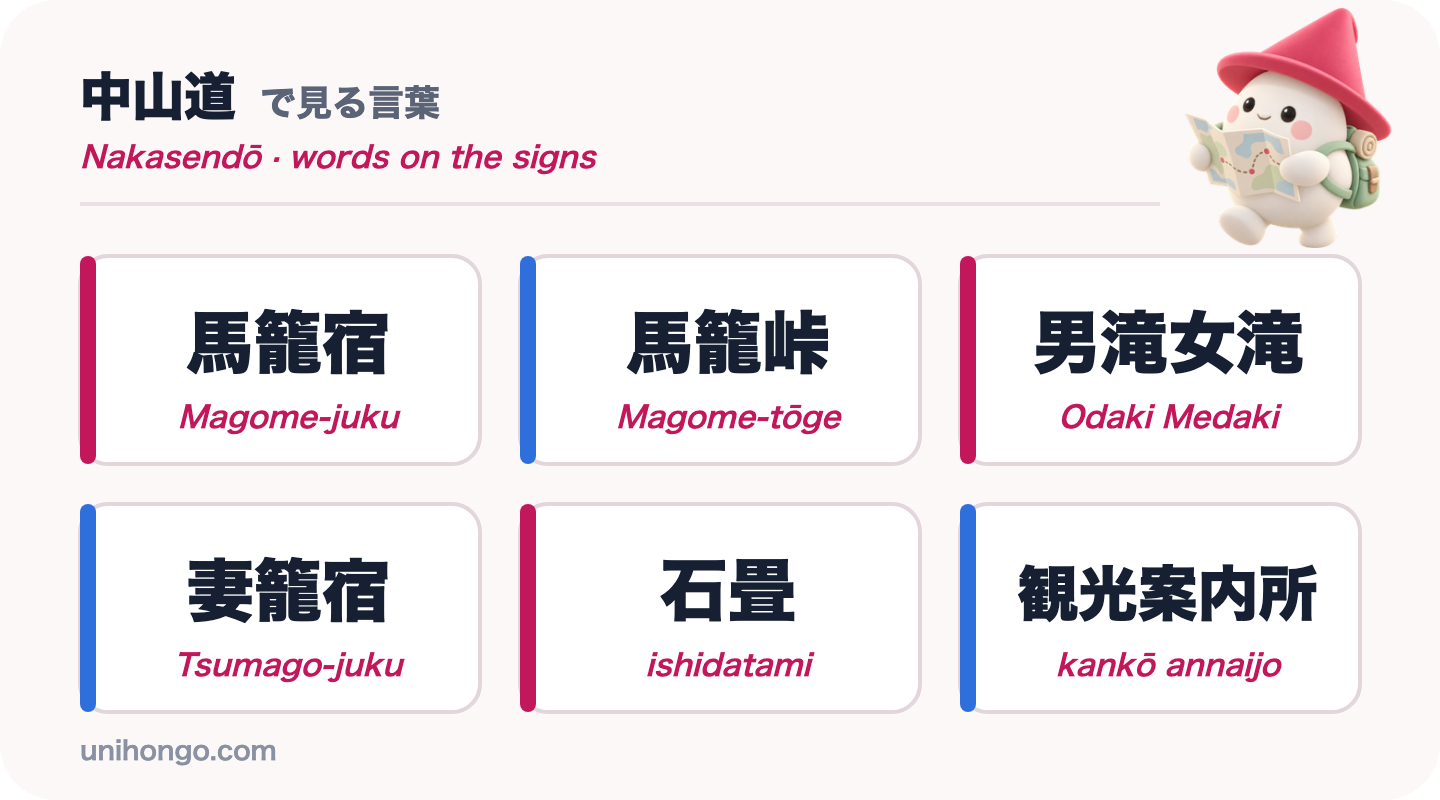
Trail signs on this section are bilingual, but the Japanese is worth reading. Every sign names the next town with 宿, juku, post town, and a distance in km. 峠, tōge, mountain pass, is a kanji made in Japan from 山, mountain, 上, up, and 下, down, which describes a pass perfectly.
石畳, ishidatami, stone paving, marks the old paved sections, which are beautiful and slippery. You will also see signs asking you to ring the bear bells hanging by the path.
| Word | Reading | Meaning |
|---|---|---|
| 中山道 | Nakasendō | The inland Edo-period highway between Edo and Kyoto |
| 馬籠宿 | Magome-juku | Magome post town |
| 馬籠峠 | Magome-tōge | Magome Pass |
| 男滝女滝 | Odaki Medaki | The male and female waterfalls |
| 妻籠宿 | Tsumago-juku | Tsumago post town |
| 石畳 | ishidatami | Stone paving |
| 観光案内所 | kankō annaijo | Tourist information centre |
| 熊よけの鈴 | kuma-yoke no suzu | Bear bell |
Japanese for luggage, bells and the tourist office
The tourist information centres at Magome and Tsumago are the hubs of the walk. They run the luggage service, rent bear bells, have maps and bus times, and at Tsumago you can buy a certificate to say you completed the walk. The luggage service runs from 20 March to 30 November in 2026: drop bags in the morning and collect them in the afternoon at the other end.
Staff are friendly and used to walkers from abroad, but a few polite sentences in Japanese make the exchange quick and pleasant.
| Japanese | Romaji | Meaning |
|---|---|---|
| 荷物は何時までに預ければいいですか。 | Nimotsu wa nanji made ni azukereba ii desu ka. | By what time do I need to drop off my luggage? |
| 熊よけの鈴を借りたいです。 | Kuma-yoke no suzu o karitai desu. | I'd like to borrow a bear bell. |
| 鈴はどこで返せばいいですか。 | Suzu wa doko de kaeseba ii desu ka. | Where should I return the bell? |
| ハイキングの地図はありますか。 | Haikingu no chizu wa arimasu ka. | Do you have a hiking map? |
| 完歩証明書をお願いします。 | Kanpo shōmeisho o onegai shimasu. | A walk completion certificate, please. |
| 五平餅を一本ください。 | Gohei-mochi o ippon kudasai. | One gohei-mochi, please. |
Etiquette, safety and timing on the Nakasendō
The trail passes homes, fields and shrines, and the towns at both ends are small communities. Walking quietly and tidily is the best way to say thank you for being let in.
- Ring the bear bells along the path and carry your own bell; talk or make noise in quiet stretches.
- Wear shoes with grip: the stone paving is slippery after rain, and there have been foot injuries on the descent.
- Take your rubbish with you, and use the toilets in the towns and at the rest stops.
- Do not step into fields or gardens, and ask before photographing people.
- Start by late morning so you arrive before the last buses and before the shops close in the late afternoon.
- Spring and autumn are the most pleasant; summer is humid and winter can bring snow and ice on the pass.
- Stay the night in Tsumago or Magome if you can: the streets are almost empty in the evening and early morning.
Practise the tourist office before you go
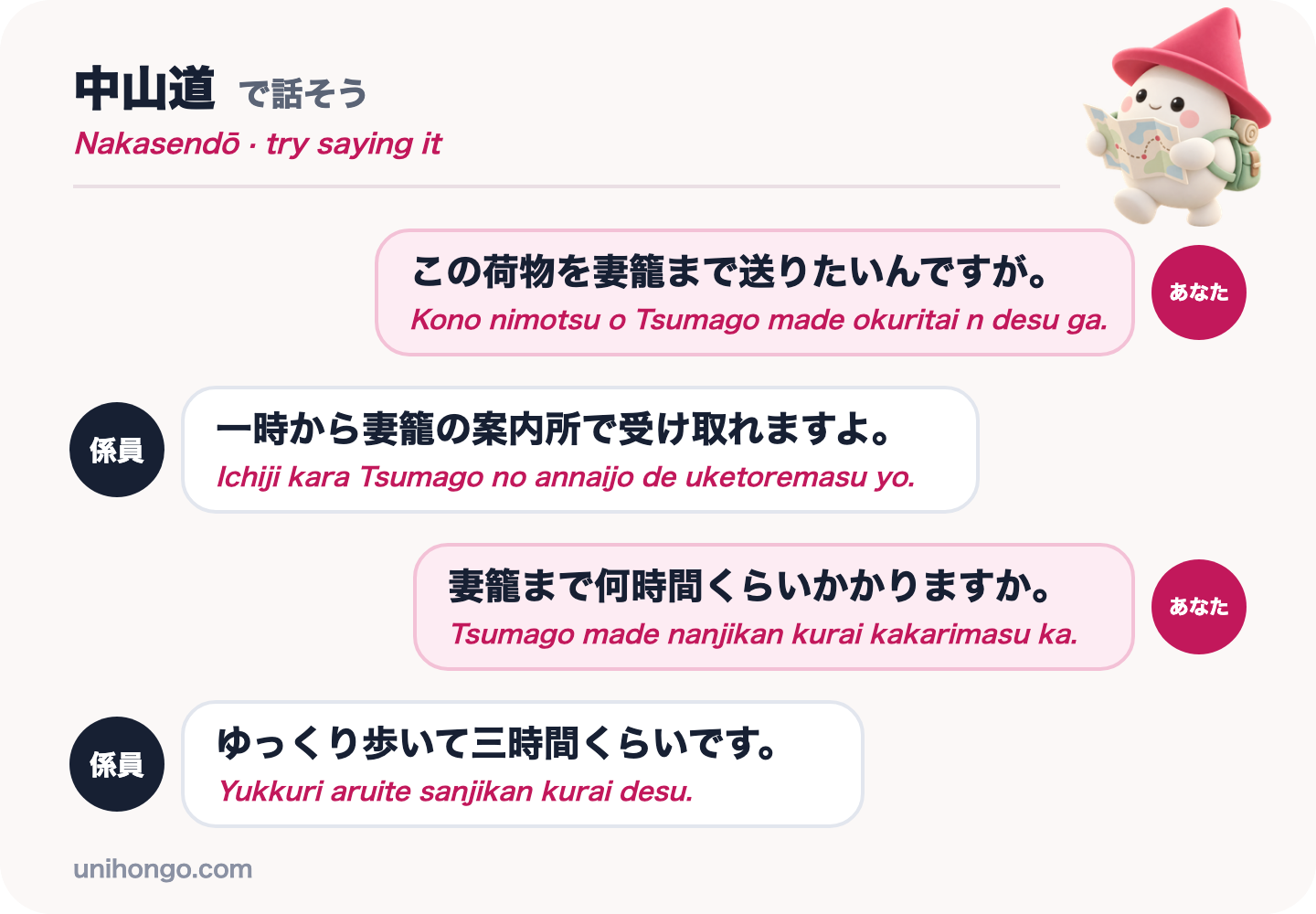
Your first conversation of the day will probably be at the Magome tourist information centre. You send your bag, hear when it can be collected, and ask how long the walk is. The staff answer with times: ichiji kara, from one o'clock, and sanjikan kurai, about three hours.
Practise the four lines until you can say them without reading. Then rehearse with someone who answers back: in Unihongo, choose the Sightseeing topic and ask your AI Sensei to play the tourist office staff, and next time start the walk from Tsumago instead.
| Japanese | Romaji | Meaning |
|---|---|---|
| この荷物を妻籠まで送りたいんですが。 | Kono nimotsu o Tsumago made okuritai n desu ga. | I'd like to send this bag to Tsumago. |
| 一時から妻籠の案内所で受け取れますよ。 | Ichiji kara Tsumago no annaijo de uketoremasu yo. | You can pick it up at the Tsumago information centre from one o'clock. |
| 妻籠まで何時間くらいかかりますか。 | Tsumago made nanjikan kurai kakarimasu ka. | About how many hours does it take to Tsumago? |
| ゆっくり歩いて三時間くらいです。 | Yukkuri aruite sanjikan kurai desu. | About three hours at an easy pace. |
Official information
The luggage service dates and fees, bear bell rental and hiking advice are published by the Tsumago and Nagiso tourist associations. The Kiso tourism office has a clear English overview of the trail.