

Why Karuizawa is Tokyo's favourite mountain escape
At about 1,000 metres, Karuizawa is cooler and drier than the Kantō plain in summer, and that simple fact made its fortune. In 1886 the Scottish-Canadian missionary Alexander Croft Shaw spent a summer here, built a villa two years later and told his friends. Missionaries called it a hospital without a roof, and by the early twentieth century it was filled with Western-style villas, churches and hotels.
The Western influence is still visible: wooden chapels in the woods, bakeries and jam shops on the old main street, tennis courts, and quiet lanes of larch and birch where the summer houses hide. It is also where the future Emperor Akihito met the future Empress Michiko on a tennis court in 1957, a story every Japanese visitor knows.
For a Japanese learner Karuizawa is relaxed and easy. Distances are short, the signs are clear, and the most useful sentences are about bikes, buses and cafés.
Getting there: Karuizawa Station and around town
Karuizawa Station, Karuizawa-eki, is on the Hokuriku Shinkansen between Tokyo and Nagano. Not every train stops here, so check the timetable, but many do, and the ride from Tokyo takes about an hour. The station also serves the Shinano Railway, a local line west towards Naka-Karuizawa and Komoro.
The north exit, kitaguchi, faces Kyū-Karuizawa: walk straight up the main road for twenty to twenty-five minutes, or take a bus or taxi. The south exit, minamiguchi, leads directly into the large Karuizawa Prince Shopping Plaza outlet mall. Local buses to Shiraito Falls, Kyū-Karuizawa and the Hoshino area leave from the north exit, and bicycle rental shops cluster around it.
| Japanese | Romaji | Meaning |
|---|---|---|
| 軽井沢に止まる新幹線は何時ですか。 | Karuizawa ni tomaru shinkansen wa nanji desu ka. | What time is the Shinkansen that stops at Karuizawa? |
| 旧軽井沢へは北口ですか。 | Kyū-Karuizawa e wa kitaguchi desu ka. | Is it the north exit for Kyū-Karuizawa? |
| 白糸の滝行きのバスはどこから出ますか。 | Shiraito no Taki yuki no basu wa doko kara demasu ka. | Where does the bus to Shiraito Falls leave from? |
| このバスは星野エリアに行きますか。 | Kono basu wa Hoshino eria ni ikimasu ka. | Does this bus go to the Hoshino area? |
| 帰りの最終バスは何時ですか。 | Kaeri no saishū basu wa nanji desu ka. | What time is the last bus back? |
Kyū-Karuizawa, chapels, ponds and waterfalls
Most of Karuizawa's sights are spread out through the forest, which is exactly why cycling is so pleasant here. The list below runs roughly from the station outward.
- Kyū-Karuizawa Ginza (旧軽井沢銀座通り): the old main street, about 750 metres of bakeries, jam and craft shops and cafés; very busy in summer.
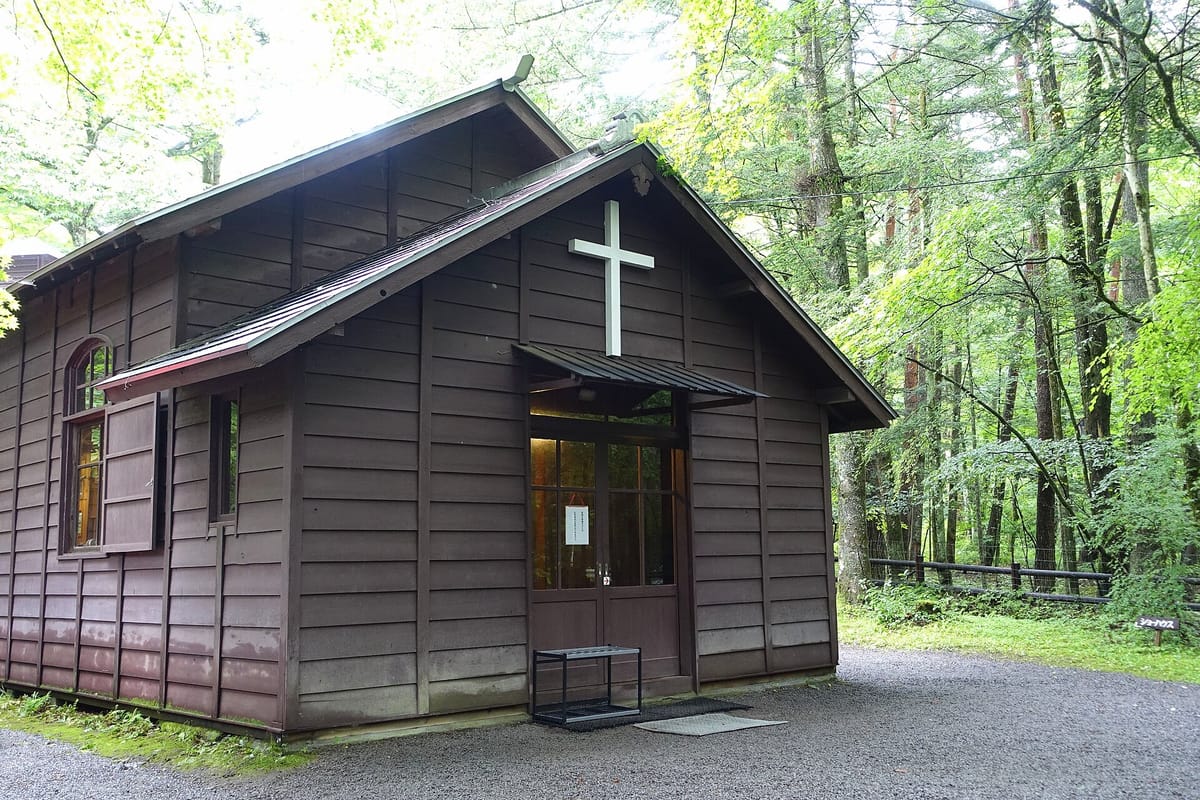
- Shaw Memorial Chapel (ショー記念礼拝堂): the simple wooden church linked to Alexander Croft Shaw, with a bust of him and a reconstruction of his house nearby.
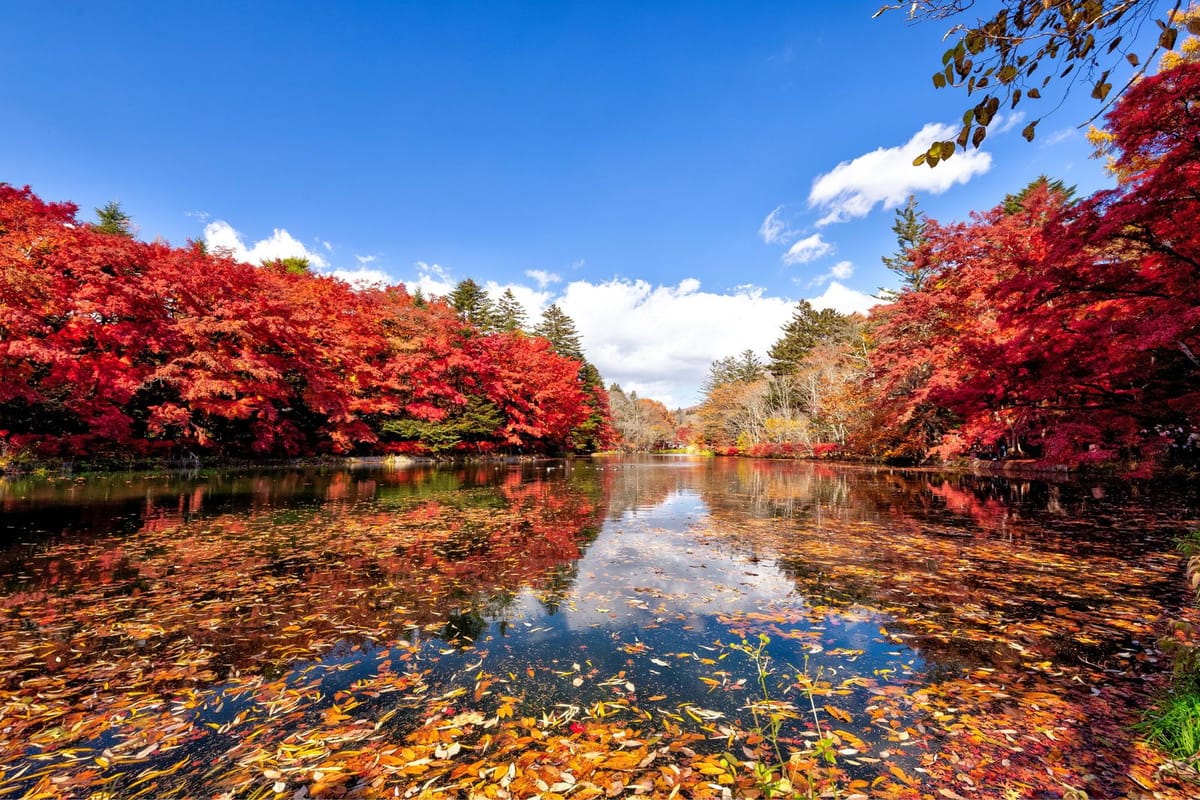
- Kumoba-ike (雲場池): a long, narrow pond with a walking path of about a kilometre round it, famous for its autumn maples; also called Swan Lake.
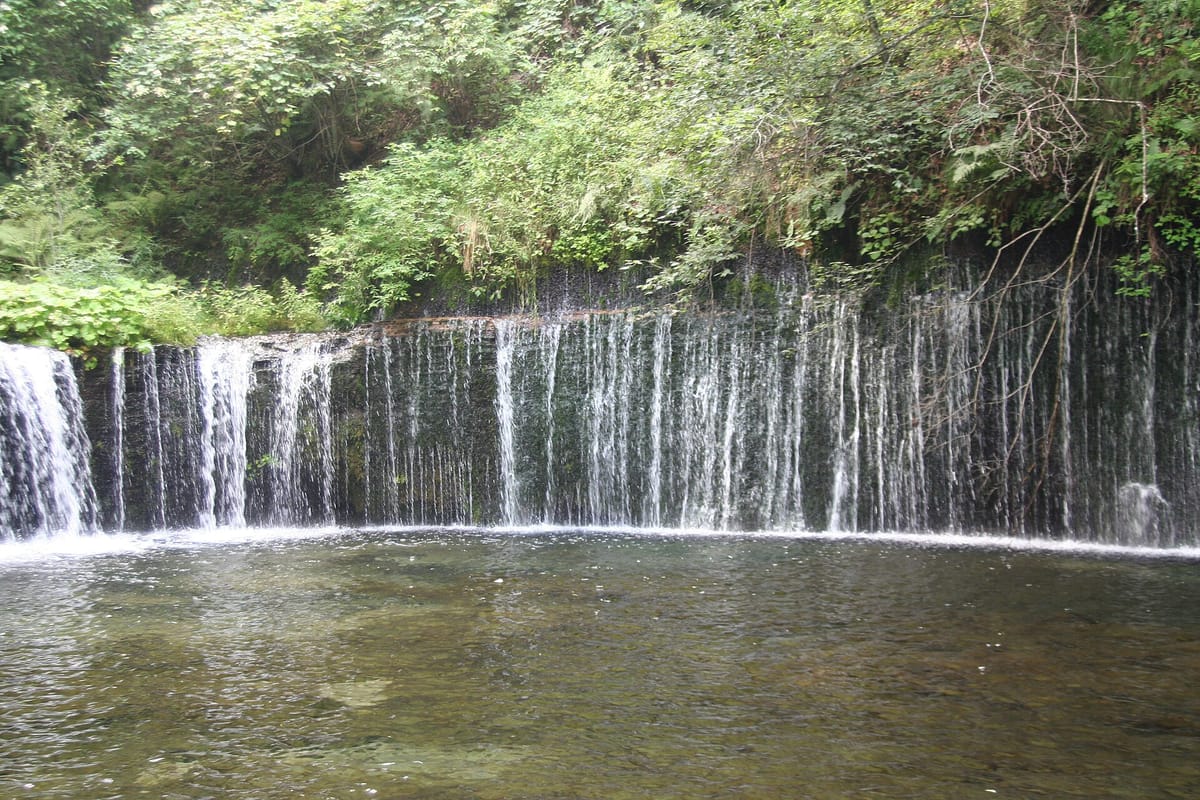
- Shiraito no Taki (白糸の滝): a waterfall only about 3 metres high but 70 metres wide, where hundreds of threads of spring water pour out of a curved rock wall.
- Hoshino area (星野エリア): a resort area near Naka-Karuizawa with the Harunire Terrace shops and cafés by a stream, a hot spring and a stone church.
- Karuizawa Prince Shopping Plaza: a very large outlet mall beside the station's south exit.
- Mount Asama (浅間山): the active volcano that dominates the northern skyline; the summit area is often closed because of volcanic activity.
Words on the signs around town
Road signs in Karuizawa are mostly direction boards with place names, plus notices for cyclists. On narrow shopping streets you will see 歩行者優先, hokōsha yūsen, pedestrians have priority, and sometimes a request to get off and push your bike.
The kanji 滝, taki, waterfall, and 池, ike, pond, appear on many signs. Once you know them you can read the names of most of the natural sights around town.
| Word | Reading | Meaning |
|---|---|---|
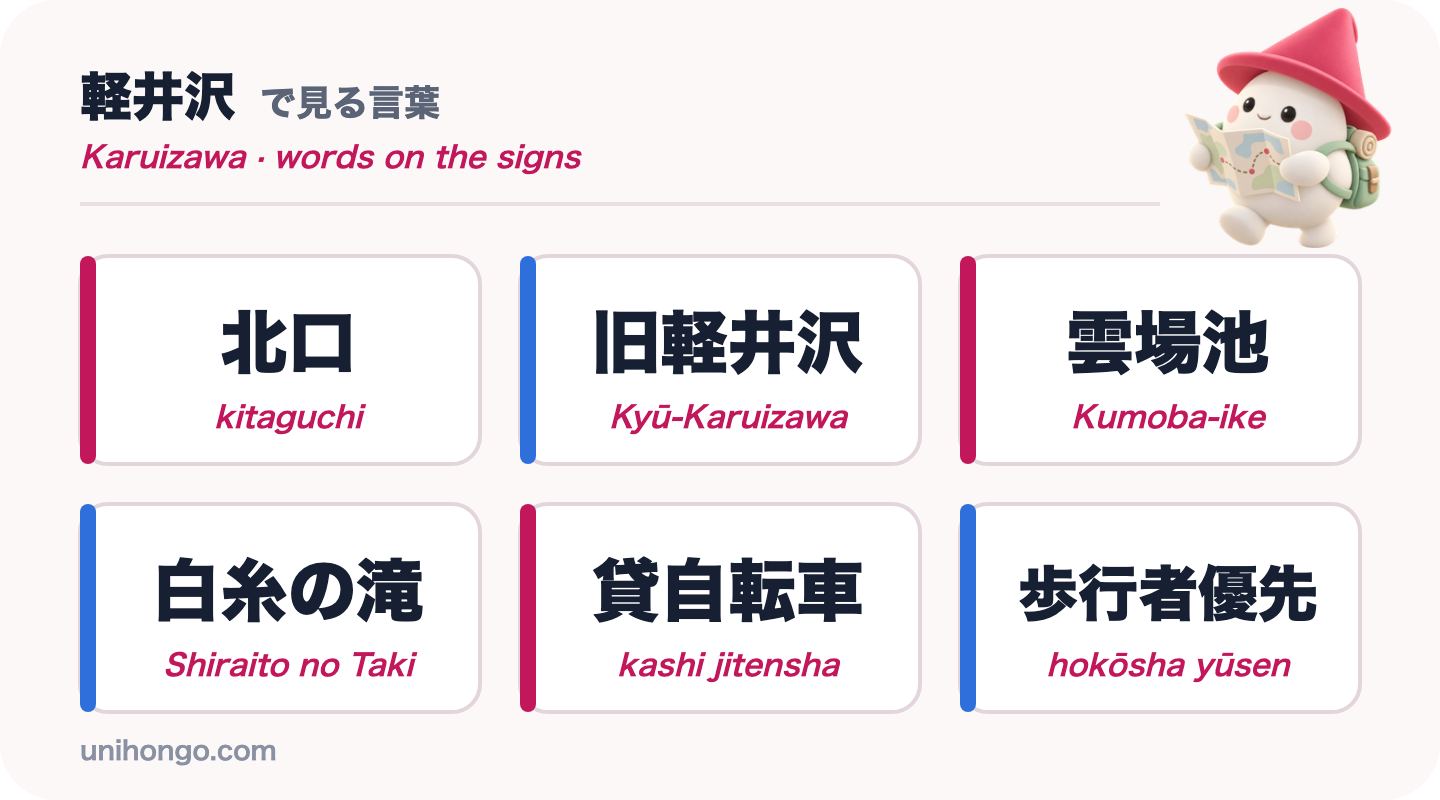
| 北口 | kitaguchi | North exit of the station |
| 旧軽井沢 | Kyū-Karuizawa | Old Karuizawa, the original resort area |
| 雲場池 | Kumoba-ike | Kumoba Pond |
| 白糸の滝 | Shiraito no Taki | Shiraito Falls, the white-thread waterfall |
| 貸自転車 | kashi jitensha | Bicycles for rent |
| 歩行者優先 | hokōsha yūsen | Pedestrians have priority |
| 自転車を降りて | jitensha o orite | Please get off your bike |
| 南口 | minamiguchi | South exit of the station |
Japanese for renting a bike and catching the bus
Karuizawa is flat around the station and Kyū-Karuizawa but climbs gently towards the north and the Hoshino area, so electric-assist bikes, dendō jitensha, are popular. Rental shops ask for your name and sometimes ID, explain the return time and may give you a map.
Local buses are useful for the longer trips to Shiraito Falls and the Hoshino area. Get on, take a numbered ticket if there is a machine by the door, and pay when you get off, matching the number on your ticket to the fare board at the front.
| Japanese | Romaji | Meaning |
|---|---|---|
| 電動自転車はまだありますか。 | Dendō jitensha wa mada arimasu ka. | Do you still have electric bikes? |
| 何時までに返せばいいですか。 | Nanji made ni kaeseba ii desu ka. | By what time do I have to return it? |
| 荷物を預かってもらえますか。 | Nimotsu o azukatte moraemasu ka. | Could you look after my luggage? |
| 地図をもらえますか。 | Chizu o moraemasu ka. | Could I have a map? |
| 白糸の滝まで、いくらですか。 | Shiraito no Taki made, ikura desu ka. | How much is it to Shiraito Falls? |
| ICカードは使えますか。 | IC kādo wa tsukaemasu ka. | Can I use an IC card? |
Etiquette, timing and seasons
Karuizawa is a resort where people come for peace and quiet, and many of the forest lanes are private villa roads. A few habits keep it that way.
- Cycle on the left, slowly, and get off in crowded streets like Kyū-Karuizawa Ginza.
- Keep to public roads and paths; many lanes into the woods lead to private villas.
- The chapels are active churches. Enter quietly, and do not take photos during services or weddings.
- Summer weekends and the Obon holiday bring heavy traffic; trains and bikes beat cars.
- Autumn colours peak from mid-October to early November, and Kumoba Pond is busiest in the morning.
- It can be several degrees cooler than Tokyo and often misty; bring a light jacket even in summer.
Practise the bike rental before you go
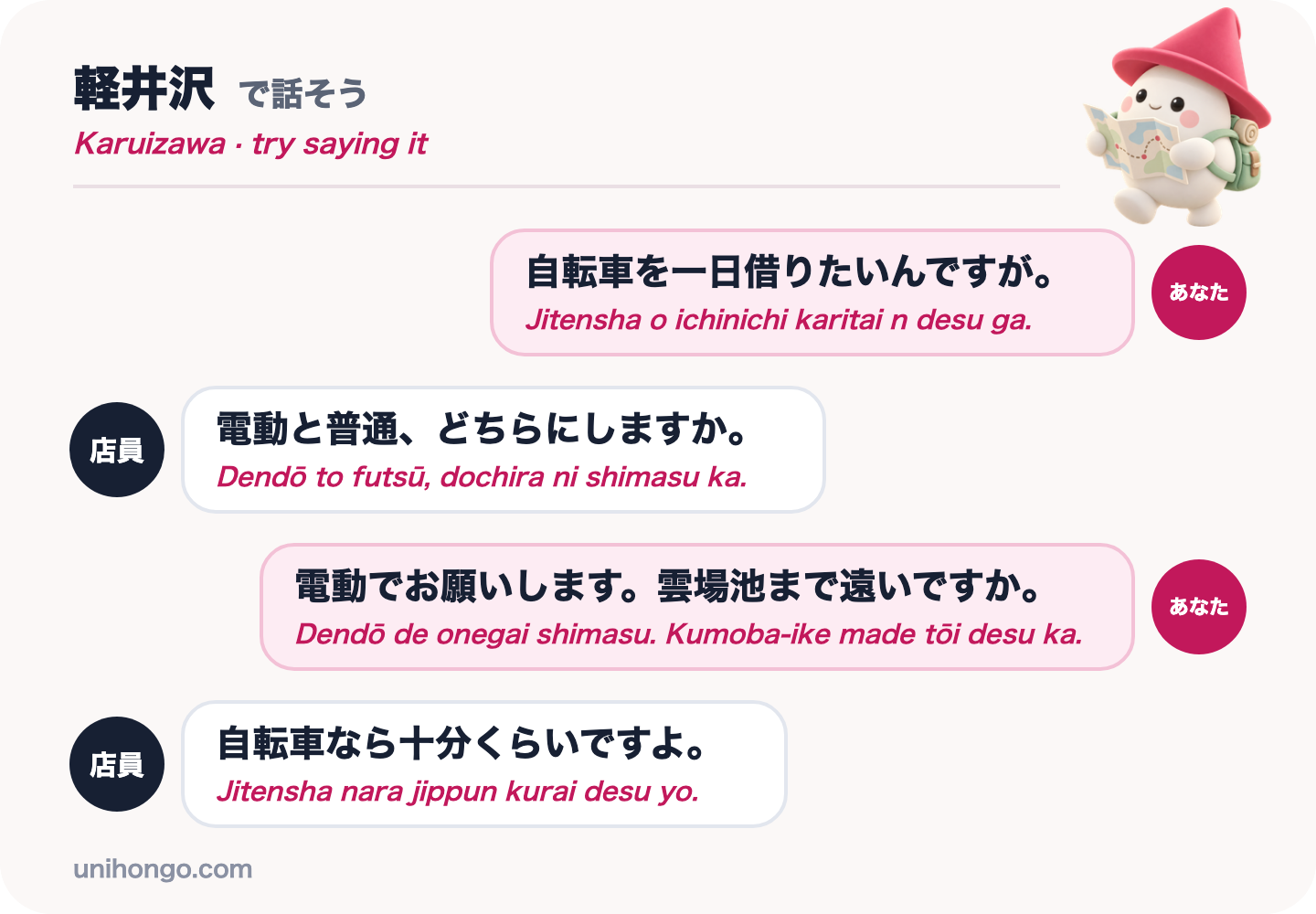
The rental shop is where you will speak the most Japanese in Karuizawa. The staff offer a choice, dendō, electric, or futsū, ordinary, and answer questions about distance in minutes by bike.
Practise the four lines until you can say them without looking. Then rehearse with a partner who answers back: in Unihongo, choose the Shopping topic and ask your AI Sensei to play the rental shop staff, and ask about Shiraito Falls or the Hoshino area in the next round.
| Japanese | Romaji | Meaning |
|---|---|---|
| 自転車を一日借りたいんですが。 | Jitensha o ichinichi karitai n desu ga. | I'd like to rent a bike for the day. |
| 電動と普通、どちらにしますか。 | Dendō to futsū, dochira ni shimasu ka. | Electric or ordinary, which would you like? |
| 電動でお願いします。雲場池まで遠いですか。 | Dendō de onegai shimasu. Kumoba-ike made tōi desu ka. | Electric, please. Is Kumoba Pond far? |
| 自転車なら十分くらいですよ。 | Jitensha nara jippun kurai desu yo. | It's about ten minutes by bike. |
Official information
Bus timetables, seasonal events and opening times for the sights are published by the Karuizawa Tourist Association. Check its site for model routes and the latest bus information before you go.