

Why Kiyomizu-dera is worth the climb
Kiyomizu-dera traces its origins to the late eighth century, before Kyoto became the capital, when a monk found the spring of the Otowa waterfall on this hillside. It is dedicated to Kannon, the bodhisattva of compassion, in her eleven-headed, thousand-armed form, and it is the head temple of the Kita-Hossō school. The temple buildings have burned and been rebuilt many times; most of what you see dates from the 1630s, when the main hall was rebuilt under the third Tokugawa shogun, Iemitsu.
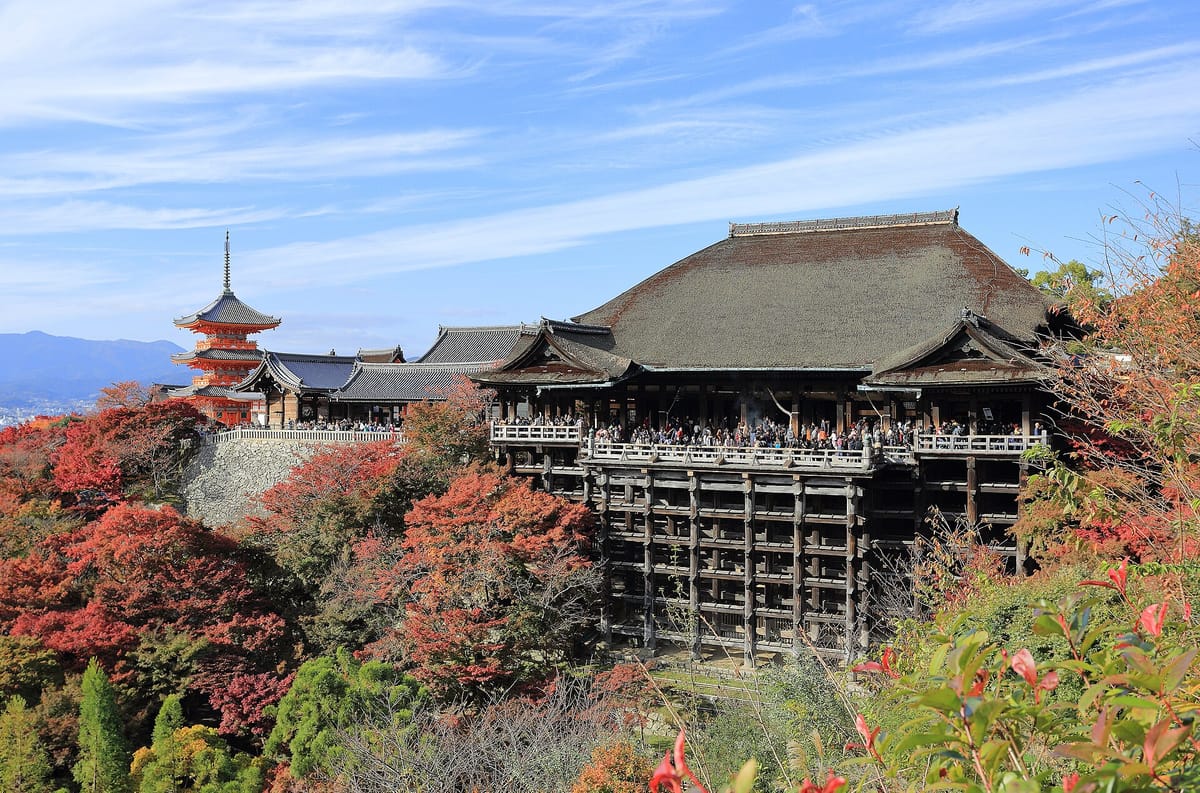
The main hall, the hondō, is a National Treasure. Its front half stands on a steep slope, supported by a grid of tall zelkova pillars joined without nails, a construction called kake-zukuri. The platform in front, the stage, is about thirteen metres above the ground below and was built for offerings of music and dance to Kannon. Its cypress-bark roof was renewed in a restoration completed in 2020.
For a learner, Kiyomizu-dera is a lesson in how temples use language. The signs are short and old-fashioned, the rituals each have a name, and the three streams of the waterfall come with a vocabulary of wishes you will hear all over Japan: study, love and a long life.
Getting there: Gojōzaka bus stop and the slopes up
From Kyoto Station, city bus 206 or 100 takes you to the Gojōzaka stop in around fifteen minutes when traffic allows. From there it is about ten minutes' walk east and uphill. You can climb Gojō-zaka, which becomes Kiyomizu-zaka near the top, or take the quieter Chawan-zaka, teapot lane, lined with pottery shops. The temple's own access page points out that there are only two proper approaches and that map apps sometimes suggest wrong routes, so follow the signs for 清水寺.
By train, Kiyomizu-Gojō Station on the Keihan Main Line is about twenty to twenty-five minutes' walk. The temple has no car park of its own, and buses are crowded in peak seasons, so walking from Gion, about twenty-five minutes past Yasaka Jinja and up Ninenzaka and Sannenzaka, is a pleasant alternative.
| Japanese | Romaji | Meaning |
|---|---|---|
| 五条坂で降りたいんですが。 | Gojōzaka de oritai n desu ga. | I would like to get off at Gojōzaka. |
| 清水寺へはこの坂を上ればいいですか。 | Kiyomizu-dera e wa kono saka o noboreba ii desu ka. | Do I go up this slope for Kiyomizu-dera? |
| 茶わん坂はどちらですか。 | Chawan-zaka wa dochira desu ka. | Which way is Chawan-zaka? |
| 清水寺まであとどのくらいですか。 | Kiyomizu-dera made ato dono kurai desu ka. | How much further to Kiyomizu-dera? |
| 京都駅に戻るバス停はどこですか。 | Kyōto-eki ni modoru basutei wa doko desu ka. | Where is the bus stop back to Kyoto Station? |
From the Niōmon to the waterfall: what you will see
The visit flows in a loop. You climb the steps to the vermilion Niōmon, the gate guarded by two fierce kings, pass the bell tower and the three-storey pagoda, and reach the ticket window. Inside, the main hall leads straight onto the stage. Beside the hall stand the iron staff and iron clogs said to belong to Benkei, the legendary warrior monk; visitors try to lift the staff.
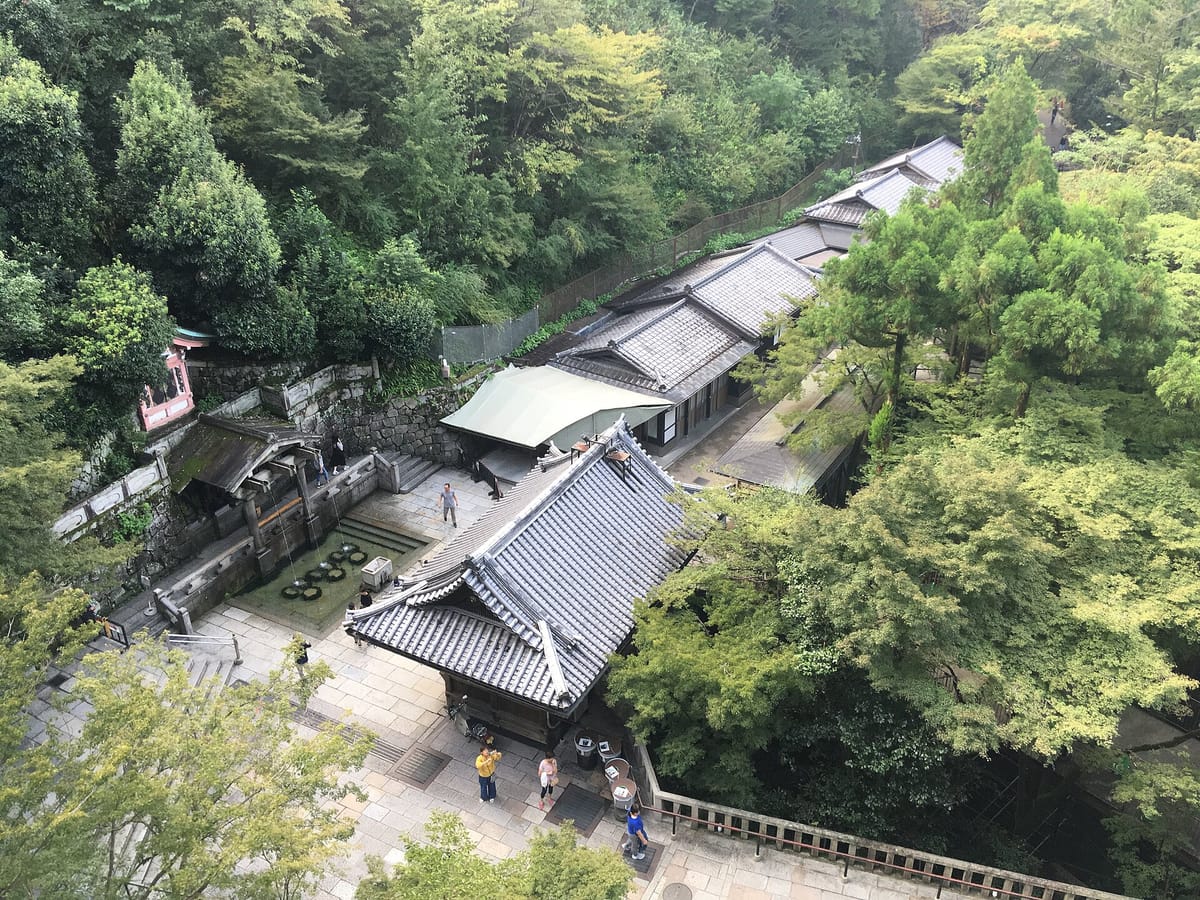
From the stage the path continues to the Okunoin, the inner hall, which has a smaller stage of its own and the classic view back at the main hall on its pillars. The path then drops through the trees to the Otowa waterfall at the bottom of the valley, and back up past the Koyasu pagoda, where people pray for safe childbirth, to the exit.
- Niōmon: the vermilion main gate at the top of the steps.
- Sanjūnotō: the three-storey pagoda, one of the tallest of its kind in Japan.
- Zuigu-dō: the hall where you can do Tainai-meguri, a walk through complete darkness.
- Hondō and the stage: the main hall and its platform over the valley.
- Okunoin: the inner hall with the best view of the stage from the side.
- Otowa no taki: the waterfall, three streams of spring water falling from a roof.
- Koyasu-no-tō: a small pagoda across the valley, reached by a short detour.
Words on the signs at Kiyomizu-dera
The signposts at Kiyomizu-dera mostly give the names of buildings, and many end in the same few kanji: 門 for gate, 塔 for pagoda, 堂 and 院 for halls. Once you spot these endings, you can guess what kind of building you are looking at even when you cannot read the rest.
Tainai-meguri, 胎内めぐり, is worth reading carefully. Tainai means inside the womb, and meguri means going round. You walk into the basement of the Zuigu-dō in total darkness, holding a rope of large beads, until you reach a softly lit stone where you make a wish, and then come out again, as if reborn.
| Word | Reading | Meaning |
|---|---|---|
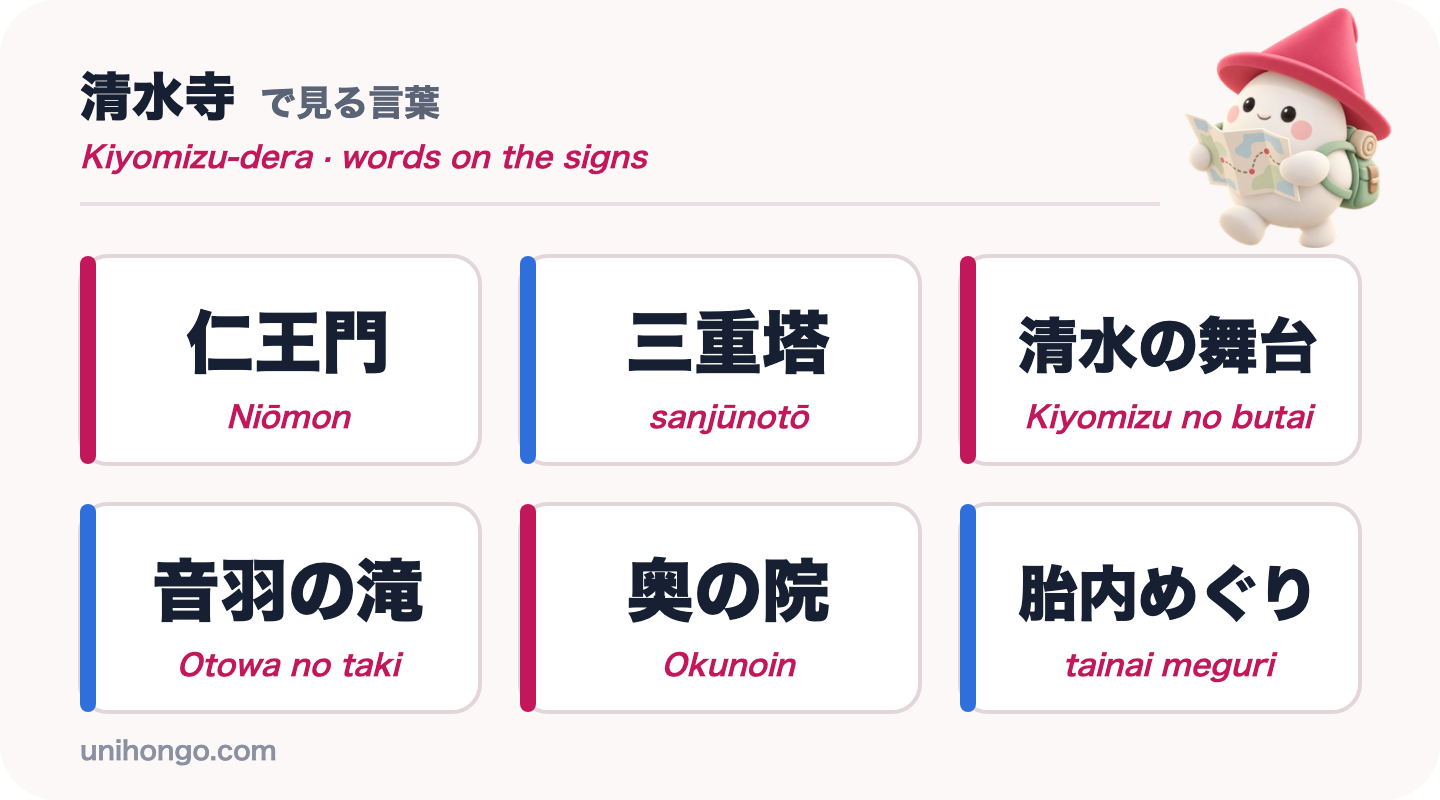
| 仁王門 | Niōmon | Gate of the two guardian kings |
| 三重塔 | sanjūnotō | Three-storey pagoda |
| 本堂 | hondō | Main hall |
| 清水の舞台 | Kiyomizu no butai | The stage of Kiyomizu |
| 奥の院 | Okunoin | Inner hall with a view of the stage |
| 音羽の滝 | Otowa no taki | Otowa waterfall |
| 胎内めぐり | tainai meguri | Walk through the darkness under the Zuigu-dō |
| 御朱印 | goshuin | Handwritten temple stamp and seal |
| 拝観券 | haikanken | Entry ticket for the main hall |
Japanese for the waterfall, the darkness walk and the goshuin
At the Otowa waterfall, visitors queue, take a long-handled cup, a hishaku, and catch water from one of the three streams. The streams are traditionally said to bring success in study, luck in love and a long life. The custom is to choose one: drinking from all three is considered greedy. Cups are placed in a steriliser after use, and a staff member keeps the queue moving.
Tainai-meguri and the goshuin counter are the other two places where a short question helps. At the Zuigu-dō you take off your shoes, pay a small fee and are asked to keep one hand on the beads. Goshuin, the handwritten stamps, are written at a counter inside the grounds, and you may see more than one design on offer.
| Japanese | Romaji | Meaning |
|---|---|---|
| ひしゃくはどう使えばいいですか。 | Hishaku wa dō tsukaeba ii desu ka. | How should I use the ladle? |
| 一つだけ選ぶんですよね。 | Hitotsu dake erabu n desu yo ne. | I choose just one, don't I? |
| 胎内めぐりはどこから入りますか。 | Tainai meguri wa doko kara hairimasu ka. | Where do I go in for Tainai-meguri? |
| ここで靴を脱ぐんですか。 | Koko de kutsu o nugu n desu ka. | Do I take my shoes off here? |
| 御朱印はどこでいただけますか。 | Goshuin wa doko de itadakemasu ka. | Where can I receive a goshuin? |
| この御朱印帳に書いていただけますか。 | Kono goshuinchō ni kaite itadakemasu ka. | Could you write it in this goshuin book? |
| 舞台からの眺めがすばらしいですね。 | Butai kara no nagame ga subarashii desu ne. | The view from the stage is wonderful, isn't it? |
Etiquette, crowds and timing
Kiyomizu-dera is an active temple, a pilgrimage site and one of Kyoto's busiest sights at once, and the paths are narrow and steep in places.
- Come in the first hour after opening, before the tour groups, or on a weekday evening during a special illumination.
- Bow at the Niōmon before you pass through, and walk to the side of the steps.
- On the stage, do not lean far over the railing or sit on it, and keep drones and selfie sticks away; the drop is real.
- At the waterfall, drink from one stream only, and return the cup to the steriliser rack when you finish.
- Wear shoes you can slip off easily for the Zuigu-dō, and keep your bag close in the dark.
- The slopes below are steep and crowded from mid-morning; leave extra time to walk up, and do not stop suddenly in the middle of the lane for photos.
Practise the waterfall before you go
The waterfall is where visitors most often have a question and are standing in a queue with time to ask it. Practise the four lines below until you can say them without reading, and listen for the three key words in the answer: gakugyō, study, ren'ai, love, and chōju, long life.
Then practise with someone who answers back. In Unihongo, choose the Sightseeing topic and ask your AI Sensei to play an attendant at Kiyomizu-dera, or use the Cultural Etiquette topic to rehearse bowing at the gate and taking off your shoes. Speaking the lines once before you go is what makes them easy on the day.
| Japanese | Romaji | Meaning |
|---|---|---|
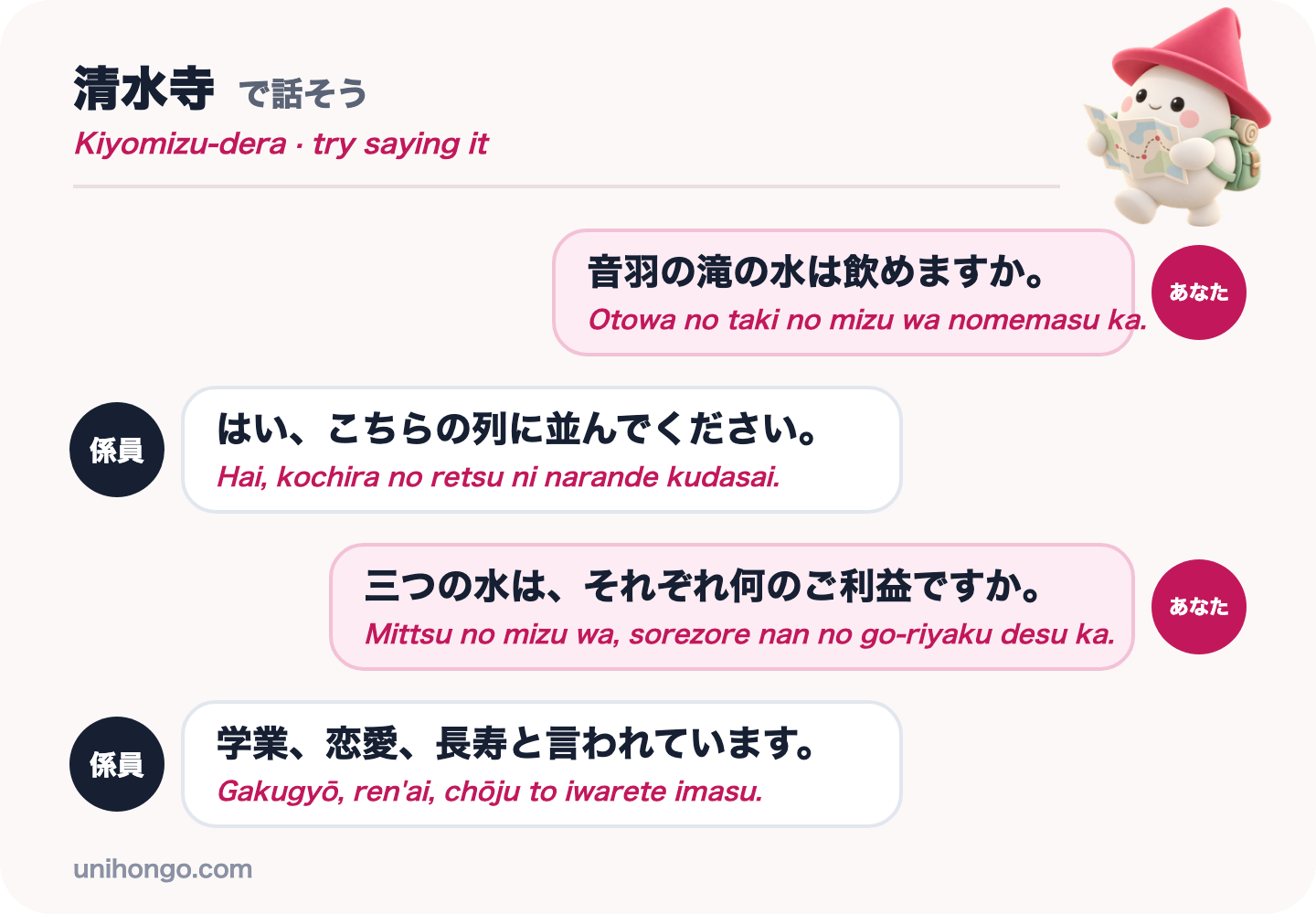
| 音羽の滝の水は飲めますか。 | Otowa no taki no mizu wa nomemasu ka. | Can I drink the water of the Otowa waterfall? |
| はい、こちらの列に並んでください。 | Hai, kochira no retsu ni narande kudasai. | Yes, please join this queue. |
| 三つの水は、それぞれ何のご利益ですか。 | Mittsu no mizu wa, sorezore nan no go-riyaku desu ka. | What blessing is each of the three streams for? |
| 学業、恋愛、長寿と言われています。 | Gakugyō, ren'ai, chōju to iwarete imasu. | They are said to be for study, love and a long life. |
Official information
Kiyomizu-dera publishes its hours, special evening openings, access advice and news on its English website. Jishu Jinja, the shrine behind the main hall, posts its own notices about the closure; check both before you go.