
Four words that get you a bowl
Oden has no set dish. Everything simmers together in one pot and you choose pieces from it, so the Japanese you need is short: the item, the number, and the broth. The items are called gu (具) or tane (種), and the broth is tsuyu (つゆ).
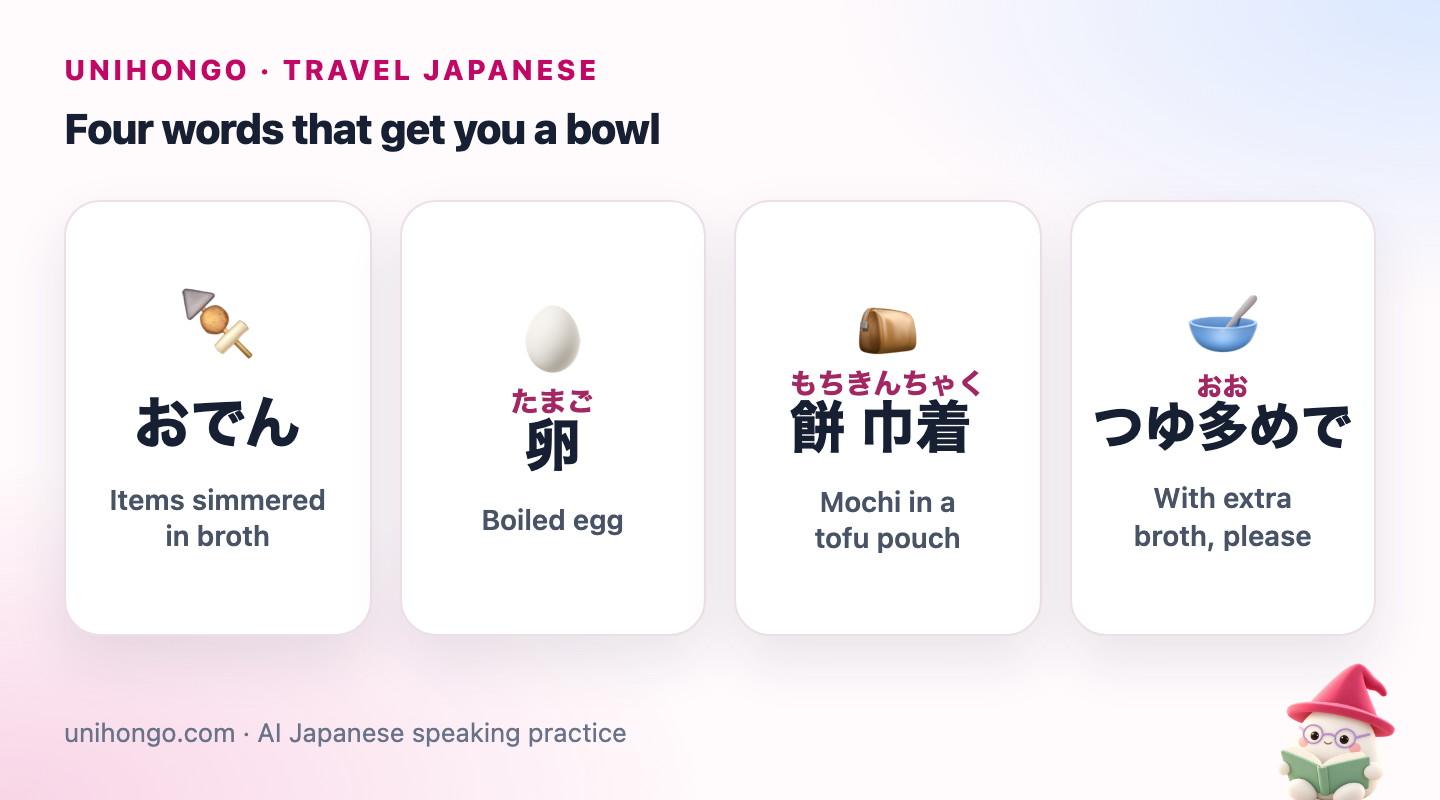
| Japanese | Romaji | Meaning |
|---|---|---|
| おでん | Oden | Items simmered in broth |
| 卵 | Tamago | Boiled egg |
| 餅巾着 | Mochi kinchaku | Mochi in a tofu pouch |
| つゆ多めで | Tsuyu ōme de | With extra broth, please |
| 大根と卵をください。 | Daikon to tamago o kudasai. | Daikon and an egg, please. |
| からし | Karashi | Japanese hot mustard |
On menus the egg is written 卵 or 玉子. Both are read tamago.
The items in the pot
Here are the pieces you will find in almost every pot. Daikon is the favourite for many people because it absorbs the most broth.
| Japanese | Romaji | Meaning |
|---|---|---|
| 大根 | Daikon | Thick slice of white radish |
| こんにゃく | Konnyaku | Firm grey konjac jelly |
| しらたき | Shirataki | Konjac noodles tied in a bundle |
| ちくわ | Chikuwa | Tube-shaped grilled fish cake |
| はんぺん | Hanpen | Soft, fluffy white fish cake |
| 厚揚げ | Atsuage | Thick deep-fried tofu |
| がんもどき | Ganmodoki | Fried tofu patty with vegetables |
| 牛すじ | Gyūsuji | Beef tendon on a skewer |
| 昆布 | Konbu | Knot of kelp |
Fish-paste items as a group are nerimono (練り物). Ganmodoki is often shortened to ganmo. In Tokyo-area pots you may also see chikuwabu (ちくわぶ), which looks like chikuwa but is a chewy tube of wheat dough with no fish in it.
Three places to eat oden
An oden shop is an oden-ya (おでん屋) and a street stall is a yatai (屋台). The words on the menu are the same in all three places; only the way you order changes.
| Place | How you order | Good to know |
|---|---|---|
| Convenience store | Tell the clerk each item and number, or serve yourself where tongs and cups are provided | Sold mainly in the colder months, and not at every shop |
| Oden shop or izakaya | Order a few items at a time from your seat; the cook lifts them from the pot | Items come on a plate with a little broth and mustard |
| Street stall | Sit on the bench and order across the pot | Seats are few, so eat, pay and make room |
Ordering by item: the exchange
Use to (と) to join items and the general counters hitotsu, futatsu, mittsu for numbers. At a shop the cook opens with a short question; at a convenience store you speak first.
| Japanese | Romaji | Meaning |
|---|---|---|
| 何にしましょう。 | Nani ni shimashō. | Staff: What will you have? |
| 大根を二つと、ちくわを一つください。 | Daikon o futatsu to, chikuwa o hitotsu kudasai. | You: Two daikon and one chikuwa, please. |
| おすすめは何ですか。 | Osusume wa nan desu ka. | You: What do you recommend? |
| つゆ多めでお願いします。 | Tsuyu ōme de onegai shimasu. | You: With extra broth, please. |
| からしはお付けしますか。 | Karashi wa otsuke shimasu ka. | Staff: Would you like mustard? |
| はい、お願いします。 | Hai, onegai shimasu. | You: Yes, please. |
| 同じものをもう一つください。 | Onaji mono o mō hitotsu kudasai. | You: One more of the same, please. |
Nani ni shimashō is friendly shop speech, less formal than the set phrases of chain restaurants. Your side stays in ordinary polite Japanese. If you do not know a name, pointing and saying Kore o hitotsu kudasai (これを一つください), one of these please, works perfectly.
Tsuyu and karashi
The broth is dashi seasoned with soy sauce, and it is meant to be drunk. Broadly, eastern Japan favours a darker, stronger broth and western Japan a paler one, though every shop guards its own recipe. Ōme (多め) means a little more than usual; its opposite is sukuname (少なめ).
Karashi (からし) is Japanese mustard and is much hotter than it looks. Put a small dab on the rim of the bowl and touch each bite to it; do not stir it into the broth.
Regional oden worth knowing
Oden changes as you travel. Around Nagoya, miso oden (味噌おでん) is simmered in or dressed with a sweet, dark miso sauce. In Himeji, oden is eaten with shōga jōyu (しょうが醤油), soy sauce with grated ginger. Shizuoka is known for skewered oden in a dark broth, dusted with fish powder and green seaweed flakes. In Kansai you may still hear oden called kantō-daki (関東煮).
These are general tendencies and shops differ, so the best question in any new town is the simple one below.
| Japanese | Romaji | Meaning |
|---|---|---|
| 味噌おでん | Miso oden | Oden with sweet miso sauce |
| しょうが醤油 | Shōga jōyu | Ginger soy sauce |
| この店の名物は何ですか。 | Kono mise no meibutsu wa nan desu ka. | What is this shop's speciality? |
Saying how it tastes
A comment or two keeps the conversation going across the counter, and oden gives you an easy one: shimiru, to soak in. Well-simmered daikon is praised with this verb.
| Japanese | Romaji | Meaning |
|---|---|---|
| 味がしみていますね。 | Aji ga shimite imasu ne. | The flavour has soaked right in. |
| 熱いけど、おいしいです。 | Atsui kedo, oishii desu. | It is hot, but delicious. |
| 体が温まります。 | Karada ga atatamarimasu. | It warms you up. |