
What hōdai means and where you will see it
Hōdai (放題) is a suffix. Put it after the stem of a verb and it means doing that thing as much as you like, with nobody stopping you. Taberu, to eat, gives tabehōdai (食べ放題). Nomu, to drink, gives nomihōdai (飲み放題). The same pattern sells train passes, phone plans and streaming services.
On a restaurant sign the word is nearly always followed by a number of minutes, so the four cards below are the four things to find first.
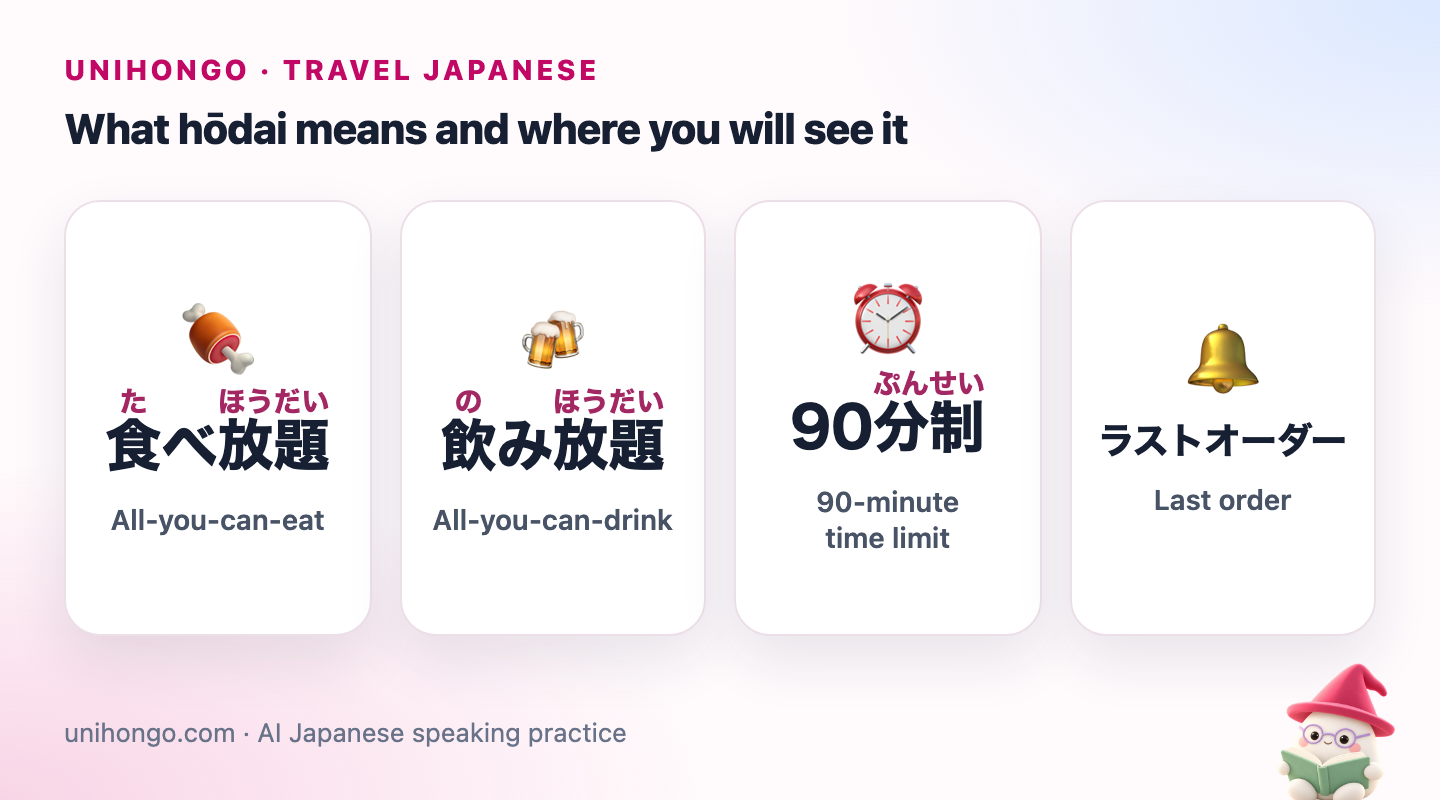
| Japanese | Romaji | Meaning |
|---|---|---|
| 食べ放題 | Tabehōdai | All-you-can-eat |
| 飲み放題 | Nomihōdai | All-you-can-drink |
| 90分制 | Kyūjuppun-sei | 90-minute time limit |
| ラストオーダー | Rasuto ōdā | Last order |
| 乗り放題 | Norihōdai | Unlimited rides |
| 見放題 | Mihōdai | Unlimited viewing |
Outside menus, hōdai can carry a note of complaint: iitai hōdai (言いたい放題) is saying whatever you please, usually about someone behaving selfishly.
The first exchange: choosing the plan
After you sit down, the first decision is the plan, called a kōsu (コース). Many restaurants offer two or three, and each one unlocks more of the menu; pointing at one and saying Kore de onegai shimasu (これでお願いします) is enough. Staff confirm the plan, ask about drinks, then recite the rules quickly. The lines below are in the order you will hear them. The staff lines are very polite restaurant speech; your answers can stay short.
| Japanese | Romaji | Meaning |
|---|---|---|
| 食べ放題でよろしいですか。 | Tabehōdai de yoroshii desu ka. | Staff: Will it be the all-you-can-eat? |
| はい、食べ放題でお願いします。 | Hai, tabehōdai de onegai shimasu. | You: Yes, the all-you-can-eat, please. |
| 飲み放題はお付けしますか。 | Nomihōdai wa otsuke shimasu ka. | Staff: Shall I add all-you-can-drink? |
| はい、付けてください。 | Hai, tsukete kudasai. | You: Yes, please add it. |
| いいえ、飲み物は単品で頼みます。 | Iie, nomimono wa tanpin de tanomimasu. | You: No, we will order drinks one by one. |
| 90分制で、ラストオーダーは終了30分前です。 | Kyūjuppun-sei de, rasuto ōdā wa shūryō sanjuppun mae desu. | Staff: It is a 90-minute plan, and last order is 30 minutes before the end. |
| わかりました。 | Wakarimashita. | You: Understood. |
Tanpin (単品) means a single item ordered on its own, the opposite of a plan. The minutes above are only an example: every restaurant sets its own clock, so listen for the two numbers.
The house rules printed on the menu
The rules sit in small print under the plan names. They look alarming in kanji, but there are only a handful and they repeat from shop to shop.
| Japanese | Romaji | Meaning |
|---|---|---|
| 制限時間 | Seigen jikan | Time limit |
| 全員同じコース | Zen'in onaji kōsu | Same plan for everyone |
| 食べ残し | Tabenokoshi | Leftover food |
| 追加料金 | Tsuika ryōkin | Extra charge |
| お一人様一品ずつ | Ohitori-sama ippin zutsu | One item per person at a time |
| グラス交換制 | Gurasu kōkan-sei | A new drink for an empty glass |
| 延長 | Enchō | Extending the time |
Leftovers are the rule people worry about most: many menus say an extra charge may apply to food left on the table. How strictly that is applied differs by shop, and the easy way to stay safe is to finish each round before ordering the next.
Some places also cap each round, for example one dish per person per order. Staff will tell you if an order goes over the cap.
Ordering rounds: okawari, tsuika and one more of the same
Once the clock starts, you order in rounds, and three words do nearly all the work. Okawari (おかわり) is another serving of what you just had, used for drinks and rice alike. Tsuika (追加) means an addition to the order. Onaji mono (同じもの), the same thing, saves you from reading the menu again.
| Japanese | Romaji | Meaning |
|---|---|---|
| おかわりをお願いします。 | Okawari o onegai shimasu. | Another one of these, please. |
| 同じものをもう一つお願いします。 | Onaji mono o mō hitotsu onegai shimasu. | One more of the same, please. |
| 追加で注文してもいいですか。 | Tsuika de chūmon shite mo ii desu ka. | May we order some more? |
| カルビを二人前追加でお願いします。 | Karubi o ninin-mae tsuika de onegai shimasu. | Two more portions of short rib, please. |
| ウーロン茶を二つください。 | Ūron-cha o futatsu kudasai. | Two oolong teas, please. |
| あと何分ですか。 | Ato nanpun desu ka. | How many minutes are left? |
At many chains you order on a tablet at the table instead of calling staff. The buttons use the same vocabulary: tsuika chūmon (追加注文) for ordering more, chūmon rireki (注文履歴) for what you have ordered so far, and ten'in yobidashi (店員呼び出し) to call a person.
Glass exchange: why your next drink waits
Nomihōdai menus often carry the line gurasu kōkan-sei (グラス交換制). The next drink arrives only in exchange for an empty glass, so you cannot line up three drinks in front of you. The server brings the new drink and takes the old glass in one movement. If yours is not empty yet, they may wait while you finish. Nobody is rushing you; it is just the system, and the smooth way to handle it is to order when you have a mouthful left.
| Japanese | Romaji | Meaning |
|---|---|---|
| グラス交換制となっております。 | Gurasu kōkan-sei to natte orimasu. | Staff: Drinks are served in exchange for your empty glass. |
| 空いたグラスをお下げします。 | Aita gurasu o osage shimasu. | Staff: I will take your empty glass. |
| はい、お願いします。 | Hai, onegai shimasu. | You: Yes, please. |
| すみません、まだ飲んでいます。 | Sumimasen, mada nonde imasu. | You: Sorry, I am still drinking this. |
When staff announce last order
Near the end, a server comes to the table or a message appears on the tablet. This is your final chance to order, usually one last round. The question is often phrased with yoroshii desu ka, which trips learners up: it asks whether you are fine as you are, so a plain hai means no more orders.
| Japanese | Romaji | Meaning |
|---|---|---|
| ラストオーダーのお時間です。 | Rasuto ōdā no ojikan desu. | Staff: It is time for last order. |
| ご注文はよろしいですか。 | Gochūmon wa yoroshii desu ka. | Staff: Are you all right for orders? |
| じゃあ、生ビールを二つお願いします。 | Jā, nama bīru o futatsu onegai shimasu. | You: Then two draft beers, please. |
| もう大丈夫です。ありがとうございます。 | Mō daijōbu desu. Arigatō gozaimasu. | You: We are fine now, thank you. |
| お席のお時間となりました。 | Oseki no ojikan to narimashita. | Staff: Your time at the table is up. |
| お会計をお願いします。 | Okaikei o onegai shimasu. | You: The bill, please. |
If you want to stay longer, ask about enchō before last order, not after: Enchō wa dekimasu ka (延長はできますか), can we extend? On a busy evening the answer may be no, because the table is booked for the next group.
Small manners that keep the table relaxed
- Order what the table can finish, then order again. Speed is not the point.
- Let one person run the tablet so dishes are not ordered twice.
- Watch the clock yourself: staff announce last order, but only once.
- Say gochisōsama deshita (ごちそうさまでした) as you leave.