

Why Shōdoshima is worth the ferry ride
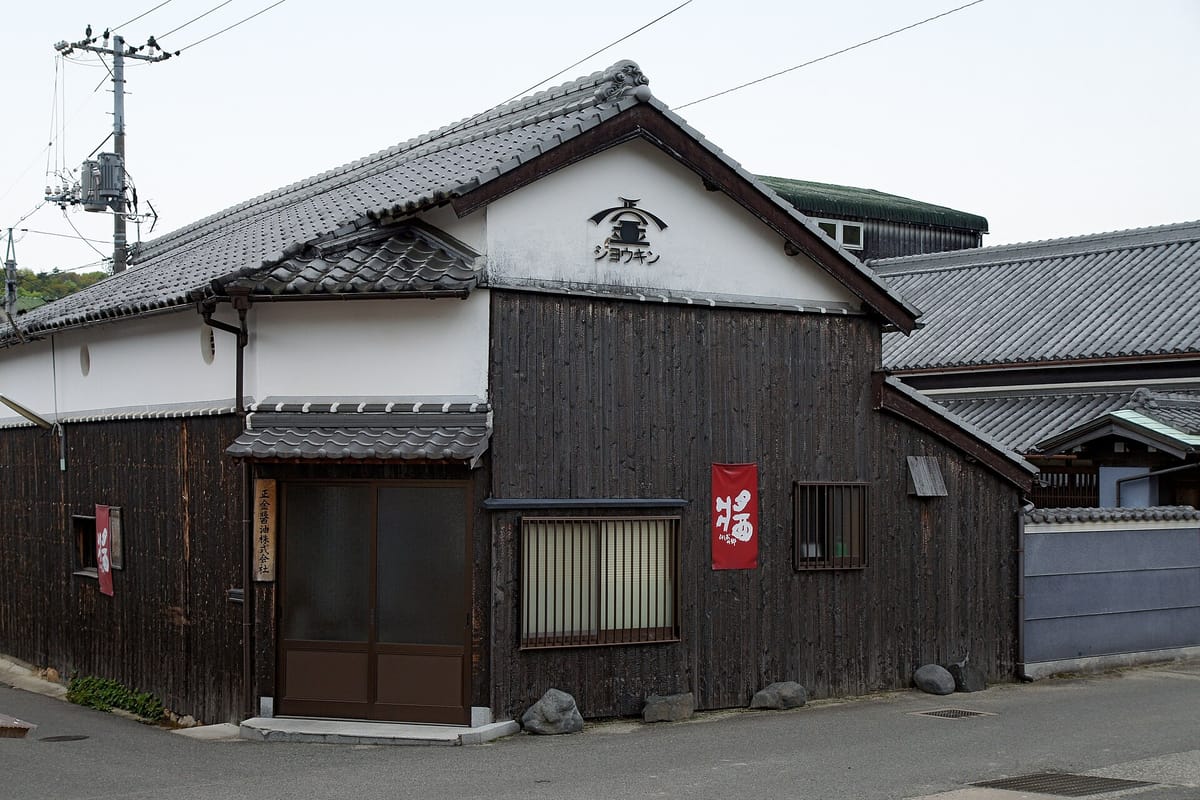
Shōdoshima has always lived from what it could make and ship. In the late sixteenth century its quarries supplied stone for the walls of Osaka Castle, and boats carried the island's salt to the mainland. When the salt trade declined, the islanders, who had learned brewing from the sailors who shipped their salt, turned to soy sauce, and the island is still dotted with old brewing storehouses.
Olives came later. In 1908 the national government tried growing olives in three prefectures to supply oil for canned fish, and only the trial on Shōdoshima succeeded; the first fruit was harvested in 1910. Today olive trees line the roads, olive oil and pickled olives fill the shops, and the island's green hills and white windmills have become its postcard image.
For a learner, the island is a gentle challenge. Signs are mostly in Japanese, buses are run by locals who expect to be asked where to get off, and the shop owners in the soy sauce district are happy to explain how their product is made, slowly, if you ask.
Getting there: ferries from Takamatsu, Okayama and Kobe
Most visitors arrive at Tonoshō Port on the west side of the island. From Takamatsu Port, a short walk from JR Takamatsu Station, ferries take about an hour and high-speed boats about thirty-five minutes. Other ferries from Takamatsu go to Ikeda and to Kusakabe. From Okayama, ferries run from Shin-Okayama Port to Tonoshō in about seventy minutes, and a long-distance ferry links Kobe with Sakate Port in the south-east.
On the island, buses run from the ports to the main sights, and rental cars and scooters are available near the ports. Distances look small on the map, but the roads wind around mountains, so allow time.
| Japanese | Romaji | Meaning |
|---|---|---|
| 土庄港まで、大人一枚お願いします。 | Tonoshō-kō made, otona ichimai onegai shimasu. | One adult to Tonoshō Port, please. |
| 高速艇とフェリー、どちらが早いですか。 | Kōsokutei to ferī, dochira ga hayai desu ka. | Which is faster, the high-speed boat or the ferry? |
| このバスはオリーブ公園に行きますか。 | Kono basu wa Orību Kōen ni ikimasu ka. | Does this bus go to Olive Park? |
| 寒霞渓へはどう行けばいいですか。 | Kankakei e wa dō ikeba ii desu ka. | How do I get to Kankakei? |
| 帰りの最終便は何時ですか。 | Kaeri no saishūbin wa nanji desu ka. | What time is the last boat back? |
Kankakei, olives and soy sauce: what you will see
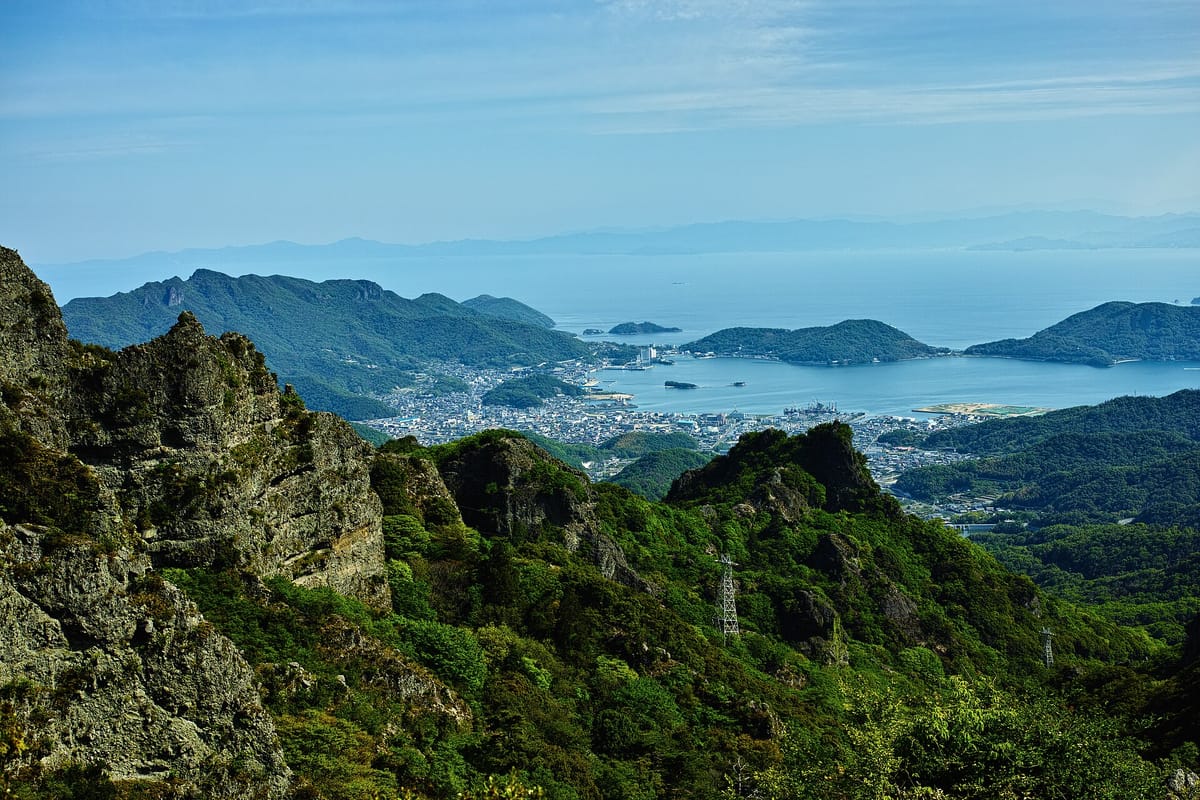
Kankakei, in the mountains at the centre of the island, is counted among Japan's three most beautiful gorges. A ropeway climbs through the rock towers to a summit viewpoint over the sea; the ride is most popular in autumn, when the maples turn red and orange among the grey cliffs.
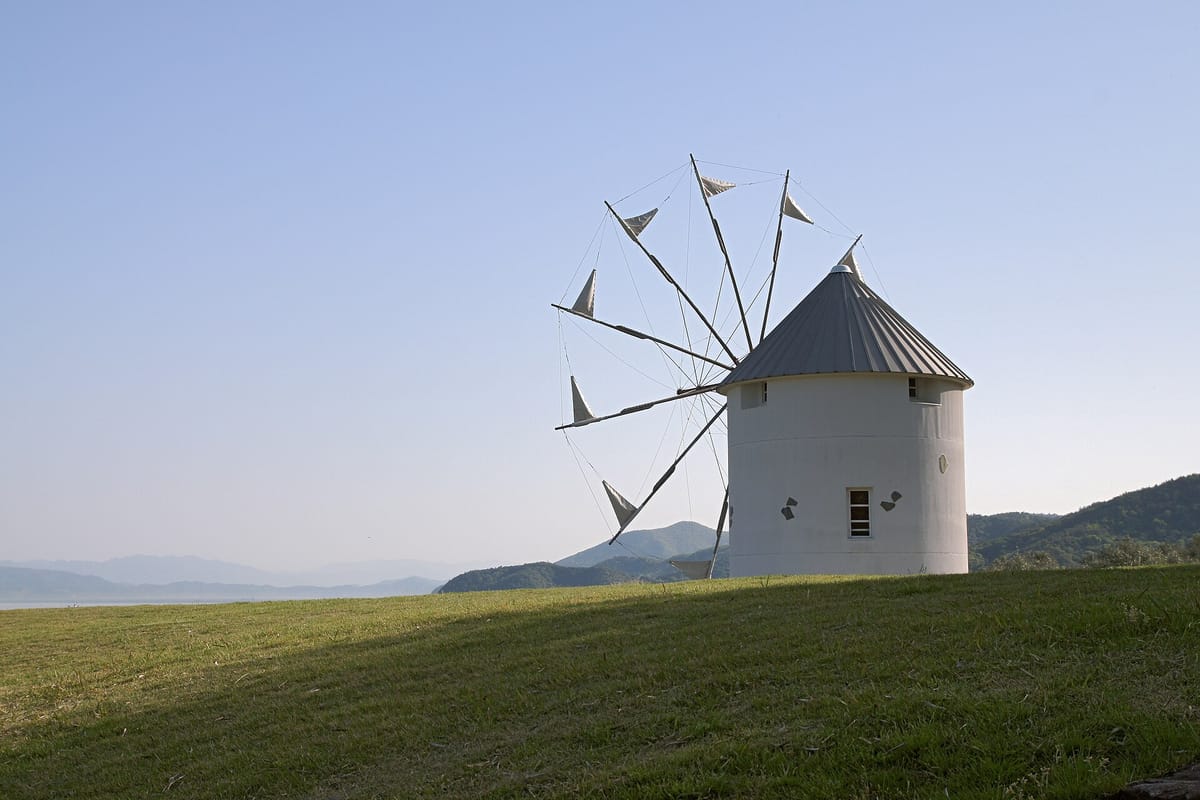
On the south coast, Olive Park is free to enter, with olive groves, a herb garden and a white Greek windmill. The park was used as a setting for the live-action film of Kiki's Delivery Service, and it lends out brooms so visitors can take a flying-witch photo. Further east, the soy sauce district around Umaki and Kusakabe, known as Hishio no Sato, has lanes of black wooden storehouses where you can smell the brewing in the air.
- Kankakei: the rocky gorge and its ropeway, with views over the sea.
- Olive Park: groves, a Greek windmill and a café with olive dishes.
- Hishio no Sato: the soy sauce district, with storehouses, small museums and shops.
- Angel Road: the sandbar near Tonoshō that appears at low tide.
- Nijūshi no Hitomi Eigamura: the film village for Twenty-Four Eyes, a classic novel and film set on the island.
- Sōmen workshops: hand-stretched noodles, dried in long strands, made on the island since 1598.
- Pilgrimage temples: Shōdoshima has its own circuit of eighty-eight sacred sites.
Words on the signs around the island
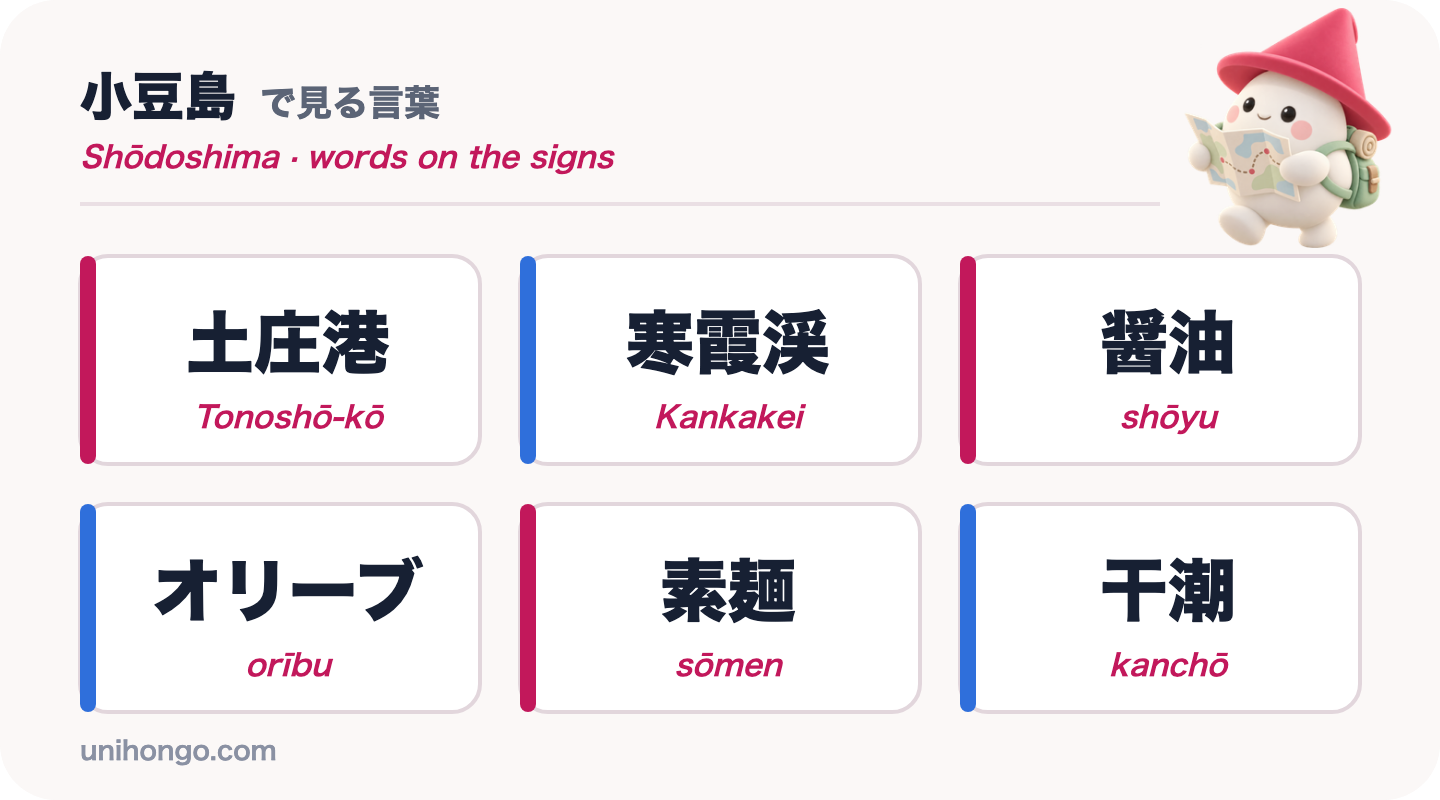
Shops on the island sell three products above all: 醤油, shōyu, soy sauce; オリーブ, orību, olives and olive oil; and 素麺, sōmen, thin wheat noodles, often written in hiragana as そうめん. The storehouses where soy sauce is aged are 蔵, kura, and the wooden barrels inside are 木桶, kioke.
At Angel Road, the key word is 干潮, kanchō, low tide. Its opposite, high tide, is 満潮, manchō. Tide tables, 潮見表, shiomihyō, show both for each day.
| Word | Reading | Meaning |
|---|---|---|
| 小豆島 | Shōdoshima | The island's name |
| 土庄港 | Tonoshō-kō | Tonoshō Port, the main arrival point |
| 寒霞渓 | Kankakei | The mountain gorge with the ropeway |
| 醤油 | shōyu | Soy sauce |
| 木桶 | kioke | Wooden barrel for brewing |
| オリーブ | orību | Olive |
| 素麺 | sōmen | Thin hand-stretched noodles |
| 干潮 | kanchō | Low tide |
| 満潮 | manchō | High tide |
Japanese for the soy sauce storehouses and island shops
Some breweries in Hishio no Sato welcome visitors into their storehouses to see the tall wooden barrels, and many sell soy sauce in small bottles that fit in a suitcase. Look out for soy sauce soft-serve ice cream and for tsukudani, small fish or seaweed simmered in soy sauce, another island speciality.
Olive shops offer tastings of oils and pickled olives, and noodle shops sell dried sōmen in gift boxes. A few polite questions turn a purchase into a conversation.
| Japanese | Romaji | Meaning |
|---|---|---|
| 中を見学してもいいですか。 | Naka o kengaku shite mo ii desu ka. | May I look around inside? |
| この醤油はどのくらい熟成させていますか。 | Kono shōyu wa dono kurai jukusei sasete imasu ka. | How long is this soy sauce aged? |
| 小さいサイズはありますか。 | Chiisai saizu wa arimasu ka. | Do you have a small size? |
| オリーブオイルを試してもいいですか。 | Orību oiru o tameshite mo ii desu ka. | May I try the olive oil? |
| 飛行機に持ち込めますか。 | Hikōki ni mochikomemasu ka. | Can I take it on the plane? |
| しょうゆソフトを一つください。 | Shōyu sofuto o hitotsu kudasai. | One soy sauce soft-serve, please. |
Tides, timing and practical tips
The island is relaxed, but ferries, buses and the tide all run on their own schedules.
- Check the tide table before visiting Angel Road, and do not start across when the water is already rising.
- Note the last ferry back before you set out; high-speed boats can be cancelled in rough weather.
- Plan bus trips with a timetable, or rent a car for more than one day of sightseeing.
- Visit Kankakei early on autumn weekends, when the ropeway and car park are busiest.
- Liquids over the carry-on limit must go in checked luggage; pack soy sauce and oil securely.
- Stay a night to enjoy the quiet evening harbours after the day visitors leave.
Practise asking about the tide before you go
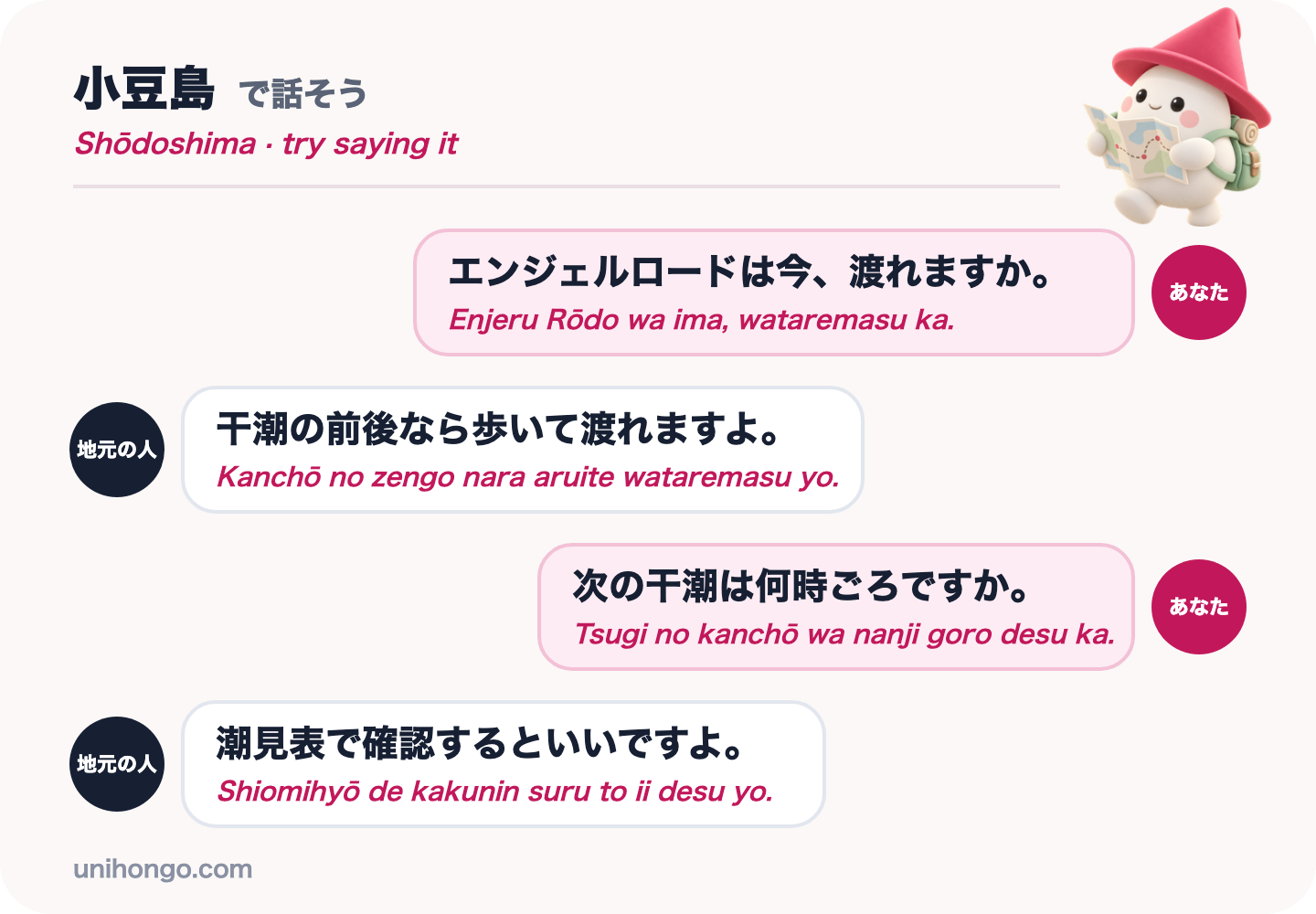
The local's answer, kanchō no zengo nara, if it is around low tide, uses zengo, before and after, a handy word for any time window. The second reply points you to a tide table, shiomihyō. Practise the four lines below until you can say them without reading.
Then practise with a partner. In Unihongo, choose the Sightseeing topic and ask your AI Sensei to play a local at Angel Road, or choose Directions to rehearse the bus to Kankakei. Saying the lines out loud once makes the island's small conversations easy.
| Japanese | Romaji | Meaning |
|---|---|---|
| エンジェルロードは今、渡れますか。 | Enjeru Rōdo wa ima, wataremasu ka. | Can I cross Angel Road now? |
| 干潮の前後なら歩いて渡れますよ。 | Kanchō no zengo nara aruite wataremasu yo. | Around low tide you can walk across. |
| 次の干潮は何時ごろですか。 | Tsugi no kanchō wa nanji goro desu ka. | About what time is the next low tide? |
| 潮見表で確認するといいですよ。 | Shiomihyō de kakunin suru to ii desu yo. | It's best to check a tide table. |
Official information
The Shōdoshima tourism association publishes ferry routes, sights and events in Japanese, and Olive Park and the Kankakei ropeway run their own sites. Check ferry timetables and ropeway operating days before you go.