
The four questions to ask
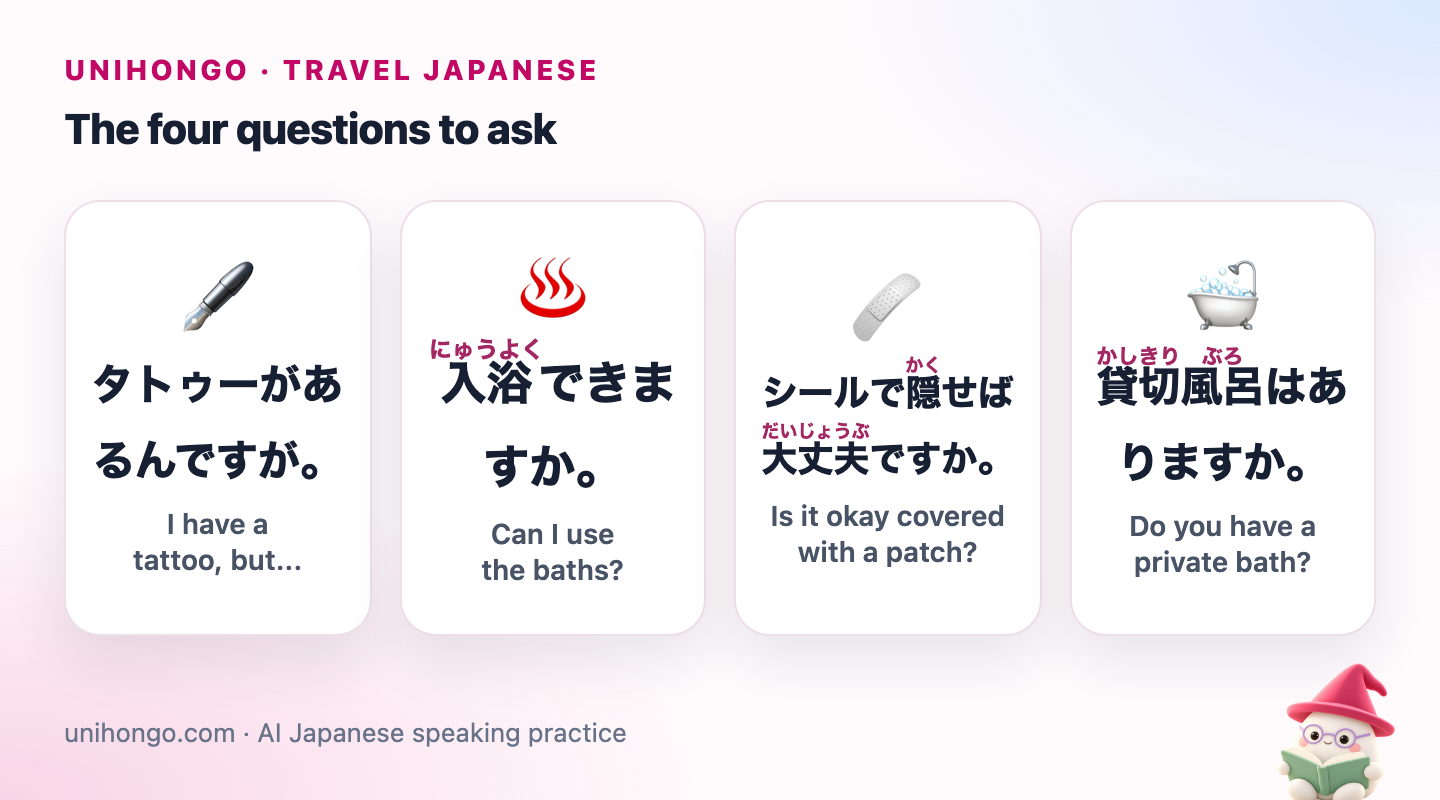
The safest time to ask is before you go: by phone, by email, or when you book. At the front desk, ask before you pay. These four lines cover the whole conversation: telling them you have a tattoo, asking whether you can bathe, asking about a cover sticker, and asking about a private bath.
| Japanese | Romaji | Meaning |
|---|---|---|
| タトゥーがあるんですが。 | Tatū ga aru n desu ga. | I have a tattoo, but... |
| 入浴できますか。 | Nyūyoku dekimasu ka. | Can I use the baths? |
| シールで隠せば大丈夫ですか。 | Shīru de kakuseba daijōbu desu ka. | Is it okay covered with a patch? |
| 貸切風呂はありますか。 | Kashikiri-buro wa arimasu ka. | Do you have a private bath? |
The ga at the end of tatū ga aru n desu ga is important. It leaves the sentence open, which in Japanese politely hands the decision to the other person. Saying only tatū ga arimasu sounds like a flat statement.
Why tattoos are an issue at Japanese baths
In Japan, tattoos have long been associated with organised crime, and many bathing facilities began refusing tattooed guests to keep them out and to reassure other customers. Attitudes are changing, especially with the growth of tourism and the popularity of tattoos among young people, and some local tourism bodies encourage facilities to welcome visitors. But the rule is made by each facility, and many still refuse visible tattoos of any kind, whatever their style or meaning.
This is not about your tattoo being judged. Staff apply a rule they did not invent, often with genuine regret. A polite question and a gracious response are what make a difference.
| Japanese | Reading | Meaning |
|---|---|---|
| 入れ墨・刺青 | irezumi | Tattoo (traditional word) |
| タトゥー | tatū | Tattoo (modern word, often used for fashion tattoos) |
| 入浴 | nyūyoku | Bathing, using the bath |
| 大浴場 | daiyokujō | Large shared bath |
| 貸切風呂 | kashikiri-buro | Private bath you reserve |
| 客室露天風呂 | kyakushitsu roten-buro | Open-air bath attached to your room |
Asking before you book: a phone dialogue
Asking in advance saves an awkward moment at the entrance. Mention where the tattoo is and roughly how big; staff often decide based on size. Te no hira kurai (about the size of a palm) is a handy measure.
| Japanese | Romaji | Meaning |
|---|---|---|
| すみません、タトゥーがあるんですが、大浴場は利用できますか。 | Sumimasen, tatū ga aru n desu ga, daiyokujō wa riyō dekimasu ka. | Guest: Excuse me, I have a tattoo. Can I use the large bath? |
| どのくらいの大きさですか。 | Dono kurai no ōkisa desu ka. | Staff: How big is it? |
| 腕に手のひらくらいの大きさです。 | Ude ni te no hira kurai no ōkisa desu. | Guest: It's on my arm, about the size of a palm. |
| その大きさでしたら、カバーシールで隠していただければ大丈夫です。 | Sono ōkisa deshitara, kabā shīru de kakushite itadakereba daijōbu desu. | Staff: At that size, it's fine if you cover it with a cover patch. |
| シールはそちらで買えますか。 | Shīru wa sochira de kaemasu ka. | Guest: Can I buy the patches from you? |
| はい、フロントで販売しております。 | Hai, furonto de hanbai shite orimasu. | Staff: Yes, we sell them at the front desk. |
Asking by email
Writing is often easier than calling, and a short, polite email lets the facility check its rule and answer clearly. Keep it simple: say when you plan to visit, where your tattoo is and how big it is, and ask whether you can use the baths. Many facilities reply within a day or two. You can also ask your hotel or travel agent to check for you.
| Japanese | Romaji | Meaning |
|---|---|---|
| 初めてご連絡いたします。 | Hajimete go-renraku itashimasu. | I am writing to you for the first time (formal). |
| 来月、そちらに宿泊する予定です。 | Raigetsu, sochira ni shukuhaku suru yotei desu. | I plan to stay with you next month. |
| 腕に小さいタトゥーがあるのですが、大浴場を利用できますでしょうか。 | Ude ni chiisai tatū ga aru no desu ga, daiyokujō o riyō dekimasu deshō ka. | I have a small tattoo on my arm; may I use the large bath? |
| お返事をいただけますと幸いです。 | Ohenji o itadakemasu to saiwai desu. | I would be grateful for a reply. |
| よろしくお願いいたします。 | Yoroshiku onegai itashimasu. | Thank you in advance (formal sign-off). |
Dekimasu deshō ka is softer than dekimasu ka and suits a written request. In speech, dekimasu ka is polite enough.
Answers you may hear
Staff answers tend to be very polite, and a no often comes wrapped in apology. Listen for okotowari shite orimasu (we decline), which means no, and go-riyō itadakemasu (you can use it), which means yes.
| Japanese | Romaji | Meaning |
|---|---|---|
| 申し訳ございませんが、タトゥーのある方のご入浴はお断りしております。 | Mōshiwake gozaimasen ga, tatū no aru kata no go-nyūyoku wa okotowari shite orimasu. | Staff: We're very sorry, but guests with tattoos cannot use the baths. |
| 貸切風呂でしたらご利用いただけます。 | Kashikiri-buro deshitara go-riyō itadakemasu. | Staff: You can use the private bath, though. |
| タトゥーがあっても大丈夫ですよ。 | Tatū ga atte mo daijōbu desu yo. | Staff: It's fine even with a tattoo. |
| シールで隠れない大きさですと、ご遠慮いただいております。 | Shīru de kakurenai ōkisa desu to, go-enryo itadaite orimasu. | Staff: If it's too big to cover with a patch, we ask you to refrain. |
Private baths and other options
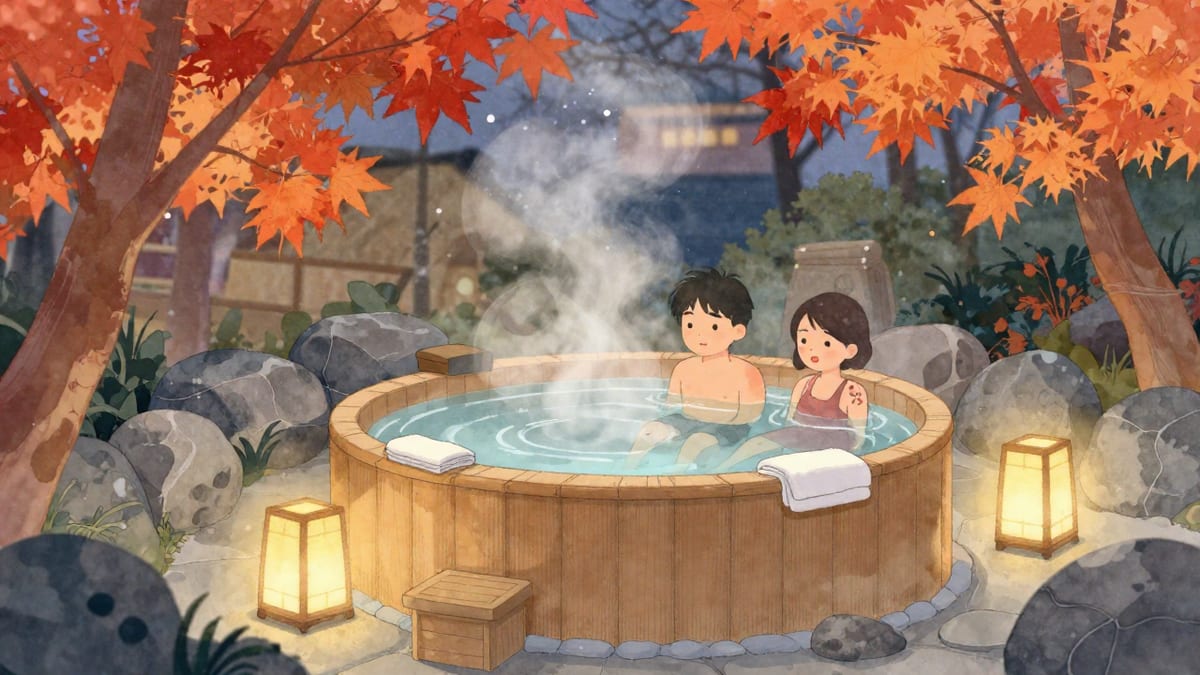
If the shared baths are closed to you, there are still good ways to enjoy hot spring water. Many ryokan have a kashikiri-buro you can reserve for a set time, and some rooms come with their own open-air bath, a kyakushitsu roten-buro. Some day-use onsen and neighbourhood bathhouses are known for being tattoo-friendly, but policies change, so still ask. Whichever option you choose, follow the normal bath manners: wash before entering, keep towels out of the water, and keep your voice low.
| Japanese | Romaji | Meaning |
|---|---|---|
| 貸切風呂を予約したいです。 | Kashikiri-buro o yoyaku shitai desu. | I'd like to reserve the private bath. |
| 何時が空いていますか。 | Nanji ga aite imasu ka. | What times are free? |
| 露天風呂付きの部屋はありますか。 | Roten-buro tsuki no heya wa arimasu ka. | Do you have rooms with their own open-air bath? |
Bath manners wherever you bathe
Whether you are in a large shared bath or a private one, the same manners apply, and staff notice guests who know them.
| Japanese | Romaji | Meaning |
|---|---|---|
| かけ湯をしてから入ってください。 | Kakeyu o shite kara haitte kudasai. | Please rinse yourself before getting in. |
| タオルはお湯に入れないでください。 | Taoru wa oyu ni irenaide kudasai. | Please don't put towels in the water. |
| 気持ちいいですね。 | Kimochi ii desu ne. | This feels wonderful, doesn't it? |
- Wash and rinse your whole body at the washing area before you get into the water.
- Keep your small towel out of the water; many people fold it on their head or leave it at the edge.
- Tie up long hair so it does not touch the water.
- No swimming, splashing or loud conversation.
- Dry off a little before you go back to the changing room so the floor stays dry.
Accepting a no, and common mistakes
If the answer is no, thank the staff warmly and leave it there. Arguing, asking for an exception or explaining the meaning of your tattoo puts the person at the desk in a difficult position, because the rule is not theirs to change.
| Japanese | Romaji | Meaning |
|---|---|---|
| わかりました。ご丁寧にありがとうございます。 | Wakarimashita. Go-teinei ni arigatō gozaimasu. | I understand. Thank you for explaining so kindly. |
| では、またの機会にします。 | Dewa, mata no kikai ni shimasu. | Then I'll come another time. |
| 近くにタトゥーが大丈夫な温泉はありますか。 | Chikaku ni tatū ga daijōbu na onsen wa arimasu ka. | Is there a tattoo-friendly onsen nearby? |
- Assuming a small tattoo does not count. Many facilities refuse any visible tattoo, whatever the size.
- Hiding a tattoo where tattoos are refused. Covering it to get round the rule is dishonest and unfair to staff.
- Asking only after you have paid and undressed. Ask before you book or at least before you pay.
- Saying tatū ga arimasu, ii desu ka abruptly. Tatū ga aru n desu ga, nyūyoku dekimasu ka is softer and more natural.
- Arguing with staff. The rule is the facility's; politeness keeps the door open for the next visitor.