

Why Ōhara is worth the hour on the bus
For more than a thousand years Ōhara has been a retreat: for monks from Mount Hiei next door, for nobles who withdrew from court life, and today for visitors who want a slower Kyoto. The valley is known as the home of shōmyō, the chanted sutra singing of Tendai Buddhism, and the temples here still feel like places of practice rather than attractions.
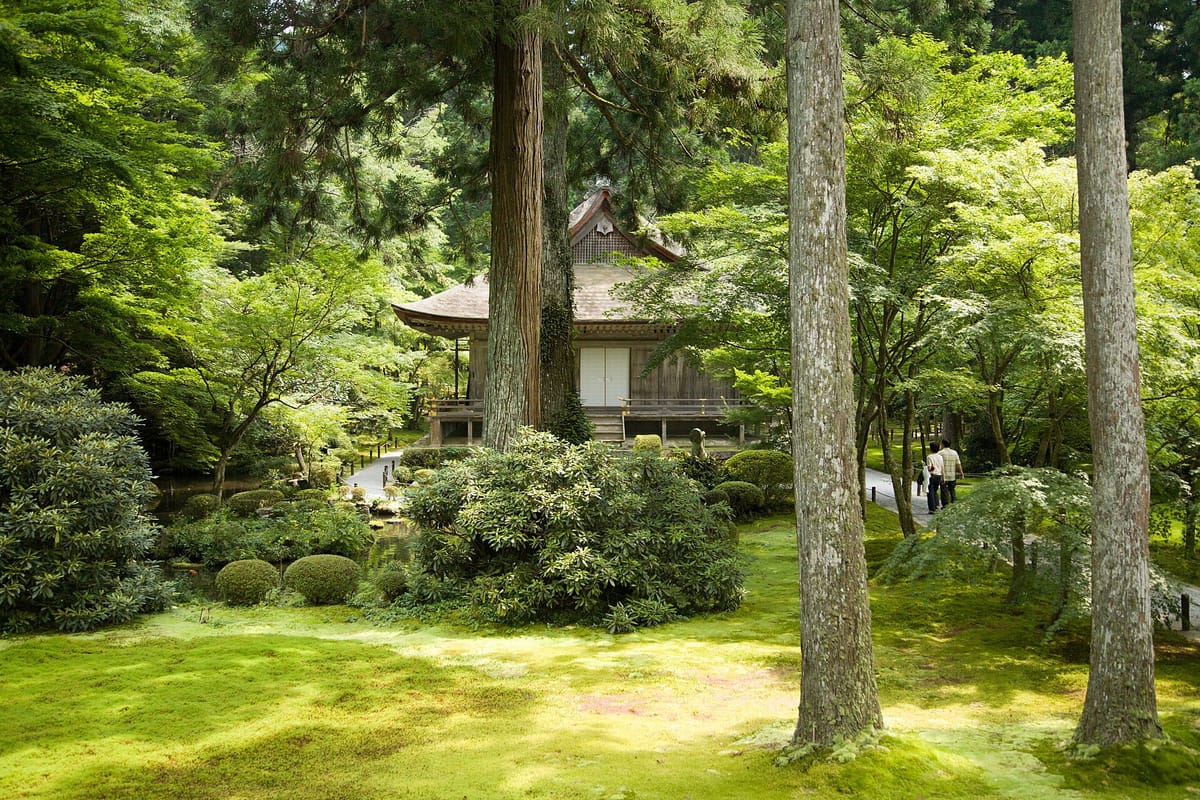
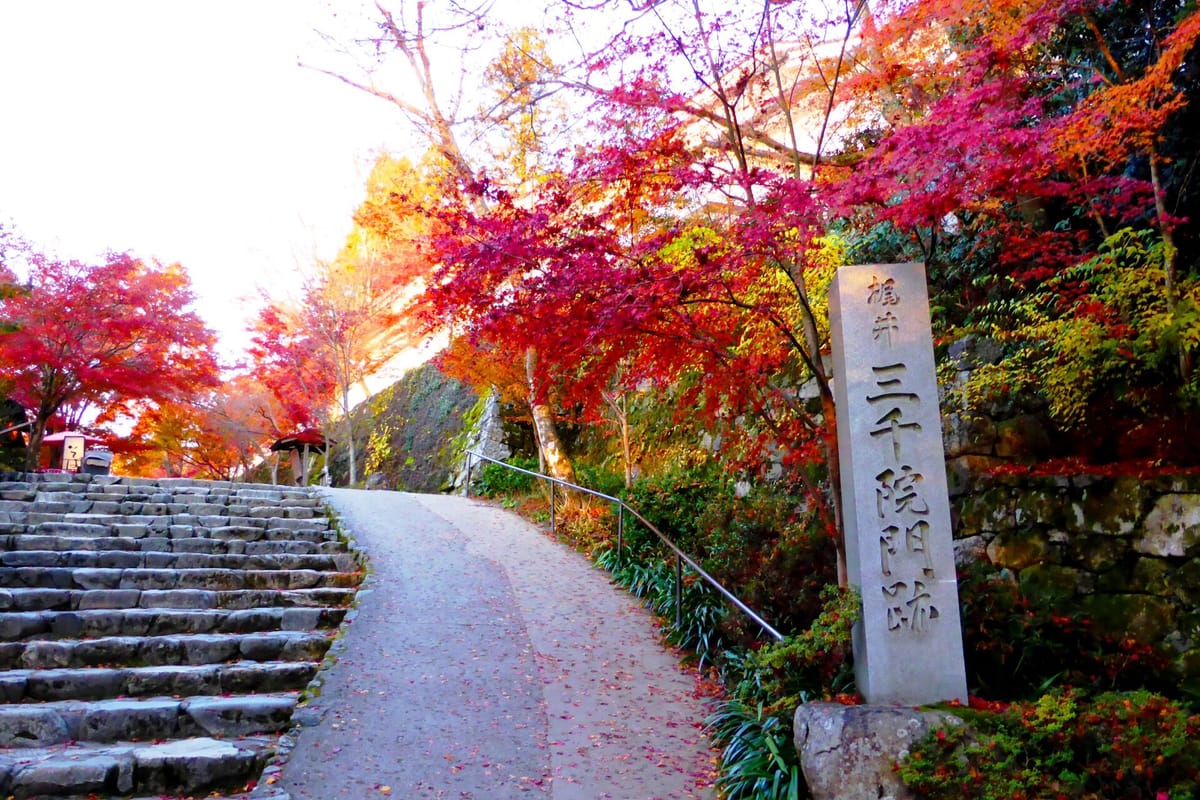
Sanzen-in is the reason most people come. It began as a hermitage founded by Saichō, the monk who established the Tendai school on Mount Hiei, and later became a monzeki, a temple whose head priests were imperial princes. After moving several times, it settled in Ōhara after the Meiji Restoration and took the name Sanzen-in in 1871. Inside the gate you walk through a series of connected halls and gardens, from a formal garden seen through open sliding doors to a forest garden of moss and cedar with a small hall at its heart.
For a Japanese learner, Ōhara is a gentle day. The shopkeepers on the lane are used to visitors tasting and asking questions, the temple signs are few and clear, and the pace of the village gives you time to read them.
Getting there: Kyoto Bus to Ōhara
There is no train to Ōhara. From Kyoto Station, Kyoto Bus route 17 leaves from stop C3 in front of the station and takes about an hour to the Ōhara stop, running through Shijō-Kawaramachi on the way. From the north of the city, it is quicker to take the Karasuma subway line to its terminus, Kokusaikaikan, and change to Kyoto Bus route 19, which reaches Ōhara in about twenty minutes. Buses run roughly every half hour; check the return times when you arrive.
From the Ōhara bus stop, cross the road and follow the signs uphill along a small stream. The lane to Sanzen-in, lined with pickle shops, tea houses and souvenir stalls, takes about ten minutes. Jakkō-in lies on the other side of the valley, about fifteen to twenty minutes' walk from the bus stop through fields and houses.
| Japanese | Romaji | Meaning |
|---|---|---|
| 大原行きのバスはどこから出ますか。 | Ōhara-yuki no basu wa doko kara demasu ka. | Where does the bus for Ōhara leave from? |
| このバスは大原まで行きますか。 | Kono basu wa Ōhara made ikimasu ka. | Does this bus go to Ōhara? |
| 三千院へはどう行けばいいですか。 | Sanzen-in e wa dō ikeba ii desu ka. | How do I get to Sanzen-in? |
| 寂光院はどちらの方向ですか。 | Jakkō-in wa dochira no hōkō desu ka. | Which direction is Jakkō-in? |
| 京都駅行きの最終バスは何時ですか。 | Kyōto-eki-yuki no saishū basu wa nanji desu ka. | What time is the last bus to Kyoto Station? |
Inside Sanzen-in and along the valley
You enter Sanzen-in through the Gotenmon, the palace-style gate that reflects its imperial past, and take off your shoes in the Kyakuden, the guest hall. Its rooms open onto the Shūheki-en, a pond garden best seen sitting on the veranda. The route continues into the Shinden, from where you look out over the Yūsei-en, the moss garden, to the Ōjō Gokuraku-in, the oldest hall on the grounds. Inside sits an Amida Buddha with two attendants, and the ceiling above them is shaped like the bottom of an upturned boat.
Down in the moss garden, walk slowly and look low: small stone warabe jizō, childlike jizō figures, sit, lie and smile among the moss. Paths lead on up to the Kannon-dō and the golden Fudō hall and past the hydrangea garden, which flowers in June and July. Outside Sanzen-in, the lane continues to smaller temples and into the forest.
- Shūheki-en: the pond garden in front of the Kyakuden, seen from the veranda.
- Yūsei-en: the moss and cedar garden, with the Ōjō Gokuraku-in at its centre.
- Warabe jizō: small, smiling stone statues in the moss.
- Hōsen-in: a small temple a few minutes on, where the entry includes matcha and a sweet, looking out on a pine centuries old.
- Jikkō-in: a quieter temple opposite Sanzen-in with a pond garden seen from the tatami rooms.
- Otonashi no taki: the soundless waterfall, about ten minutes' walk beyond Sanzen-in.
- Jakkō-in: across the valley, the nunnery where the empress Kenreimon-in spent her last years in the Tale of the Heike; its main hall burned in 2000 and has been rebuilt.
Words on the signs in Ōhara
Temple names in Ōhara tend to end in 院, in, a word for a temple building or sub-temple, and garden names end in 園, en. That is enough to tell buildings from gardens on the map at the entrance. On the lane, the words are about food: 漬物, tsukemono, pickles, and 試食, shishoku, tasting, which you will see on small signs next to dishes of samples.
The table adds a few more words you will meet on the way, including the mark for the temple stamp that Sanzen-in gives in several different designs.
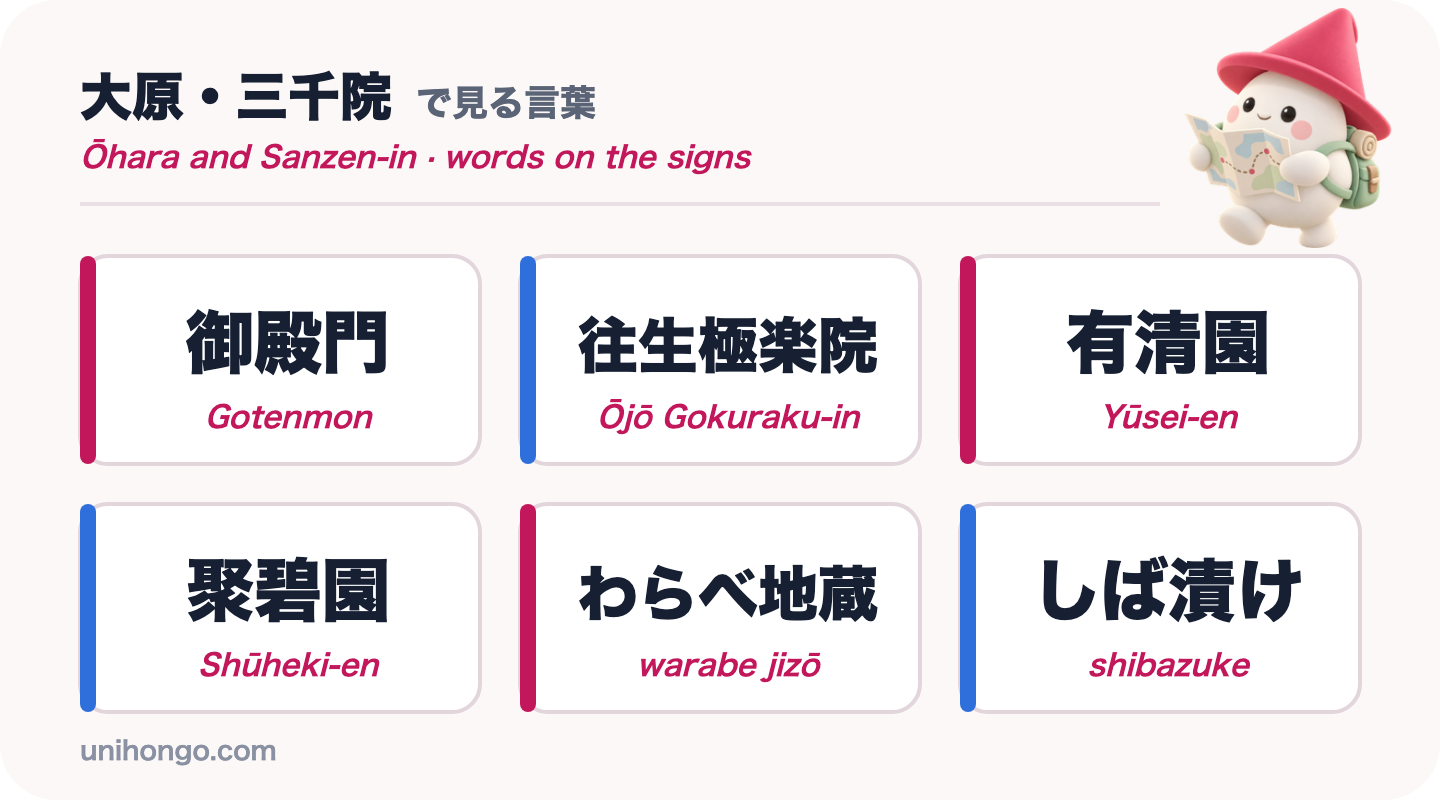
| Word | Reading | Meaning |
|---|---|---|
| 御殿門 | Gotenmon | The palace-style main gate of Sanzen-in |
| 往生極楽院 | Ōjō Gokuraku-in | The small hall of Amida in the moss garden |
| 有清園 | Yūsei-en | The moss and cedar garden |
| 聚碧園 | Shūheki-en | The pond garden in front of the guest hall |
| わらべ地蔵 | warabe jizō | Small childlike stone jizō statues |
| しば漬け | shibazuke | Ōhara's purple pickle made with red shiso |
| 試食 | shishoku | Free tasting sample |
| 御朱印 | goshuin | Handwritten temple stamp and seal |
| 音無の滝 | Otonashi no taki | The soundless waterfall |
Japanese for pickles, tea and souvenirs
The lane to Sanzen-in is lined with shops selling pickles: shibazuke, but also pickled cucumbers on sticks, radish and seasonal vegetables. Most have samples out and are happy for you to try; asking first is polite and gets a friendly answer. Pickles are vacuum-packed for travel, and staff will tell you how to keep them.
Tea is the other ritual of the day. At Hōsen-in, matcha and a sweet are part of the visit, served as you sit and look at the garden, and tea houses on the lane serve matcha, warabi-mochi and simple lunches. A few phrases cover both.
| Japanese | Romaji | Meaning |
|---|---|---|
| これは何の漬物ですか。 | Kore wa nan no tsukemono desu ka. | What kind of pickle is this? |
| 飛行機に持って行っても大丈夫ですか。 | Hikōki ni motte itte mo daijōbu desu ka. | Is it all right to take this on a plane? |
| 常温で大丈夫ですか。 | Jōon de daijōbu desu ka. | Is it fine at room temperature? |
| 抹茶とお菓子のセットをお願いします。 | Matcha to o-kashi no setto o onegai shimasu. | The matcha and sweet set, please. |
| お菓子は先にいただくんですか。 | O-kashi wa saki ni itadaku n desu ka. | Do I eat the sweet first? |
| 御朱印は全部で何種類ありますか。 | Goshuin wa zenbu de nanshurui arimasu ka. | How many kinds of goshuin are there in all? |
Etiquette, seasons and timing
Ōhara is a working village as well as a temple area, and a little care keeps it pleasant for the people who live there.
- Stay on the paths in Sanzen-in's moss garden; moss is fragile and takes years to grow back.
- Shoes come off in the Kyakuden and Shinden. Wear socks and shoes that are easy to take on and off.
- Do not walk into rice fields or farmyards for photos, and keep to the roads between temples.
- Arrive early in mid November, when the leaves peak and the buses fill up.
- Bring cash for small shops and tea houses, even though many now take cards.
- Allow half a day at least; a full day lets you add Jakkō-in, the waterfall and a relaxed lunch.
Practise the pickle shop before you go
Buying pickles is the most natural conversation you will have in Ōhara: you ask to taste, say what you think, buy and get a piece of advice. The four lines below cover all of it, and the shopkeeper's last line, reizō shite kudasai, keep it refrigerated, is exactly the kind of instruction you will hear with food souvenirs all over Japan.
Practise the lines until you can say them without reading, then practise with a partner who can vary the answers. In Unihongo, choose the Shopping topic and ask your AI Sensei to play an Ōhara shopkeeper, or the Tea Ceremony topic to rehearse your bowl of matcha at Hōsen-in. Once you have said oishii desu out loud to someone, it is easy to say again in the shop.
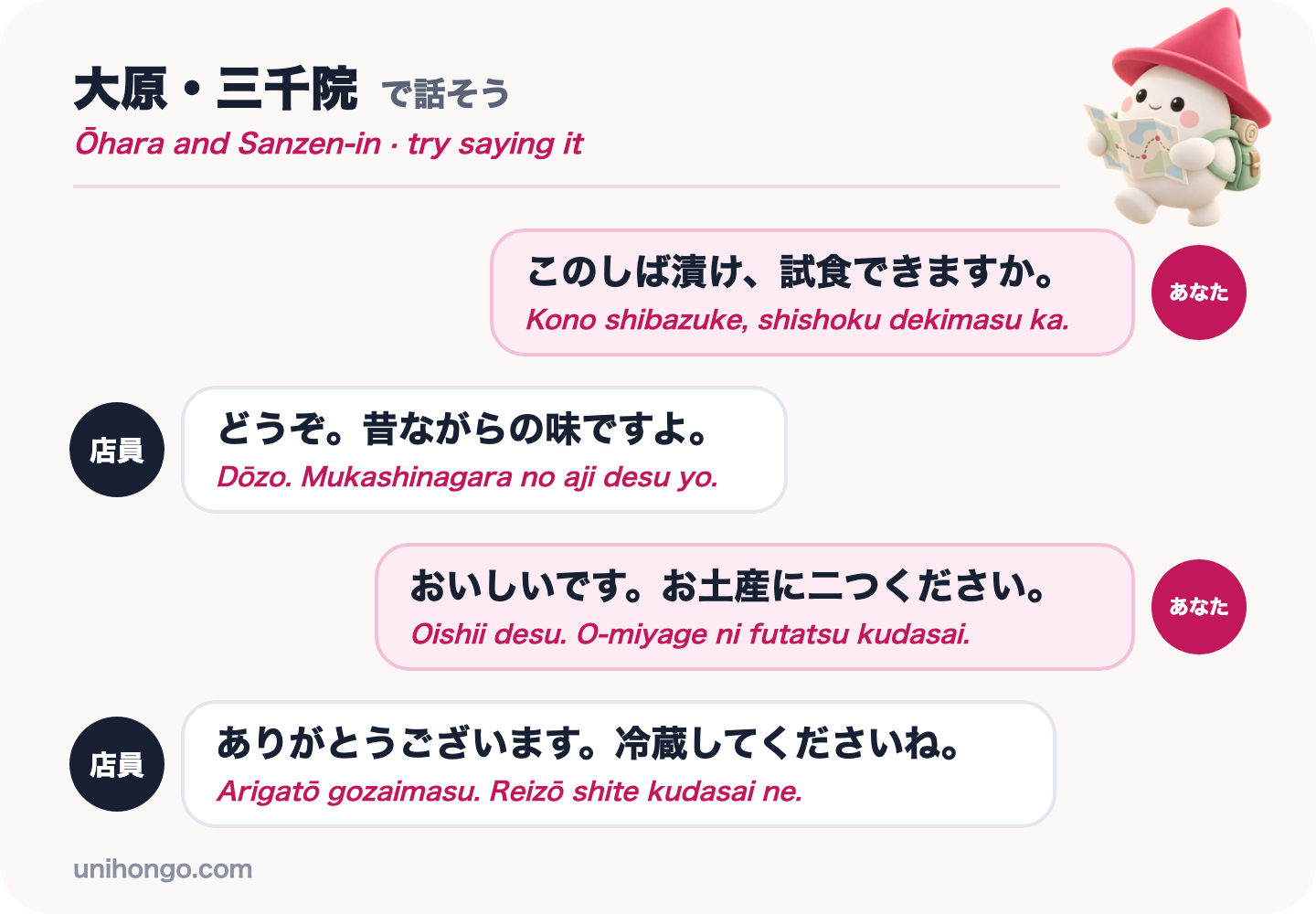
| Japanese | Romaji | Meaning |
|---|---|---|
| このしば漬け、試食できますか。 | Kono shibazuke, shishoku dekimasu ka. | Can I taste this shibazuke? |
| どうぞ。昔ながらの味ですよ。 | Dōzo. Mukashinagara no aji desu yo. | Please do. It is the traditional flavour. |
| おいしいです。お土産に二つください。 | Oishii desu. O-miyage ni futatsu kudasai. | It is delicious. Two, please, as souvenirs. |
| ありがとうございます。冷蔵してくださいね。 | Arigatō gozaimasu. Reizō shite kudasai ne. | Thank you. Please keep them refrigerated. |
Official information
Sanzen-in publishes its hours, fees, events and access directions in English and Japanese on its website. Check it before you go, along with the Kyoto City travel guide for the wider Ōhara area.