

Why Nanzen-ji is a Zen temple on a grand scale
In 1289 Emperor Kameyama took Buddhist vows at his detached palace in the eastern hills of Kyoto, and soon afterwards gave the palace to become a Zen temple. That imperial founding gave Nanzen-ji a special rank: when the Five Mountains system of great Zen temples was set, Nanzen-ji was placed above all of them. Its buildings were destroyed in the wars of the fifteenth century, and most of what stands today dates from the early seventeenth century, when powerful warlords and the court helped rebuild it.
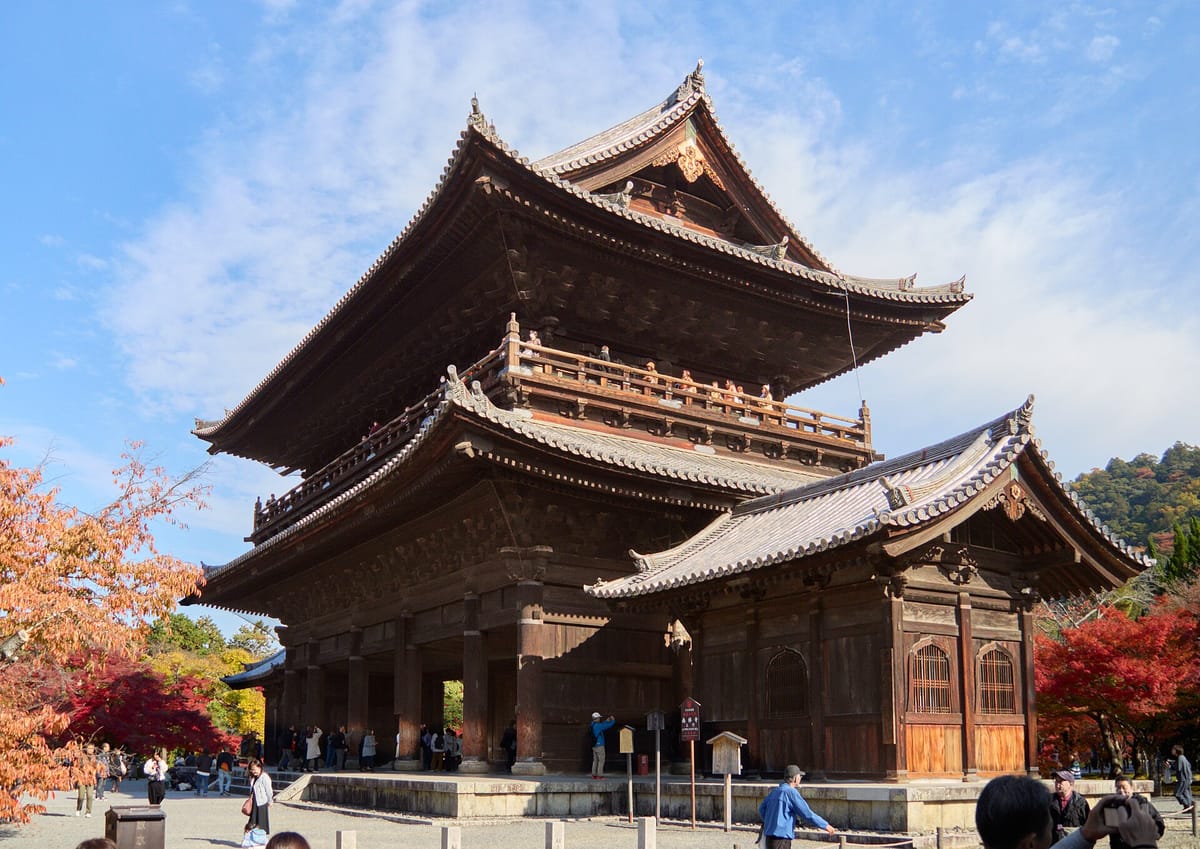
The layout is classic Zen: a straight line of gate, lecture hall and abbot's quarters, set among tall pines. The Sanmon, rebuilt in 1628 by the lord Tōdō Takatora in memory of soldiers who fell at the siege of Osaka, is counted among the three great gates of Japan. Behind it, the Hattō, the Dharma hall, is closed to visitors but can be seen from outside, and beyond it the Hōjō holds a rock garden and some of the most famous tiger paintings in Japan.
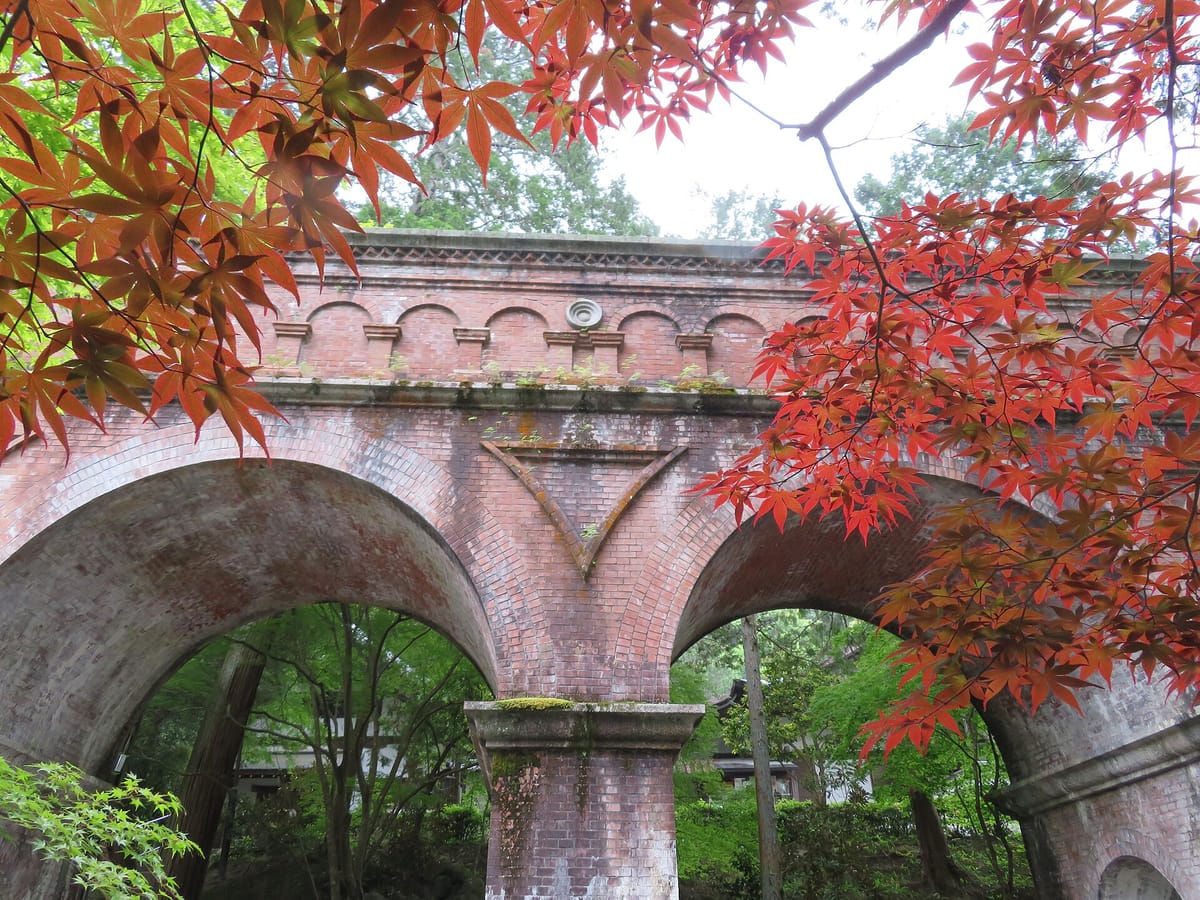
Then there is the surprise: a red-brick aqueduct with Roman-style arches, part of the Lake Biwa Canal, crossing the temple grounds. It was controversial when it was built, and is now one of the best-loved sights in Kyoto. For a learner, the temple is a chance to meet Zen vocabulary on the signs and food vocabulary at lunch.
Getting there: Keage Station and the Nanzen-ji approach
The nearest station is Keage on the Tōzai subway line. Take exit 1 and walk through the short brick tunnel under the old incline railway, the nejirimanpo, whose bricks are laid in a twisting spiral. The road beyond leads to the temple's approach and the Sanmon in about ten minutes. City buses stop at Nanzenji-Eikandō-michi, a few minutes to the north-west.
Nanzen-ji is also easy to combine with other sights on foot. Heian Jingū and the museums of Okazaki are about fifteen minutes west, Eikandō and the start of the Philosopher's Path a short walk north, and the Keage Incline, a restored railway track for canal boats now lined with cherry trees, is right beside Keage Station.
| Japanese | Romaji | Meaning |
|---|---|---|
| 蹴上駅の一番出口はどちらですか。 | Keage-eki no ichiban deguchi wa dochira desu ka. | Which way is exit 1 of Keage Station? |
| 南禅寺へはこのトンネルを通ればいいですか。 | Nanzen-ji e wa kono tonneru o tōreba ii desu ka. | Do I go through this tunnel for Nanzen-ji? |
| インクラインはどこから歩けますか。 | Inkurain wa doko kara arukemasu ka. | Where can I walk onto the incline? |
| 水路閣はお寺の中にありますか。 | Suirokaku wa o-tera no naka ni arimasu ka. | Is the Suirokaku inside the temple grounds? |
| 平安神宮まで歩いてどのくらいですか。 | Heian Jingū made aruite dono kurai desu ka. | How long is it on foot to Heian Jingū? |
The Sanmon, the Hōjō and the aqueduct
Start with the Sanmon. The climb is short but steep, and from the balcony you look west over the rooftops of Kyoto and the pine-covered grounds below. Then walk on past the Hattō to the Hōjō, the abbot's quarters and a National Treasure. Its large hall is said to have been moved here from the imperial palace, and a smaller hall behind holds the Tora no ma, the tiger room, with screen paintings attributed to Kanō Tan'yū. The best-known shows a tiger drinking water. In front, the raked-gravel garden is called Tora no ko watashi, tigers crossing with their cubs, and is attributed to Kobori Enshū.
Outside the Hōjō, follow the signs to the Suirokaku. The canal was built from 1885 to 1890 to bring water, transport and later hydroelectric power from Lake Biwa to Kyoto, and the aqueduct carries it along the hillside behind the temple. You can walk beneath the arches, and a path leads up to the channel itself, where water still flows. Beyond it is Nanzen-in, the site of Kameyama's original palace, with a quiet pond garden and the emperor's tomb.
- Sanmon: the great gate, about 22 metres tall, with a balcony you can climb for a fee.
- Hattō: the Dharma hall, seen from outside only.
- Hōjō: the abbot's quarters, a National Treasure, with the tiger paintings and the Tora no ko watashi garden.
- Suirokaku: the red-brick aqueduct of the Lake Biwa Canal, free to visit.
- Nanzen-in: the birthplace of the temple, with a Kamakura-period pond garden.
- Konchi-in: a sub-temple with a crane and turtle garden attributed to Kobori Enshū.
- Tenju-an: a small sub-temple with a rock garden and a pond garden, colourful in autumn.
Words on the signs at Nanzen-ji
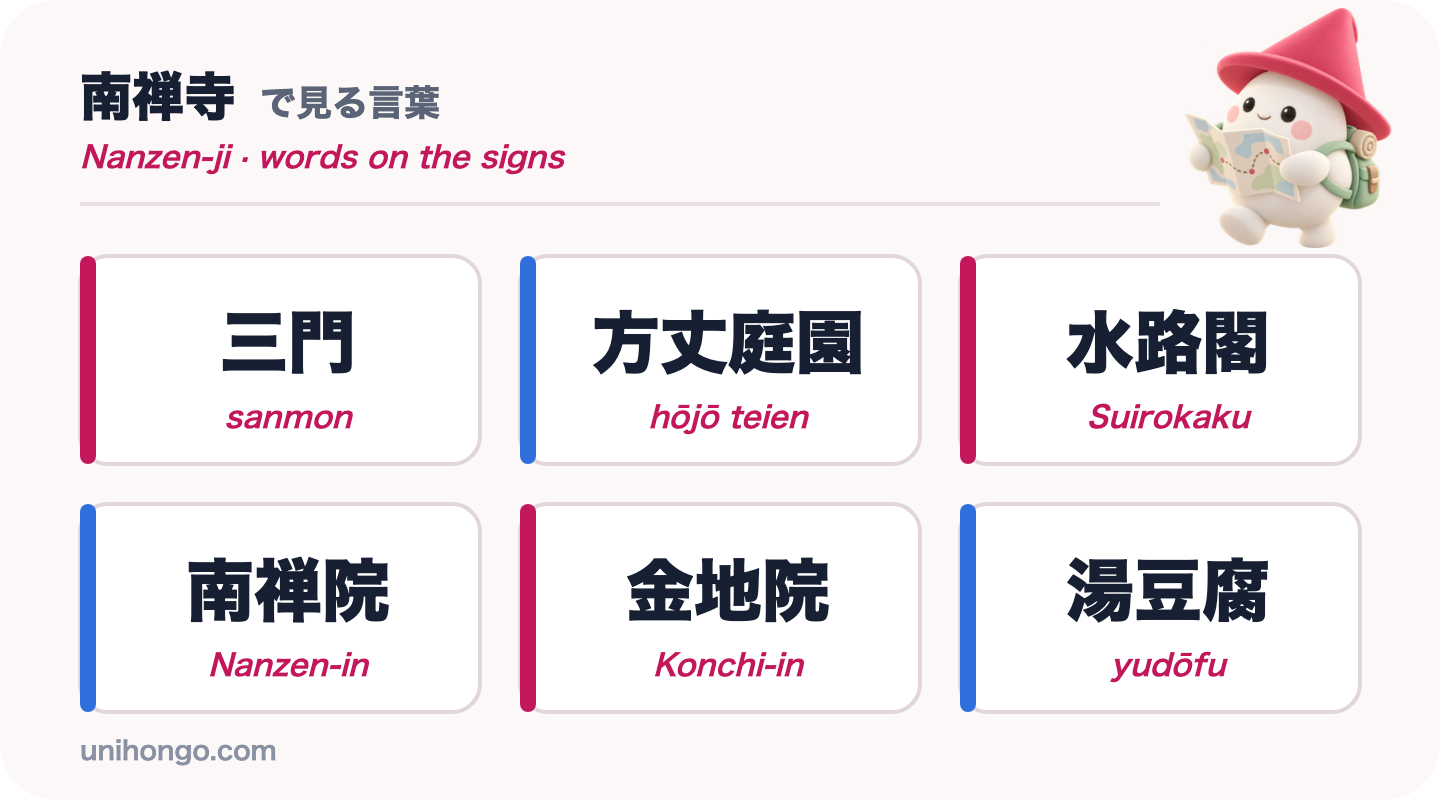
Nanzen-ji's many ticket windows can be confusing, so learn the names. Sub-temples end in 院, in, or 庵, an, a hermitage, and each has its own gate and fee. The aqueduct's name, 水路閣, is simply water, route and pavilion, a grand name for a piece of engineering.
On the way out, the signs change to food. 湯豆腐, yudōfu, is written with the kanji for hot water and tofu, and restaurants along the approach display it on banners and wooden boards, often with 精進料理, shōjin ryōri, the vegetarian temple cooking it belongs to.
| Word | Reading | Meaning |
|---|---|---|
| 三門 | sanmon | The great main gate |
| 法堂 | Hattō | Dharma hall for lectures and ceremonies |
| 方丈庭園 | hōjō teien | Gardens of the abbot's quarters |
| 虎の子渡し | Tora no ko watashi | Name of the Hōjō garden, tigers crossing with cubs |
| 水路閣 | Suirokaku | The brick aqueduct of the canal |
| 南禅院 | Nanzen-in | Sub-temple on the site of the original palace |
| 金地院 | Konchi-in | Sub-temple with the crane and turtle garden |
| 湯豆腐 | yudōfu | Tofu simmered in kombu broth |
| 精進料理 | shōjin ryōri | Vegetarian Buddhist temple cooking |
Japanese for a yudōfu lunch
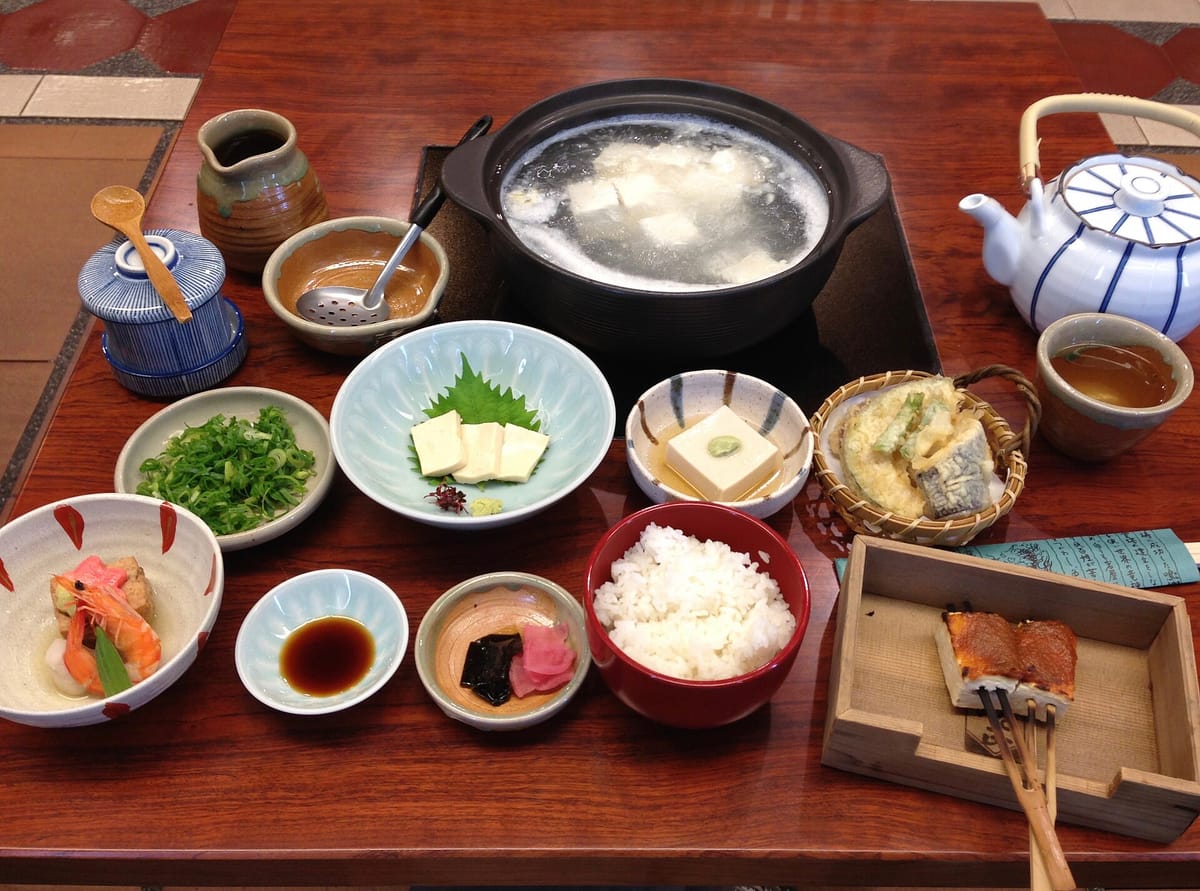
Yudōfu restaurants around Nanzen-ji usually serve one or two set courses, so ordering is simple: say how many people and which set. The tofu arrives in a pot of kombu broth over a small flame, alongside dishes such as sesame tofu, simmered vegetables, tempura and rice. Some restaurants have garden seating or tatami rooms, where you remove your shoes.
The meal is vegetarian at heart, though the dipping sauce can be made with fish stock. If you avoid all animal products, ask. Staff will explain how to eat: wait for the tofu to warm through, lift it out with the small ladle and dip it in the sauce.
| Japanese | Romaji | Meaning |
|---|---|---|
| 予約していないんですが、入れますか。 | Yoyaku shite inai n desu ga, hairemasu ka. | I have not booked. Can we come in? |
| コースは一種類だけですか。 | Kōsu wa isshurui dake desu ka. | Is there only one set course? |
| たれにかつおだしは使っていますか。 | Tare ni katsuo dashi wa tsukatte imasu ka. | Is bonito stock used in the sauce? |
| お座敷と椅子の席、どちらがいいですか。 | O-zashiki to isu no seki, dochira ga ii desu ka. | Would you like a tatami room or a table with chairs? |
| 椅子の席をお願いします。 | Isu no seki o onegai shimasu. | A table with chairs, please. |
| お豆腐のおかわりはできますか。 | O-tōfu no okawari wa dekimasu ka. | Can I have more tofu? |
Etiquette and timing at Nanzen-ji
Nanzen-ji is a working training monastery as well as a sightseeing spot, and its open grounds are used by locals walking through.
- Take your shoes off at the Hōjō and carry them in the plastic bag the temple hands you; take the bag home afterwards.
- Hold the handrail on the Sanmon stairs and do not carry open drinks up.
- Keep your voice low near the sub-temples and the training hall, and do not enter areas marked as closed.
- Do not climb onto the aqueduct's channel or lean over the water.
- Autumn, mid to late November, is the busiest season; the Hōjō and Sanmon are quietest early in the morning.
- Yudōfu restaurants fill up at lunchtime at weekends; arrive before noon or book.
Practise the yudōfu lunch before you go
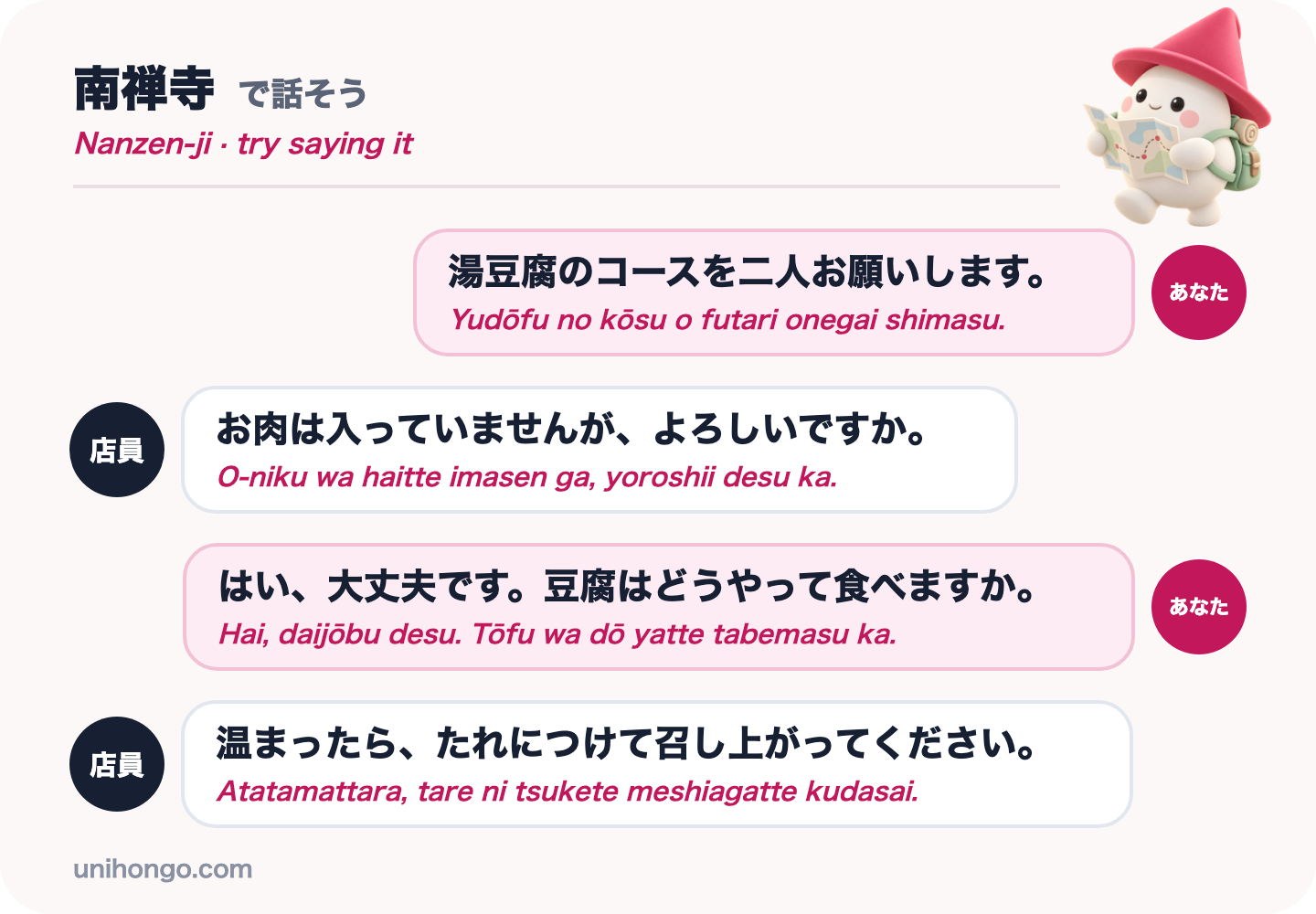
The four lines below are a typical exchange at a tofu restaurant near the temple. You order the course, the server checks you are happy with a meal without meat, and you ask how to eat it. The last line uses honorific Japanese, meshiagatte kudasai, which you will hear often in restaurants and never need to say yourself.
Say the lines aloud until you can do it without reading, then practise with a partner who can ask you follow-up questions. In Unihongo, choose the Japanese Cuisine topic and ask your AI Sensei to play the server, or the Restaurant topic to rehearse seating and paying. Having heard the honorific once in practice makes it much easier to follow at the table.
| Japanese | Romaji | Meaning |
|---|---|---|
| 湯豆腐のコースを二人お願いします。 | Yudōfu no kōsu o futari onegai shimasu. | The yudōfu course for two, please. |
| お肉は入っていませんが、よろしいですか。 | O-niku wa haitte imasen ga, yoroshii desu ka. | There is no meat in it. Is that all right? |
| はい、大丈夫です。豆腐はどうやって食べますか。 | Hai, daijōbu desu. Tōfu wa dō yatte tabemasu ka. | Yes, that is fine. How do I eat the tofu? |
| 温まったら、たれにつけて召し上がってください。 | Atatamattara, tare ni tsukete meshiagatte kudasai. | When it has warmed up, dip it in the sauce and enjoy. |
Official information
Nanzen-ji publishes information on its buildings, gardens, visiting rules and events on its website, in Japanese. Check it for current hours and fees, and for notices such as the shoe-bag rule and seasonal changes.