

Why Kiso-Fukushima is worth a stop on the Nakasendō
The Nakasendō, the mountain highway between Edo and Kyoto, passed through the narrow Kiso Valley for much of its length, and its eleven post towns there are known together as the Kisoji. Fukushima-juku was the fifth of them and lay roughly halfway between the two capitals, which made it an obvious place for the shogunate to control traffic. Its checkpoint, set up in the first years of the seventeenth century, was counted among the four great barriers of the Edo period.
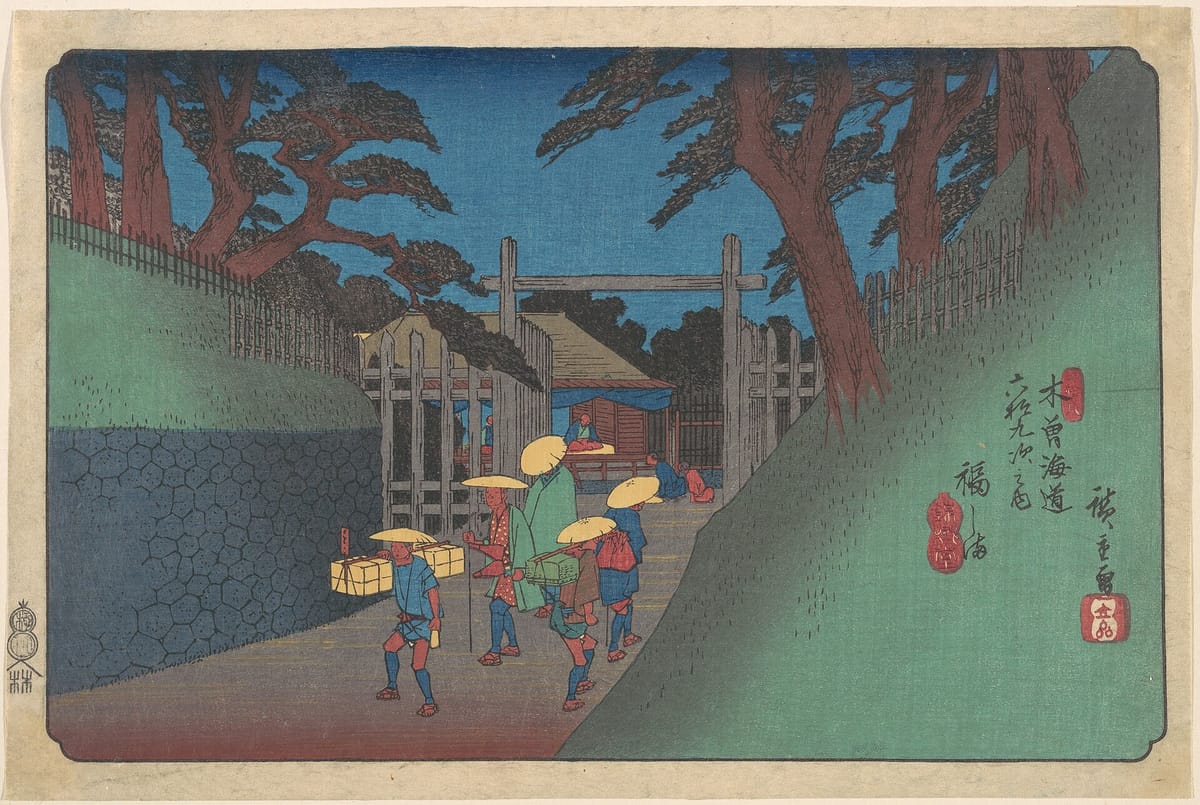
The town also housed the Yamamura family, hereditary administrators who governed the valley and its valuable cypress forests. Their residence, part of which survives with its garden, is now a museum. Hiroshige's print of Fukushima in his Sixty-nine Stations of the Kiso Kaidō shows travellers kneeling before officials at the barrier as their papers are checked.
For a learner, Kiso-Fukushima is a working town rather than a museum piece. Shops serve local people, the soba restaurants are busy with Japanese travellers, and conversations happen naturally at counters and stations. It is a good place to practise without crowds.
Getting there: the Shinano from Nagoya
Kiso-Fukushima Station is on the JR Chūō Main Line, and limited express Shinano trains stop here. According to the local tourism bureau, the ride from Nagoya takes about an hour and twenty minutes; Matsumoto is less than an hour away in the other direction. Local trains also run along the valley, more slowly and less often, and link the town with the other post towns of the Kisoji.
From the station, the town centre and the Kiso River are a few minutes' walk downhill. The checkpoint site is at the northern end of town, about fifteen minutes on foot from the station, and Ue-no-dan is on the slope above the river. Buses run from the station to the Kaida highlands and towards Mount Ontake.
| Japanese | Romaji | Meaning |
|---|---|---|
| 木曽福島まで、特急の指定席を一枚お願いします。 | Kiso-Fukushima made, tokkyū no shiteiseki o ichimai onegai shimasu. | One reserved seat on the limited express to Kiso-Fukushima, please. |
| しなのは何番線から出ますか。 | Shinano wa nanbansen kara demasu ka. | Which platform does the Shinano leave from? |
| 関所跡はどちらですか。 | Sekisho ato wa dochira desu ka. | Which way is the checkpoint site? |
| 上の段まで歩いて何分くらいですか。 | Ue-no-dan made aruite nanpun kurai desu ka. | About how many minutes on foot to Ue-no-dan? |
| 開田高原行きのバスはどこから出ますか。 | Kaida Kōgen-yuki no basu wa doko kara demasu ka. | Where does the bus to the Kaida highlands leave from? |
Checkpoint, Ue-no-dan and the magistrate's house: what you will see
The checkpoint site sits where the valley narrows, between the river and the mountainside, so there was no way round it. After the barrier was abolished in 1868 the buildings disappeared, but excavations in the 1970s allowed the east and west gates to be reconstructed, and a small museum displays travel permits, weapons and the tools of inspection. The site is a National Historic Site.
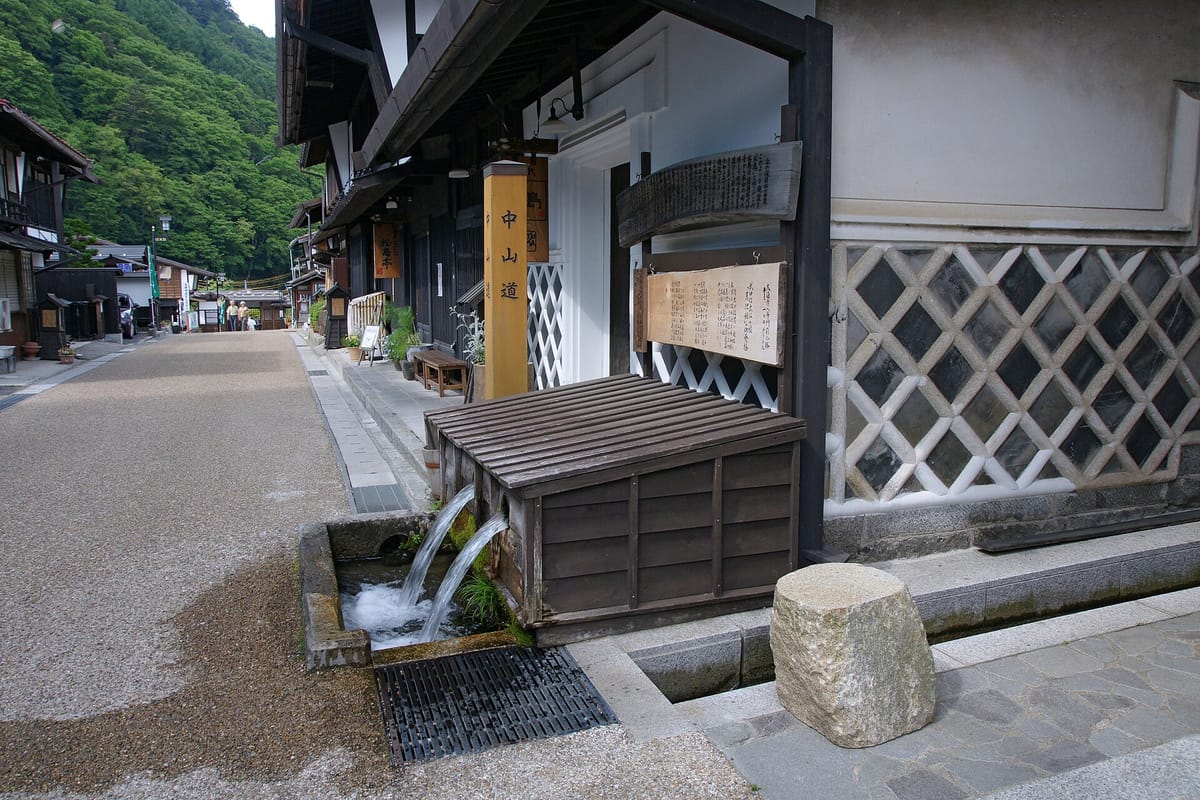
Ue-no-dan, the upper terrace, is the most atmospheric part of town: a few lanes of old houses with latticed fronts, a crank in the road built to slow attackers, and wooden troughs, mizuba, where mountain water runs constantly. Down by the Kiso River, a free footbath lets you soak tired feet, and the Yamamura magistrate's residence keeps part of its house and garden.
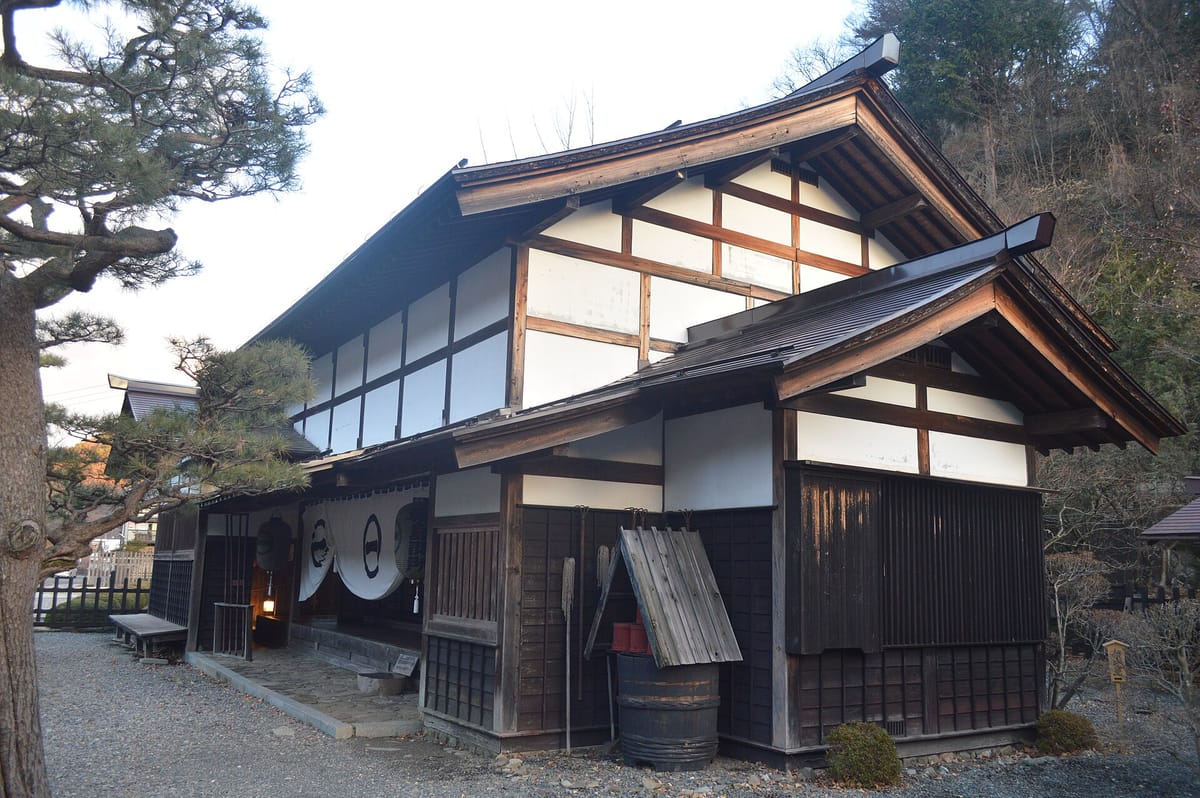
- Fukushima Sekisho: the reconstructed checkpoint gates and museum.
- Ue-no-dan: the old upper street with its stone lanes and water troughs.
- Yamamura Daikan Yashiki: the residence of the valley's hereditary administrators.
- Kōzen-ji: a Zen temple linked with the Kiso clan, known for its gardens.
- Ashiyu: a free footbath beside the Kiso River.
- Goryōkan: the former regional office of the Imperial forests, a reminder of the valley's timber wealth.
Words on the signs in Kiso-Fukushima
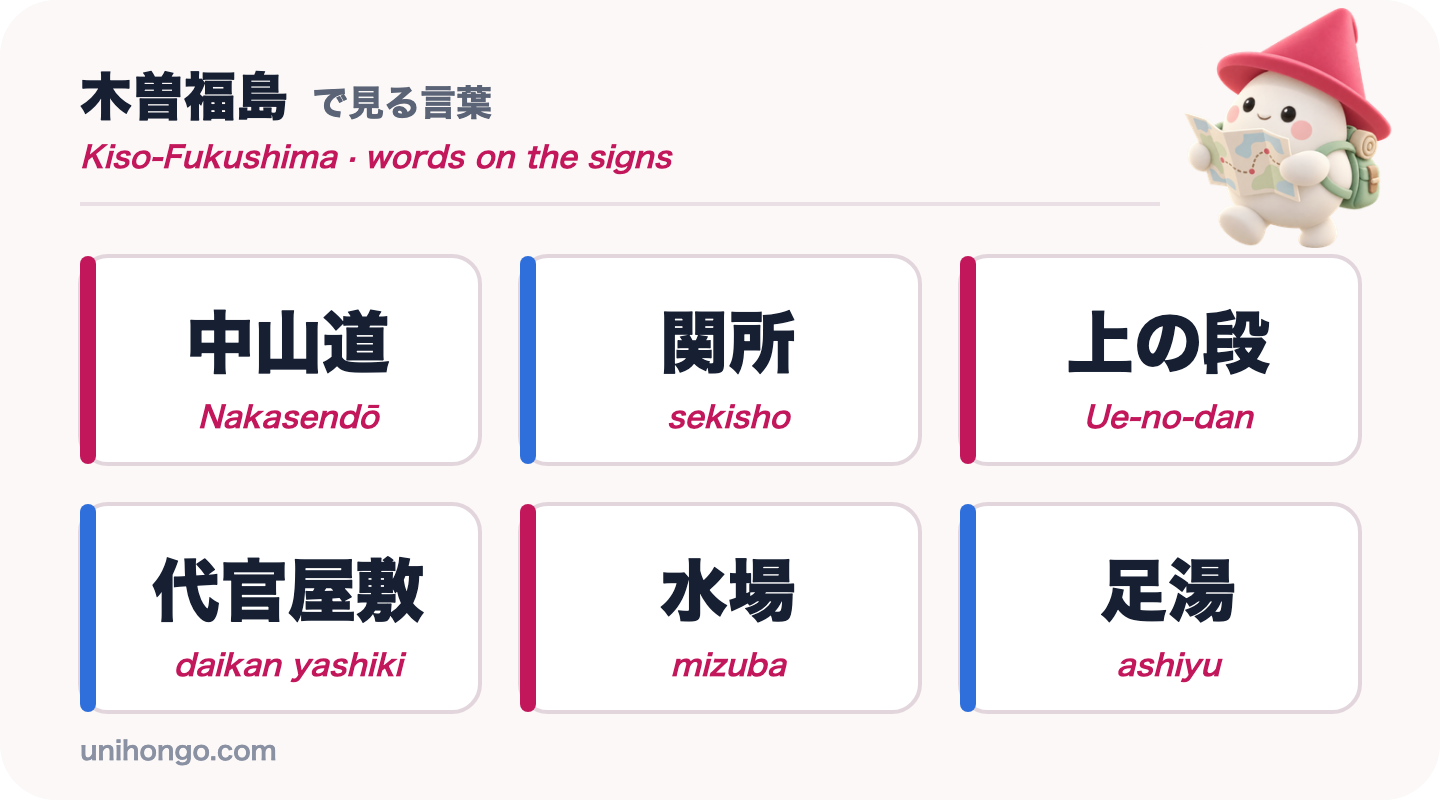
The word you will see most is 中山道, Nakasendō, the central mountain road, on signposts, stone markers and shop names. 関所, sekisho, is a checkpoint; the 関 is the same kanji as in 関西, Kansai, west of the barrier, and 関東, Kantō, east of it.
In the old town, 水場, mizuba, marks the water troughs, and 足湯, ashiyu, the footbath. 代官屋敷, daikan yashiki, is the residence of a daikan, a shogunate administrator, a word familiar to Japanese from period dramas.
| Word | Reading | Meaning |
|---|---|---|
| 中山道 | Nakasendō | The highway between Edo and Kyoto |
| 宿場 | shukuba | Post town on a highway |
| 関所 | sekisho | Checkpoint |
| 関所資料館 | sekisho shiryōkan | Checkpoint museum |
| 上の段 | Ue-no-dan | The old upper street |
| 代官屋敷 | daikan yashiki | Magistrate's residence |
| 水場 | mizuba | Spring-fed water trough |
| 足湯 | ashiyu | Footbath |
| すんき | sunki | Kiso's salt-free fermented pickle |
Japanese for Kiso soba and sunki
The Kiso Valley is soba country, and new-season soba, shinsoba, is celebrated each autumn. The simplest order is zarusoba, cold noodles on a bamboo tray with a dipping sauce. In winter, look for sunki soba, hot soba topped with the local salt-free pickle, which you will find nowhere else.
At the end of the meal, many shops bring sobayu, the hot water the noodles were cooked in, to pour into the leftover dipping sauce and drink. If it does not come, you can ask.
| Japanese | Romaji | Meaning |
|---|---|---|
| ざるそばを大盛りでお願いします。 | Zarusoba o ōmori de onegai shimasu. | A large zarusoba, please. |
| 温かいそばと冷たいそば、どちらがおすすめですか。 | Atatakai soba to tsumetai soba, dochira ga osusume desu ka. | Which do you recommend, hot or cold soba? |
| すんきは今の季節もありますか。 | Sunki wa ima no kisetsu mo arimasu ka. | Is sunki available at this time of year? |
| そば湯をいただけますか。 | Sobayu o itadakemasu ka. | Could I have some sobayu? |
| このそば粉は地元のものですか。 | Kono sobako wa jimoto no mono desu ka. | Is this buckwheat flour local? |
| ごちそうさまでした。おいしかったです。 | Gochisōsama deshita. Oishikatta desu. | Thank you for the meal. It was delicious. |
Timing and practical tips
Kiso-Fukushima is small and easy, but trains and museum days need a little planning.
- Check the Shinano timetable for your onward train; local services along the valley are infrequent.
- The checkpoint museum and the magistrate's house close on different weekdays; check before you go.
- Wear good shoes: Ue-no-dan and the checkpoint are on slopes and steps.
- Bring a small towel for the riverside footbath.
- Winters are cold and snowy in the valley; autumn colours and the shinsoba season make October and November especially rewarding.
- Mount Ontake is an active volcano; if you plan to go up, check the eruption alert level first.
Practise ordering soba before you go
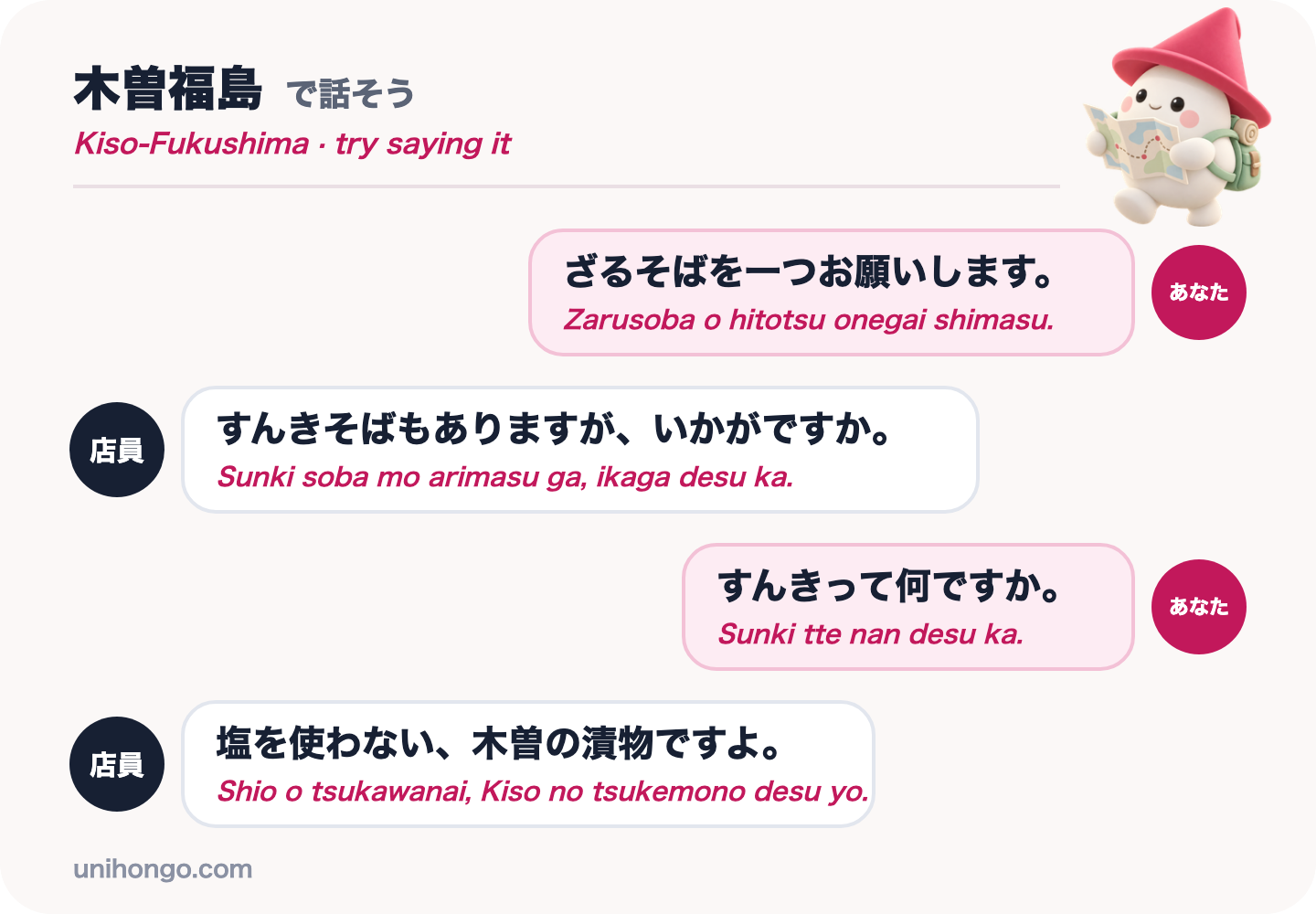
The server's suggestion, ikaga desu ka, how about it, is the polite way to offer something, and you can accept with ja, sore de onegai shimasu, then that one, please. The answer to your question explains sunki in one line: shio o tsukawanai, without using salt. Practise the four lines below until you can say them without reading.
Then practise with a partner. In Unihongo, choose the Japanese Cuisine topic and ask your AI Sensei to play a soba shop owner in the Kiso Valley, or choose Regional Dialects and ask about the way people speak in the mountains of Nagano. Saying the lines once before you go makes the real order easy.
| Japanese | Romaji | Meaning |
|---|---|---|
| ざるそばを一つお願いします。 | Zarusoba o hitotsu onegai shimasu. | One zarusoba, please. |
| すんきそばもありますが、いかがですか。 | Sunki soba mo arimasu ga, ikaga desu ka. | We also have sunki soba. Would you like that? |
| すんきって何ですか。 | Sunki tte nan desu ka. | What is sunki? |
| 塩を使わない、木曽の漬物ですよ。 | Shio o tsukawanai, Kiso no tsukemono desu yo. | It's a Kiso pickle made without salt. |
Official information
The Kiso Ontake tourism bureau publishes sights, access times, events and Mount Ontake volcano information, and Kiso town lists the opening details of the checkpoint museum and the magistrate's house. Check both before you go.