

Why the Kyoto Railway Museum is worth half a day
Railways in Japan are more than transport: they shaped where people live, how cities grew and even how the country tells time. The Kyoto Railway Museum tells that story with real trains rather than models. It opened in 2016 on the site of the Umekōji Steam Locomotive Museum, which had opened in 1972 for the centenary of Japanese railways, and it took in many exhibits from the Modern Transportation Museum in Osaka, which closed in 2014.
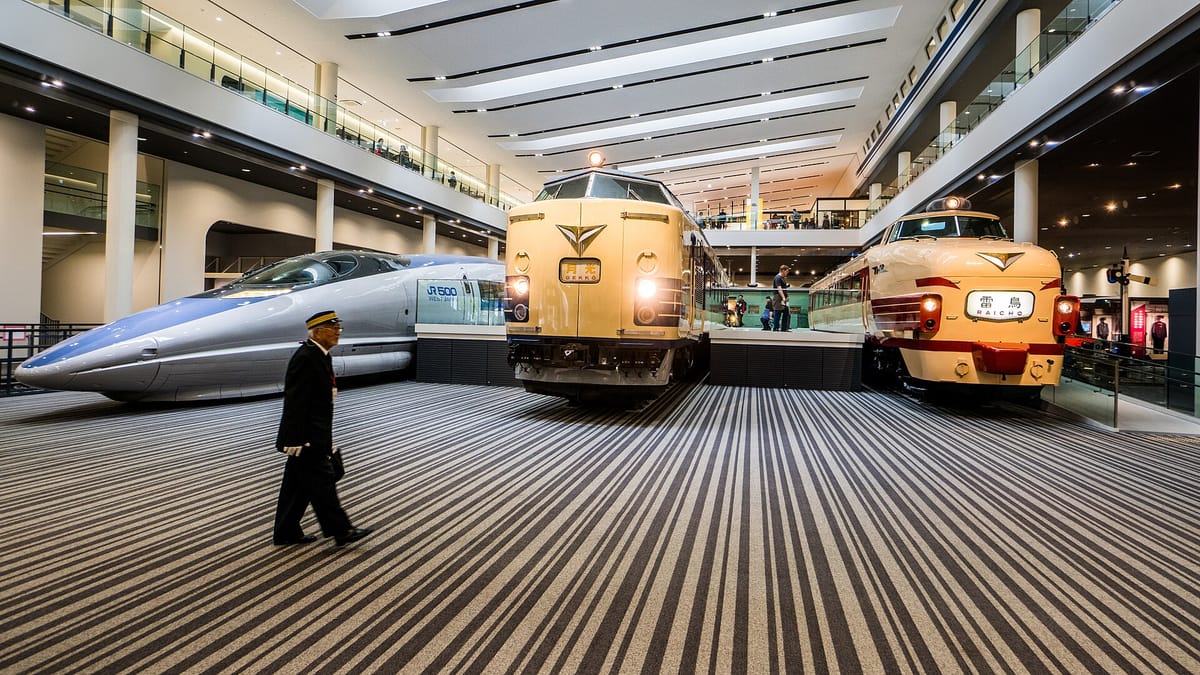
The collection runs from a steam locomotive built in 1903 to the four original 0 series shinkansen cars of 1964, the first bullet train, and the 500 series with its long pointed nose. Many trains stand at platform height so you can walk alongside them and look into the cabs. The largest and oldest part of the museum, though, is outdoors: the Umekōji roundhouse of 1914, where steam locomotives are still kept, maintained and turned.
For a learner, the museum is a crash course in the words you see at every station in Japan: 線, line, 番線, platform number, 乗車券, ticket, 特急, limited express. You spend half a day reading them on real carriages, and they stay with you when you get back on a train.
Getting there: Umekōji-Kyōtonishi Station
JR Umekōji-Kyōtonishi Station, which opened in 2019 on the Sagano Line, is the museum's own station. It is the first stop west of Kyoto Station, a couple of minutes by train, and the museum entrance is a few minutes' walk from the exit. The Sagano Line is the same line that runs on to Arashiyama, so the museum fits well at the start or end of a day in western Kyoto.
If you prefer to walk, the museum is about twenty minutes west of Kyoto Station through Umekōji Park, a large lawn with a stream and play areas. City buses also run from Kyoto Station to stops by the park. The Kyoto Aquarium is at the other end of the same park, which makes a good pairing for families.
| Japanese | Romaji | Meaning |
|---|---|---|
| 梅小路京都西駅は次の駅ですか。 | Umekōji-Kyōtonishi-eki wa tsugi no eki desu ka. | Is Umekōji-Kyōtonishi the next station? |
| 嵯峨野線は何番線ですか。 | Sagano-sen wa nanbansen desu ka. | Which platform is the Sagano Line? |
| 京都鉄道博物館はどちらですか。 | Kyōto Tetsudō Hakubutsukan wa dochira desu ka. | Which way is the Kyoto Railway Museum? |
| 京都駅から歩いて行けますか。 | Kyōto-eki kara aruite ikemasu ka. | Can I walk from Kyoto Station? |
| 水族館も近くにありますか。 | Suizokukan mo chikaku ni arimasu ka. | Is the aquarium nearby too? |
From the Promenade to the roundhouse: what you will see
After the entrance you walk along the Promenade, a long covered gallery of full-size trains, including a steam locomotive and early shinkansen cars. The Promenade leads into the main building, the honkan, with more vehicles, cutaway models, hands-on displays about how signals and tracks work, a large layout of model trains, and the driving simulators.
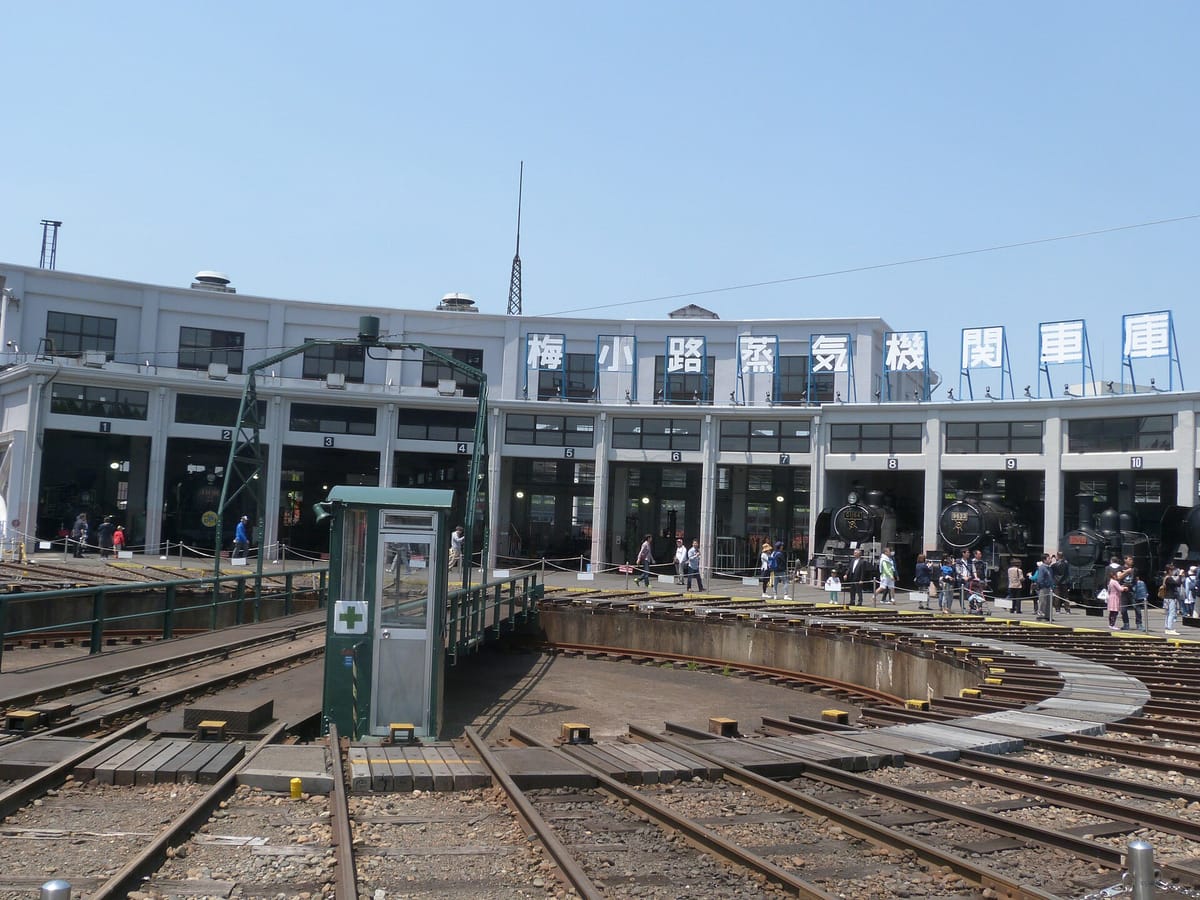
Beyond the main building is the roundhouse. Twenty tracks radiate from a central turntable, and around twenty steam locomotives from the Meiji to the Shōwa eras are kept in its bays, some still in working order. You can watch engines being turned and moved, and the SL Steam ride leaves from a platform beside it. The route ends at the old Nijō Station building, a wooden station of 1904 moved here from the city centre, which now serves as the exit and museum shop.
- Promenade: the covered outdoor gallery of full-size trains at the entrance.
- Honkan: the main building with shinkansen cars, displays and simulators.
- 0 series shinkansen: the cars of the first bullet train, from 1964.
- Model train layout: a large diorama with scheduled running shows.
- Ōgigata shako: the 1914 roundhouse with about twenty steam locomotives.
- Tenshadai: the turntable at the centre of the roundhouse.
- Kyū Nijō Ekisha: the old Nijō Station building, now the exit and shop.
Railway words on the signs
Railway Japanese uses a small set of kanji again and again. 車 is vehicle or car, 線 is line, 駅 is station and 庫 is a storehouse, so 車庫 is a depot. Once you have seen them on the museum's signs, you will start spotting them on every platform and ticket machine for the rest of your trip.
The steam ride is signed with the English letters SL, for steam locomotive, which Japanese reads as esu-eru. The formal word is 蒸気機関車, jōki kikansha, which you will see on the name plates of the locomotives in the roundhouse. The table below covers the words you will meet.
| Word | Reading | Meaning |
|---|---|---|
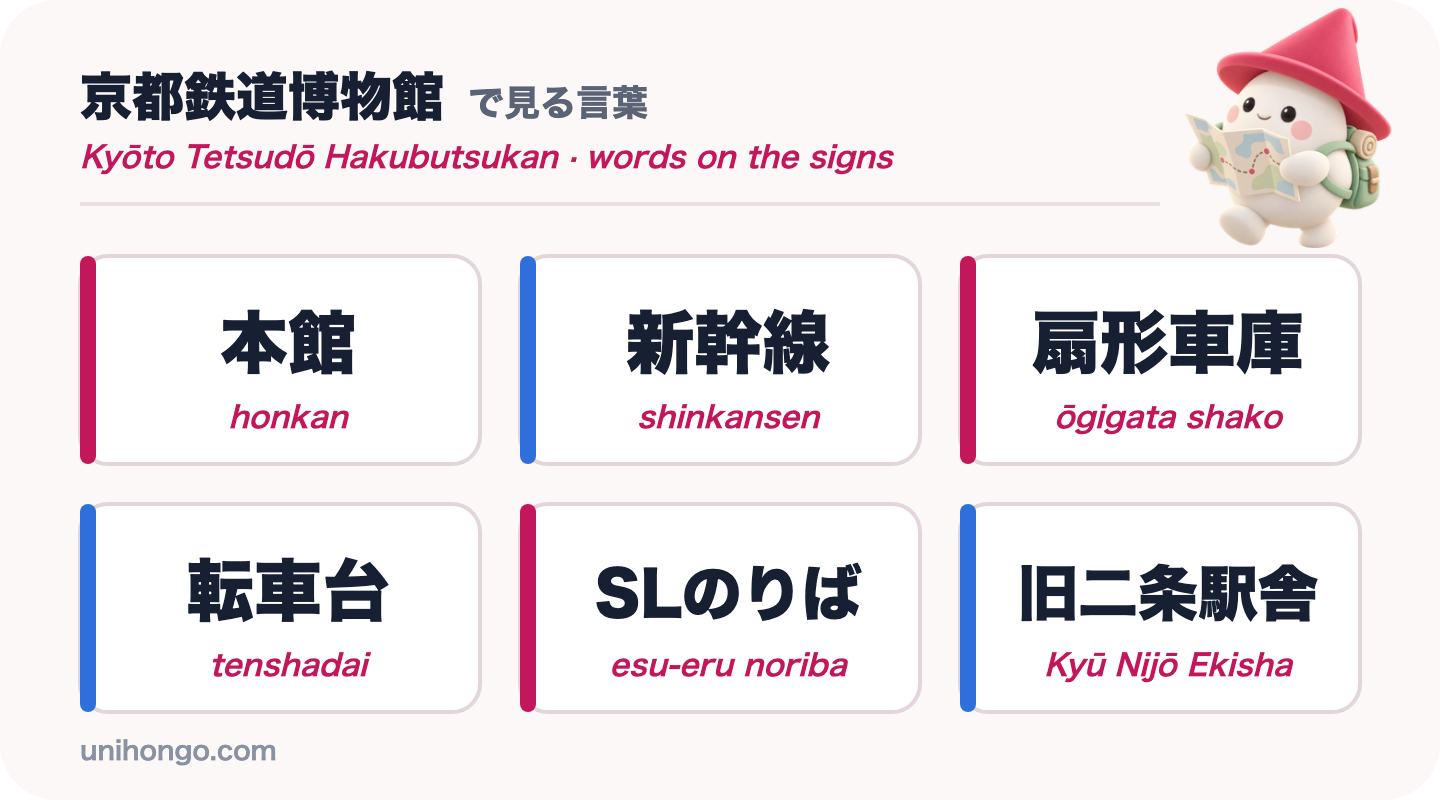
| 本館 | honkan | Main building |
| 新幹線 | shinkansen | Bullet train, literally new trunk line |
| 扇形車庫 | ōgigata shako | Fan-shaped engine shed; the roundhouse |
| 転車台 | tenshadai | Turntable |
| SLのりば | esu-eru noriba | Boarding point for the steam train ride |
| 蒸気機関車 | jōki kikansha | Steam locomotive |
| 運転シミュレータ | unten shimyurēta | Driving simulator |
| 旧二条駅舎 | Kyū Nijō Ekisha | The old Nijō Station building |
| 特急 | tokkyū | Limited express, written on many train fronts |
Japanese for the steam ride and the simulators
The SL Steam ride is the one activity you pay for on the day inside the museum. You buy a ticket, wait at the platform by the roundhouse, and ride a short round trip in old carriages behind a steam engine, with the whistle and the smell of coal smoke included. The departure times are posted at the platform.
The driving simulators are booked online in advance for a small fee, so there is less to say on the day, but staff at the simulator area will check your booking and explain the controls. The phrases below cover both, plus the questions you might ask in the main building.
| Japanese | Romaji | Meaning |
|---|---|---|
| スチーム号の切符はどこで買えますか。 | Suchīmu-gō no kippu wa doko de kaemasu ka. | Where can I buy a ticket for the steam ride? |
| 次の発車まで何分ありますか。 | Tsugi no hassha made nanpun arimasu ka. | How many minutes until the next departure? |
| 運転シミュレータの予約を確認してください。 | Unten shimyurēta no yoyaku o kakunin shite kudasai. | Please check my simulator booking. |
| 新幹線と在来線、どちらにしますか。 | Shinkansen to zairaisen, dochira ni shimasu ka. | Shinkansen or conventional line, which will you choose? |
| 運転席の中に入ってもいいですか。 | Untenseki no naka ni haitte mo ii desu ka. | May I go inside the driver's cab? |
| 転車台が動くのは何時ですか。 | Tenshadai ga ugoku no wa nanji desu ka. | What time does the turntable move? |
Timing and practical tips
The museum is popular with families, especially at weekends and in school holidays, and the simulators and steam ride are the parts that fill up first.
- The museum is usually closed on Wednesdays and at New Year; check the calendar for exceptions.
- Book the driving simulators online as soon as they go on sale for your date.
- Head to the roundhouse early and check the SL Steam departure times on arrival.
- Allow two to three hours, more with young children who want to climb into every cab.
- Pair the visit with the Kyoto Aquarium in the same park, or with Arashiyama further along the Sagano Line.
Practise the steam ride before you go
The steam ride is the question most visitors ask about, and the answer usually points you somewhere: next to the roundhouse, by the turntable, over there. Practise the four lines below until you can say them without reading, and listen for noriba, boarding point, and jikoku, timetable, in the replies.
Then practise with a partner who answers back. In Unihongo, choose the Train Tickets topic and ask your AI Sensei to play a museum attendant, or try the Catch the Right Train mission to rehearse the Sagano Line. Saying the lines once before you arrive is what makes them come out on the day.
| Japanese | Romaji | Meaning |
|---|---|---|
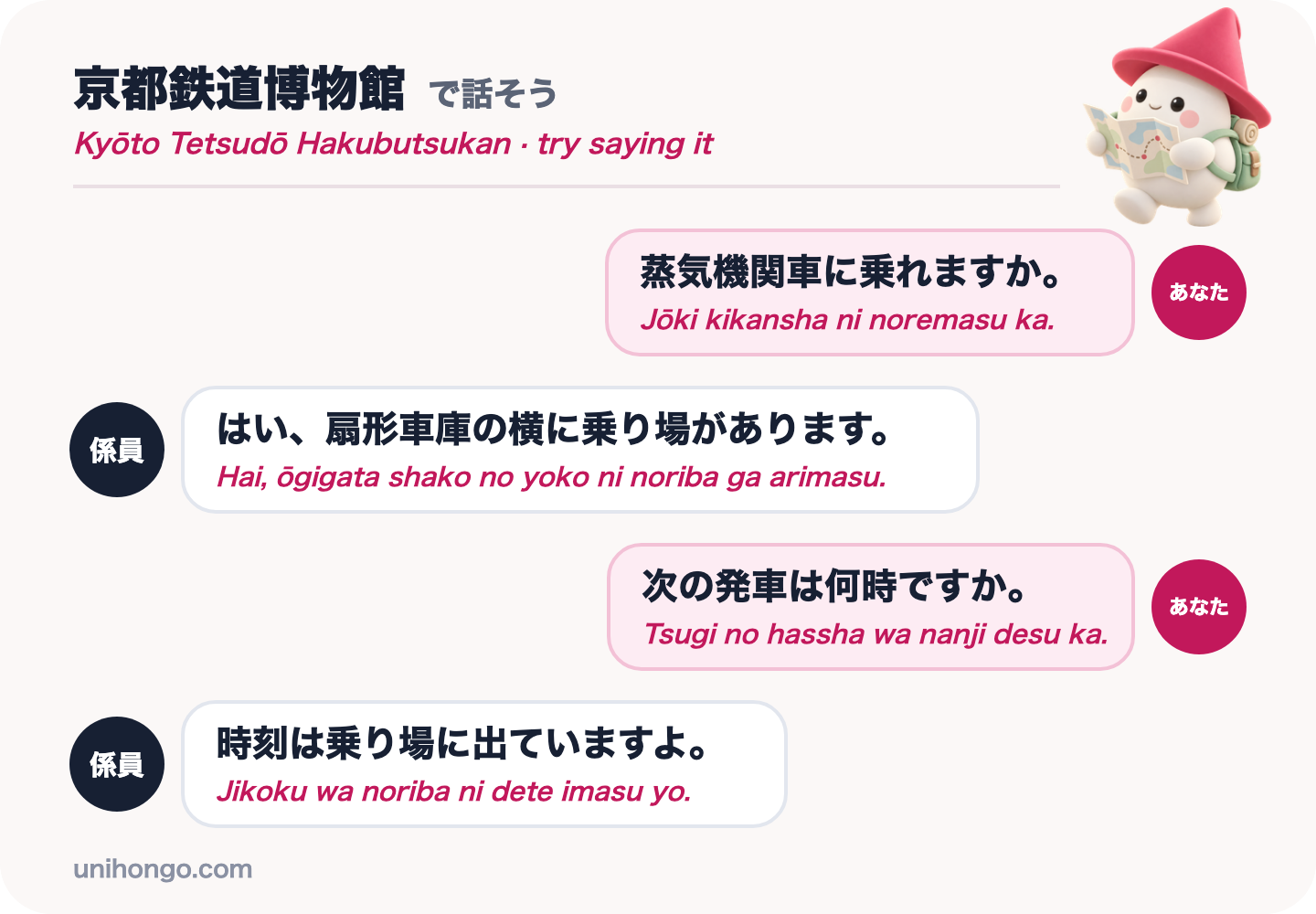
| 蒸気機関車に乗れますか。 | Jōki kikansha ni noremasu ka. | Can I ride the steam locomotive? |
| はい、扇形車庫の横に乗り場があります。 | Hai, ōgigata shako no yoko ni noriba ga arimasu. | Yes, the boarding point is next to the roundhouse. |
| 次の発車は何時ですか。 | Tsugi no hassha wa nanji desu ka. | What time is the next departure? |
| 時刻は乗り場に出ていますよ。 | Jikoku wa noriba ni dete imasu yo. | The times are posted at the boarding point. |
Official information
The Kyoto Railway Museum publishes its opening calendar, admission, simulator bookings, steam ride information and events on its website. Check it before you go, especially the calendar if you plan to visit on a Wednesday.