

Why Ginkaku-ji is the quiet counterpart to the Golden Pavilion
Ashikaga Yoshimasa, the eighth Ashikaga shogun, was a poor ruler and a great patron of the arts. While Kyoto was being destroyed in the Ōnin War, he withdrew to the eastern hills and built a villa where he gathered painters, garden makers and tea masters. The culture that grew up around him, known as Higashiyama culture, shaped the tea ceremony, flower arranging, ink painting and the Japanese ideal of quiet, understated beauty.
His villa became the Zen temple Jishō-ji after his death, and two of its original buildings survive as National Treasures: the Kannonden, the two-storey pavilion now called Ginkaku, and the Tōgudō, whose small study room is often described as the oldest surviving example of the shoin style that became the model for Japanese tatami rooms. The temple belongs to the Shōkoku-ji branch of Rinzai Zen, like Kinkaku-ji, and is part of the Historic Monuments of Ancient Kyoto World Heritage Site.
Where Kinkaku-ji dazzles, Ginkaku-ji asks you to slow down. That makes it a natural start to a walk, and the Philosopher's Path begins almost at its gate.
Getting there: Ginkakuji-michi and the temple approach
From Kyoto Station, city bus 5 or 17 goes to the Ginkakuji-michi stop in around thirty-five to forty minutes; from there walk east along the canal, across the small bridge at the northern end of the Philosopher's Path, and up the shop-lined approach to the temple gate, about ten minutes in all. Bus 100 stops at Ginkakuji-mae, a little closer. From Gion or central Kyoto, bus 203 also runs to Ginkakuji-michi.
Many visitors do the route in reverse: take the subway to Keage Station on the Tōzai Line, visit Nanzen-ji, and walk north along the Philosopher's Path to finish at Ginkaku-ji, then catch a bus back. Either direction works; walking north means you end at the temple, walking south means you end near the subway.
| Japanese | Romaji | Meaning |
|---|---|---|
| 銀閣寺道で降ります。 | Ginkakuji-michi de orimasu. | I am getting off at Ginkakuji-michi. |
| 銀閣寺の入口はこの坂の上ですか。 | Ginkaku-ji no iriguchi wa kono saka no ue desu ka. | Is the entrance to Ginkaku-ji at the top of this slope? |
| 哲学の道の入口はどこですか。 | Tetsugaku no michi no iriguchi wa doko desu ka. | Where does the Philosopher's Path begin? |
| 蹴上駅まで歩くとどのくらいですか。 | Keage-eki made aruku to dono kurai desu ka. | How long is it on foot to Keage Station? |
| 京都駅行きのバスはどこから乗れますか。 | Kyōto-eki-yuki no basu wa doko kara noremasu ka. | Where can I catch a bus to Kyoto Station? |
Inside Ginkaku-ji: sand, moss and the hillside view
After the gate, a long passage between tall hedges leads into the grounds. The route then circles the garden in one direction. First comes the Ginshadan, the sea of silver sand, a broad platform of raked white sand, and beside it the Kōgetsudai, a flat-topped cone of sand whose name means platform facing the moon. Beyond them stands the Kannonden, the pavilion itself, overlooking a pond with small islands and bridges.
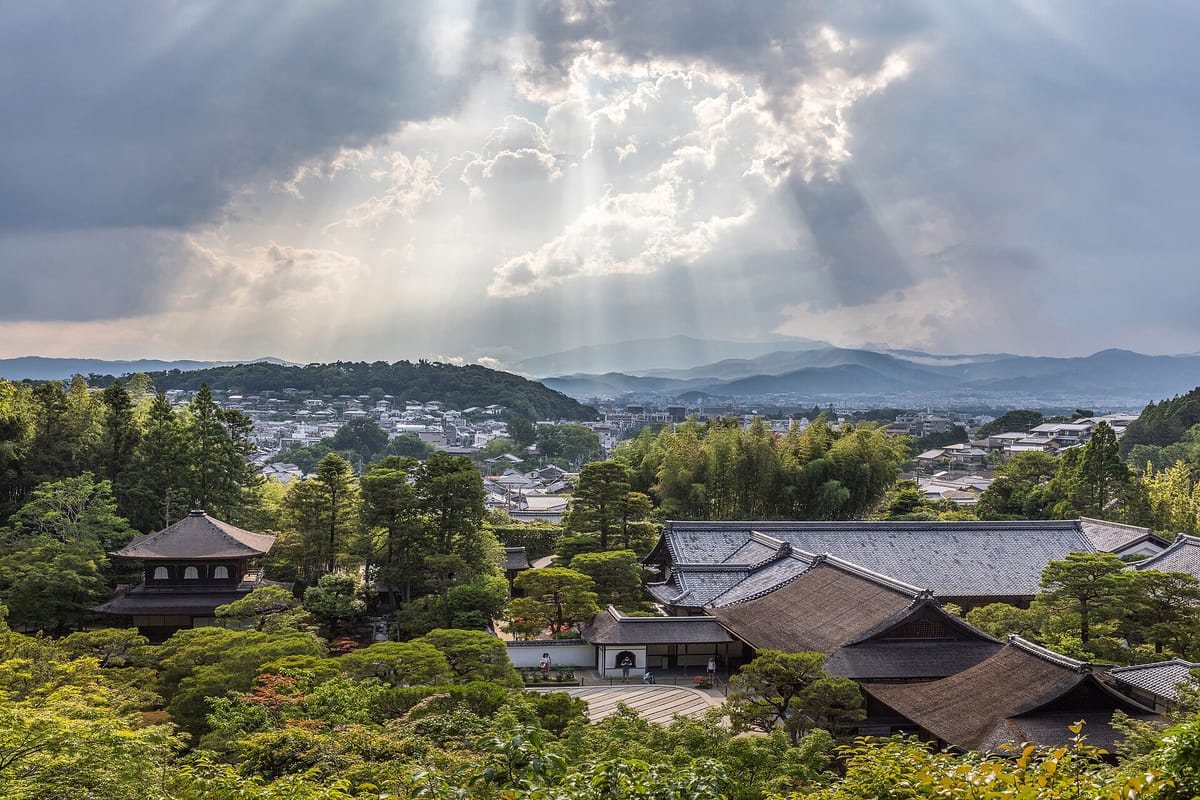
The path then winds through a moss garden and climbs the hillside behind the temple. From the top you look down over the roofs and the sand garden to the city, the view in the photo at the top of this guide. The buildings are viewed from outside; the Tōgudō and the main hall open only for occasional special viewings.
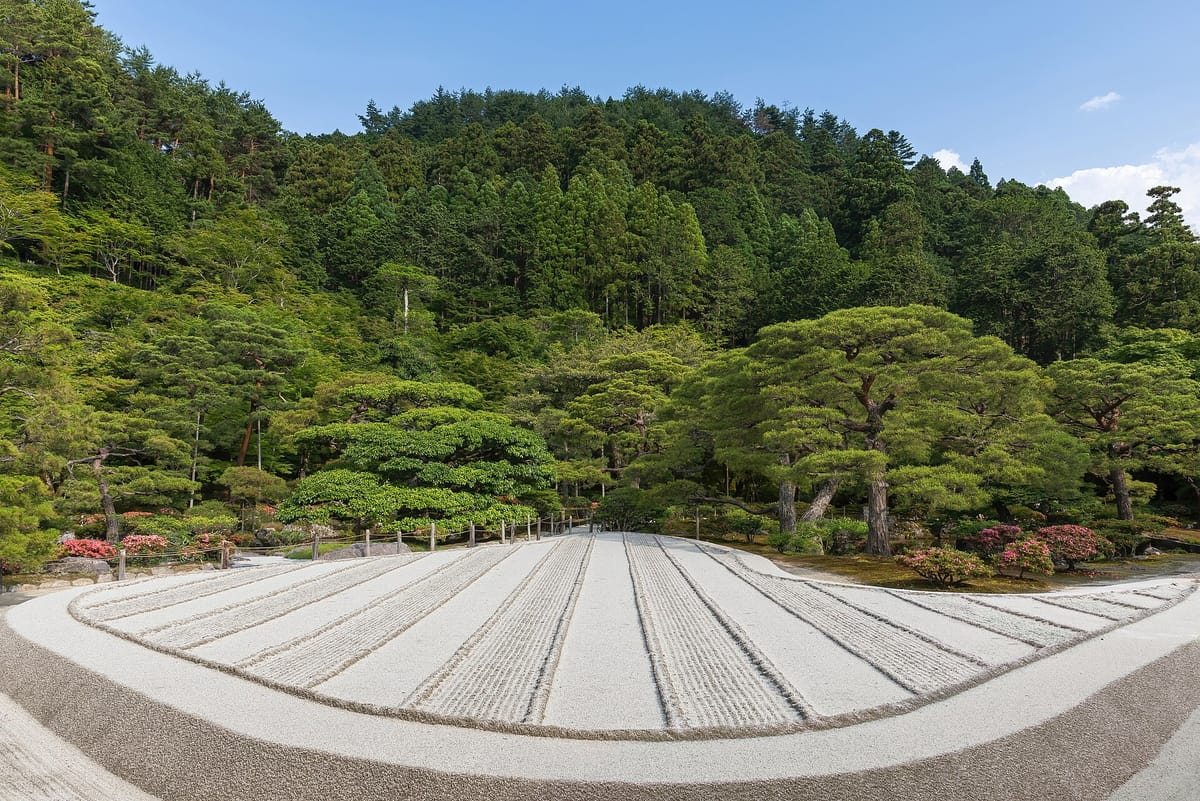
- Ginshadan: the raked sand garden, redone by the monks to keep its sharp lines.
- Kōgetsudai: the sand cone beside it, a striking shape with no single agreed meaning.
- Kannonden: the two-storey pavilion, Ginkaku, with a Kannon statue inside.
- Tōgudō: Yoshimasa's private hall, with the study room called Dōjinsai.
- Moss garden and pond: a stroll garden of streams, stones and many kinds of moss.
- Hillside viewpoint: the short climb behind the temple with a view over Kyoto.
The Philosopher's Path: canal, cherry trees and detours
The Philosopher's Path follows a branch of the Lake Biwa Canal, built in the late nineteenth century to bring water to Kyoto, along the foot of the eastern hills. It takes its name from the philosopher Nishida Kitarō, who is said to have walked here each day while he thought. Hundreds of cherry trees line the canal, and it has been chosen as one of Japan's hundred best roads.
The walk itself is gentle and almost flat. The best parts are the detours: small temples and shrines just up the hill to the east, reached by short lanes. Look out for the signs as you go and turn off for whichever catches your eye.
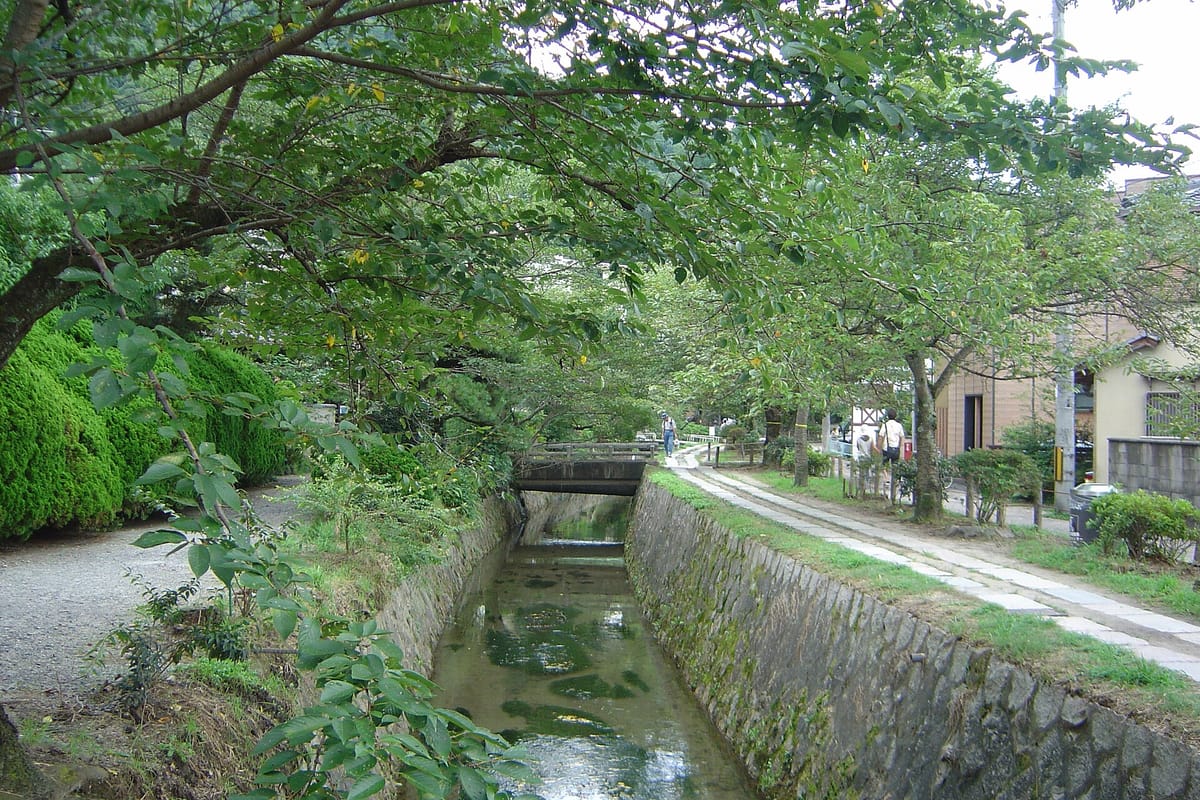
- Hōnen-in: a quiet temple with a thatched gate and two mounds of sand shaped with seasonal designs; the grounds are free.
- Ōtoyo Jinja: a small shrine known for its guardian mice instead of the usual lion-dogs.
- Cafés and craft shops: dotted along the canal, especially towards the middle of the walk.
- Nyakuōji bridge: the southern end of the path, near Eikandō and a short walk from Nanzen-ji.
Words on the signs from Ginkaku-ji to the canal
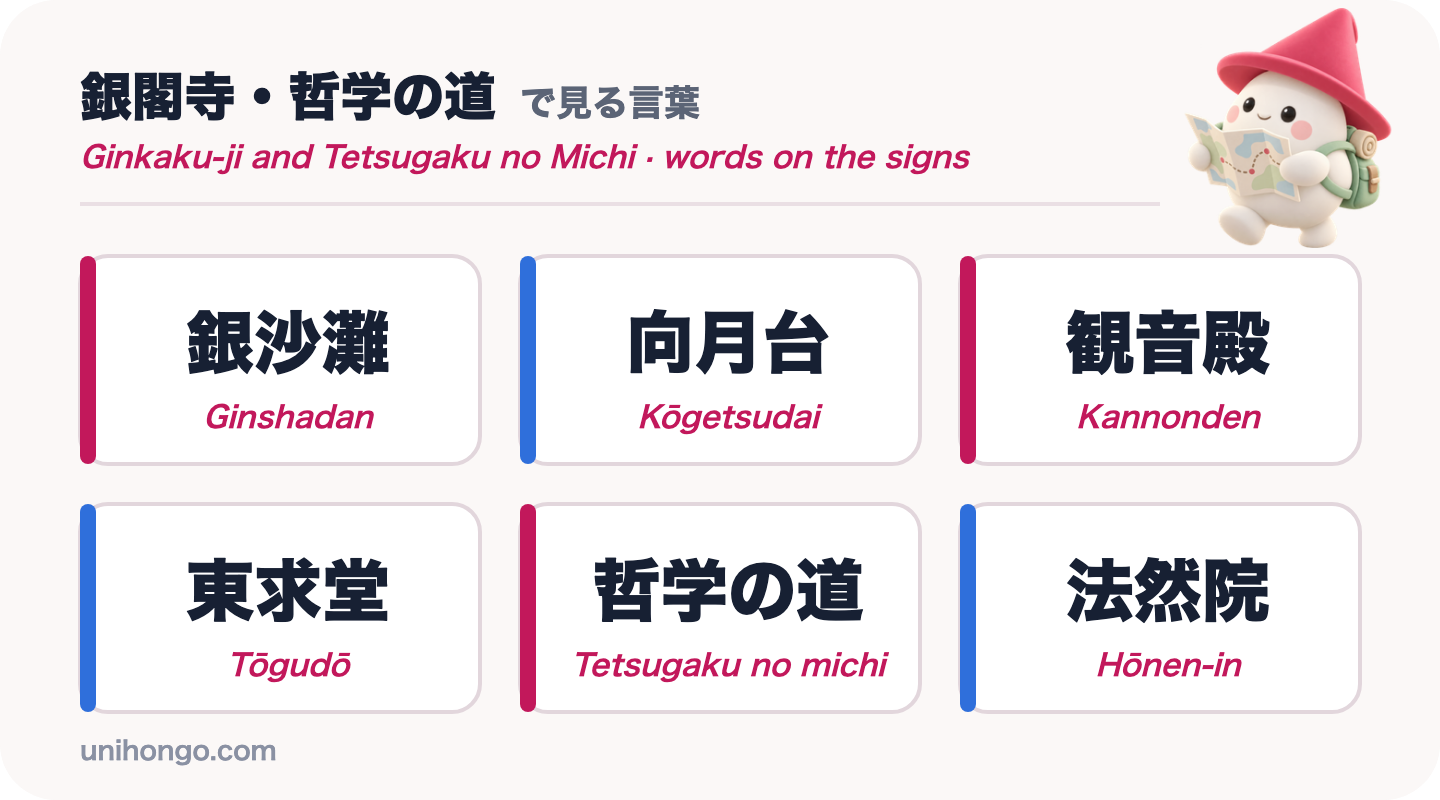
The garden signs at Ginkaku-ji use poetic names built from simple kanji. 銀沙灘 combines silver, sand and a stretch of sea or rapids; 向月台 is facing, moon, platform. Reading them slowly is half the pleasure of the visit.
Along the canal, stone markers and wooden signposts give the name of the path and point up the side lanes to temples. The table below covers the garden names, the path and the most common signpost words.
| Word | Reading | Meaning |
|---|---|---|
| 銀閣寺 | Ginkaku-ji | Temple of the Silver Pavilion |
| 慈照寺 | Jishō-ji | The temple's formal name |
| 銀沙灘 | Ginshadan | The raked sand garden, sea of silver sand |
| 向月台 | Kōgetsudai | The sand cone, platform facing the moon |
| 観音殿 | Kannonden | Kannon hall, the pavilion itself |
| 東求堂 | Tōgudō | Yoshimasa's private hall |
| 哲学の道 | Tetsugaku no michi | The Philosopher's Path |
| 法然院 | Hōnen-in | Temple with sand mounds, up a side lane |
| 疏水 | sosui | Canal, the waterway beside the path |
Japanese for the walk: directions, breaks and seasons
The Philosopher's Path is a residential walkway as well as a sight, and people walking it are generally relaxed and happy to point you in the right direction. The questions you need are about where the temples are, how far to the next one, and where to stop for a drink or a toilet.
If you visit in spring, you will hear a lot about the blossoms: whether they have opened yet, saite imasu, and whether they are in full bloom, mankai. It is the easiest small talk in Japan.
| Japanese | Romaji | Meaning |
|---|---|---|
| 法然院はこの道の途中ですか。 | Hōnen-in wa kono michi no tochū desu ka. | Is Hōnen-in along this path? |
| 永観堂へはどう行けばいいですか。 | Eikandō e wa dō ikeba ii desu ka. | How do I get to Eikandō? |
| 桜はもう咲いていますか。 | Sakura wa mō saite imasu ka. | Are the cherry blossoms out yet? |
| 近くにお手洗いはありますか。 | Chikaku ni o-tearai wa arimasu ka. | Is there a toilet nearby? |
| 抹茶ラテを一つお願いします。 | Matcha rate o hitotsu onegai shimasu. | One matcha latte, please. |
| 何時ごろが空いていますか。 | Nanji goro ga suite imasu ka. | Around what time is it quiet? |
Etiquette and timing
Ginkaku-ji is small and its paths are narrow, and the Philosopher's Path runs past people's homes, so a little care goes a long way.
- Keep to the marked route in Ginkaku-ji and do not step on the moss or touch the sand.
- Visit Ginkaku-ji at opening time; tour groups arrive from mid-morning.
- On the path, walk on the side, especially when cyclists and residents are passing.
- Do not climb the canal walls or lean out over the water for photos of the blossoms.
- Take your rubbish with you; there are few bins along the canal.
- In cherry blossom season, start early and plan for the crowds at both ends of the walk.
Practise the walk before you go
Asking a local whether you are on the right path, and how long it takes, is the conversation this walk is made for. Practise the four lines below until you can say them without reading, and listen for the answer's time, yonjippun kurai, about forty minutes, and michizoi, along the road.
Then practise with someone who answers back. In Unihongo, choose the Directions topic and ask your AI Sensei to play a local on the Philosopher's Path, or choose the Café topic to rehearse ordering on the way. Speaking the lines once before you arrive is what makes them come out on the day.
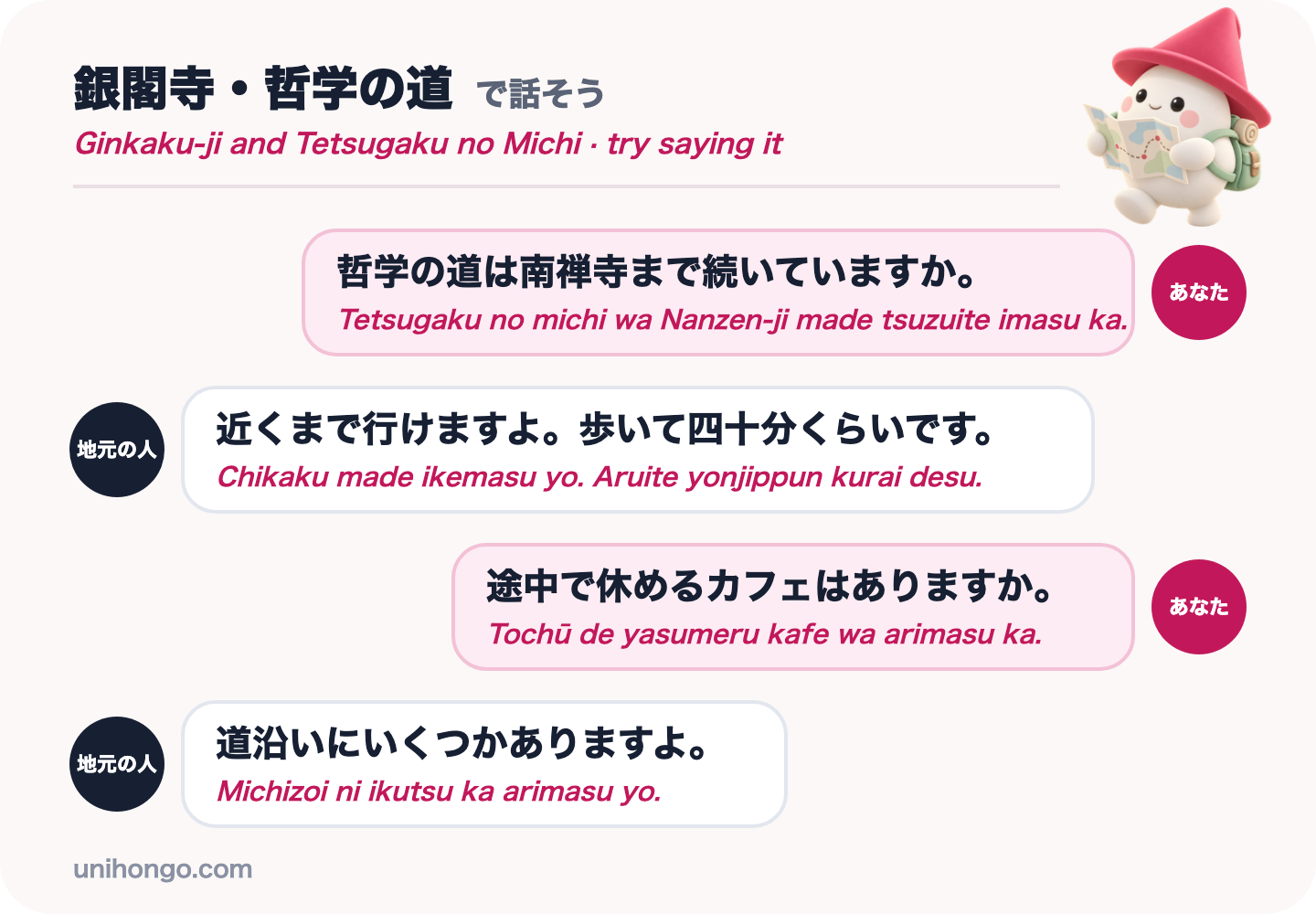
| Japanese | Romaji | Meaning |
|---|---|---|
| 哲学の道は南禅寺まで続いていますか。 | Tetsugaku no michi wa Nanzen-ji made tsuzuite imasu ka. | Does the Philosopher's Path go all the way to Nanzen-ji? |
| 近くまで行けますよ。歩いて四十分くらいです。 | Chikaku made ikemasu yo. Aruite yonjippun kurai desu. | It takes you close to it. About forty minutes on foot. |
| 途中で休めるカフェはありますか。 | Tochū de yasumeru kafe wa arimasu ka. | Is there a café where I can rest on the way? |
| 道沿いにいくつかありますよ。 | Michizoi ni ikutsu ka arimasu yo. | There are a few along the path. |
Official information
Ginkaku-ji's hours, fees and any special openings of the Tōgudō are published by Shōkoku-ji on its English site. For the path and seasonal blossom news, see Kyoto City's official travel guide.