

Why Inuyama Castle is worth the trip from Nagoya
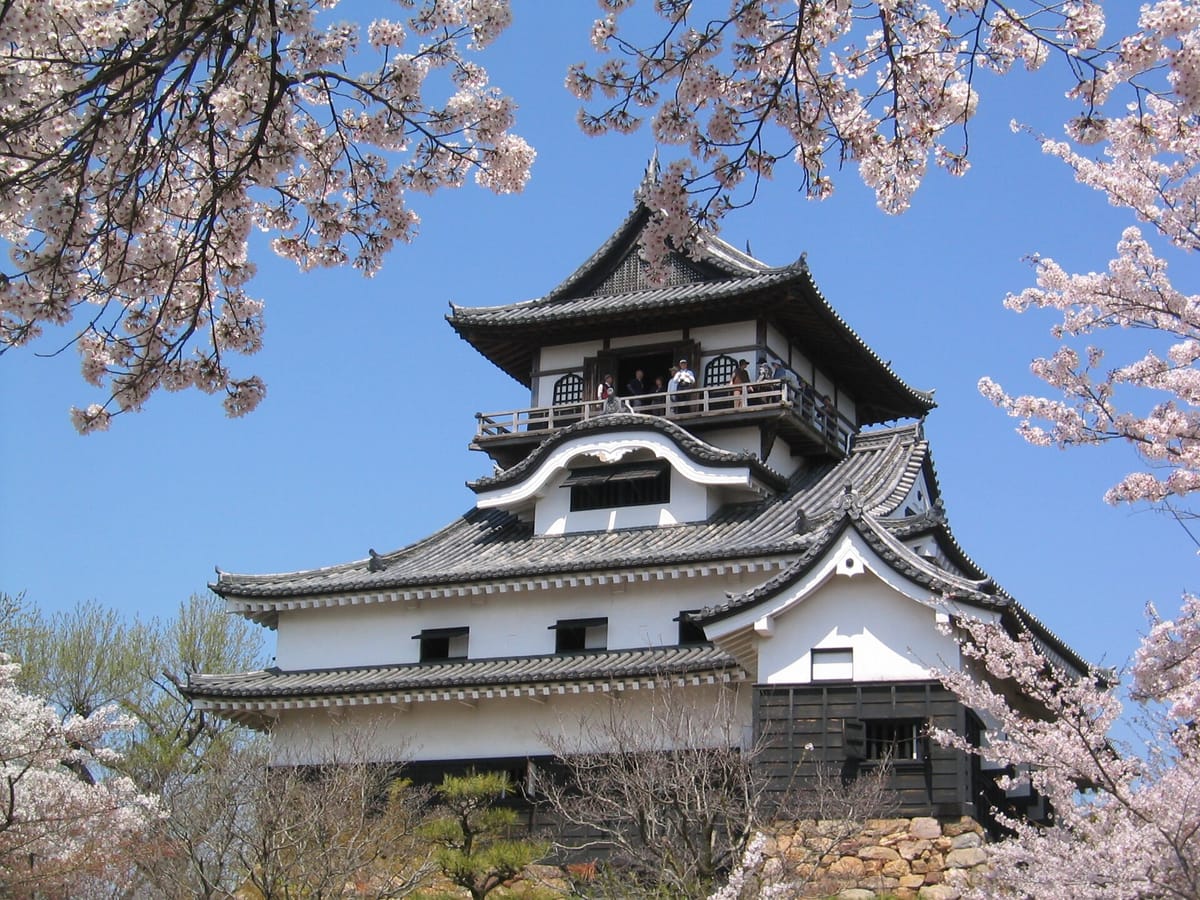
Inuyama Castle is said to have been built around 1537 by Oda Nobuyasu, an uncle of Oda Nobunaga, on a hill at the edge of the Nōbi Plain where the Kiso River leaves the mountains. That position made it strategic: it watched over the river, the roads to Gifu and the border between Owari and Mino provinces. The castle's own history points out that Nobunaga, Toyotomi Hideyoshi and Tokugawa Ieyasu, the three unifiers of Japan, each held it at one point on their way to power.
What makes it special today is that the keep is authentic. Japan has only twelve castles whose keeps survive from the feudal era, and only five, Himeji, Matsumoto, Hikone, Matsue and Inuyama, are National Treasures. The castle describes Inuyama's keep as the oldest of them. It is small compared with Himeji, but that is part of its charm: inside you walk on worn floorboards, climb ladder-like stairs and duck under beams that have held up the roof for centuries.
For a Japanese learner, Inuyama is a friendly, compact place to practise. The signs are clear and short, the staff are used to visitors from overseas, and the castle town below is full of small shops where a few words of Japanese go a long way.
Getting there: Meitetsu to Inuyama Station and the castle town
From Meitetsu Nagoya Station, next to JR Nagoya Station, take an express, kyūkō, or semi-express, junkyū, on the Meitetsu Inuyama Line bound for Shin-Unuma. The castle's official site gives the direct journey as about twenty-five minutes. Get off at Inuyama Station and leave by the West Exit, nishi-guchi, then walk through the castle town to the foot of the hill, about fifteen to twenty minutes. Trains from Chūbu Centrair Airport also run through to Inuyama without a change.
At the top of the castle town, three paths lead up to the ticket office. The official site recommends the Ōtemichi, the main approach, which passes the stone marker with the castle's name. The other two go through shrines: the path through Haritsuna Jinja, entered by the big torii straight ahead, and the path through Sankō Inari, a small shrine with a tunnel of red torii on the left.
| Japanese | Romaji | Meaning |
|---|---|---|
| 犬山に行く急行は何番線ですか。 | Inuyama ni iku kyūkō wa nanbansen desu ka. | Which platform is the express to Inuyama on? |
| この電車は犬山駅に止まりますか。 | Kono densha wa Inuyama-eki ni tomarimasu ka. | Does this train stop at Inuyama Station? |
| 犬山城は西口ですか。 | Inuyama-jō wa nishi-guchi desu ka. | Is Inuyama Castle from the West Exit? |
| 城下町を通って行けますか。 | Jōkamachi o tōtte ikemasu ka. | Can I go through the castle town? |
| 歩いて何分くらいかかりますか。 | Aruite nanpun kurai kakarimasu ka. | About how many minutes does it take on foot? |
Inside the keep: steep stairs, old beams and the balcony
The keep has two floors below ground, built into the stone base, and four floors above. You enter at the bottom and climb through each level on narrow, steep wooden stairs, holding your bag of shoes in one hand and the rope or rail in the other. The rooms are mostly bare, which lets you see the structure: massive pillars, rough-hewn beams and the small openings once used for defence.
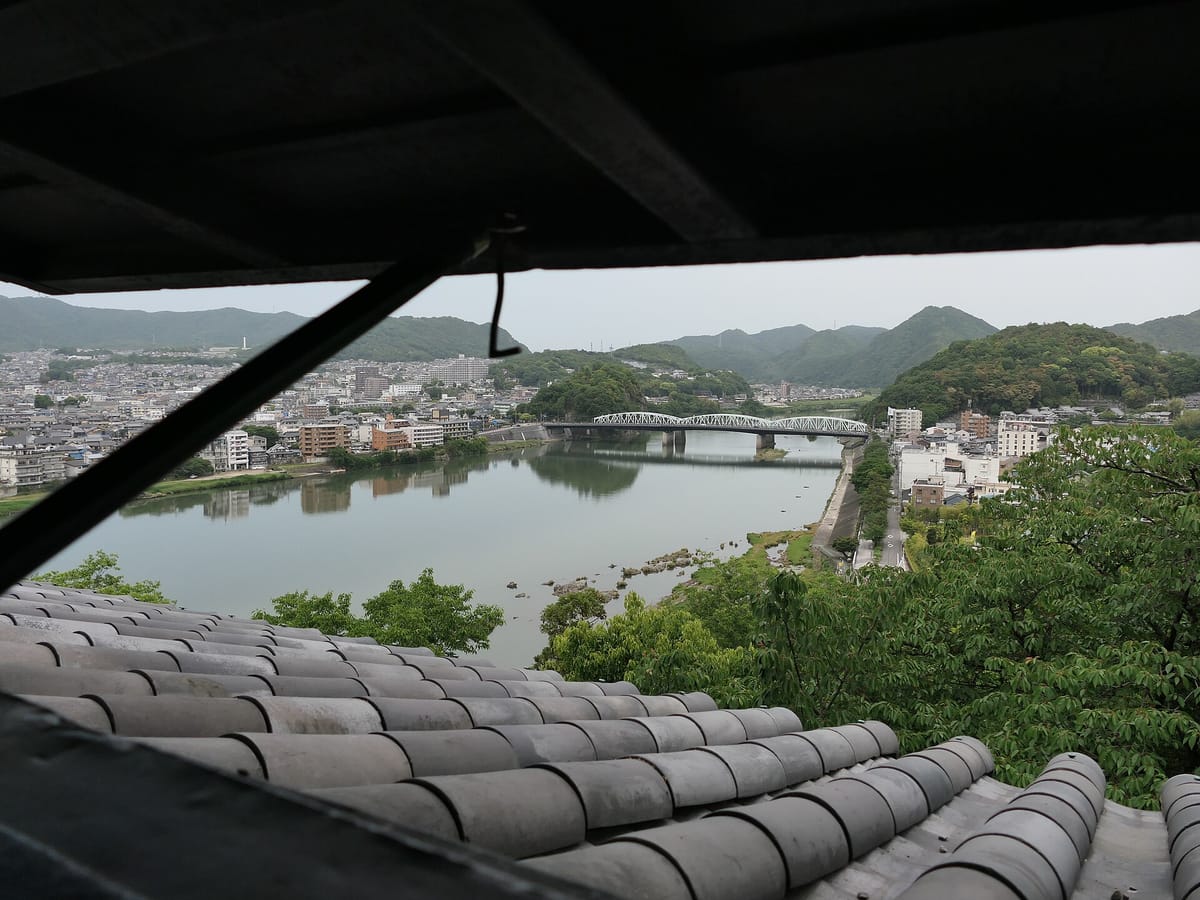
The reward is the top floor. A narrow wooden balcony, mawari-en, runs right round the outside, and from it you see the Kiso River curving below, the bridge to Gifu Prefecture and the flat plain stretching south towards Nagoya.
- Tenshu: the keep itself, a National Treasure.
- Mawari-en: the balcony around the top floor, with views of the river and plain.
- Ishigaki: the stone walls of the hill; climbing them is prohibited.
- Haritsuna Jinja: a shrine at the foot of the castle, on one of the paths up.
- Sankō Inari: a small Inari shrine with red torii, on another path up.
- Jōkamachi: the old castle town, with sweet shops, sake breweries and small museums on the way from the station.
- Uraku-en: a garden nearby holding the Jo-an tea room, itself a National Treasure; combined tickets are sold with the castle.
Words on the castle signs
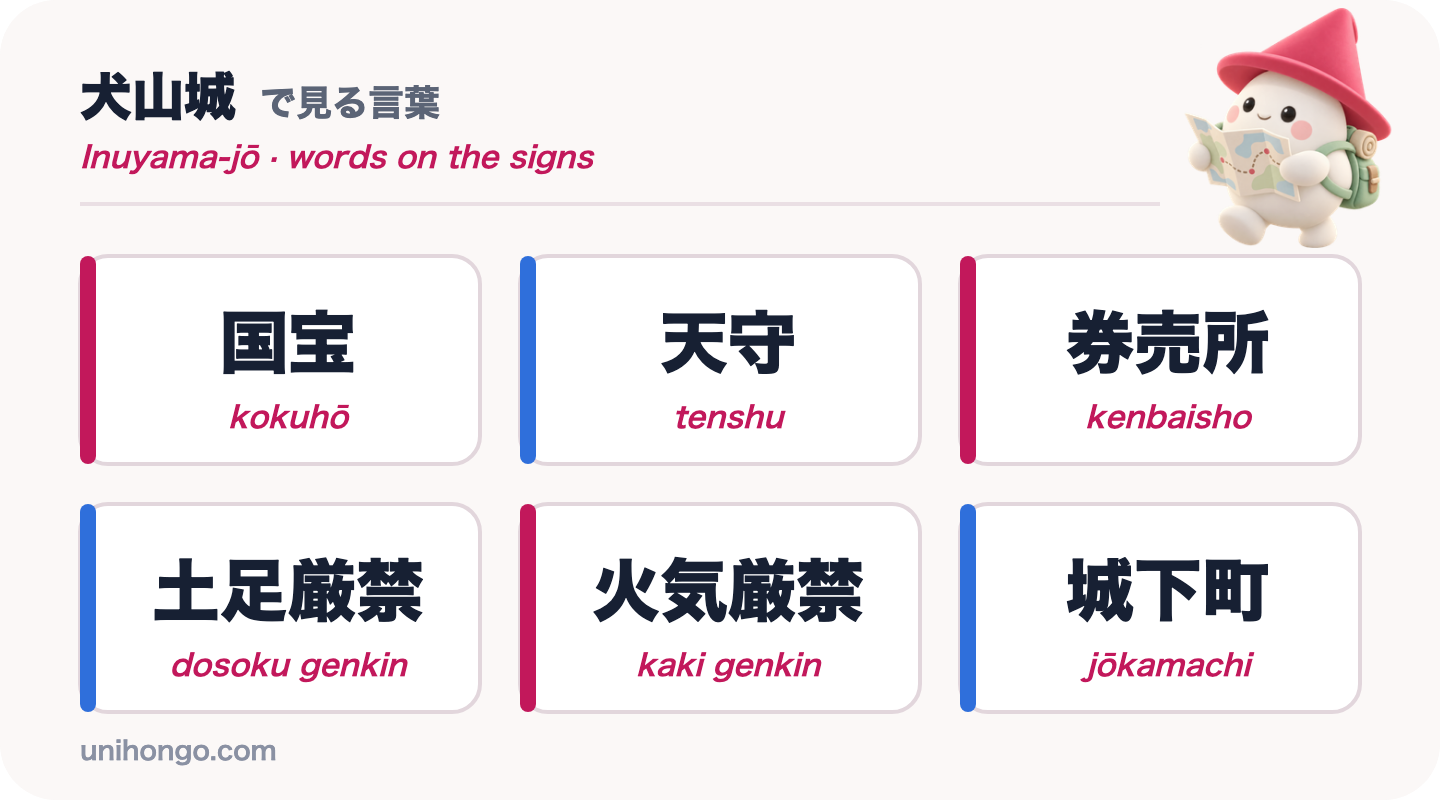
Two sign words at Inuyama end in the same pair of kanji, 厳禁, genkin, strictly forbidden. 土足厳禁 means no outdoor shoes, because the keep's floors are original wood; 火気厳禁 means no fire or flames, and the castle's rules apply it to the whole hill, where there is no smoking area at all. Both are signs you will meet again at temples, onsen and old wooden buildings all over Japan.
The ticket office is 券売所, kenbaisho, literally ticket-selling place. On the way up from the station you will also read 城下町, jōkamachi, the town below the castle, on maps and street signs.
| Word | Reading | Meaning |
|---|---|---|
| 国宝 | kokuhō | National Treasure |
| 天守 | tenshu | Castle keep |
| 券売所 | kenbaisho | Ticket office |
| 入場門 | nyūjōmon | Entrance gate |
| 土足厳禁 | dosoku genkin | No outdoor shoes |
| 火気厳禁 | kaki genkin | No fire or smoking |
| 城下町 | jōkamachi | Castle town |
| 大手道 | Ōtemichi | The main approach to the castle |
| 御城印 | gojōin | Castle seal, a souvenir stamp sheet |
Japanese for tickets, shoe bags and the queue
The ticket office has machines for castle-only tickets and a staffed window for groups and combined tickets; the official site says cards, transport IC cards and QR payments are accepted, but combined tickets are cash only at the window. Show your ticket at the entrance gate, and if there is a line, queue along the posts to the keep.
At the keep's entrance, shoes come off. Plastic bags are provided; put your shoes in and carry them with you through the keep, and take the bag home afterwards. Large luggage is not allowed inside, so use the coin lockers by the ticket office, at the tourist information centre by the car park or outside the ticket gates at Meitetsu Inuyama Station.
| Japanese | Romaji | Meaning |
|---|---|---|
| 大人一枚お願いします。 | Otona ichimai onegai shimasu. | One adult ticket, please. |
| 有楽苑とのセット券はありますか。 | Urakuen to no setto-ken wa arimasu ka. | Is there a combined ticket with Uraku-en? |
| セット券は現金だけですか。 | Setto-ken wa genkin dake desu ka. | Are combined tickets cash only? |
| コインロッカーはどこですか。 | Koin rokkā wa doko desu ka. | Where are the coin lockers? |
| 袋はここでもらえますか。 | Fukuro wa koko de moraemasu ka. | Can I get a bag here? |
| 御城印はどこで買えますか。 | Gojōin wa doko de kaemasu ka. | Where can I buy a castle seal? |
| 英語のパンフレットはありますか。 | Eigo no panfuretto wa arimasu ka. | Do you have a leaflet in English? |
House rules, timing and practical tips
Inuyama Castle's rules are there to protect a wooden building that has survived for centuries. The official site lists them clearly, and staff will remind you if you forget.
- No smoking or fire anywhere on the castle hill, and no climbing the stone walls.
- Selfie sticks, monopods and tripods are not allowed, and neither is live-streaming; drones are banned without special permission.
- No food or drink inside the keep apart from water in a bottle with a cap; you may eat a packed lunch in the grounds past the entrance gate, and take your rubbish home.
- Pets are not allowed, even in a bag or carrier.
- The stairs are steep and narrow. Wear clothes you can move in, and keep one hand free.
- Come early on weekends and in spring and autumn, when the wait for the keep can be over an hour. The castle posts current waiting times on its website.
- Visit in early April for cherry blossom and the Inuyama Festival, or in summer for cormorant fishing on the Kiso River.
Practise the visit before you go
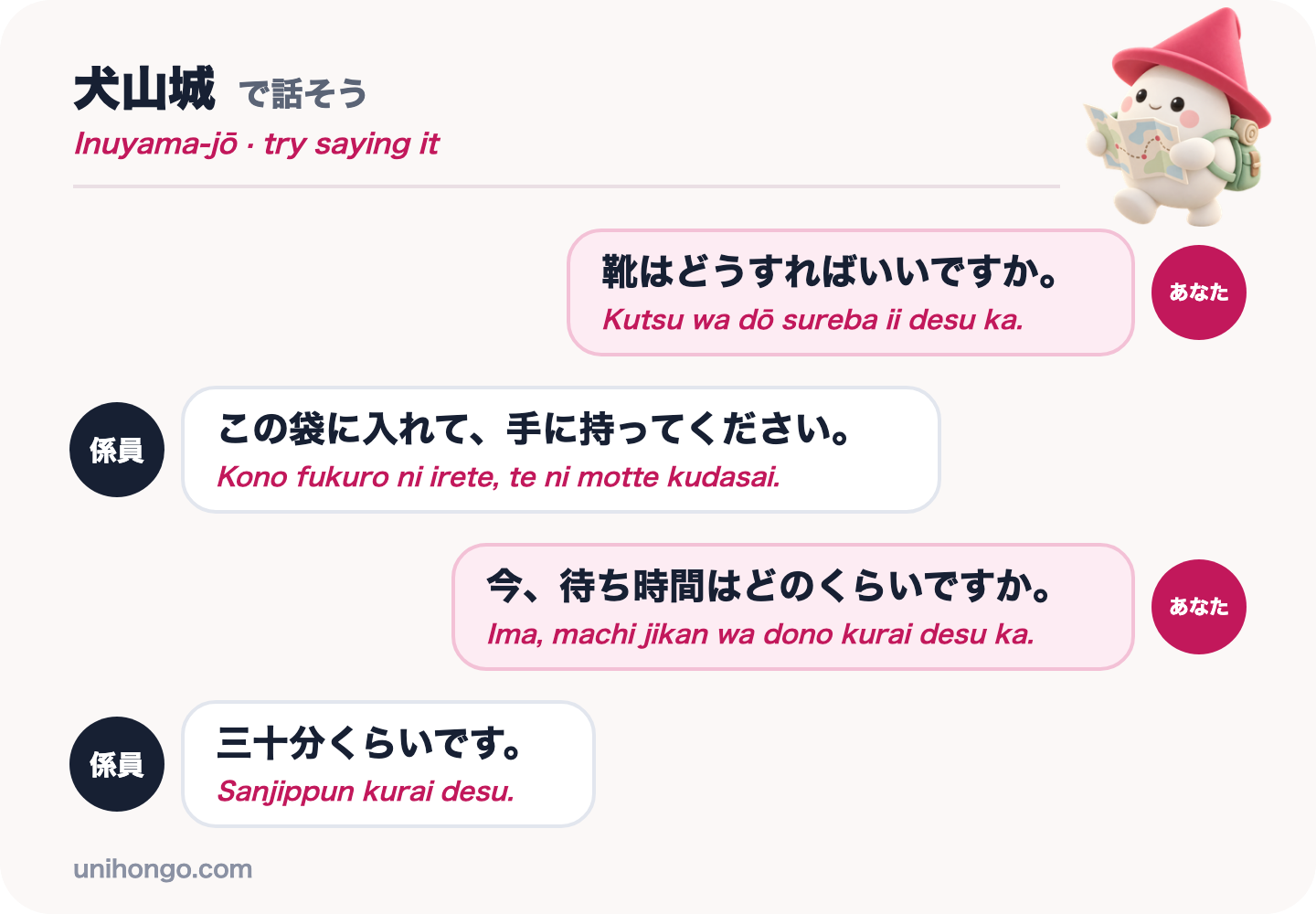
At the entrance to the keep, the two questions are about shoes and waiting. The staff answer uses the te-form to link two instructions, put them in this bag, and carry them, which is a pattern you will hear everywhere in Japan. Practise the four lines until you can say them without reading.
Then practise with someone who answers back. In Unihongo, choose the Sightseeing topic and ask your AI Sensei to play a member of staff at the castle, or choose Directions to rehearse finding your way from Inuyama Station through the castle town. A little speaking before you go makes the real conversation easy.
| Japanese | Romaji | Meaning |
|---|---|---|
| 靴はどうすればいいですか。 | Kutsu wa dō sureba ii desu ka. | What should I do with my shoes? |
| この袋に入れて、手に持ってください。 | Kono fukuro ni irete, te ni motte kudasai. | Put them in this bag and carry them with you. |
| 今、待ち時間はどのくらいですか。 | Ima, machi jikan wa dono kurai desu ka. | How long is the wait now? |
| 三十分くらいです。 | Sanjippun kurai desu. | About thirty minutes. |
Official information
Opening hours, the waiting time, admission, combined tickets and the visitor rules are published on the castle's official site, in Japanese, with pages in several other languages. Check it before you go, especially at weekends and during the spring festival.