

Finding and booking a class
A cooking class is a ryōri kyōshitsu, and a single session is often called a taiken, an experience, or a ressun. Listings use words like katei ryōri, home cooking, washoku, Japanese cuisine, and the name of the dish: gyōza, sushi, ramen, tempura, wagashi. Classes for visitors are usually booked online, but smaller schools and home kitchens may still prefer a phone call or a message.
The questions worth asking before you pay are the practical ones: how many people, whether English is available, what to bring, how long the class runs and what happens if you cancel. Fees, group sizes and cancellation rules vary from class to class, so ask rather than assume. Most classes provide aprons and ingredients, but some ask you to bring a hand towel or hair tie.
| Japanese | Romaji | Meaning |
|---|---|---|
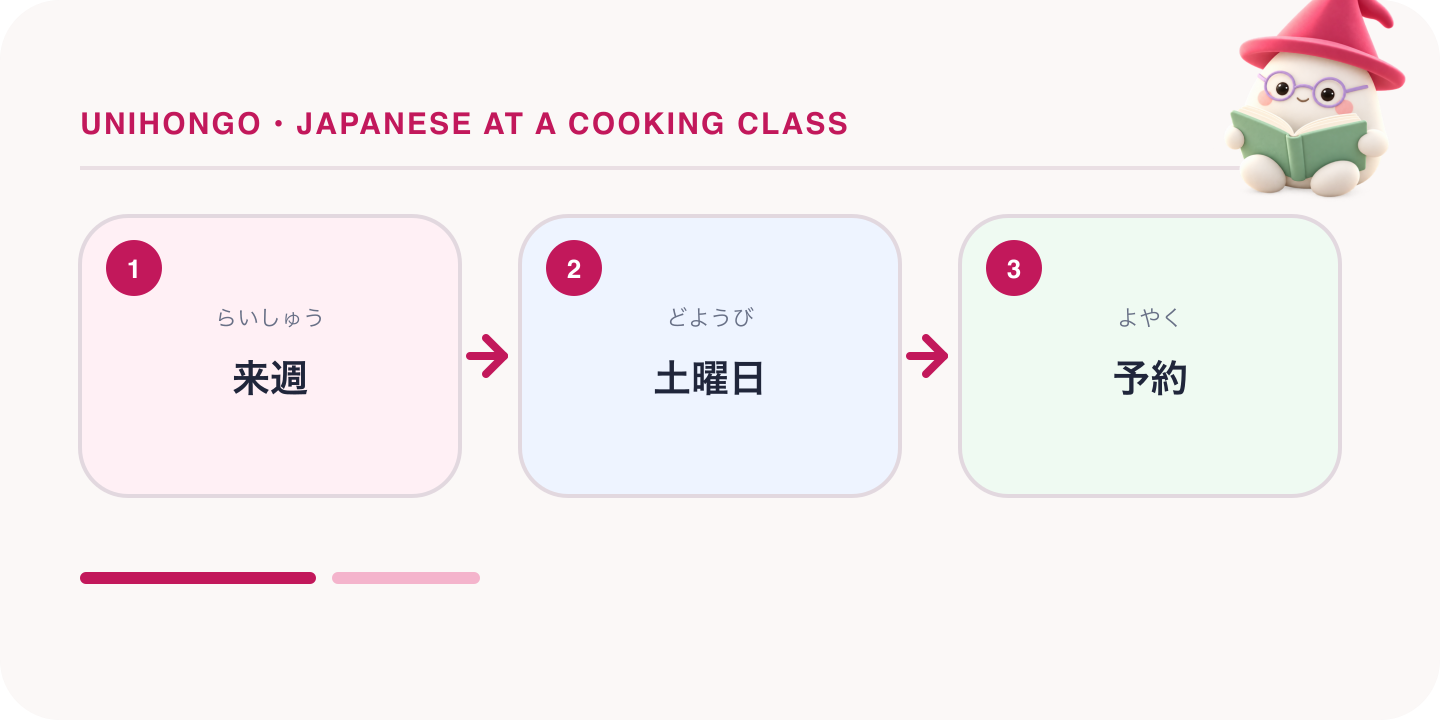
| 来週の土曜日に予約したいんですが。 | Raishū no doyōbi ni yoyaku shitai n desu ga. | I'd like to book for next Saturday. |
| 二名で予約できますか。 | Nimei de yoyaku dekimasu ka. | Can I book for two people? |
| 英語対応のクラスはありますか。 | Eigo taiō no kurasu wa arimasu ka. | Is there a class with English support? |
| 持ち物は何ですか。 | Mochimono wa nan desu ka. | What should I bring? |
| エプロンは貸してもらえますか。 | Epuron wa kashite moraemasu ka. | Can I borrow an apron? |
| 何時に集合ですか。 | Nanji ni shūgō desu ka. | What time do we meet? |
| キャンセル料はかかりますか。 | Kyanseru-ryō wa kakarimasu ka. | Is there a cancellation fee? |
Allergies, diets and things you cannot eat
Say this at booking, not when the fish is already in the pan. Instructors plan a menu and shop for it in advance, and swapping an ingredient on the day is often impossible. The core sentence is the ingredient plus arerugī ga arimasu, I have an allergy to. For something you avoid by choice, use tabemasen, I don't eat, or taberaremasen, I can't eat, which is softer and covers both.
Japanese food hides ingredients in places you might not expect. Dashi stock is usually made with katsuobushi, dried bonito, so many vegetable dishes are not vegetarian. Soy sauce contains wheat. Miso can contain fish stock when sold as a ready mix. Ask directly about the sauce or the stock rather than the dish, and be specific about what you can and cannot have. The word for vegetarian is bejitarian and vegan is bīgan, but what they exclude is not always shared, so spell it out.
| Japanese | Romaji | Meaning |
|---|---|---|
| えびアレルギーがあります。 | Ebi arerugī ga arimasu. | I have a shrimp allergy. |
| 卵は食べられません。 | Tamago wa taberaremasen. | I can't eat eggs. |
| ベジタリアンなので、肉と魚は食べません。 | Bejitarian na node, niku to sakana wa tabemasen. | I'm vegetarian, so I don't eat meat or fish. |
| 出汁に魚は入っていますか。 | Dashi ni sakana wa haitte imasu ka. | Is there fish in the stock? |
| 小麦の入っていない醤油はありますか。 | Komugi no haitte inai shōyu wa arimasu ka. | Do you have soy sauce without wheat? |
| 代わりの材料はありますか。 | Kawari no zairyō wa arimasu ka. | Is there a substitute ingredient? |
| 豚肉は宗教上の理由で食べません。 | Butaniku wa shūkyō-jō no riyū de tabemasen. | I don't eat pork for religious reasons. |
The instructor's verbs: kitte, mazete, itamete
Once the class starts, the instructor's Japanese collapses into a handful of te-form verbs plus kudasai. The dictionary forms help you recognise the pattern: kiru becomes kitte, cut; mazeru becomes mazete, mix; itameru becomes itamete, stir-fry; niru becomes nite, simmer; muku becomes muite, peel; ireru becomes irete, put in. In a friendly class you may hear the bare kitte or a softened kitte ne, and in a formal one kitte kudasai.
Adverbs before the verb tell you how: usuku, thinly; komakaku, finely; yoku, well; sotto, gently; hayaku, quickly. Heat levels come as tsuyobi, high heat; chūbi, medium; and yowabi, low. When you are not sure you have understood, do the first cut and ask kō desu ka, like this?
| Japanese | Romaji | Meaning |
|---|---|---|
| 玉ねぎを薄く切ってください。 | Tamanegi o usuku kitte kudasai. | Please slice the onion thinly. |
| 一口大に切ってください。 | Hitokuchi-dai ni kitte kudasai. | Please cut it into bite-sized pieces. |
| よく混ぜてください。 | Yoku mazete kudasai. | Please mix it well. |
| 強火で炒めてください。 | Tsuyobi de itamete kudasai. | Please stir-fry it on high heat. |
| 弱火で十分煮てください。 | Yowabi de juppun nite kudasai. | Please simmer it on low heat for ten minutes. |
| 皮をむいてください。 | Kawa o muite kudasai. | Please peel it. |
| ひっくり返してください。 | Hikkurikaeshite kudasai. | Please flip it over. |
| こうですか。 | Kō desu ka. | Like this? |
| もう一度見せてもらえますか。 | Mō ichido misete moraemasu ka. | Could you show me once more? |
Asking how much and how long
Japanese home recipes are measured in spoons: ōsaji, a tablespoon, and kosaji, a teaspoon, counted with hai, so ōsaji ippai is one tablespoon and kosaji nihai is two teaspoons. Half a spoon is hanbun. A cup is kappu. Then come the vaguer words that frustrate learners: shōshō, a pinch; hitotsumami, a small pinch between the fingers; and tekiryō, an appropriate amount, which really means as much as you think it needs. Ask the instructor to show you the first time.
The question word for amount is dore kurai or dono kurai, how much or how long, and for time nanpun kurai, about how many minutes. When you have already added something and are not sure, kore de tarimasu ka, is this enough, or mō sukoshi ireta hō ga ii desu ka, should I add a bit more, get you a quick yes or no. For heat, hikagen wa kore de ii desu ka checks the flame.
| Japanese | Romaji | Meaning |
|---|---|---|
| 醤油はどれくらい入れますか。 | Shōyu wa dore kurai iremasu ka. | How much soy sauce do I put in? |
| 大さじ一杯です。 | Ōsaji ippai desu. | One tablespoon. |
| 塩は少々です。 | Shio wa shōshō desu. | Just a pinch of salt. |
| 何分くらい煮ますか。 | Nanpun kurai nimasu ka. | About how many minutes do I simmer it? |
| これで足りますか。 | Kore de tarimasu ka. | Is this enough? |
| もう少し入れたほうがいいですか。 | Mō sukoshi ireta hō ga ii desu ka. | Should I add a bit more? |
| 火加減はこれでいいですか。 | Hikagen wa kore de ii desu ka. | Is the heat right like this? |
Kitchen safety words
Two words matter more than any others: abunai, dangerous or watch out, and atsui, hot to the touch. When you hear either, stop moving and look at the instructor. You will also hear neko no te, cat's paw, the instruction to curl your fingertips under while holding food against the knife, and hi o tomete, turn off the heat. The table below covers the words most likely to come up around knives, oil and hot pans.
| Word | Reading | Meaning |
|---|---|---|
| 危ない | abunai | Watch out, dangerous |
| 熱い | atsui | Hot to the touch |
| 火傷 | yakedo | A burn |
| 包丁 | hōchō | Kitchen knife |
| 猫の手 | neko no te | Cat's paw: fingertips curled under |
| まな板 | manaita | Chopping board |
| 火を止める | hi o tomeru | To turn off the heat |
| 火加減 | hikagen | Heat level, flame strength |
| 油が跳ねる | abura ga haneru | The oil spits |
| 鍋つかみ | nabetsukami | Oven glove, pot holder |
| 蓋 | futa | Lid |
| 絆創膏 | bansōkō | Sticking plaster |
If you do get hurt, say it plainly: yubi o kitte shimaimashita, I've cut my finger, or yakedo shimashita, I've burned myself. Instructors keep a first-aid kit and would rather stop for a minute than have you carry on.
Tasting, complimenting and eating together
Ajimi is tasting for seasoning, and the instructor will hand you a spoon with ajimi shite mite kudasai, have a taste. The useful replies are about balance: chōdo ii, just right; chotto usui, a bit weak or under-seasoned; sukoshi shoppai, a bit salty; amai, sweet; karai, spicy or hot. Usui and koi, weak and strong, are the natural words for seasoning strength.
Most classes end with everyone eating together. Say itadakimasu before the first bite and gochisōsama deshita at the end, exactly as at a restaurant. Compliments in Japanese lean on oishii and on giving credit: sensei no okage desu, it's thanks to you. A phrase Japanese hosts love to hear is jibun de tsukuru to motto oishii desu ne, it tastes even better when you make it yourself.
| Japanese | Romaji | Meaning |
|---|---|---|
| 味見してみてください。 | Ajimi shite mite kudasai. | Have a taste. |
| ちょうどいいです。 | Chōdo ii desu. | It's just right. |
| ちょっと薄いかもしれません。 | Chotto usui kamo shiremasen. | It might be a bit under-seasoned. |
| いただきます。 | Itadakimasu. | Said before eating. |
| すごくおいしいです。 | Sugoku oishii desu. | It's really delicious. |
| 自分で作ると、もっとおいしいですね。 | Jibun de tsukuru to, motto oishii desu ne. | It tastes even better when you make it yourself. |
| 先生のおかげです。 | Sensei no okage desu. | It's thanks to you, teacher. |
| ごちそうさまでした。 | Gochisōsama deshita. | Thank you for the meal. |
Taking the recipe home
The last ten minutes are your chance to make the class useful after you leave. Most instructors give a printed recipe or send one by email, but not all do, and some prefer that you take photos of the demonstration rather than film it. Ask before filming anyone. If a seasoning was the secret of the dish, ask whether it exists abroad; instructors who teach visitors usually know which substitutes work.
- Reshipi o moraemasu ka: could I have the recipe?
- Shashin o totte mo ii desu ka: may I take photos?
- Kono chōmiryō wa kaigai de mo kaemasu ka: can I buy this seasoning abroad?
- Kawari ni nani o tsukaeba ii desu ka: what can I use instead?
- Nokori wa mochikaeremasu ka: can I take the leftovers home?
- Himochi wa dore kurai desu ka: how long does it keep?
- Kyō wa arigatō gozaimashita, totemo benkyō ni narimashita: thank you for today, I learned a lot
The leftovers question depends on the class; some pack them for you, others cannot for hygiene reasons, so accept a no gracefully. For the recipe vocabulary itself, such as measurement words, cutting styles and the names of common seasonings, the separate guide on Japanese for cooking and recipes goes into far more detail than fits here.
Mistakes and when something goes wrong
Things will go wrong in a cooking class, and that is the point. Japanese instructors are patient, but they need to hear about a problem in time to fix it. The pattern for confessing a small disaster is the te form plus shimaimashita: koboshite shimaimashita, I've spilled it; kogashite shimaimashita, I've burned it; junban o machigaete shimaimashita, I did the steps in the wrong order. Shimaimashita adds the regret that makes it sound like an apology.
If the class is moving too fast, say sukoshi hayai desu, it's a bit fast, or mō ichido onegai shimasu, once more please. If you are running late, message the host before the start time, and say okurete sumimasen on arrival.
| Japanese | Romaji | Meaning |
|---|---|---|
| すみません、こぼしてしまいました。 | Sumimasen, koboshite shimaimashita. | Sorry, I've spilled it. |
| 焦がしてしまいました。 | Kogashite shimaimashita. | I've burned it. |
| 順番を間違えてしまいました。 | Junban o machigaete shimaimashita. | I did the steps in the wrong order. |
| ちょっと速いので、もう一度お願いします。 | Chotto hayai node, mō ichido onegai shimasu. | It's a bit fast, could you do it once more? |
| 分からないので、手伝ってもらえますか。 | Wakaranai node, tetsudatte moraemasu ka. | I'm not sure, could you help me? |
| 遅れてすみません。 | Okurete sumimasen. | Sorry I'm late. |