

Why Zenkō-ji is worth the trip to Nagano
Zenkō-ji is one of the oldest and most important pilgrimage temples in Japan, and Nagano began life as the town at its gate. The temple's own history dates it to 642. Its principal image is an Amida triad sharing a single halo, said to have come from India by way of Korea as the first Buddhist image in Japan, and it has been a hibutsu, a hidden Buddha, since 654. No one alive has seen it; even the priests work with a copy.
What makes Zenkō-ji unusual is its openness. It is run jointly by a Tendai temple and a Jōdo temple rather than belonging to one sect, and for centuries it accepted women and people of every school of Buddhism when many temples did not. There is an old saying, ushi ni hikarete Zenkōji mairi, led by a cow to Zenkō-ji, about a woman who chased a cow to the temple and found faith there by accident. People use it today for ending up somewhere good without planning to.
The main hall, the hondō, dates from 1707 and is a National Treasure, with a deep, two-level roof and room inside for hundreds of worshippers on tatami. For a learner, the temple is a gentle place to practise: the visit follows one straight line from the gate to the hall, the staff are used to visitors from everywhere, and the key words, from gate names to ticket types, repeat at every corner.
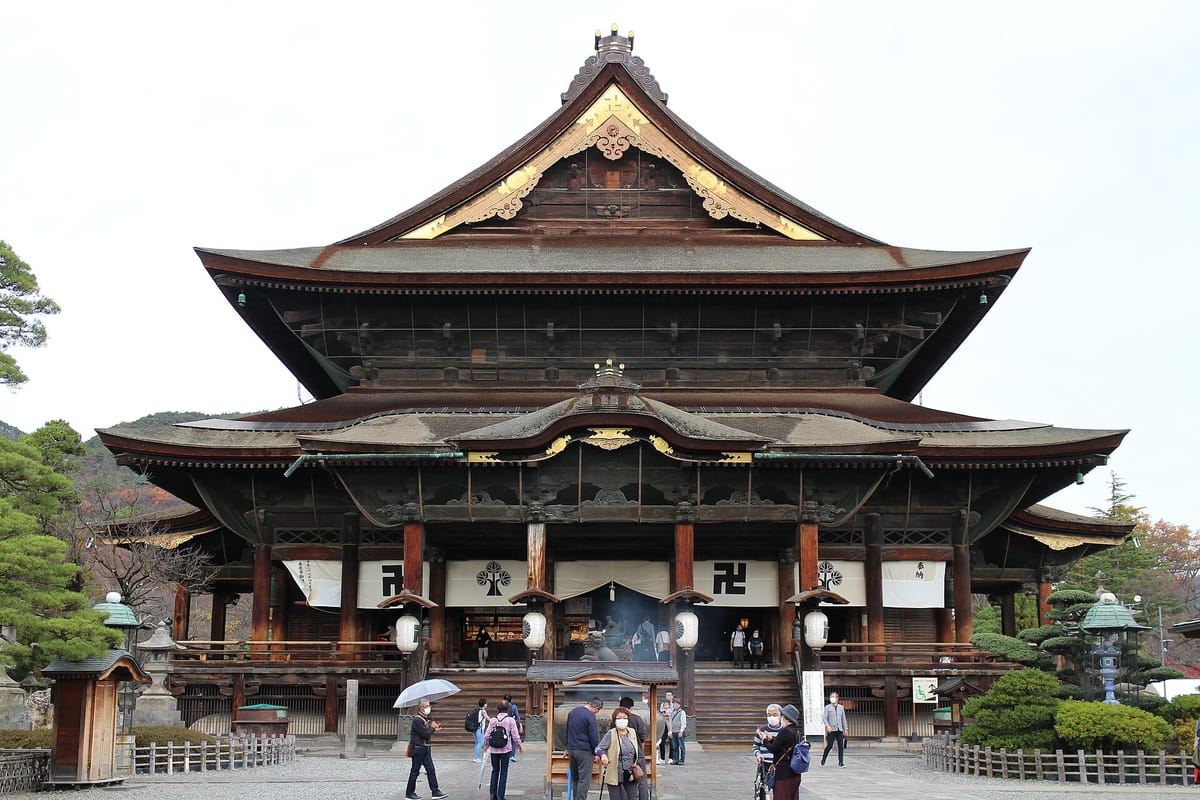
Getting there: Nagano Station, the Zenkōji exit and the Daimon stop
Nagano is on the Hokuriku Shinkansen, about an hour and a half from Tokyo on the fastest trains. At Nagano Station, follow the signs for the Zenkōji exit, Zenkōji-guchi, where the bus rotary is. The temple's own access page points you to bus stop number 1, bound for Zenkō-ji; ride about fifteen minutes to the Zenkōji Daimon stop, then walk about five minutes up the approach to the main hall. You pay as you get off, by IC card or cash.
Walking is just as good. The main street, Chūō-dōri, climbs straight north from the station to the temple in about thirty minutes, past old storehouses, cafés and shops, and it is the traditional pilgrim route. A third option is the Nagano Dentetsu line, whose Zenkōjishita Station is a short walk east of the grounds.
| Japanese | Romaji | Meaning |
|---|---|---|
| 善光寺行きのバスはどこから出ますか。 | Zenkōji-yuki no basu wa doko kara demasu ka. | Where does the bus to Zenkō-ji leave from? |
| 善光寺大門で降りたいんですが。 | Zenkōji Daimon de oritai n desu ga. | I would like to get off at Zenkōji Daimon. |
| このバスは善光寺に行きますか。 | Kono basu wa Zenkō-ji ni ikimasu ka. | Does this bus go to Zenkō-ji? |
| 駅から歩いて行けますか。 | Eki kara aruite ikemasu ka. | Can I walk from the station? |
| 善光寺口はどちらですか。 | Zenkōji-guchi wa dochira desu ka. | Which way is the Zenkōji exit? |
From the Niōmon to the main hall: what you will see
The approach, the sandō, runs in one straight line. First comes the Niōmon, the gate guarded by two muscular guardian kings, then Nakamise, a short street of souvenir shops, sweet stalls and the temple lodges called shukubō. At the top stands the Sanmon, a massive two-storey gate from the eighteenth century, and beyond it the stone-paved courtyard in front of the main hall, with a huge bronze incense burner where people waft the smoke over themselves.
Inside the main hall, the outer area, the gejin, is free to enter. Near the entrance sits Binzuru, a wooden statue of one of the Buddha's disciples, worn smooth by visitors who rub the part of him that matches the part of their own body they want healed. With a ticket you go further, into the naijin, the tatami-floored inner sanctuary, and down the steps to the Okaidan.
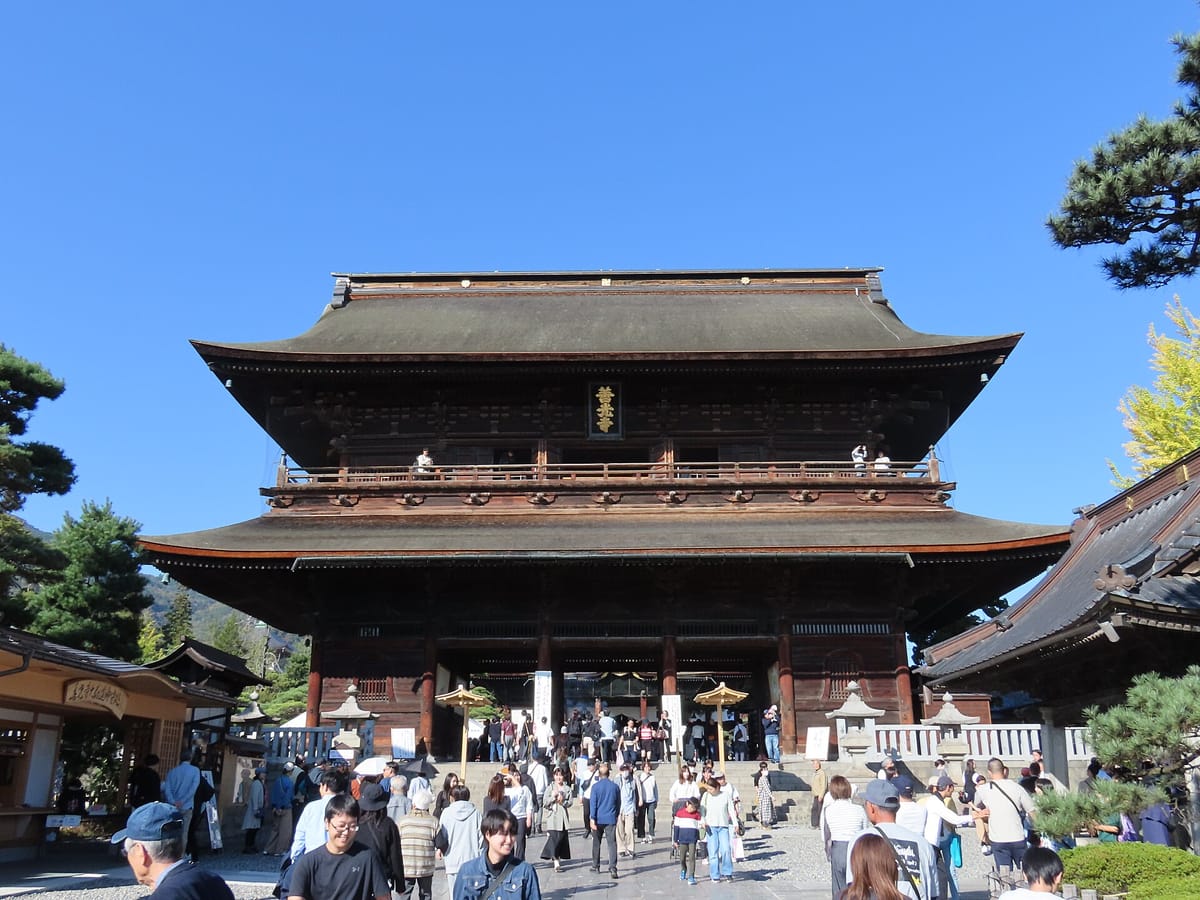
- Niōmon: the first gate, with its two fierce guardian kings.
- Nakamise: the shop street between the gates, good for oyaki and shichimi spice.
- Sanmon: the great gate; climb it for a view down the approach towards the city.
- Hondō: the main hall, a National Treasure, with the free outer hall and the ticketed inner sanctuary.
- Binzuru: the much-rubbed wooden statue near the hall entrance.
- Okaidan: the dark passage beneath the altar, entered from inside the hall.
- Chūreiden: a pagoda-style hall housing the Zenkō-ji History Museum, on the same ticket as the inner sanctuary.
Words on the signs at Zenkō-ji
The ticket window inside the main hall sells the 内陣券, naijinken, the inner sanctuary ticket, and it is the one you need for the Okaidan. The temple's English pages use the same word, so it is worth recognising in kanji. Climbing the Sanmon has its own ticket, and there is usually a combined option.
Notice how many signs use 門, gate: 仁王門, 山門 and the bus stop 大門, great gate, which is named after the gateway area of the old temple town. The table below gathers the words you will meet between the bus stop and the Okaidan.
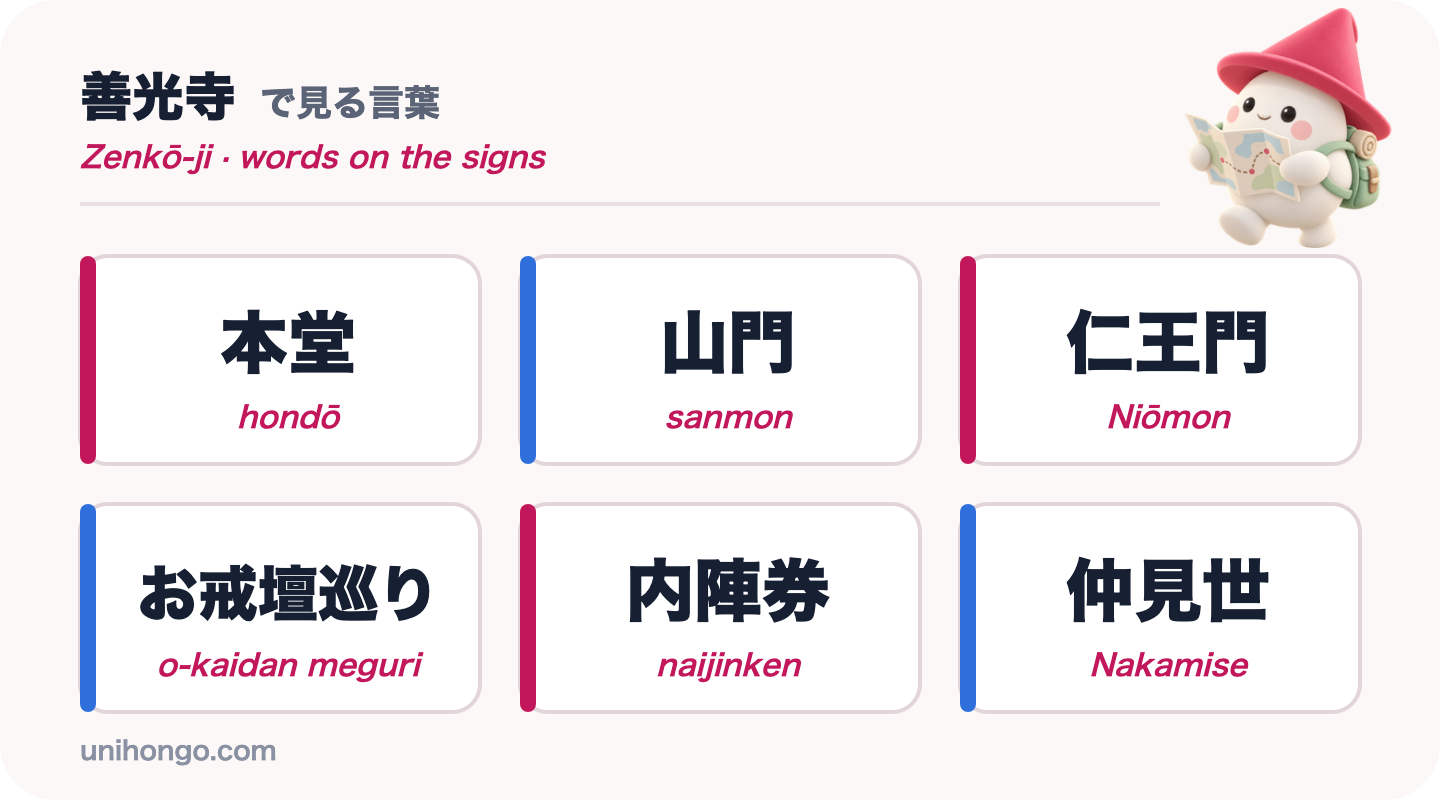
| Word | Reading | Meaning |
|---|---|---|
| 仁王門 | Niōmon | Gate of the two guardian kings |
| 仲見世 | Nakamise | The shopping street on the approach |
| 山門 | sanmon | The two-storey main gate |
| 本堂 | hondō | Main hall |
| 内陣券 | naijinken | Ticket for the inner sanctuary and the Okaidan |
| お戒壇巡り | o-kaidan meguri | The walk through the dark passage under the altar |
| 極楽の錠前 | gokuraku no jōmae | The lock to paradise that you touch in the dark |
| 宿坊 | shukubō | Temple lodging |
| 大門 | Daimon | Great gate; also the name of the bus stop |
Japanese for the ticket counter, the Okaidan and the morning service
The Okaidan is short but disorienting. You go down a flight of steps from the inner hall into total darkness, keep your right hand on the wall, and walk slowly until your fingers find the lock hanging on the wall, the gokuraku no jōmae. Then you continue round and climb back into the light. Leave phones and torches off; the darkness is the point.
If you can get up early, the o-asaji morning service is held in the main hall every day, with its start time changing through the year to follow sunrise. Before and after it, the chief priests walk to and from the hall and touch the heads of kneeling visitors with their rosaries, a blessing called o-juzu chōdai. It needs no ticket or booking.
| Japanese | Romaji | Meaning |
|---|---|---|
| 内陣券を一枚お願いします。 | Naijinken o ichimai onegai shimasu. | One inner sanctuary ticket, please. |
| 山門にも登れますか。 | Sanmon ni mo noboremasu ka. | Can I climb the Sanmon gate as well? |
| お戒壇巡りはどのくらいかかりますか。 | O-kaidan meguri wa dono kurai kakarimasu ka. | How long does the Okaidan take? |
| 錠前はどのあたりにありますか。 | Jōmae wa dono atari ni arimasu ka. | Whereabouts is the lock? |
| 明日のお朝事は何時からですか。 | Ashita no o-asaji wa nanji kara desu ka. | What time does tomorrow's morning service start? |
| お数珠頂戴はどこで待てばいいですか。 | O-juzu chōdai wa doko de mateba ii desu ka. | Where should I wait for the rosary blessing? |
| 御朱印はどこでいただけますか。 | Goshuin wa doko de itadakemasu ka. | Where can I receive a goshuin? |
Etiquette, timing and Nagano food
Zenkō-ji is a working temple with a daily rhythm, and visiting it well is mostly about timing and quiet.
- Come early: the morning service and blessing are the heart of the temple day, and the approach is calm before the shops open.
- Bow at each gate, and step aside in the main hall while people are praying.
- Take your shoes off where the signs ask before stepping up onto the tatami of the inner hall.
- In the Okaidan, keep your right hand on the wall, move slowly and do not use a light.
- Try oyaki, stuffed dumplings, on Nakamise, and the local shichimi spice sold by a long-established shop on the approach; Nagano is also known for soba.
- For the 2027 Gokaichō, expect long queues and full hotels; staying at a shukubō inside the temple town is the traditional way to be there for the dawn service.
Practise the dark passage before you go
The attendant's answer is the part to listen for. Naijinken o katte means buy an inner sanctuary ticket, and migite de kabe o sawatte, touching the wall with your right hand, is the one instruction that gets you safely through. Practise the four lines below until you can say them without reading.
Then practise with a partner who replies. In Unihongo, choose the Shrine Visit topic and ask your AI Sensei to play an attendant at Zenkō-ji, or choose Directions to rehearse finding the bus at Nagano Station. Saying the lines once before you travel is what makes them come out at the counter.
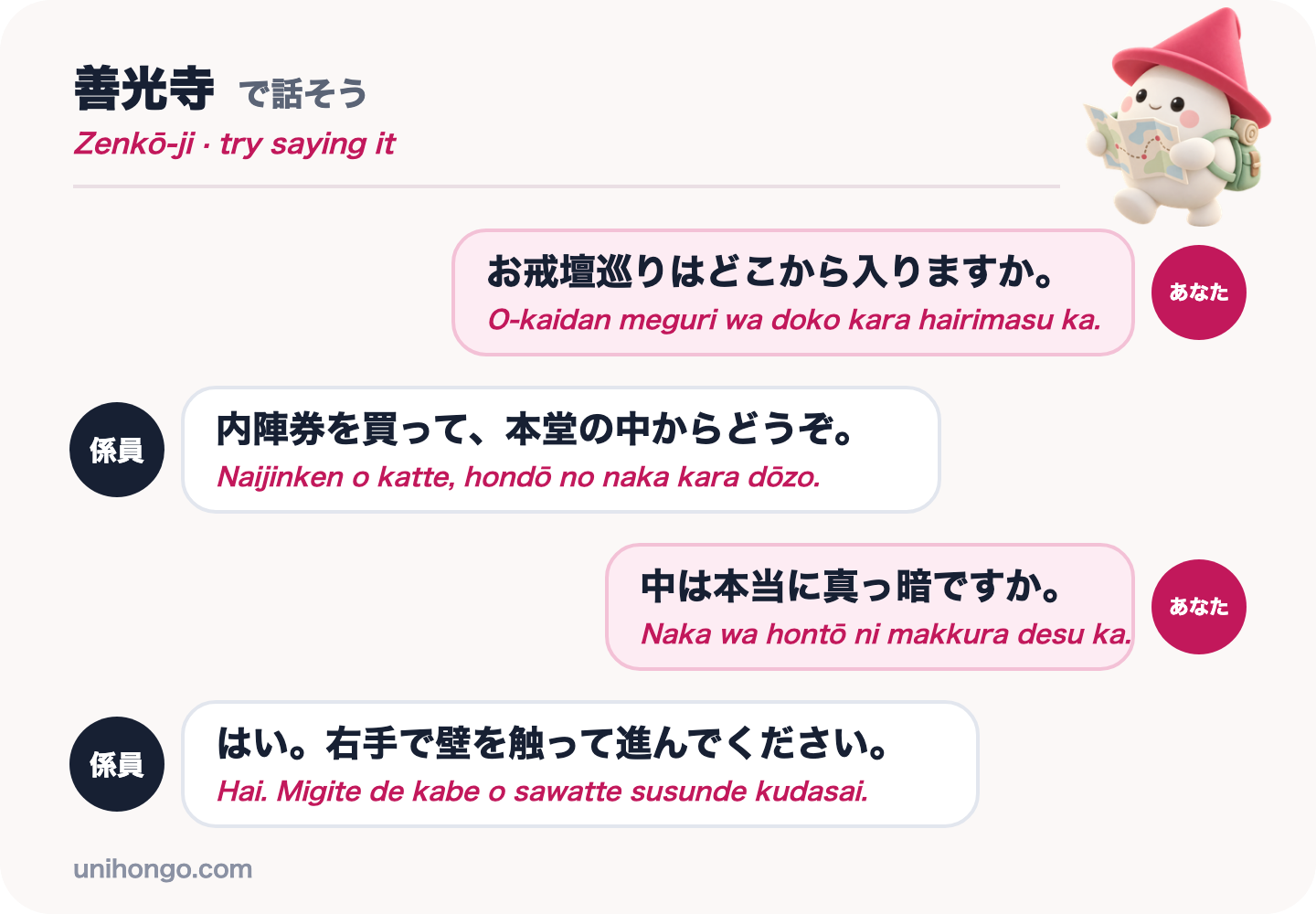
| Japanese | Romaji | Meaning |
|---|---|---|
| お戒壇巡りはどこから入りますか。 | O-kaidan meguri wa doko kara hairimasu ka. | Where do I go in for the Okaidan? |
| 内陣券を買って、本堂の中からどうぞ。 | Naijinken o katte, hondō no naka kara dōzo. | Buy an inner sanctuary ticket and go in from inside the main hall. |
| 中は本当に真っ暗ですか。 | Naka wa hontō ni makkura desu ka. | Is it really pitch dark inside? |
| はい。右手で壁を触って進んでください。 | Hai. Migite de kabe o sawatte susunde kudasai. | Yes. Keep your right hand on the wall as you go. |
Official information
Zenkō-ji publishes its opening times, which change with the season, the morning service schedule, ticket details and news in English on its official website. The Nagano prefecture tourism site covers the 2027 Gokaichō and the town around the temple.