

Why Tenryū-ji is the heart of Arashiyama
The land at the foot of Arashiyama has long attracted emperors and monks. In the ninth century an empress founded Danrin-ji here, described by Tenryū-ji as Japan's first Zen temple; later the emperors Go-Saga and Kameyama built a villa on the site, and the young Go-Daigo studied here. When Go-Daigo died in 1339, the shogun Ashikaga Takauji, who had once fought for him and then against him, founded Tenryū-ji in his memory, with the Zen master Musō Soseki as abbot. To pay for the building, the temple sent trading ships to China.
Tenryū-ji became the first of Kyoto's Five Mountains, the ranking of great Zen temples, and is still the head temple of its own branch of Rinzai Zen. It once owned most of the Sagano district. Fires destroyed it eight times, the last in 1864, and today's main buildings were rebuilt around 1900. The garden, though, survived, and it is what makes Tenryū-ji one of the essential sights of Kyoto.
For a Japanese learner, Tenryū-ji is a good place to practise temple vocabulary that also works at other Zen temples: the names of the halls, the garden words and the polite language of the ticket desk and the shōjin restaurant.
Getting there: Randen Arashiyama and the main gate
The closest station is Arashiyama on the Keifuku Randen tram line, five minutes' walk from the temple's main gate on the main street of Arashiyama. JR Saga-Arashiyama Station is about thirteen minutes away, and Hankyū Arashiyama, across the river, about fifteen. City and Kyoto buses stop at Arashiyama Tenryūji-mae, right outside.
There are three ways in: the main gate on the main street, the entrance to the main building, and the north gate, which connects to the bamboo path. If you want the garden at its quietest, enter by the main gate as it opens and see the Sōgenchi first, then leave by the north gate into the bamboo before the day's crowds arrive.
| Japanese | Romaji | Meaning |
|---|---|---|
| 天龍寺の正門はどこですか。 | Tenryū-ji no seimon wa doko desu ka. | Where is the main gate of Tenryū-ji? |
| 嵐電の嵐山駅から近いですか。 | Randen no Arashiyama-eki kara chikai desu ka. | Is it close to Randen's Arashiyama Station? |
| 天龍寺前で降ります。 | Tenryūji-mae de orimasu. | I am getting off at Tenryūji-mae. |
| 北門から竹林に出られますか。 | Kitamon kara chikurin ni deraremasu ka. | Can I go out to the bamboo grove from the north gate? |
| 篩月の入口はどちらですか。 | Shigetsu no iriguchi wa dochira desu ka. | Which way is the entrance to Shigetsu? |
The Sōgenchi garden, the halls and the cloud dragon
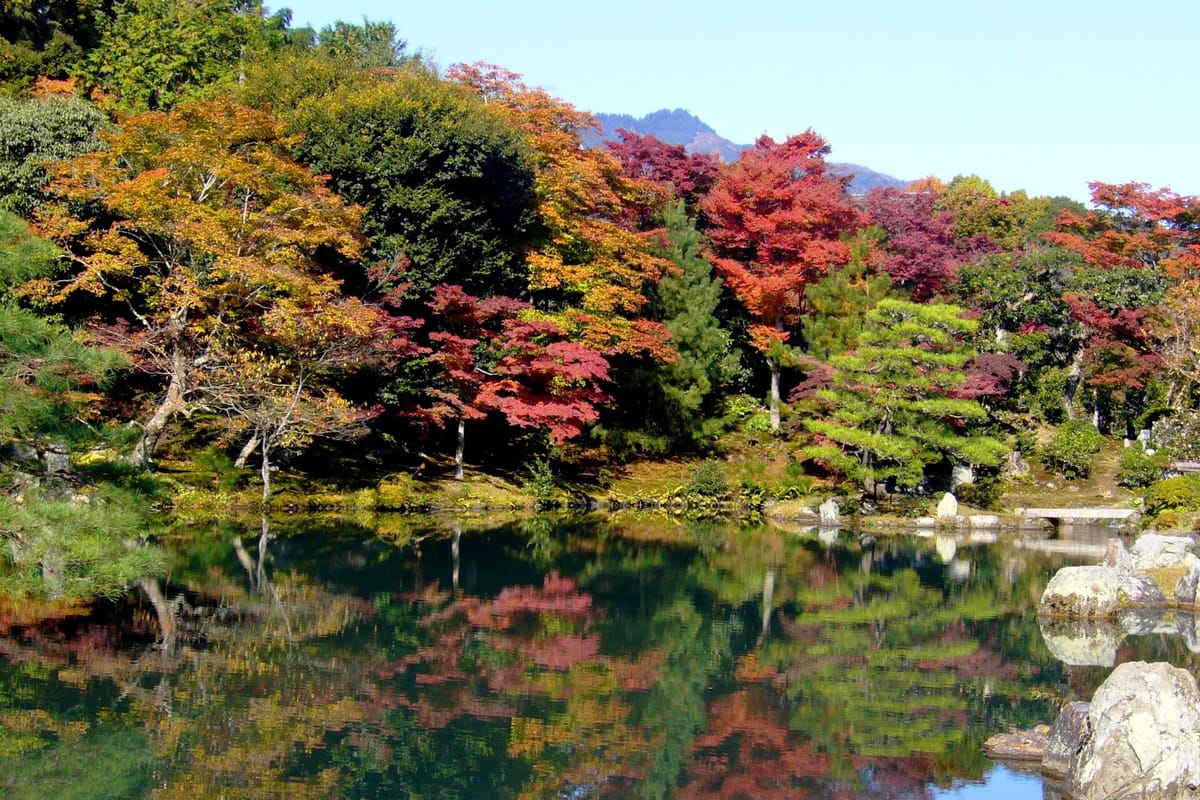
The Sōgenchi is a stroll garden around a pond, designed to be seen from the Daihōjō veranda and from the path around it. Musō Soseki used the hills of Arashiyama and Kameyama behind the pond as borrowed scenery, shakkei, so the garden seems far larger than it is. Directly across from the centre of the veranda, a group of tall upright rocks stands for the Dragon Gate falls of Chinese legend, where a carp that climbs the waterfall turns into a dragon, an image of enlightenment. Unusually, the carp stone here sits to the side of the falls, caught in the act of changing.
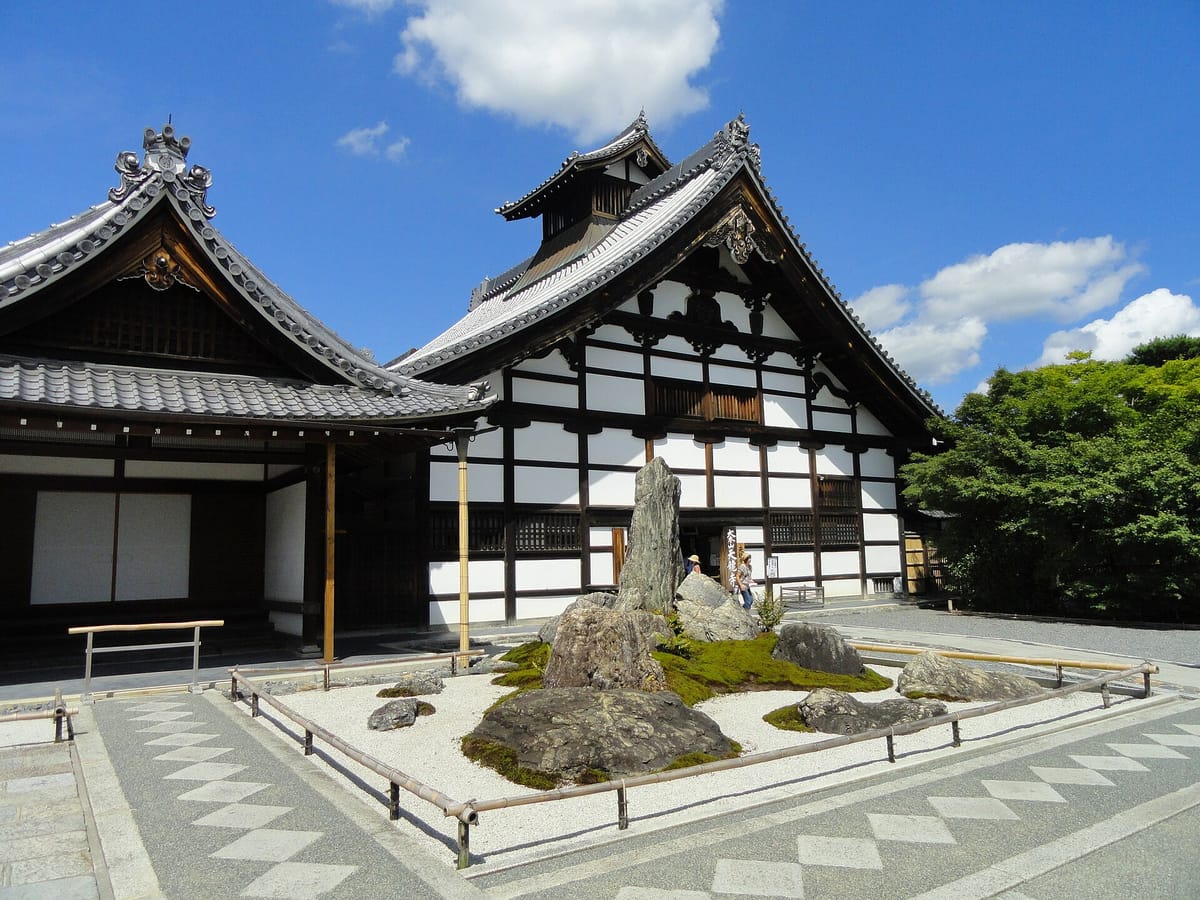
The Kuri, with its tall white gable, is the building on most postcards and the entrance to the halls; inside hangs a large painting of Bodhidharma. The Daihōjō has wide verandas facing the pond, and a covered corridor climbs to the Tahōden, which enshrines a statue of Go-Daigo. Separately, the Hattō holds the Unryūzu, a cloud dragon painted on the ceiling in 1997 by the artist Kayama Matazō. It is painted in the happō nirami style, glaring in eight directions, so the dragon seems to look at you wherever you stand.
- Sōgenchi teien: Musō Soseki's pond garden, a Special Place of Scenic Beauty and Historic Site.
- Kuri: the tall-gabled kitchen building, the symbol of the temple and the way into the halls.
- Daihōjō: the largest hall, with a veranda that frames the classic garden view.
- Tahōden: a hall dedicated to Emperor Go-Daigo, reached by a covered corridor.
- Hattō: the Dharma hall with the cloud dragon ceiling, open on set days only.
- Hyakka'en: the garden of a hundred flowers on the slope towards the north gate.
- Kitamon: the north gate, opening onto the bamboo path.
Words on the signs at Tenryū-ji
The ticket board at Tenryū-ji divides the visit into 庭園, teien, garden, 諸堂, shodō, the various halls, and 法堂, Hattō, with its own price. Reading those three words tells you exactly what you are paying for. The Hattō's name uses the Zen reading hattō rather than hōdō.
The dragon kanji 龍 is everywhere: in the temple's name, in 雲龍図, Unryūzu, the cloud dragon picture, and on the sliding doors of the Daihōjō. You may also see it written in the simpler form 竜, which means the same thing.
| Word | Reading | Meaning |
|---|---|---|
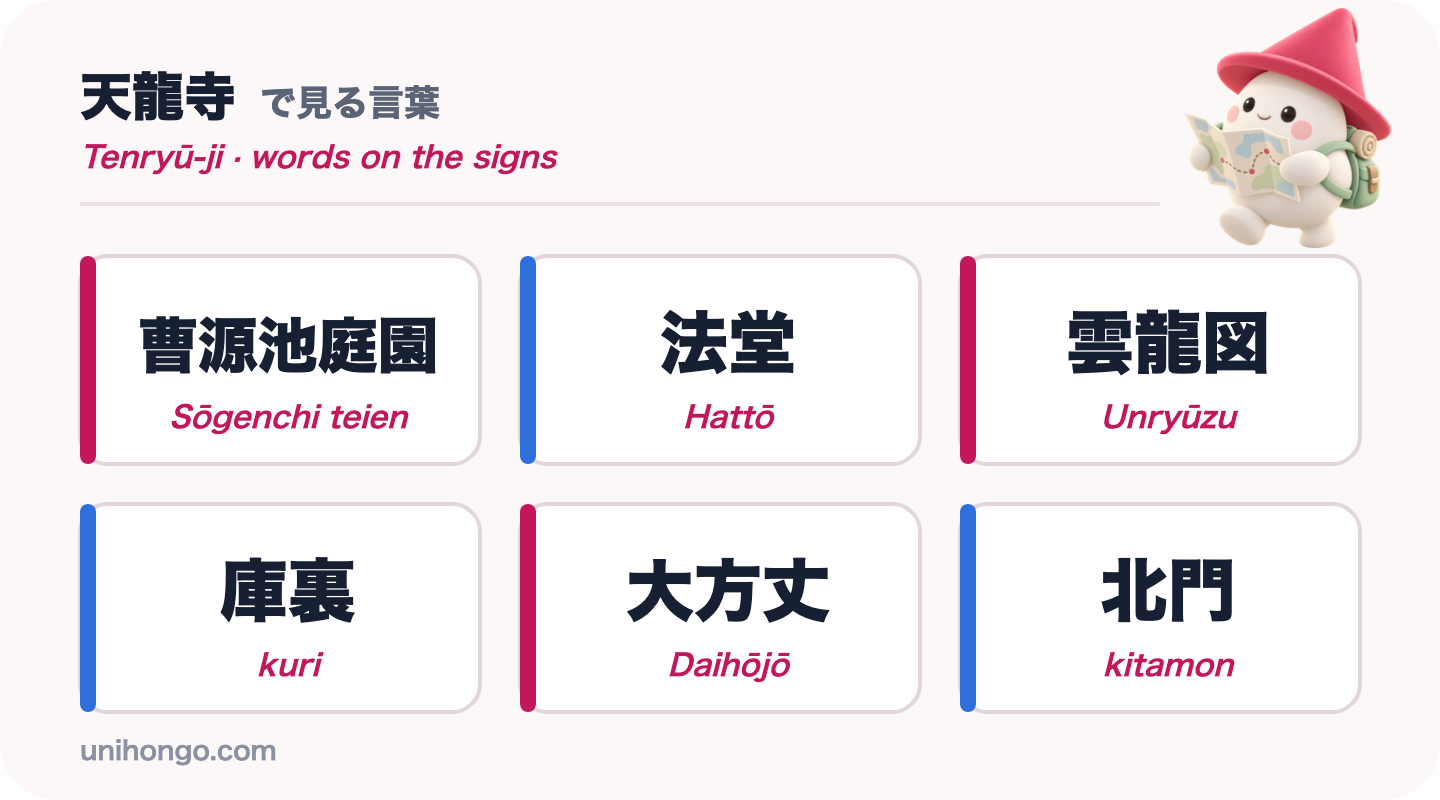
| 曹源池庭園 | Sōgenchi teien | Musō Soseki's pond garden |
| 法堂 | Hattō | The Dharma hall with the dragon ceiling |
| 雲龍図 | Unryūzu | The cloud dragon painting |
| 庫裏 | kuri | Kitchen and office building, the temple's entrance |
| 大方丈 | Daihōjō | The main hall facing the garden |
| 北門 | kitamon | North gate, towards the bamboo grove |
| 諸堂 | shodō | The temple halls, on the ticket board |
| 篩月 | Shigetsu | The temple's shōjin ryōri restaurant |
| 精進料理 | shōjin ryōri | Zen vegetarian cuisine |
Japanese for the shōjin ryōri lunch at Shigetsu
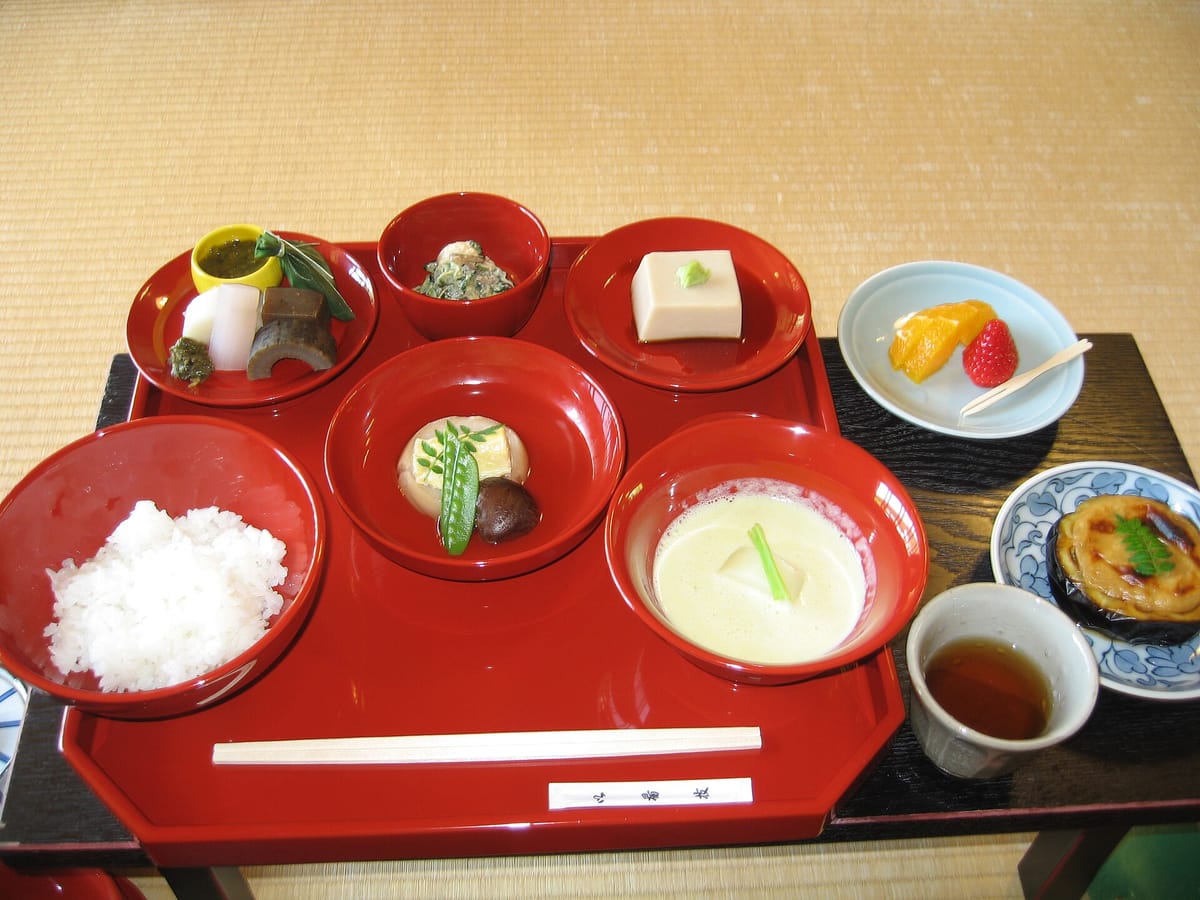
Shigetsu is run directly by Tenryū-ji in a building beside the pond, and serves shōjin ryōri, the Zen vegetarian cuisine that came to Japan with Zen in the thirteenth century. Courses are named by the number of dishes, rice and soup plus five, six or seven sides, and change with the season. You book ahead online; walk-ins are not the norm. Meals are served at low tables in tatami rooms.
The Japanese you need is about booking, ingredients and the dishes in front of you. Staff will name the dishes as they serve them, often with words such as goma-dōfu, sesame tofu, and yuba, tofu skin, so it helps to know a few in advance.
| Japanese | Romaji | Meaning |
|---|---|---|
| 二人で予約している者です。 | Futari de yoyaku shite iru mono desu. | We have a reservation for two. |
| これは何で作られていますか。 | Kore wa nan de tsukurarete imasu ka. | What is this made from? |
| これはごま豆腐ですか。 | Kore wa goma-dōfu desu ka. | Is this sesame tofu? |
| だしにも動物のものは使っていませんか。 | Dashi ni mo dōbutsu no mono wa tsukatte imasen ka. | Is nothing from animals used in the stock either? |
| ご飯のおかわりはできますか。 | Gohan no okawari wa dekimasu ka. | Can I have more rice? |
| ごちそうさまでした。 | Gochisōsama deshita. | Thank you for the meal. |
Etiquette, timing and tickets
Tenryū-ji is in the busiest part of Arashiyama, and its garden is popular from opening time. A little planning makes a big difference.
- Arrive at opening time for a quiet garden, especially in autumn and at weekends.
- Decide on tickets before you queue: garden only, garden and halls, and the Hattō separately on its open days.
- Take off your shoes at the Kuri entrance before the halls, and carry them where asked.
- Do not step onto the garden or the moss for photos; stay on the paths and the veranda edge.
- The halls occasionally close for ceremonies without notice; the temple lists scheduled closures on its website.
- A free monthly zazen meeting is held at Yūun-an on the second Sunday morning, open to the public without reservation.
Practise the ticket desk before you go
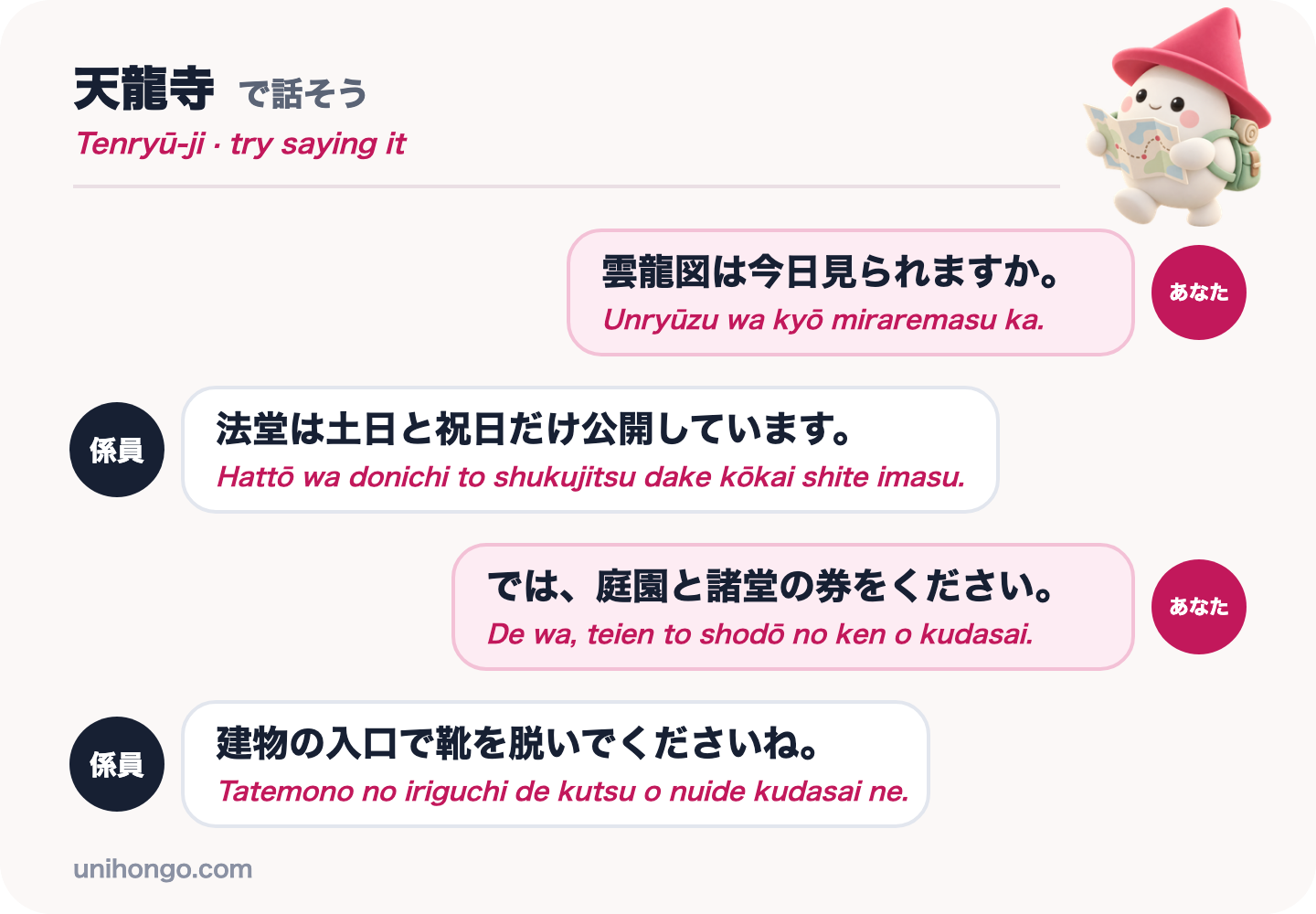
Visitors on weekdays often ask about the cloud dragon and find the Hattō is closed. This exchange shows the answer you are likely to hear outside the special periods, and the natural next step: buying the garden and halls ticket. Listen for kōkai, open to the public, and dake, only.
Say the lines aloud until you can do it without reading, then practise with a partner who can change the answer. In Unihongo, choose the Sightseeing topic and ask your AI Sensei to play the Tenryū-ji attendant, or Japanese Cuisine to rehearse lunch at Shigetsu. Hearing kōkai shite imasu at natural speed once makes it easy to catch at the window.
| Japanese | Romaji | Meaning |
|---|---|---|
| 雲龍図は今日見られますか。 | Unryūzu wa kyō miraremasu ka. | Can I see the cloud dragon today? |
| 法堂は土日と祝日だけ公開しています。 | Hattō wa donichi to shukujitsu dake kōkai shite imasu. | The Hattō is open only on weekends and holidays. |
| では、庭園と諸堂の券をください。 | De wa, teien to shodō no ken o kudasai. | Then a ticket for the garden and the halls, please. |
| 建物の入口で靴を脱いでくださいね。 | Tatemono no iriguchi de kutsu o nuide kudasai ne. | Please take your shoes off at the entrance to the building. |
Official information
Tenryū-ji publishes its hours, fees, the Hattō opening calendar, scheduled closures and Shigetsu reservations on its website, in English and Japanese. Check it before you go, especially if the cloud dragon or lunch matters to you.