
The first question: here or to go, hot or iced
The barista greets you and asks, in very polite language, whether you will drink in the shop. Then come the drink, the temperature, the size, any changes, and payment. You answer each with a single word and de (で), the particle that marks a choice. Tennai de (店内で) means in the shop; mochikaeri de (持ち帰りで) means to take away.
The here-or-to-go question is not small talk. The consumption tax rate differs between eating in and taking out, so the till needs your answer before it can show a total.
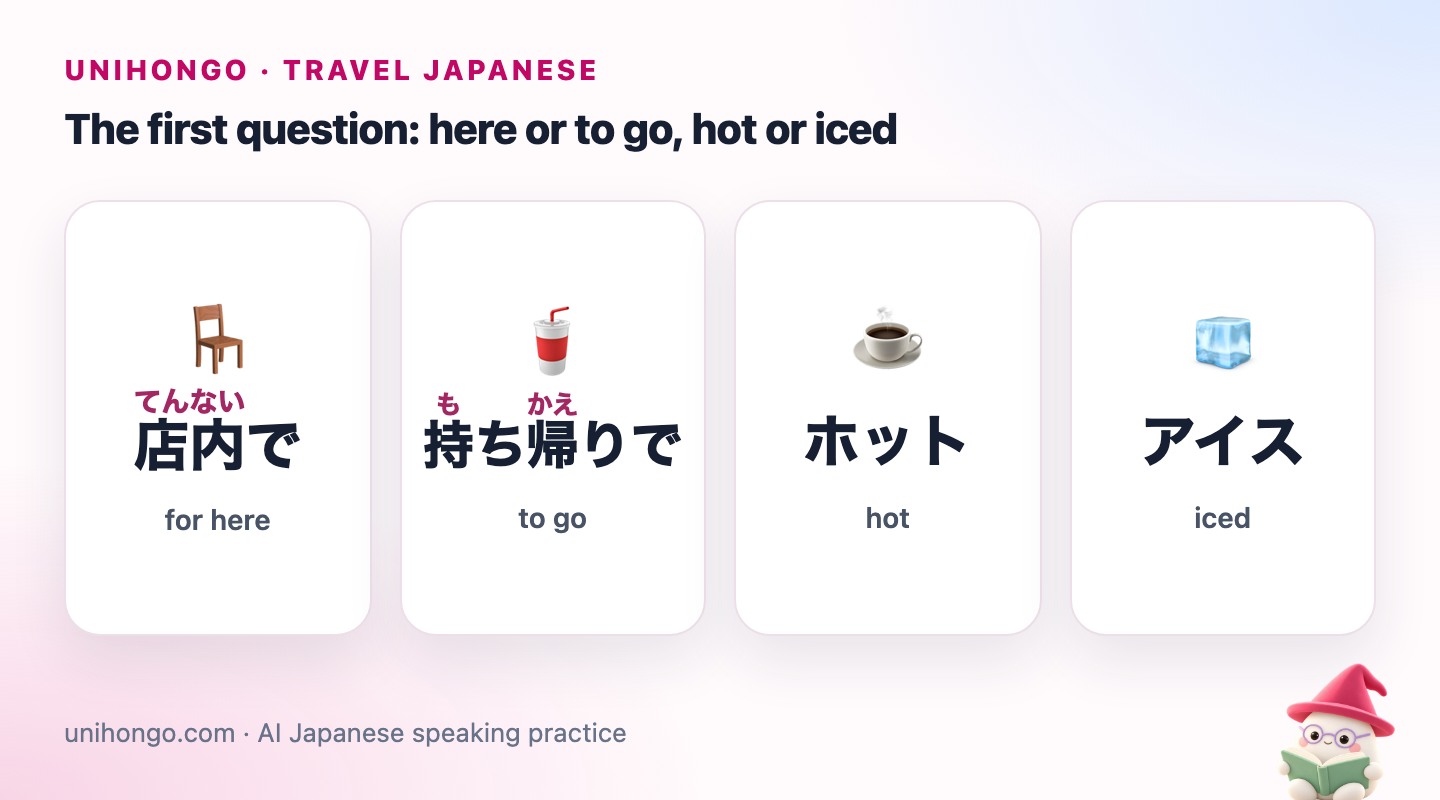
| Japanese | Romaji | Meaning |
|---|---|---|
| 店内で | tennai de | for here |
| 持ち帰りで | mochikaeri de | to go |
| ホット | hotto | hot |
| アイス | aisu | iced |
| 店内でお召し上がりですか。 | Tennai de o-meshiagari desu ka. | Will you be having it here? |
| 持ち帰りでお願いします。 | Mochikaeri de onegai shimasu. | To go, please. |
Sizes: shōto, tōru, gurande, benti
The size names are the international ones in katakana, with one thing many visitors do not expect: shōto (ショート), short, the smallest cup, is a regular menu size in Japan. Above it come tōru (トール), gurande (グランデ) and benti (ベンティ). If you say nothing, the barista will ask. The long vowels matter: tōru, not toru, which is a different word.
| Japanese | Romaji | Meaning |
|---|---|---|
| ショート | shōto | short, the smallest size |
| トール | tōru | tall |
| グランデ | gurande | grande |
| ベンティ | benti | venti, the largest size |
| サイズはいかがなさいますか。 | Saizu wa ikaga nasaimasu ka. | What size would you like? |
| トールでお願いします。 | Tōru de onegai shimasu. | Tall, please. |
Putting the order together
There is no single correct word order. Temperature, drink and size can come in any sequence, and the barista will ask for whatever is missing. A reliable pattern is the drink, then no, then the size: aisu rate no tōru. Add o hitotsu onegai shimasu for a complete polite sentence. If you are staying, staff may ask whether a mug is fine instead of a paper cup.
| Japanese | Romaji | Meaning |
|---|---|---|
| アイスラテのトールを一つお願いします。 | Aisu rate no tōru o hitotsu onegai shimasu. | One tall iced latte, please. |
| ドリップコーヒーをショートで。 | Dorippu kōhī o shōto de. | A short drip coffee. |
| ホットとアイス、どちらになさいますか。 | Hotto to aisu, dochira ni nasaimasu ka. | Would you like it hot or iced? |
| アイスで。 | Aisu de. | Iced. |
| マグカップでよろしいですか。 | Magukappu de yoroshii desu ka. | Is a mug all right? |
Customising: change, remove, less, add
Custom orders use a few small words. Henkō (変更) is a change, used with ni for the thing you want. Nuki (抜き) after a noun means without it. Sukuname (少なめ) is less and ōme (多め) is more. Tsuika (追加) is an addition. With these you can build almost any request, and the menu or the barista will tell you which changes cost extra.
| Japanese | Romaji | Meaning |
|---|---|---|
| ミルクを豆乳に変更できますか。 | Miruku o tōnyū ni henkō dekimasu ka. | Can I change the milk to soy milk? |
| シロップ抜きでお願いします。 | Shiroppu-nuki de onegai shimasu. | Without syrup, please. |
| 氷少なめでお願いします。 | Kōri sukuname de onegai shimasu. | Light ice, please. |
| エスプレッソショットを追加してください。 | Esupuresso shotto o tsuika shite kudasai. | Please add an espresso shot. |
| ホイップ多めで。 | Hoippu ōme de. | Extra whipped cream. |
| オーツミルク | ōtsu miruku | oat milk |
| ディカフェ | dikafe | decaf |
Furapechīno and kikan gentei: the seasonal menu
The loudest part of the menu board is the seasonal drink. Kikan gentei (期間限定) means for a limited period, and in Japan the chain is known for limited Frappuccino blended drinks, furapechīno (フラペチーノ), built around seasonal flavours such as cherry blossom in spring. They are widely talked about and can sell out.
You rarely need the full name. Kikan gentei no furapechīno, or pointing at the poster and saying kore o hitotsu, is enough. Many seasonal drinks are made in one size only, and the barista will tell you so.
| Japanese | Romaji | Meaning |
|---|---|---|
| 期間限定 | kikan gentei | for a limited time |
| 新作 | shinsaku | new release |
| これを一つお願いします。 | Kore o hitotsu onegai shimasu. | One of these, please. |
| トールサイズのみです。 | Tōru saizu nomi desu. | It comes in tall size only. |
Paying and listening for your drink
Payment is another one-word answer with de. Transit cards are accepted at most branches, and the phrase is kōtsūkei IC de (交通系ICで), by transit IC card. After paying you move along to the pick-up counter. Baristas in Japan do not usually write your name on the cup. They call the drink itself, or the number printed on your receipt, so keep the receipt and listen for your order, not your name.
| Japanese | Romaji | Meaning |
|---|---|---|
| お支払いはいかがなさいますか。 | O-shiharai wa ikaga nasaimasu ka. | How would you like to pay? |
| 交通系ICで。 | Kōtsūkei aishī de. | By transit IC card. |
| カードでお願いします。 | Kādo de onegai shimasu. | By card, please. |
| あちらのカウンターでお待ちください。 | Achira no kauntā de o-machi kudasai. | Please wait at the counter over there. |
| トールのアイスラテでお待ちのお客様。 | Tōru no aisu rate de o-machi no o-kyaku-sama. | The customer waiting for a tall iced latte. |
Mobile order in brief
The chain's app lets you order and pay ahead, called mobairu ōdā (モバイルオーダー). You choose a branch, build the drink on screen with the same customisations, and enter a nickname. At the shop you skip the queue and wait near the pick-up counter until your nickname or order number is called. It removes the speaking, which is useful on a tired day and a missed chance on any other. If your drink does not appear, show the screen and use the lines below.
| Japanese | Romaji | Meaning |
|---|---|---|
| モバイルオーダーです。 | Mobairu ōdā desu. | It is a mobile order. |
| 注文した飲み物がまだなんですが。 | Chūmon shita nomimono ga mada na n desu ga. | The drink I ordered has not come yet. |